Question
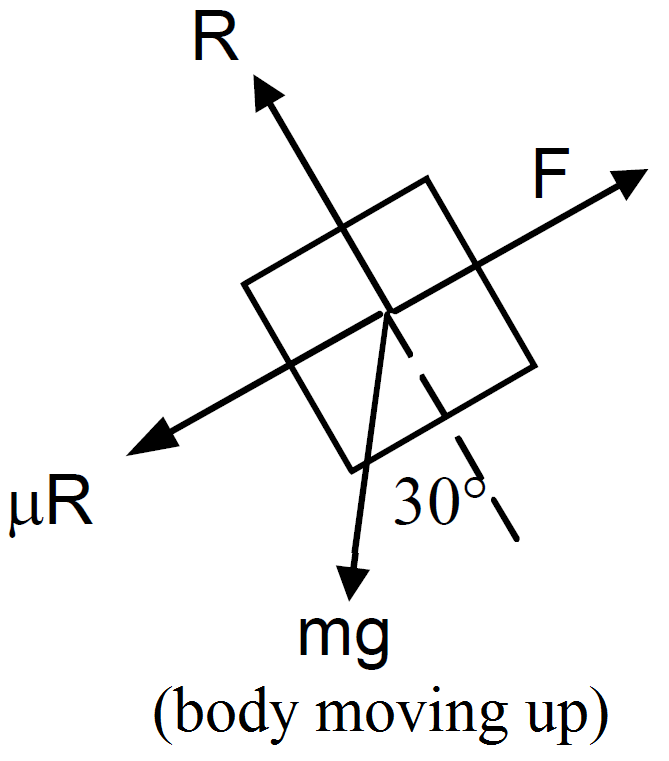
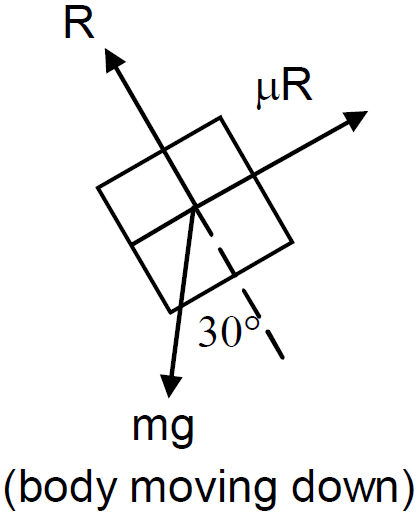
A body of mass 2kg is lying on a rough inclined plane of inclination 30°. Find the magnitude of the force parallel to the incline needed to make the block move:
  1. Up the incline
  2. Down the incline. Coefficient of static friction = 0.2.
Answer

  1.  

To make the block move up the incline, the force should be equal and opposite to the net force acting down the incline $=\mu\text{R}+2\text{g}\sin30^{\circ}$
$=0.2\times(9.8)\sqrt{3}+219.8\times\Big(\frac{1}{2}\Big)$ [from(1)]
$=3.39+9.8=13\text{N}$
With this minimum force the body move up the incline with a constant velocity as net force on it is zero.
  1. Net force acting down the incline is given by,

$\text{F}=2\text{g}\sin30^{\circ}-\mu\text{R}$
$=2\times9.8\times\Big(\frac{1}{2}\Big)-3.39=6.41\text{N}$
Due to F = 6.41N the body will move down the incline with acceleration.
No external force is required.
$\therefore$ Force required is zero.

Need a full question paper?

Generate a complete, print-ready paper with questions like this in minutes — across 16+ boards, with answer keys.

Start Generating Free

Similar questions

Calculate the total energy of a satellite and define binding energy.
Two ideal gas thermometers A and B use oxygen and hydrogen respectively. The following observations are made:
Temperature
Pressure thermometer A
Pressure thermometer B
Triple-point of water
$1.250 \times 10^5Pa$
$0.200 \times 10^5Pa$
Normal melting point of sulphur
$1.797 \times 10^5Pa$
$0.287 \times 10^5Pa$
What is the absolute temperature of normal melting point of sulphur as read by thermometers A and B?
What do you think is the reason behind the slight difference in answers of thermometers A and B? (The thermometers are not faulty). What further procedure is needed in the experiment to reduce the discrepancy between the two readings?
Two coherent point sources $S_1$ and $S_2$ vibrating in phase emit light of wavelength $\lambda$. The separation between the sources is $2\lambda$. Consider a line passing through $S_2$ and perpendicular to the line $S_1S_2$. What is the smallest distance from $S_2$ where a minimum of intensity occurs?
A mass 5kg starts sliding from A on a smooth surface shown in the figure. Find the velocity of the mass at B and C?
Briefly explain how you will estimate the molecular diameter of oleic acid.
Find the components along the x, y, z axes of the angular momentum l of a particle, whose position vector is r with components x, y, z and momentum is p with components px, py and pz. Show that if the particle moves only in the x-y plane the angular momentum has only a z-component.
A rocket is fired ‘vertically’ from the surface of mars with a speed of $2km\ s^{-1}$. If $20\%$ of its initial energy is lost due to martian atmospheric resistance, how far will the rocket go from the surface of mars before returning to it? Mass of mars $= 6.4 \times 10^{23}kg;$ radius of mars $= 3395km;\ G = 6.67 \times 10^{-11}N\ m^2\ kg^{-2}.$
A projectile shot at an angle of 60° above the horizontal ground strikes a vertical wall 30m away at a point 15m above the ground. Find the speed with which the projectile was launched and the speed with which it strikes the wall.
Explain gravitational potential at a point in gravitational field. Give relation between gravitational field intensity and gravitational potential.
What is the moment of inertia? Explain its physical importance.