Find the components along the x, y, z axes of the angular momentum l of a particle, whose position vector is r with components x, y, z and momentum is p with components px, py and pz. Show that if the particle moves only in the x-y plane the angular momentum has only a z-component.
Download our app for free and get started
$\text{l}_{\text{x}}=\text{yp}_{\text{z}}-\text{zp}_{\text{y}}$ $\text{l}_{\text{y}}=\text{zp}_{\text{x}}-\text{zp}_{\text{z}}$ $\text{l}_{\text{z}}=\text{xp}_{\text{y}}-\text{yp}_{\text{x}}$ Linear momentum of the particle, $\vec{\text{p}}=\text{p}_{\text{x}}\hat{\text{i}}+\text{p}_{\text{y}}\hat{\text{j}}+\text{p}_{\text{z}}\hat{\text{k}}$ Position vector of the particle, $\vec{\text{r}}={\text{x}}\hat{\text{i}}+{\text{y}}\hat{\text{j}}+{\text{z}}\hat{\text{k}}$ Angular momentum, $\vec{\text{l}}=\vec{\text{r}}\times\vec{\text{p}}$ $=({\text{x}}\hat{\text{i}}+{\text{y}}\hat{\text{j}}+{\text{z}}\hat{\text{k}})\times(\text{p}_{\text{x}}\hat{\text{i}}+\text{p}_{\text{y}}\hat{\text{j}}+\text{p}_{\text{z}}\hat{\text{k}})$ $=\begin{vmatrix}\vec{\text{i}}&\vec{\text{j}}&\vec{\text{k}}\\\text{x}&\text{y}&\text{z}\\\text{p}_{\text{x}}&\text{p}_{\text{y}}&\text{p}_{\text{z}}\end{vmatrix}$ $=\text{l}_{\text{x}}\hat{\text{i}}+\text{l}_{\text{y}}\hat{\text{j}}+\text{l}_{\text{z}}\hat{\text{k}}$ $=\hat{\text{i}}(\text{yp}_{\text{z}}-\text{zp}_{\text{y}})-\hat{\text{j}}(\text{zp}_{\text{x}}-\text{zp}_{\text{z}})+\hat{\text{k}}(\text{xp}_{\text{y}}-\text{yp}_{\text{x}})$ Comparing the coefficients of $\hat{\text{i}},\hat{\text{j}}$ and $\hat{\text{k}},$ we get $ \text{l}_{\text{x}}=\text{yp}_{\text{z}}-\text{zp}_{\text{y}},\text{ l}_{\text{y}}=\text{zp}_{\text{x}}-\text{zp}_{\text{z}},\text{ l}_{\text{z}}=\text{xp}_{\text{y}}-\text{yp}_{\text{x}}\ ...(\text{i})$ The particle moves in the x-y plane. Hence, the z-component of the position vector and linear momentum vector becomes zero, i.e., Z = Pz = 0 Thus, equation (i) reduces to, $\text{l}_{\text{x}}=0,\text{ l}_{\text{y}}=0,\text{ l}_{\text{y}}=\text{x}\text{p}_{\text{y}}-\text{y}\text{p}_{\text{x}}\ ...(\text{ii})$ Therefore, when the particle is confined to move in the x-y plane, the direction of angular momentum is along the z-direction.

Download our appand get started for free
Experience the future of education. Simply download our apps or reach out to us for more information. Let's shape the future of learning together!No signup needed.*
Similar Questions
- 1View SolutionThree particles of masses 1.0kg, 2.0kg and 3.0kg are placed at the corners A, B and C respectively of an equilateral triangle ABC of edge 1m. Locate the centre of mass of the system.
- 2A mass m is allowed to roll down an inclined plane $(\theta)$ If the vertical height is h, find.View Solution
- Acceleration along the inclined plane.
- Velocity down the plane.
- 3Separation of Motion of a system of particles into motion of the centre of mass and motion about the centre of mass: Show $\text{K}=\text{K}'+\frac{1}{2}\text{M}\text{V}^2$ where K' is the total kinetic energy of the system of particles, K′ is the total kinetic energy of the system when the particle velocities are taken with respect to the centre of mass and $\frac{\text{MV}^2}{2}$ is the kinetic energy of the translation of the system as a whole (i.e. of the centre of mass motion of the system). The result has been used in $\sec7.14$View Solution
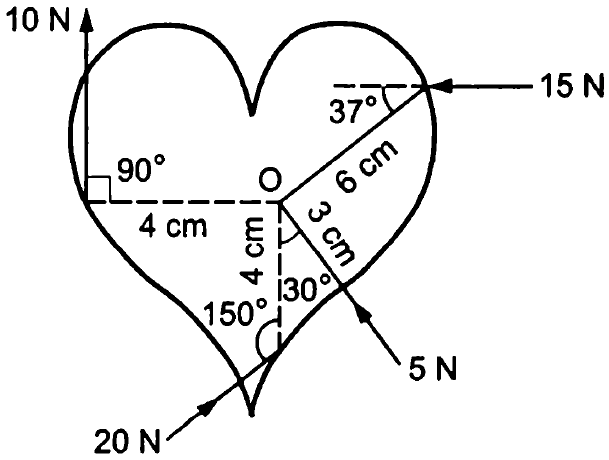
- 4View SolutionCalculate the total torque acting on the body shown in figure about the point O.
- 5A uniform rod pivoted at its upper end hangs vertically. It is displaced through an angle of $60°$ and then released. Find the magnitude of the force acting on a particle of mass dm at the tip of the rod when the rod makes an angle of $37°$ with the vertical.View Solution
- 6View SolutionA disc of radius R is cut out from a larger disc of radius 2R in such a way that the edge of the hole touches the edge of the disc. Locate the centre of mass of the residual disc.
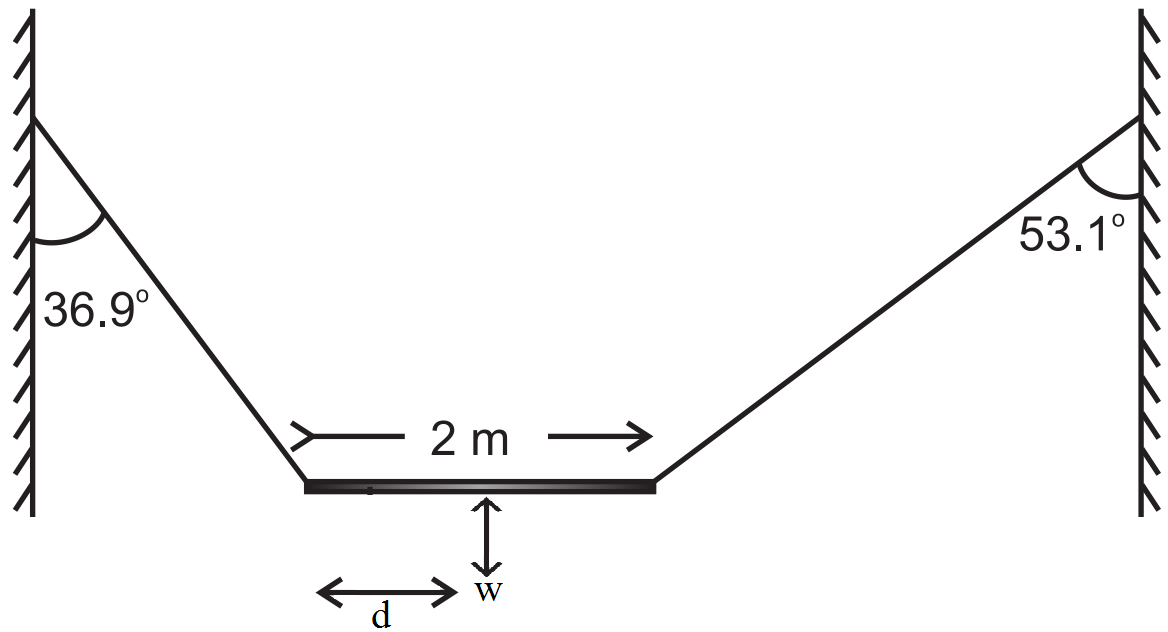
- 7A non-uniform bar of weight W is suspended at rest by two strings of negligible weight as shown in. The angles made by the strings with the vertical are $36.9°$ and $53.1°$ respectively. The bar is $2m$ long. Calculate the distance d of the centre of gravity of the bar from its left end.View Solution
- 8Establish the relation $\theta=\omega_0\text{t}+\frac{1}{2}\alpha\text{t}^2$ where the letters have their usual meanings.View Solution
- 9An electron of mass $9 \times 10^{-31}kg$ revolves in a circle of radius $0.53\mathring{\text{A}}$ around the nucleus of hydrogen with a velocity of $2.2 \times 10^6ms$. Show that angular momentum of elect ron is $\frac{\text{h}}{2\pi}$ where h is Planck's constant.View Solution
- 10View SolutionEstablish the relationship between Torque and Moment of Inertia.