A body of mass $5\, gm$ is executing $S.H.M.$ about a point with amplitude $10 \,cm$. Its maximum velocity is $100\, cm/sec$. Its velocity will be $50\, cm/sec$ at a distance
Medium


Download our appand get started for free
Experience the future of education. Simply download our apps or reach out to us for more information. Let's shape the future of learning together!No signup needed.*
Similar Questions
- 1A particle executes simple harmonic motion. Its amplitude is $8 \,cm$ and time period is $6 \,s$. The time it will take to travel from its position of maximum displacement to the point corresponding to half of its amplitude, is ............. $s$View Solution
- 2A pendulum is executing simple harmonic motion and its maximum kinetic energy is $K_1$. If the length of the pendulum is doubled and it performs simple harmonic motion with the same amplitude as in the first case, its maximum kinetic energy is $K_2$ thenView Solution
- 3View SolutionA simple pendulum is set into vibrations. The bob of the pendulum comes to rest after some time due to
- 4Equations $y = 2A \cos ^2 \omega \,t$ and $y = A (\sin \omega t + \cos \omega t )$ represent the motion of two particles.View Solution
- 5Speed $v$ of a particle moving along a straight line, when it is at a distance $x$ from a fixed point on the line is given by $v^2 = 108 - 9x^2$ (all quantities in $S.I.$ unit). ThenView Solution
- 6A spring is stretched by $5 \,\mathrm{~cm}$ by a force $10 \,\mathrm{~N}$. The time period of the oscillations when a mass of $2 \,\mathrm{~kg}$ is suspended by it is :(in $s$)View Solution
- 7A pendulum is formed by pivoting a disc. What distance from center of mass, it should be pivoted for minimum time period while performing $SHM$ ?View Solution
- 8What is the velocity of the bob of a simple pendulum at its mean position, if it is able to rise to vertical height of $10\,cm$ ($g = 9.8\, m/s^2$) ..... $m/s$View Solution
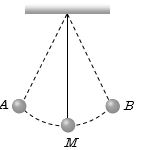
- 9A particle of mass $10$ grams is executing simple harmonic motion with an amplitude of $0.5\, m$ and periodic time of $(\pi /5)$ seconds. The maximum value of the force acting on the particle is ... $N$View Solution
- 10On a frictionless horizontal plane, a bob of mass $m=0.1 kg$ is attached to a spring with natural length $l_0=0.1 m$. The spring constant is $k_1=0.009 Nm ^{-1}$ when the length of the spring $I > l_0$ and is $k_2=0.016 Nm ^{-1}$ when $ I < l_0$. Initially the bob is released from $l=0.15 m$. Assume that Hooke's law remains valid throughout the motion. If the time period of the full oscillation is $T=(n \pi) s$, then the integer closest to $n$ is. . . . .View Solution