A body of mass M is kept on a rough horizontal surface (friction coefficient $\mu $). A person is trying to pull the body by applying a horizontal force but the body is not moving. The force by the surface on the body is $F$, where
Medium
Download our app for free and get started
(c) Maximum force by surface when friction works
$F = \sqrt {{f^2} + {R^2}} = \sqrt {{{(\mu R)}^2} + {R^2}} = R\sqrt {{\mu ^2} + 1} $
Minimum force $ = R$ when there is no friction
Hence ranging from $R$ to $R\sqrt {{\mu ^2} + 1} $
We get, $Mg \le F \le Mg\sqrt {{\mu ^2} + 1} $

Download our appand get started for free
Experience the future of education. Simply download our apps or reach out to us for more information. Let's shape the future of learning together!No signup needed.*
Similar Questions
- 1A ball of mass $0.25\, kg$ attached to the end of a string of length $1.96 \,m$ is moving in a horizontal circle. The string will break if the tension is more than $25 \,N$. .......... $m/s$ is the maximum speed with which the ball can be movedView Solution
- 2A block of mass $1 \,kg$ is projected from the lowest point up along the inclined plane. If $g=10 \,ms ^{-2}$, the retardation experienced by the block is ............. $ms ^ {-2}$View Solution
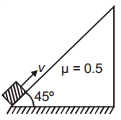
- 3Consider a block kept on an inclined plane (inclined at $45^{\circ}$ ) as shown in the figure. If the force required to just push it up the incline is $2$ times the force required to just prevent it from sliding down, the coefficient of friction between the block and inclined plane $(\mu)$ is equal toView Solution
- 4A block starts moving up an inclined plane of inclination $30^{\circ}$ with an initial velocity of $v_{0}$. It comes back to its initial position with velocity $\frac{v_{0}}{2} .$ The value of the coefficient of kinetic friction between the block and the inclined plane is close to $\frac{ I }{1000},$ The nearest integer to $I$ is......View Solution
- 5View SolutionA homogeneous rectangular brick lies on a rough inclined plane of very small inclination. Which half part of brick exters greater contact force on plane
- 6A lift is moving downwards with an acceleration equal to acceleration due to gravity. $A$ body of mass $M$ kept on the floor of the lift is pulled horizontally. If the coefficient of friction is $\mu $, if the lift is moving upwards with a uniform velocity, then the frictional resistance offered by the body isView Solution
- 7A marble block of mass $2\, kg$ lying on ice when given a velocity of $6\, m/s$ is stopped by friction in $10s$. Then the coefficient of friction is-View Solution
- 8Starting from rest a body slides down a $45^o$ inclined plane in twice the time it takes to slide down the same distance in the absence of friction. The co-efficient of friction between the body and the inclined plane is:View Solution
- 9A ball of mass $0.1\, Kg$. is whirled in a horizontal circle of radius $1\, m$. by means of a string at an initial speed of $10\, R.P.M.$ Keeping the radius constant, the tension in the string is reduced to one quarter of its initial value. The new speed is ....... $r.p.m.$View Solution
- 10A block $A$ of mass $4\, kg$ is placed on another block $B$ of mass $5\, kg$, and the block $B$ rests on a smooth horizontal table. If the minimum force that can be applied on $A$ so that both the blocks move together is $12\, N$, the maximum force that can be applied to $B$ for the blocks to move together will be $..... N$View Solution