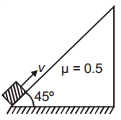
A block of mass $1 \,kg$ is projected from the lowest point up along the inclined plane. If $g=10 \,ms ^{-2}$, the retardation experienced by the block is ............. $ms ^ {-2}$
Medium
Download our app for free and get started
(a)
Retarding forces will be friction and gravitational force
$a=-\left(g \sin 45^{\circ}+\mu g \cos 45^{\circ}\right)$
$=-\left(\frac{10}{\sqrt{2}}+(0.5) \frac{(10)}{\sqrt{2}}\right)$
$=15 / \sqrt{2}$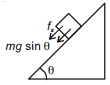

Download our appand get started for free
Experience the future of education. Simply download our apps or reach out to us for more information. Let's shape the future of learning together!No signup needed.*
Similar Questions
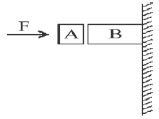
- 1Given in the figure are two blocks $A$ and $B$ of weight $20\ N$ and $100\ N,$ respectively. These are being pressed against a wall by a force $F$ as shown. If the coefficient of friction between the blocks is $0.1$ and between block $B$ and the wall is $0.15$, the frictional force applied by the wall on block $B$ is $......... N$View Solution
- 2View SolutionWhich is a suitable method to decrease friction
- 3A body takes $1\frac{1}{3}$ times as much time to slide down a rough identical but smooth inclined plane. If the angle of inclined plane is $45^o$, the coefficient of friction isView Solution
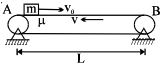
- 4With what minimum velocity should block be projected from left end $A$ towards end $B$ such that it reaches the other end $B$ of conveyer belt moving with constant velocity $v$. Friction coefficient between block and belt is $\mu$ .View Solution
- 5A smooth circular groove has a smooth vertical wall as shown in figure. A block of mass $m$ moves against the wall with a speed $v$. Which of the following curve represents the correct relation between the normal reaction on the block by the wall $( N )$ and speed of the block $(v)$ ?View Solution
- 6The tension $T$ in the string shown in figure isView Solution
- 7A block of mass $m$ is moving with a constant acceleration a on a rough plane. If the coefficient of friction between the block and ground is $\mu $, the power delivered by the external agent after a time $t$ from the beginning is equal toView Solution
- 8A person with his hand in his pocket is skating on ice at the rate of $10 m / s$ and describes a circle of radius $50 m$. What is his inclination to vertical: $\left( g =10 m / sec ^2\right)$View Solution
- 9A block of mass $10\, kg$ moving at $10\,m/s$ is released to slide on rough surface having coefficient of friction $0.2.$ It will stop by travelling distance ........ $m$View Solution
- 10A motor cyclist moving with a velocity of $72\, km/hour$ on a flat road takes a turn on the road at a point where the radius of curvature of the road is $20$ meters. The acceleration due to gravity is $10 m/sec^2$. In order to avoid skidding, he must not bend with respect to the vertical plane by an angle greater thanView Solution