MCQ
A body of mass $m$ is rotating in a vertical circle of radius $'r\ '$ with critical speed. The difference in its $K.E.$ at the top and the bottom is $.............$
  • $\text{2mgr}$
  • B
    $\text{4mgr}$
  • C
    $\text{6mgr}$
  • D
    $\text{3mgr}$

Answer

Correct option: A.
$\text{2mgr}$
The change of kinetic energy will be equet to the change in potential energy.
$\triangle\text{KE}=\triangle\text{PE}=\text{mg}(\text{h}_1-\text{h}_2)$
Since radious $r,$
$h_1- h_2= r$

Need a full question paper?

Generate a complete, print-ready paper with questions like this in minutes — across 16+ boards, with answer keys.

Start Generating Free

Similar questions

$105$ calories of heat is required to raise the temperature of $3$ moles of an ideal gas at constant pressure from $30^{\circ} C$ to $35^{\circ} C$. The amount of heat required in calories to raise the temperature of the gas through the range $\left(60^{\circ} C\right.$ to $\left.65^{\circ} C \right)$ at constant volume is ........ $cal$ $\left(\gamma=\frac{C_p}{C_v}=1.4\right)$
A batsman hits back a ball straight in the direction of the bowler without changing its initial speed of $12 \;m/ s$.

If the mass of the ball is $0.15 \;kg$, determine the impulse (in $N\;s$) imparted to the ball. (Assume linear motion of the ball)
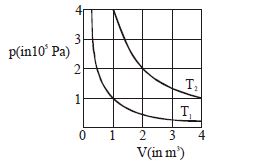
The given diagram shows isotherms for a fixed mass of an ideal gas at temperature $T_1$ and $T_2$ . What is the value of the ratio $\frac{{{\text{r}}{\text{.m}}{\text{.s}}{\text{. speed of the molecules at temperature }}{{\text{T}}_{2{\text{ }}}}}}{{{\text{r}}{\text{.m}}{\text{.s}}{\text{. speed of the molecules at temperature }}{{\text{T}}_1}}}$ ?
Two balls $A$ and $B$ having masses $1\, kg$ and $2\, kg$, moving with speeds $21\, m/s$ and $4\, m/s$ respectively in opposite direction, collide head on. After collision Amoves with a speed of $1\,m/s$ in the same direction, then correct statements is :
A $0.1 \mathrm{~kg}$ mass is suspended from a wire of negligible mass. The length of the wire is $1 \mathrm{~m}$ and its crosssectional area is $4.9 \times 10^{-7} \mathrm{~m}^2$. If the mass is pulled a little in the vertically downward direction and released, it performs simple harmonic motion of angular frequency $140 \ \mathrm{rad} \mathrm{s}^{-1}$. If the Young's modulus of the material of the wire is $\mathrm{n} \times 10^9 \mathrm{Nm}^{-2}$, the value of $\mathrm{n}$ is
A body of mass $0.4\, kg$ is whirled in a vertical circle making $2\, rev/sec$. If the radius of the circle is $2\, m$, then tension in the string when the body is at the top of the circle, is ......... $N$
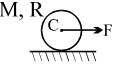
In the following problems, indicate the correct direction of friction force acting on the cylinder, which is pulled on a rough surface by a constant force $F$. $A$ cylinder of mass $M$ and radius $R$ is pulled horizontally by a force $F$. The friction force can be given by which of the following diagrams
A body is moving unidirectionally under the influence of a constant power source. Its displacement in time $t$ is proportional to :
A beaker containing a liquid is kept inside a big closed jar. If the air inside the jar is continuously pumped out, the pressure in the liquid near the bottom of the liquid will
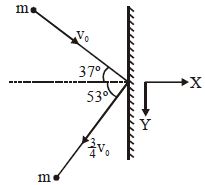
A ball of mass $m$ moving with velocity $v_0$ collides a wall as shown in figure. After impact it rebounds with a velocity $\frac {3}{4}v_0$. The impulse acting on ball during impact is