Question
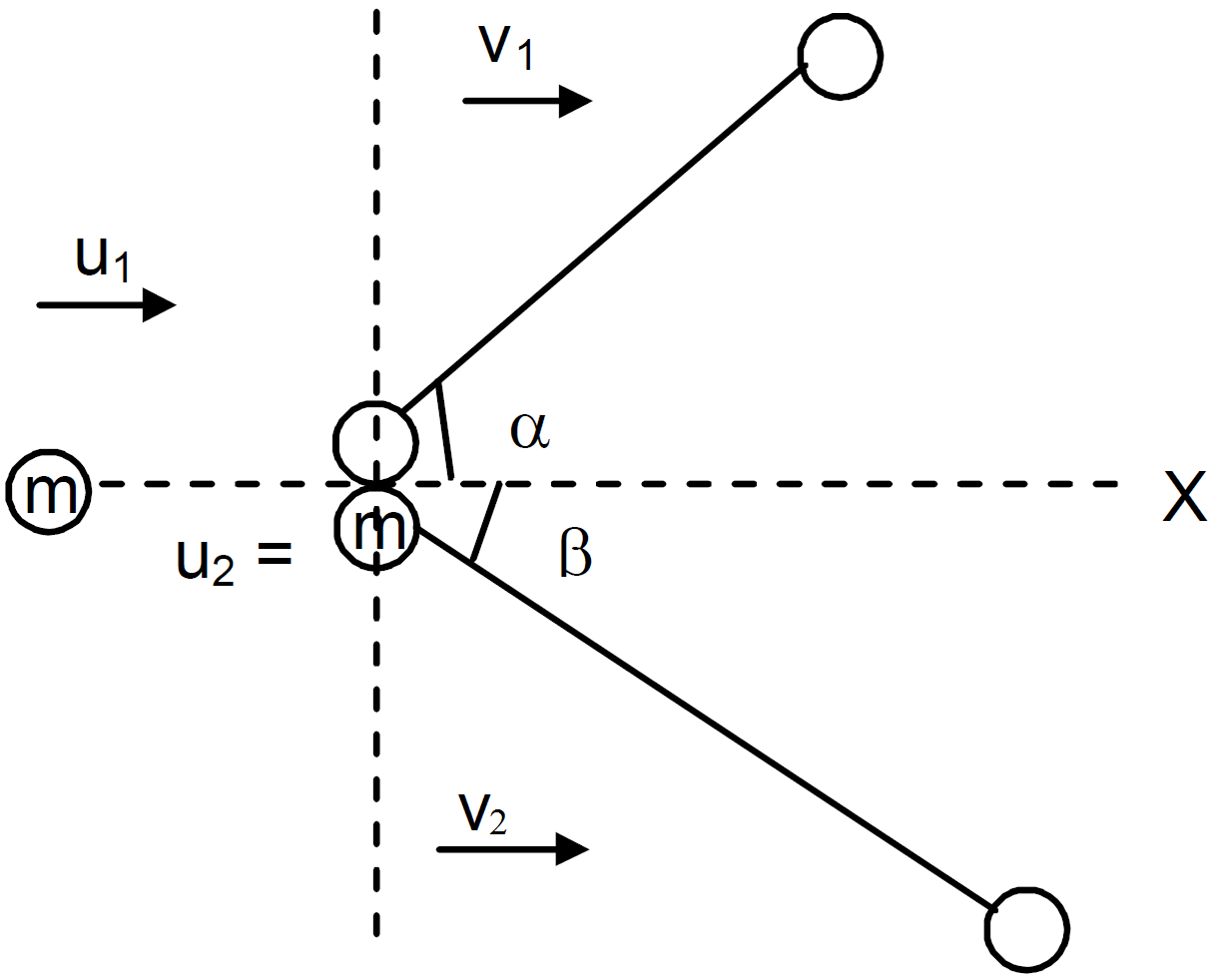
A body of mass m makes an elastic collision with another identical body at rest. Show that if the collision is not head-on, the bodies go at right angle to each other after the collision.
Answer

Since it is not an head on collision, the two bodies move in different dimensions. Let $V_1, V_2$ → velocities of the bodies vector collision. Since, the collision is elastic. Applying law of conservation of momentum on X-direction.
$\text{mu}_1+\text{mx}_0=\text{mv}_1\cos\alpha+\text{mv}_2\cos\beta$
$\Rightarrow\text{v}_1\cos\text{a}+\text{v}_2\cos\text{b}=\text{u}_1\ \dots(1)$
Putting law of conservation of momentum in y direction.$0=\text{mv}_1\sin\alpha-\text{mv}_2\sin\beta$
$\Rightarrow\text{v}_1\sin\alpha=\text{v}_2\sin\beta\ \dots(2)$
Again $\frac{1}2{}\text{mu}_1^2+0=\frac{1}{2}\text{mv}_1^2+\frac{1}{2}\text{mv}_2^2$$\Rightarrow\text{u}_1^2=\text{v}_1^2+\text{v}_2^2\ \dots(3)$
Squaring equation (1)$\text{u}_1^2=\text{v}_1^2\cos^2\alpha+\text{v}_2^2\cos^2\beta+2\text{v}_1\text{v}_2\cos\alpha\cos\beta$
Equating (1) & (3)$\text{v}_1^2+\text{v}_2^2=\text{v}_1^2\cos^2\alpha+\text{v}_2^2\cos^2\beta+2\text{v}_1\text{v}_2\cos\alpha\cos\beta$
$\Rightarrow\text{v}_1^2\sin^2\alpha+\text{v}_2^2\sin^2\beta=2\text{v}_1\text{v}_2\cos\alpha\cos\beta$
$\Rightarrow\text{2v}_1^2\sin^2\alpha=2\times\text{v}_1\times\frac{\text{v}_1\sin\alpha}{\sin\beta}\times\cos\alpha\cos\beta$
$\Rightarrow\sin\alpha\sin\beta=\cos\alpha\cos\beta$
$\Rightarrow\cos\alpha\cos\beta-\sin\alpha\sin\beta=0$
$\Rightarrow\cos(\alpha+\beta)=0=\cos90^\circ$
$\Rightarrow(\alpha+\beta)=90 ^\circ$

Need a full question paper?

Generate a complete, print-ready paper with questions like this in minutes — across 16+ boards, with answer keys.
Start Generating Free

Similar questions

Consider the situation of the previous problem. A charges of $-2.0 \times 10^{-4}C$ is moved from the point A to the point B. Find the change in electrical potential energy $U_B - U_A$ for the cases (a), (b) and (c).
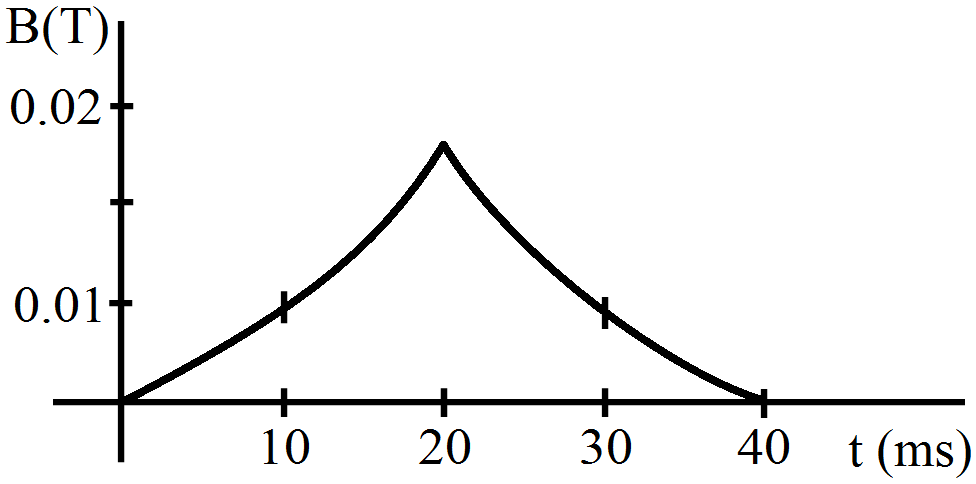
  1. The magnetic field in a region varies as shown in figure. Calculate the average induced emf in a conducting loop of area $2.0 \times 10^{-3}m^2$ placed perpendicular to the field in each of the $10ms$ intervals shown.
  2. In which intervals is the emf not constant? Neglect the behaviour near the ends of 10ms intervals.
The time constant of an LR circuit is 40ms. The circuit is connected at t = 10 and the steady-state current is found to be 2.0A. Find the current at:
  1. t = 10ms
  2. t = 20ms
  3. t = 100ms
  4. t = 1s.
A ball falls on an inclined plane of inclination $\theta$ from a height h above the point of impact and makes a perfectly elastic collision. Where will it hit the plane again?
Consider the situation of the previous problem. Suppose each of the blocks is pulled by a constant force F instead of any impulse. Find the maximum elongation that the spring will suffer and the distances moved by the two blocks in the process.
A particle of mass m is kept on a fixed, smooth sphere of radius R at a position, where the radius through the particle makes an angle of 30° with the vertical. The particle is released from this position.
  1. What is the force exerted by the sphere on the particle just after the release?
  2. Find the distance travelled by the particle before it leaves contact with the sphere.
The earth revolves round the sun due to gravitational attraction. Suppose that the sun and the earth are point particles with their existing masses and that Bohr's quantization rule for angular momentum is valid in the case of gravitation. (a) Calculate the minimum radius the earth can have for its orbit. (b) What is the value of the principal quantum number n for the present radius? Mass of the earth $=6.0 \times 10^{-24} \mathrm{~kg}$. Mass of the sun $=2.0 \times 10^{30} \mathrm{~kg}$, earthsun distance $=1.5 \times 10^{11} \mathrm{~m}$.
A $10g$ bullet with a charge of $4.00\mu\text{C}$ is fired at a speed of $270m/s^{-1}$ in a horizontal direction. A vertical magnetic field of $500\mu\text{T}$ exists in the space. Find the deflection of the bullet due to the magnetic field as it travels through 100m. Make appropriate approximations.
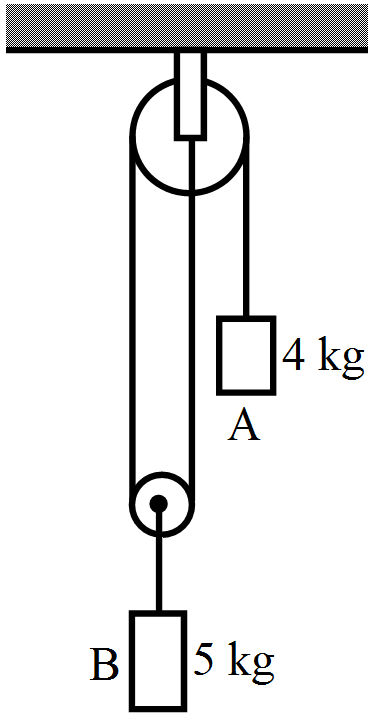
Find the acceleration of the blocks A and B in the three situations shown in figure.


A uniform magnetic field B exists in a cylindrical region, shown dotted in figure. The magnetic field increases at a constant rate $\frac{\text{dB}}{\text{dt}}.$ Consider a circle of radius r coaxial with the cylindrical region.
  1. Find the magnitude of the electric field E at a point on the circumference of the circle.
  2. Consider a point P on the side of the square circumscribing the circle. Show that the component of the induced electric field at P along ba is the same as the magnitude found in part (a).