Question
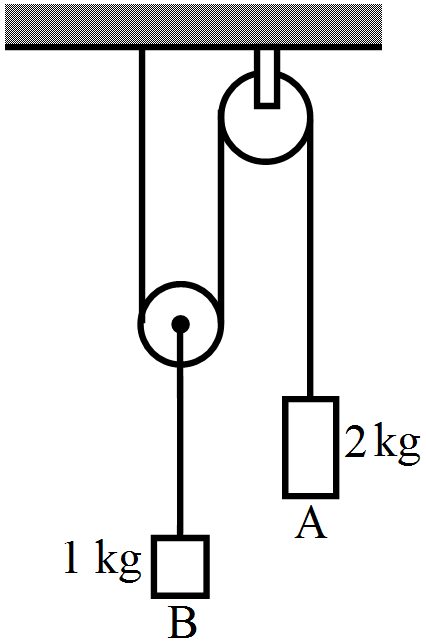
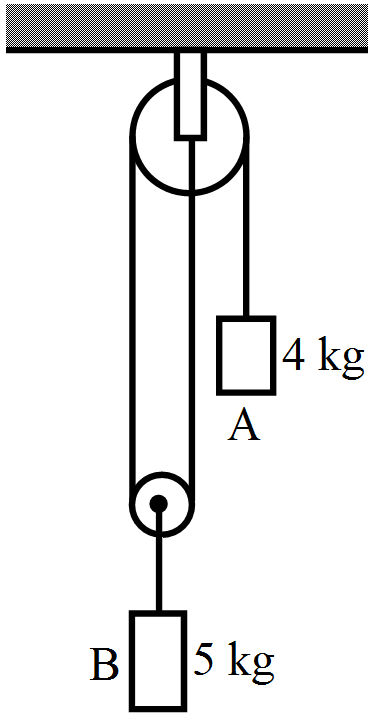
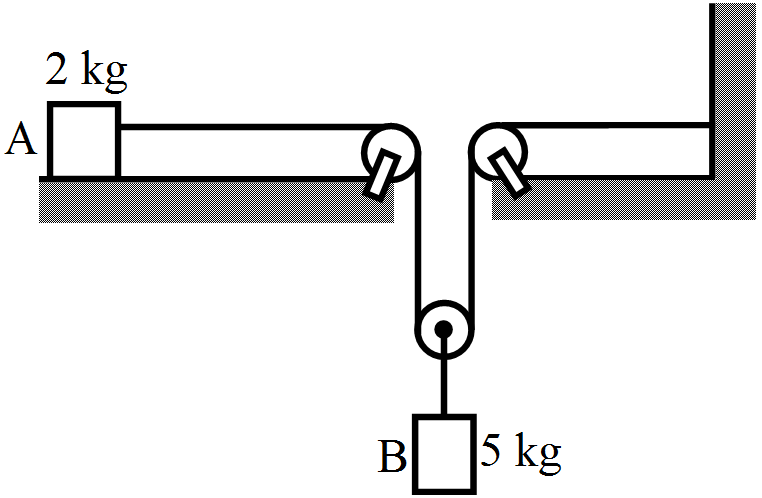
Find the acceleration of the blocks A and B in the three situations shown in figure.


Answer


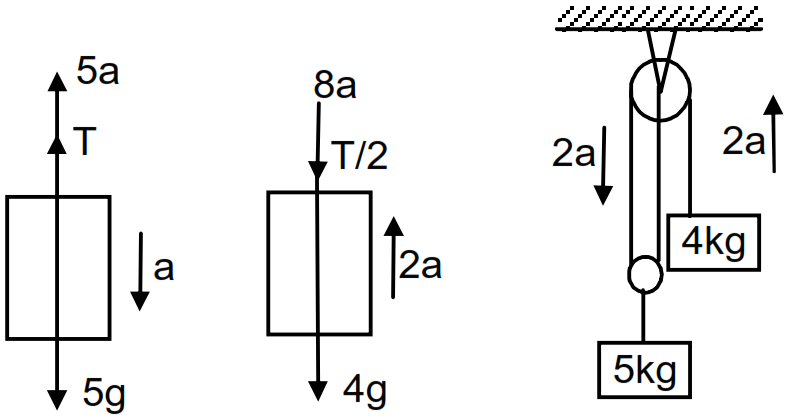
  1. $5\text{a + T}-5\text{g}=0\Rightarrow\text{T}=5\text{g}-5\text{a} \ ...(\text{i})$ (From FBD - 1)
Again $\Big(\frac{1}{2}\Big)-4\text{g}-8\text{a}=0\Rightarrow\text{T}=8\text{g}-16\text{a} \ ...(\text{ii})$ (From FBD - 2)

From equn (i) and (ii), we get

$\text{5g}-5\text{a}=8\text{g}+16\text{a}\Rightarrow21\text{a}=-3\text{g}\Rightarrow\text{a}=-\frac{1}{7}\text{g}$

So, acceleration of 5kg mass is $\frac{\text{g}}{7}$ upward and that of 4kg mass is $2\text{a}=\frac{2\text{g}}{7}$ (downward).
  1.  


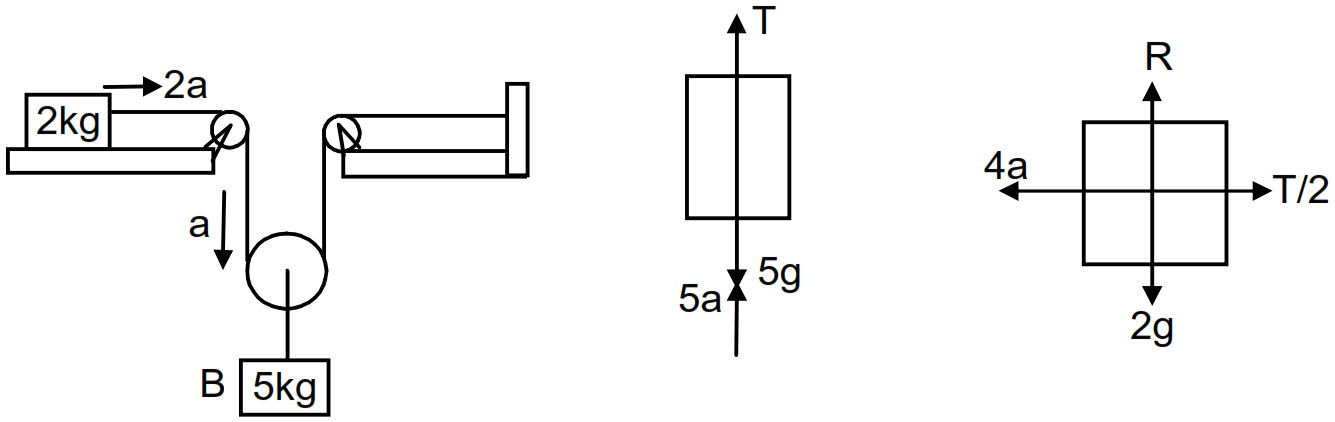
$4\text{a}-\frac{\text{t}}{2}=0\Rightarrow8\text{a}-\text{T}=0\Rightarrow\text{T = 8a} \ ...(\text{ii})$ [from FBD - 4]

Again, $\text{T + 5a}-5\text{g}=0\Rightarrow8\text{a + 5a}-5\text{g}=0$

$\Rightarrow13\text{a}-5\text{g}=0\Rightarrow\text{a =}\frac{5\text{g}}{13}$ downward. (from FBD - 3)

Acceleration of mass
  1. $\text{kg is 2a}=\frac{10}{13}(\text{g}) \ \& \ 5\text{kg}$
  2. is $\frac{5\text{g}}{13}.$
  1.  


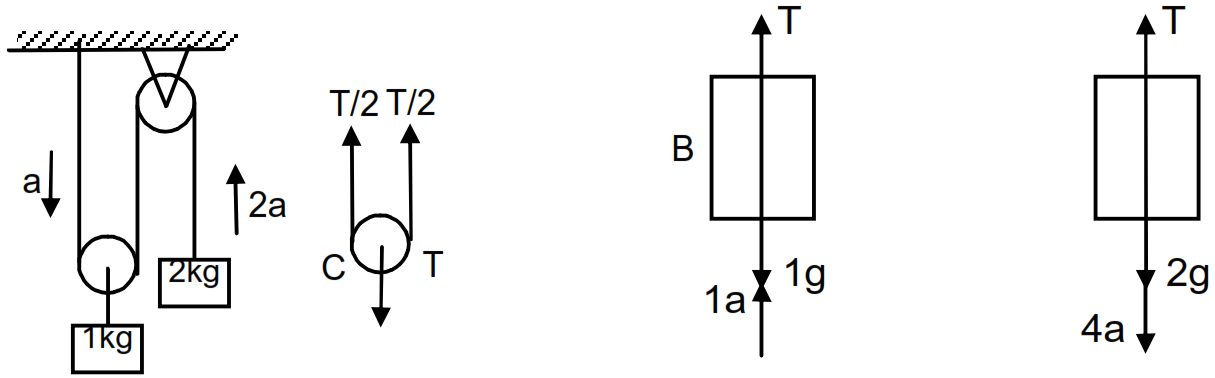
$\text{T + 1a}-1\text{g}=0\Rightarrow\text{T = 1g}-1\text{a} \ ...(\text{i})$ [From FBD - 5]

Again, $\frac{\text{T}}{2}-2\text{g}-4\text{a}=0\Rightarrow\text{T}-4\text{g}-8\text{a}=0 \ ...(\text{ii})$ [From FBD - 6]

$\Rightarrow1\text{g}-1\text{a}-4\text{g}-8\text{a}=0$ [From (i)]

$\Rightarrow\text{a}=-\Big(\frac{\text{g}}{3}\Big)$ downward.

Acceleration of mass 1kg(b) is $\frac{\text{g}}{3}\text{(up)}$

Acceleration of mass 2kg(A) is $\frac{2\text{g}}{3}$ (downward).

Need a full question paper?

Generate a complete, print-ready paper with questions like this in minutes — across 16+ boards, with answer keys.
Start Generating Free

Similar questions

Discuss Newton's formula for the velocity of longitudinal waves in air. What correction was applied by Laplace and why?
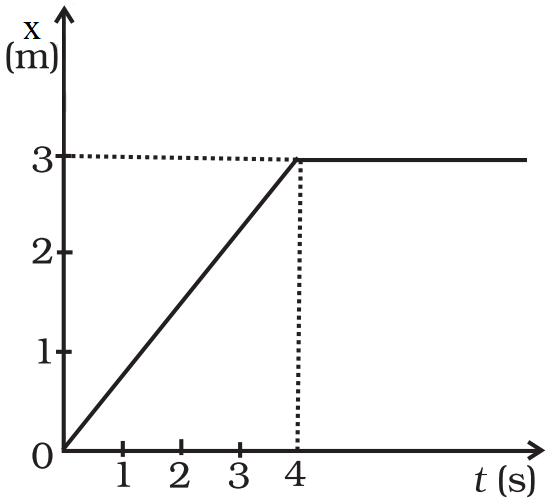
The position time graph of a body of mass $2kg$ is as given in What is the impulse on the body at $t = 0 s$ and $t = 4s$.
A hoop of radius $2m$ weighs $100kg$. It rolls along a horizontal floor so that its centre of mass has a speed of $20cm/s$. How much work has to be done to stop it?
When a proton is released from rest in a room, it starts with an initial acceleration $a_0$ towards west. When it is projected towards north with a speed $v_0$, it moves with an initial acceleration $3a_0$ towards west. Find the electric field and the maximum possible magnetic field in the room.
A parallel-plate capacitor having plate area $400cm^2$ and separation between the plates $1.0mm$ is connected to a power supply of 100V. A dielectric slab of thickness $1.0mm$ and dielectric constant $5.0$ is inserted into the gap:
  1. Find the increase in electrostatic energy.
  2. If the power supply is now disconnected and the dielectric slab is taken out, find the further increase in energy.
  3. Why does the energy increase in inserting the slab as well as in taking it out?
What is the amplitude, wavelength and velocity of the wave represented by
$\phi(\text{x, t})=5\sin(6\pi\text{t}-4\text{x})?$
Obtain the formula for velocity of efflux from a hole in a tank h metres below the surface of water. Explain Toricelli's theory.
Derive an expression for moment of inertia of a circular disc about an axis passing through its centre and perpendicular to its plane.
A constant current exists in an inductor-coil connected to a battery. The coil is short-circuited and the battery is removed. Show that the charge flown through the coil after the short-circuiting is the same as that which flows in one time constant before the short-circuiting.
At what temperature is the root mean square speed of an atom in an argon gas cylinder equal to the rms speed of a helium gas atom at $-20°C$? (atomic mass of $Ar = 39.9u$, of $He = 4.0u$).