MCQ
A body performing unifom circular motion completed $140$ revolution in a second. Its angular speed is .......... $rad / s$
  • $880$
  • B
    $440$
  • C
    $220$
  • D
    $240$

Answer

Correct option: A.
$880$
a
(a)

$f=140 red / sec$

$\omega=2 \pi F \rightarrow$ frequency

$\downarrow$

angular speed

$\omega=2 \pi x 140$.

$\omega=280 \times 3.14=879.8 rad / s$

$\omega \simeq 880 rad / s$

Need a full question paper?

Generate a complete, print-ready paper with questions like this in minutes — across 16+ boards, with answer keys.
Start Generating Free

Similar questions

The density of ice is $0.9 \,g / cm ^3$. What percentage by volume of the block of ice floats outside the water is ..........$\%$
A particle moves in the X - Y plane according to the equation $\overrightarrow{\text{r}}=\Big(\overrightarrow{\text{i}}+2\overrightarrow{\text{j}}\Big)\text{A}\cos\omega\text{t}.$ The motion of the particle is:
  1. On a straight line.
  2. On an ellipse.
  3. Periodic.
  4. Simple harmonic.
A cubic vessel (with face horizontal + vertical) contains an ideal gas at NTP. The vessel is being carried by a rocket which is moving at a speed of 500ms-1 in vertical direction. The pressure of the gas inside the vessel as observed by us on the ground:
  1. Remains the same because 500ms-1 is very much smaller than vrms of the gas.
  2. Remains the same because motion of the vessel as a whole does not affect the relative motion of the gas molecules and the walls.
  3. Will increase by a factor equal to (v2rms + (500)2)/ v2rms where vrms was the original mean square velocity of the gas.
  4. Will be different on the top wall and bottom wall of the vessel.
Radius of orbit of satellite of earth is $R$. Its kinetic energy is proportional to
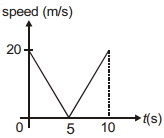
The speed-time graph for a body moving along a straight line is shown in figure. The average acceleration of body may be .......... $m / s ^2$
A body is moving according to the equation $x = at + b{t^2} - c{t^3}$ where $x = $ displacement and $a,\;b$ and $c$ are constants. The acceleration of the body is
The power (P) of an engine lifting a mass of 100kg upto a height of 10m in 1 min is:
If Planck’s constant (h) and speed of light in vacuum (c) are taken as two fundamental quantities, which one of the following can, in addition, be taken to express length, mass and time in terms of the three chosen fundamental quantities?
A boat is moving with velocity of $3\hat i + 4\hat j$ in river and water is moving with a velocity of $ - 3\hat i - 4\hat j$ with respect to ground. Relative velocity of boat with respect to water is :
Two Carnot engines $A$ and $B$ are operated in series. The first one, $A,$ receives heat at $T_1(= 600\,K)$ and rejects to a reservoir at temperature $T_2.$ The second engine $B$ receives heat rejected by the first engine and, in turns, rejects to a heat reservoir at $T_3 (=400\,K).$ Calculate the temperature $T_2$ if the work outputs of the two engines are equal   ..... $K$