MCQ
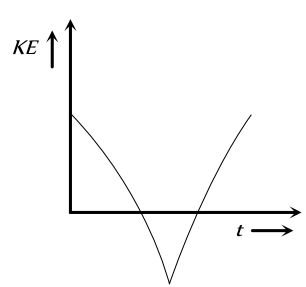
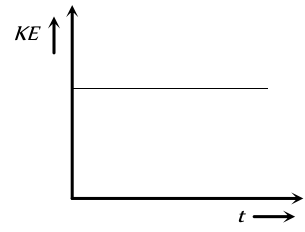
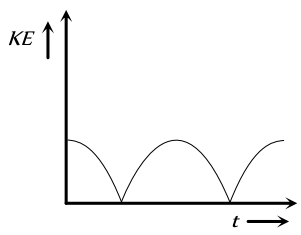
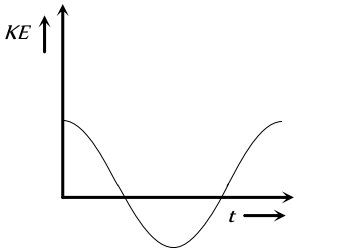
A body performs S.H.M. Its kinetic energy $K$ varies with time $t$ as indicated by graph
  • Image
  • B
    Image
  • C
    Image
  • D
    Image

Answer

Correct option: A.
Image
(a) Kinetic energy varies with time but is never negative.

Need a full question paper?

Generate a complete, print-ready paper with questions like this in minutes — across 16+ boards, with answer keys.
Start Generating Free

Similar questions

A body executing simple harmonic motion has a maximum acceleration equal to $24$ metres $/ sec ^2$ and maximum velocity equal to $16$ metres $/ sec$. The amplitude of the simple harmonic motion is
The ratio of speed of an electron in ground state in Bohrs first orbit of hydrogen atom to velocity of light in air is
During the adiabatic expansion of $2$ moles of a gas, the internal energy of the gas is found to decrease by $2$ joules, the work done during the process on the gas will be equal to
Velocity of light in glass whose refractive index with respect to air is $1.5$ is $2 \times 10 \mathrm{~m} / \mathrm{s}$ and in certain liquid the velocity of light found to be $2.5 \times 10 \mathrm{~m} / \mathrm{s}$. The refractive index of the liquid with respect to air is
If $R=$ universal gas constant, the amount of heat needed to raise the temperature of $2$ mole of an ideal monoatomic gas from $273 K$ to $373 K$ when no work is done
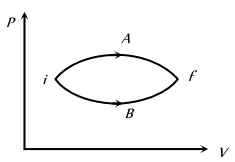
In the figure given two processes $A$ and $B$ are shown by which a thermo-dynamical system goes from initial to final state $F$. If $\Delta Q_A$ and $\Delta Q_B$ are respectively the heats supplied to the systems then
Image
Temperature is a measurement of coldness or hotness of an object. This definition is based on
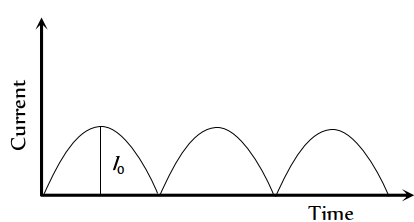
The output current versus time curve of a rectifier is shown in the figure. The average value of output current in this case is
Image
The triode constant is out of the following
A glass convex lens $\left(\mu_g=1.5\right)$ has a focal length of $8 \mathrm{~cm}$ when placed in air. What would be the focal length of the lens when it is immersed in water $\left(\mu_w=1.33\right)$