MCQ
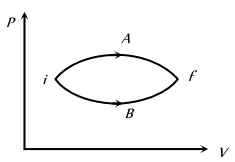
In the figure given two processes $A$ and $B$ are shown by which a thermo-dynamical system goes from initial to final state $F$. If $\Delta Q_A$ and $\Delta Q_B$ are respectively the heats supplied to the systems then
Image
  • A
    $\Delta Q_A=\Delta Q_B$
  • B
    $\Delta Q_A \geq \Delta Q_B$
  • C
    $\Delta Q_A<\Delta Q_B$
  • $\Delta Q_A>\Delta Q_B$

Answer

Correct option: D.
$\Delta Q_A>\Delta Q_B$
(d) $\Delta Q=\Delta U+\Delta W ; \Delta U$ does not depend upon path.$\because \Delta W_A>\Delta W_B \Rightarrow \Delta Q_A>\Delta Q_B$

Need a full question paper?

Generate a complete, print-ready paper with questions like this in minutes — across 16+ boards, with answer keys.

Start Generating Free

Similar questions

$50 \Omega$ and $100 \Omega$ resistors are connected in series. This connection is connected with a battery of 2.4 volts. When a voltmeter of $100 \Omega$ resistance is connected across $100 \Omega$ resistor, then the reading of the voltmeter will be
In the above question, the force acting on the object is
In a certain circuit current changes with time according to $i=2 \sqrt{t}$. r.m.s. value of current between $t=2$ to $t=4 s$ will be
In the visible region the dispersive powers and the mean angular deviations for crown and flint glass prisms are $\omega, \omega^{\prime}$ and $d, d$ respectively. The condition for getting deviation without dispersion when the two prisms are combined is
Coatings used on raincoat are waterproof because
The state of a thermodynamic system is represented by
An iron rod of volume $10^{-4} \mathrm{~m}^3$ and relative permeability $1000$ is placed inside a long solenoid wound with $5$ turns $/ \mathrm{cm}$. If a current of $0.5 A$ is passed through the solenoid, then the magnetic moment of the rod is
The kinetic energy of an electron is $5 \mathrm{eV}$. Calculate the de-Broglie wavelength associated with it $\left(h=6.6 \times 10^{-} / \mathrm{s}, m=9.1 \times 10^{-} \mathrm{kg}\right)$
The temperatures of two bodies $A$ and $B$ are respectively $727^{\circ} \mathrm{C}$ and $327^{\circ} \mathrm{C}$. The ratio $H_A: H_B$ of the rates of heat radiated by them is
Two bodies of masses $m_1$ and $m_2$ have equal kinetic energies. If $p_1$ and $p_2$ are their respective momentum, then ratio $p_1: p_2$ is equal to