Question
A body performs simple harmonic motion according to the following equation :
$
x=6 \sin \left(3 \pi t+\frac{\pi}{3}\right)
$
Find out : (i) amplitude (ii) period (iii) initial art (iv) displacement, velocity and acceleration at time $t = 2$.
Answer

Given equation :
$x=6 \sin \left(3 \pi t+\frac{\pi}{3}\right)$
The general equation of simple harmonic motion is as follows :
$x=A \sin (\omega t+\phi)$
Comparing it with the given equation
(i) Dimension $A =6 m$
(ii) $\omega=3 \pi$
$\begin{aligned}\text {But}\quad\omega & =\frac{2 \pi}{T} \\T & =\frac{2 \pi}{\omega}=\frac{2 \pi}{3 \pi}=\frac{2}{3} sec \\T & =0 \cdot 666 sec .\end{aligned}$
(iii) Initial phase $=\frac{\pi}{3}$ radian
(iv) $x=6 \sin \left(3 \pi t +\frac{\pi}{3}\right)$ by keeping $t=2$ in
$\begin{aligned}x & =6 \sin \left(3 \pi \times 2+\frac{\pi}{3}\right) \\& =6 \sin \frac{\pi}{3}=6 \times \frac{\sqrt{3}}{2}=3 \sqrt{3}\end{aligned}$
Displacement $=3 \sqrt{3} m$.
$A =6$ and $\omega=3 \pi$ putting these values in the equation of velocity,
$\begin{array}{l}v= 3 \pi\left[(6)^2-(3 \sqrt{3})^2\right]^{\frac{1}{2}} \\\quad\left(\because v=\omega \sqrt{A^2-x^2}\right) \\=3 \pi(36-27)^{\frac{1}{2}}=3 \pi \times 3=9 \pi\end{array}$
Acceleration $a=\omega^2 x=(3 \pi)^2 \times 3 \sqrt{3}$
$=9 \pi^2 \times 3 \sqrt{3}=27 \sqrt{3} \pi^2$
Amplitude $=6$, period $=0.666 sec$.
Initial phase $=\frac{\pi}{3}$, displacement $=3 \sqrt{3} m / s$
Velocity $=9 \pi m / s$ and acceleration
$=27 \sqrt{3} \pi^2 m / s^2$

Need a full question paper?

Generate a complete, print-ready paper with questions like this in minutes — across 16+ boards, with answer keys.

Start Generating Free

Similar questions

A simple harmonic motion has an amplitude A and time period T. What is the time taken to travel from $\text{x}=\text{A}$ $\text{x}=\frac{\text{A}}{2}$?
If the earth were a homogeneous sphere and a straight hole bored in it through its centre, show that if a body were dropped into the hole it would execute a simple harmonic motion. Also find its time period.
Two particles of mass 2kg and 1kg are moving along the same line with speeds 2ms-1 and 5ms-1 respectively. What is the speed of the centre of mass of the system if both the particles are moving (a) in same direction (b) in opposite direction?
Derive an expression for pressure of a gas in a container. Using it, relate K.E. with pressure.
A disc revolves with a speed of $33\frac{1}{3}\text{rev/min},$ and has a radius of 15cm. Two coins are placed at 4cm and 14cm away from the centre of the record. If the co-efficient of friction between the coins and the record is 0.15, which of the coins will revolve with the record?
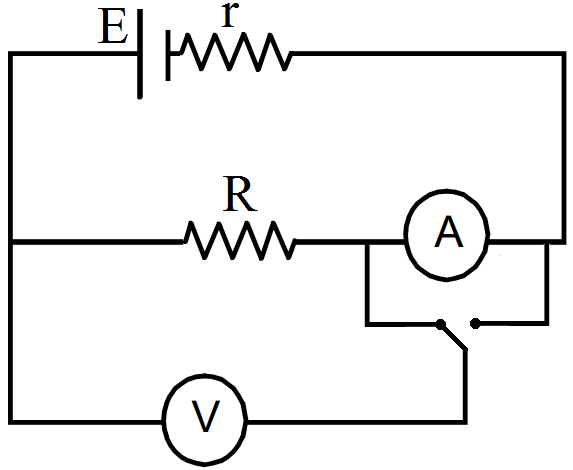
The emf $\in$ and the internal resistance r of the battery, shown in the figure. are 4.3V and $1.0\Omega$ respectively. The external resistance R is $50\Omega.$ The resistances of the ammeter and voltmeter are $2.0\Omega$ and $200\Omega$ respectively. (a) Find the readings of the two $200\Omega$ respectively. (a) Find the readings of the two meters. (b) The switch is thrown to the other side. What will be the readings of the two meters now?

When a metal plate is exposed to a monochromatic beam of light of wavelength 400nm, a negative potential of 1.1V is needed to stop the photocurrent. Find the threshold wavelength for the metal.
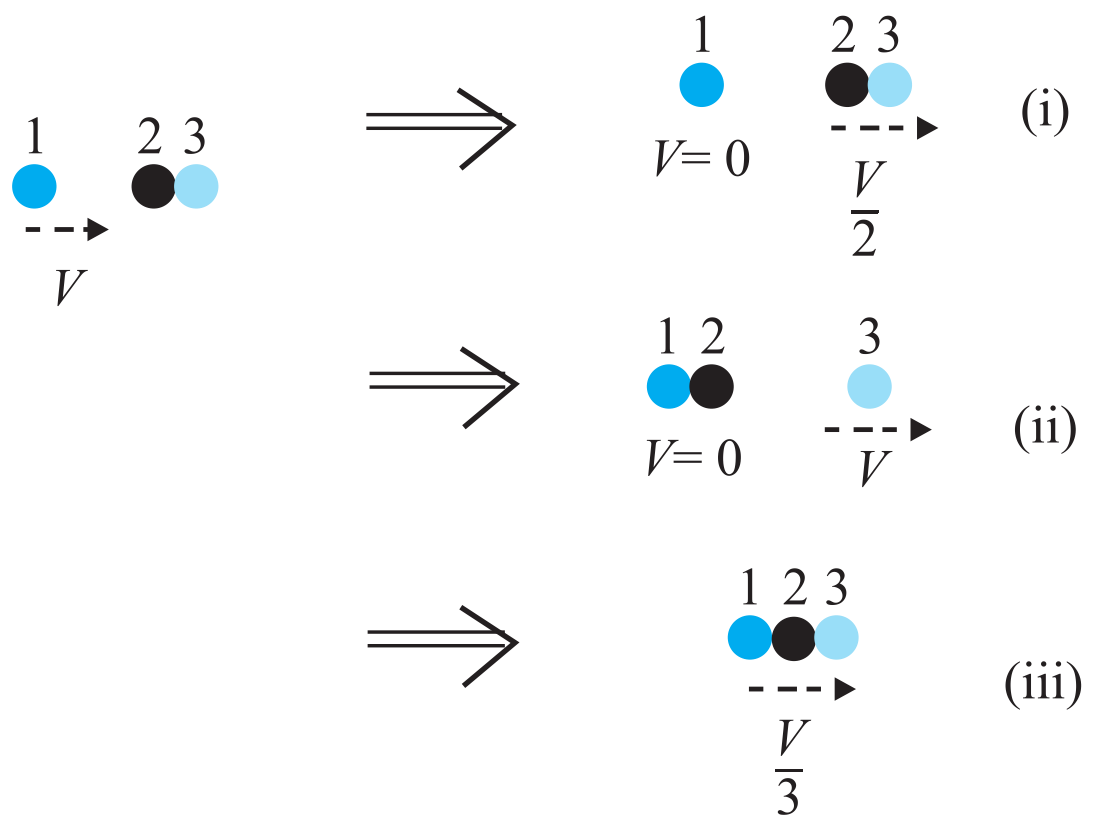
Two identical ball bearings in contact with each other and resting on a frictionless table are hit head-on by another ball bearing of the same mass moving initially with a speed V. If the collision is elastic, which of the following is a possible result after collision?

A body of mass 5kg is acted upon by two perpendicular forces 8N and 6N. Give the magnitude and direction of the acceleration of the body.
Four equal charges 2.0 × 10-6C each are fixed at the four corners of a square of side 5cm. Find the Coulomb force experienced by one of the charges due to the rest three.