Question types

PART - 2 CH - 13 Oscillations question types

182 questions across 9 question groups — pick any mix to generate a Physics paper with step-by-step answer keys.

182
Questions
9
Question groups
5
Question types
Sample Questions

PART - 2 CH - 13 Oscillations questions

One sample from each question group in this chapter. Select any group above to see the full set with answer keys.

If a tunnel is made along the diameter of the 90 and in that if you leave a stone :
  • A
    The stone will stop at the centre of the earth
  • B
    The stone will stop after reaching the other end of the earth
  • The stone will make simple harmonic motion at the centre of the earth
  • D
    The stone will reach the other end of the earth and go into space

Answer: C.

View full solution
Following are the equation of motion of a body. Which of these relations will be correct for simple harmonic motion ?
  • A
    Resultant force = kx
  • B
    Velocity $=k x^2$
  • C
    Velocity $=k\left(A^2-x^2\right)$
  • Potential energy $=\frac{1}{2} KA ^2 \sin ^2 \omega t$

Answer: D.

View full solution
Simple harmonic motion is such a harmonic motion in which the restoring force F is directly proportional to :
  • A
    Amplitude
  • displacement
  • C
    Velocity
  • D
    Square of displacement

Answer: B.

View full solution
The lengths of the second pendulum at two places are/and/respectively the result of gravitational acceleration at those places $(g_1: g_2)$ will be :
  • A
    $\frac{l_2}{l_1}$
  • $\frac{l_1}{l_1}$
  • C
    $\frac{l_2^2}{l_2^1}$
  • D
    $\frac{l_1^2}{l_2^2}$

Answer: B.

View full solution
What is the restoring force proportional to in simple harmonic motion?
  • A
    Velocity
  • Displacement from mean position
  • C
    Mass
  • D
    Angular acceleration

Answer: B.

View full solution
While performing simple harmonic motion, the ratio of kinetic energy at the mean position of the pendulum and potential energy at the maximum displacement is equal to 1.
View full solution
The angular frequencies of two simple harmonic motion are 10 and 100 radians per second. If displacement (amplitude) is the same then the ratio of their maximum accelerations will be $\left(1: 10^2\right).$
View full solution
The lengths of the second pendulum at two places are $l_1$ and $l_2$ respectively, the value of gravitational acceleration at those places $g_1: g_2$, will be $l_1: l_2$.
View full solution
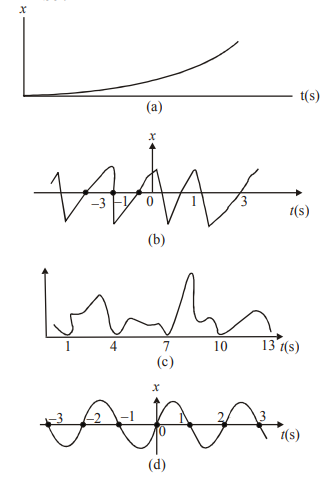
depicts four x-t plots for linear motion of a particle. Which of the plots represent periodic motion? What is the period of motion (in case of periodic motion)?
Image
View full solution
Which of the following examples represent (nearly) simple harmonic motion and which represent periodic but not simple harmonic motion?
(a) the rotation of earth about its axis.
(b) motion of an oscillating mercury column in a U-tube.
(c) motion of a ball bearing inside a smooth curved bowl, when released from a point slightly above the lower most point.
(d) general vibrations of a polyatomic molecule about its equilibrium position.
View full solution
The piston in the cylinder head of a locomotive has a stroke (twice the amplitude) of 1.0 m . If the piston moves with simple harmonic motion with an angular frequency of $200 rad / min$, what is its maximum speed?
View full solution
A body hanging from a spring can oscillate in a horizontal plane with angular velocity $\omega$ without friction or damping when it is stretched to a distance and then released. It passes through the equilibrium center with a velocity at time $t=0$. Find the amplitude of the resultant oscillation in terms of parameter $\omega_0, x_0$ and $v_0$.
[Hint : The equation $x=a \cos (\omega t+\theta)$ is negative keep in mind that the initial]
View full solution
An object moves in simple harmonic motion with an amplitude of 5 cm and a frequency of 0.2 sec . Find the acceleration and velocity of the object when the displacement of the object is (a) 5 cm (b) 3 cm (c) 0 cm .
View full solution
Q 263 Marks Question3 Marks
Which of the following relationships between the acceleration $a$ and the displacement $x$ of a particle involve simple harmonic motion?
(a) $a=0.7 x$
(b) $a=-200 x^2$
(c) $a=-10 x$
(d) $a=100 x^3$
View full solution
Q 283 Marks Question3 Marks
If a mass of 0.8 kg is moving in simple harmonic motion starting from equilibrium position. The dimensions of the body of mass 1.0 m and if the period is 11/7 sec then 0.6 m. Find velocity of the particle at displacement and also write the equation of motion.
View full solution
Q 303 Marks Question3 Marks
The time period of a mass hanging from an ideal spring is 2 seconds. If along with it 2 kg if the mass is added and the time period becomes 3 seconds find the value of $m$.
View full solution
Q 314 Marks Question4 Marks
A spring balance has a scale that reads from 0 to 50 kg . The length of the scale is 20 cm . A body suspended from this balance, when displaced and released, oscillates with a period of 0.6 s . What is the weight of the body ?
View full solution
Q 324 Marks Question4 Marks
The acceleration due to gravity on the surface of moon is $1.7 ms^{-2}$. What is the time period of a simple pendulum on the surface of moon if its time period on the surface of earth is 3.5 s ? ( $g$ on the surface of earth is $9.8 m s ^{-2}$ ).
View full solution
Q 334 Marks Question4 Marks
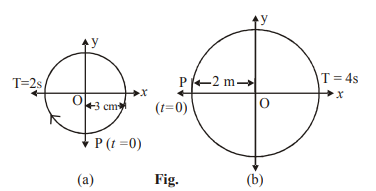
Figures correspond to two circular motions. The radius of the circle, the period of revolution, the initial position, and the sense of revolution (i.e. clockwise or anti-clockwise) are indicated on each figure.
Image
Obtain the corresponding simple harmonic motions of the $x$-projection of the radius vector of the revolving particle $P$, in each case.
View full solution
AB
1. The value of angular frequency ( $\omega)$ is equal(A) Square of amplitude and square of frequency
2. What will be kinetic energy if maximum displacement $y= \pm A$ is taken ?(B) $\frac{1}{2} T$
3. $\int_0^{ T } \cos ^2 \omega t d t$ The value of it will be :(C) Zero
4. In simple harmonic motion the total energy of the particle is proportional to:(D) $K =\frac{ K _1 K_2}{K_1+ K _2}$
5. Series sequence is spring combination(E) $\sqrt{\frac{k}{m}}$
View full solution
AB
1. An example of non periodic motion is :(A). Different equation of linear simple harmonic motion
2. An example of harmonic motion is :(B)  Movement of electrons in the orbital of atom
3. There is relation between frequency and period.(C) $\frac{2 \pi}{\omega}$
4. $\frac{d^2 y}{d t^2}+\omega^2 y=0$(D) nT = 1
5. Time period T =(E) Throwing the ball
View full solution
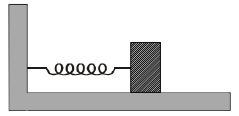
A spring having with a spring constant $1200 N m ^{-1}$ is mounted on a horizontal table as shown in Fig. A mass of 3 kg is attached to the free end of the spring. The mass is then pulled sideways to a distance of 2.0 cm and released.
Image
Determine (i) the frequency of oscillations, (ii) maximum acceleration of the mass. and (iii) the maximum speed of the mass.
View full solution
The motion of a particle executing simple harmonic motion is described by the displacement function.
$
x(t)=A \cos (\omega t+\phi)
$
If the initial $(t=0)$ position of the particle is 1 cm and its initial velocity is $\omega cm / s$, what are its amplitude and initial phase angle? The angular frequency of the particle is $\pi s ^{-1}$. If instead of the consine function, we choose the sine functions to describe the SHM : $x$ $= B \sin (\omega t+\alpha)$, what are the amplitude and initial phase of the particle with the above initial conditions?
View full solution
A particle is in linear simple harmonic motion between two points, $A$ and $B, 10 cm$ apart. Take the direction from $A$ to $B$ as the positive direction and give the signs of velocity, acceleration and force on the particle when it is :
(a) at the end A,
(b) at the end B,
(c) at the mid-point of AB going towards A ,
(d) at 2 cm away from B going towards A ,
(e) at 3 cm away from $A$ going towards $B$, and
(f) at 4 cm away from $B$ going towards $A$.
View full solution
Which of the following functions of time represent (a) simple harmonic, (b) periodic but not simple harmonic, and (c) non-periodic motion? Give period for each case of periodic motion ( $\omega$ is any positive constant) :
(a) $\sin \omega t-\cos \omega t$
(b) $\sin ^3 \omega t$
(c) $3 \cos \left(\frac{\pi}{4}-2 \omega t\right)$
(d) $\cos \omega t+\cos 3 \omega t+\cos 5 \omega t$
(e) $\exp \left(-\omega^2 t^2\right)$
(f) $1+\omega t+\omega^2 t^2$
View full solution
One end of a U-tube containing mercury is connected to a suction pump and the other end to atmosphere. A small pressure difference is maintained between the two columns. Show that, when the suction pump is removed, the column of mercury in the U-tube executes simple harmonic motion.
View full solution

Generate a PART - 2 CH - 13 Oscillations paper free

Pick question groups from the list above, set marks and difficulty, and export a branded PDF with step-by-step answer keys. First 3 chapters free — no signup.

Download App