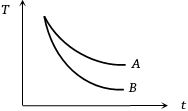
A body takes $4$ minutes to cool from ${100^o}C$ to ${70^o}C$. To cool from ${70^o}C$ to ${40^o}C$ it will take ........ $\min.$ (room temperature is ${15^o}C$)
Medium


Download our appand get started for free
Experience the future of education. Simply download our apps or reach out to us for more information. Let's shape the future of learning together!No signup needed.*
Similar Questions
- 1View SolutionMud houses are cooler in summer and warmer in winter because
- 2A cup of tea cools from ${80^0}C$ to ${60^o}C$ in one minute. The ambient temperature is ${30^o}C$. In cooling from ${60^o}C$ to ${50^o}C$ it will take ....... $\sec$View Solution
- 3The power radiated by a black body is $P$ and it radiates maximum energy at wavelength,$\lambda_0.$ If the temperature of the black body is now changed so that it radiates maximum energy at wavelength $\frac{3}{4}\lambda_0$, the power radiated by it becomes $nP$. The value of $n$ isView Solution
- 4$Assertion :$ A tube light emits white light.View Solution
$Reason :$ Emission of light in a tube takes place at a very high temperature. - 5A black body radiates energy at the rate of $E$ $W/m^2$ at a high temperature $TK$ . When the temperature is reduced to $\frac{T}{2}K$, the radiant energy will beView Solution
- 6Two identical rods of copper and iron are coated with wax uniformly. When one end of each is kept at temperature of boiling water, the length upto which wax melts are $8.4cm$ and $4.2cm$ respectively. If thermal conductivity of copper is $0.92$ , then thermal conductivity of iron isView Solution
- 7A body of length 1m having cross sectional area $0.75\;m^2$ has heat flow through it at the rate of $ 6000\; Joule/sec$ . Then find the temperature difference if $K = 200\;J{m^{ - 1}}{K^{ - 1}}$ ...... $^oC$View Solution
- 8View SolutionIf black wire of platinum is heated, then its colour first appear red, then yellow and finally white. It can be understood on the basis of
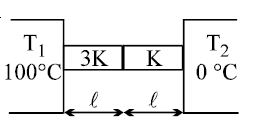
- 9Two rods $A$ and $B$ of same cross-sectional are $A$ and length $l$ connected in series between a source $(T_1 = 100^o C)$ and a sink $(T_2 = 0^o C)$ as shown in figure. The rod is laterally insulated If $G_A$ and $G_B$ are the temperature gradients across the rod $A$ and $B$, thenView Solution
- 10View SolutionWater and turpentine oil (specific heat less than that of water) are both heated to same temperature. Equal amounts of these placed in identical calorimeters are then left in air