A body takes time $t$ to reach the bottom of an inclined plane of angle $\theta$ with the horizontal. If the plane is made rough, time taken now is $2t$. The coefficient of friction of the rough surface is
Medium


Download our appand get started for free
Experience the future of education. Simply download our apps or reach out to us for more information. Let's shape the future of learning together!No signup needed.*
Similar Questions
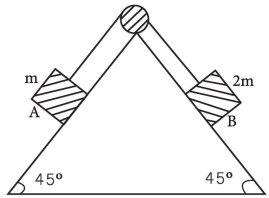
- 1Consider the diagram shown below in which two masses of $m$ and $2 m$ are placed on a fixed triangular wedge. The coefficient of friction between block $A$ and the wedge is $2 / 3$, while that for block $B$ and the wedge is $1 / 3$View Solution
- 2View SolutionStatic friction between two surfaces
- 3A horizontal force of $40\,N$ is applied to a $5\, kg$ block which is at rest on the horizontal surface. If the coefficient of kinetic friction is $0.4$, then the acceleration of the block is ........ $m/s^2$ $(g = 10 \,m/s^2)$View Solution
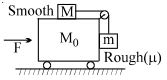
- 4Imagine $a$ situation in which the horizontal surface of block $M_0$ is smooth and its vertical surface is rough with $a$ coefficient of friction $\mu$ In above problem, choose the correct value $(s)$ of F which the blocks $M$ and $m$ remain stationary with respect to $M_0$View Solution
- 5......... $m/s^2$ is magnitude of acceleration of a block moving with speed $10\,m/s$ on a rough surface if coefficient of friction is $0.2$.View Solution
- 6A body of mass M is kept on a rough horizontal surface (friction coefficient $\mu $). A person is trying to pull the body by applying a horizontal force but the body is not moving. The force by the surface on the body is $F$, whereView Solution
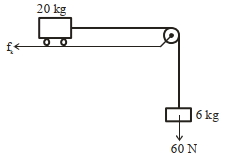
- 7Consider a block and trolley system as shown in figure. If the coefficient of kinetic friction between the trolley and the surface is $0.04$ , the acceleration of the system in $\mathrm{ms}^{-2}$ is :View Solution
(Consider that the string is massless and unstretchable and the pulley is also massless and frictionless):
- 8A body of mass $'m'$ is launched up on a rough inclined plane making an angle of $30^{\circ}$ with the horizontal. The coeffcient of friction between the body and plane is $\frac{\sqrt{x}}{5}$ if the time of ascent is half of the time of descent. The value of $x$ is ..... .View Solution
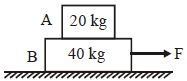
- 9In figure, the coefficient of friction between the floor and the block $B$ is $0.2$ and between blocks $A$ and $B$ is $0.3$. ........ $N$ is the maximum horizontal force $F$ can be applied to the block $B$ so that both blocks move together .View Solution
- 10A $1\,kg$ block is being pushed against a wall by a force $F = 75\,N$ as shown in the Figure. The coefficient of friction is $0.25.$ The magnitude of acceleration of the block is ........ $m/s^2$View Solution
