MCQ
A body will have uniform acceleration if its:
  • A
    Speed changes at uniform rate
  • B
    Velocity changes at uniform rate
  • C
    Speed changes at non - uniform rate
  • D
    Velocity remains constant

Answer

  1. Velocity changes at uniform rate

Explanation:

If the velocity of an object changes at a uniform rate, then the acceleration that causes the change in velocity is called uniform acceleration or constant acceleration.

For example, the force of gravity imparts an acceleration uniformly which is called acceleration due to gravity.

Need a full question paper?

Generate a complete, print-ready paper with questions like this in minutes — across 16+ boards, with answer keys.
Start Generating Free

Similar questions

A body of mass $'m'$ is launched up on a rough inclined plane making an angle of $30^{\circ}$ with the horizontal. The coeffcient of friction between the body and plane is $\frac{\sqrt{x}}{5}$ if the time of ascent is half of the time of descent. The value of $x$ is ..... .
If the maximum velocity and maximum acceleration of a particle executing $SHM$ are equal in magnitude, the time period will be .... $\sec$
An ideal gas at a pressures of $1$ atmosphere and temperature of ${27^o}C$ is compressed adiabatically until its pressure becomes $8$ times the initial pressure, then the final temperature is ..... $^oC$ ($\gamma  = 3/2$)
A particle of mass $m$ moves on a straight line with its velocity increasing with distance according to the equation $\mathrm{v}=\alpha \sqrt{\mathrm{x}}$, where $\alpha$ is a constant. The total work done by all the forces applied on the particle during its displacement from $\mathrm{x}=0$ to $\mathrm{x}=\mathrm{d}$, will be:
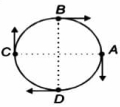
Four particles $A, B, C$ and $D$ are moving with constant speed $v$ each. At the instant shown relative velocity of $A$ with respect to $B, C$ and $D$ are in directions
The ratio of the radius of gyration of a thin uniform disc about an axis passing through its centre and normal to its plane to the radius of gyration of the disc about its diameter is
Two bodies $A$ and $B$ of mass $m$ and $2\, m$ respectively are placed on a smooth floor. They are connected by a spring of negligible mass. $A$ third body $C$ of mass $m$ is placed on the floor. The body $C$ moves with a velocity $v_0$ along the line joining $A$ and $B$ and collides elastically with $A$. At a certain time after the collision it is found that the instantaneous velocities of $A$ and $B$ are same and the compression of the spring is $x_0$. The spring constant $k$ will be
$A$ ship $X$ moving due north with speed $v$ observes that another ship $Y$ is moving due west with same speed $v$. The actual velocity of $Y$ is $........$.
A body of mass $‘M’$ collides against a wall with a velocity $v$ and retraces its path with the same speed. The change in momentum is (take initial direction of velocity as positive)
During an adiabatic process, if the pressure of a gas is found to be proportional to the cube of its absolute temperature, then the ratio of $\frac{C_p}{C_V}$ for the gas is: