Question types

Motion in a Straight Line question types

590 questions across 8 question groups — pick any mix to generate a Physics paper with step-by-step answer keys.

590
Questions
8
Question groups
5
Question types
Sample Questions

Motion in a Straight Line questions

One sample from each question group in this chapter. Select any group above to see the full set with answer keys.

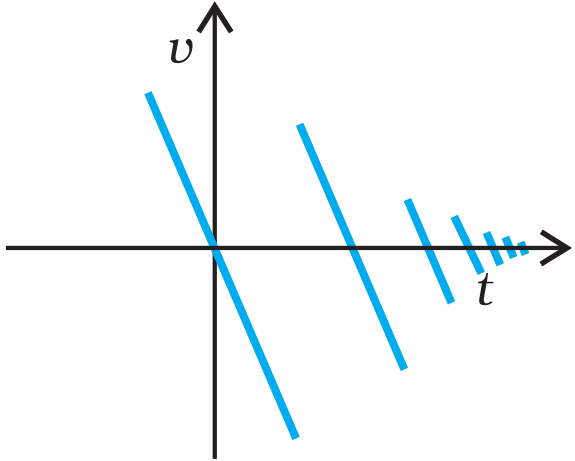
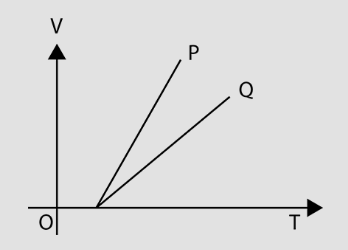
Figure shows the V−T graph for two particles P and Q. The relative velocity of P w.r.t. Q is:
  • A
    Is zero.
  • B
    Is non-zero but constant
  • C
    Continuously decreases
  • D
    Continuously increases
View full solution
A stone is released from an elevator going up with an acceleration a. The acceleration of the stone after the release is:
  • A
    a upward.
  • B
    (g - a) upward.
  • C
    (g - a) downward.
  • D
    g downward.
View full solution
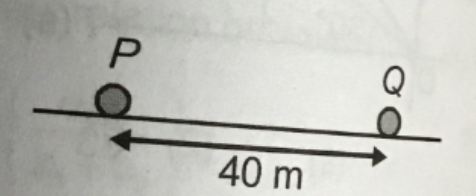
Two particle P and Q are initially 40m apart P behind Q. Particle P starts moving with a uniform velocity 10m/ s towards Q. Particle Q starting from rest has an acceleration 2ms2 in the direction of velocity of P. Then the minimum distance between P and Q will be:

  • A
    45m
  • B
    15m
  • C
    35m
  • D
    30m
View full solution
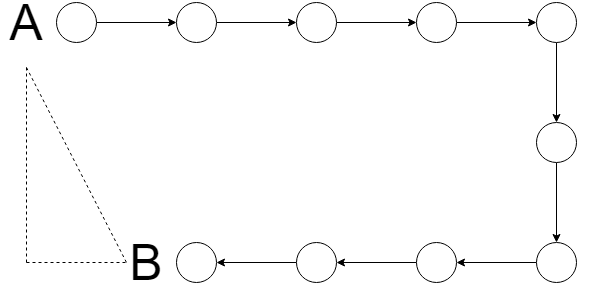
If, in the following diagram, distance between each circle is 1 unit, what is the displacement between A and B?

  • A
    5 units
  • B
    Square root (5) units
  • C
    2 units
  • D
    1 unit
View full solution
A vehicle travels half the distance L with speed V1 and the other half with speed V2, then its average speed is:
  • A
    $\frac{\text{v}_1+\text{v}_2}{2}$
  • B
    $\frac{2\text{v}_1+\text{v}_2}{\text{v}_1+\text{v}_2}$
  • C
    $\frac{2\text{v}_1\text{v}_2}{\text{v}_1+\text{v}_2}$
  • D
    $\frac{\text{L}(\text{v}_1+\text{v}_2)}{\text{v}_1\text{v}_2}$
View full solution
A student goes from his house to his friend's house with speed v1. Finding the door of his friend's closed, returns back to his own house with the speed v2. Then the average speed of the student is ______.
View full solution
Read statement below carefully and state with reasons and examples, if it is true or false;
A particle in one-dimensional motion.
With zero speed at an instant may have non-zero acceleration at that instant.
View full solution
Read statement below carefully and state with reasons and examples, if it is true or false;
A particle in one-dimensional motion.
With positive value of acceleration must be speeding up.
View full solution
Read statement below carefully and state with reasons and examples, if it is true or false;
A particle in one-dimensional motion.
With zero speed may have non-zero velocity.
View full solution
Read statement below carefully and state with reasons and examples, if it is true or false;
A particle in one-dimensional motion.
With constant speed must have zero acceleration.
View full solution
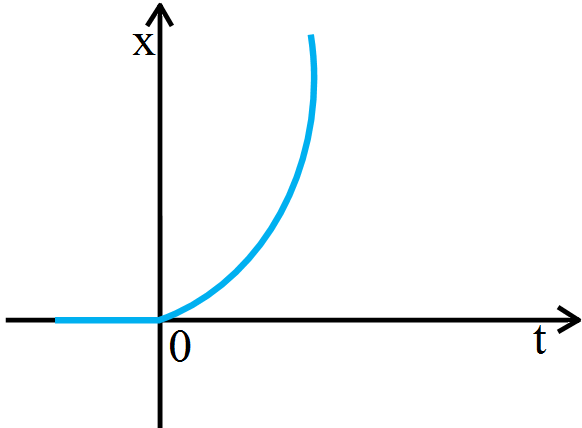
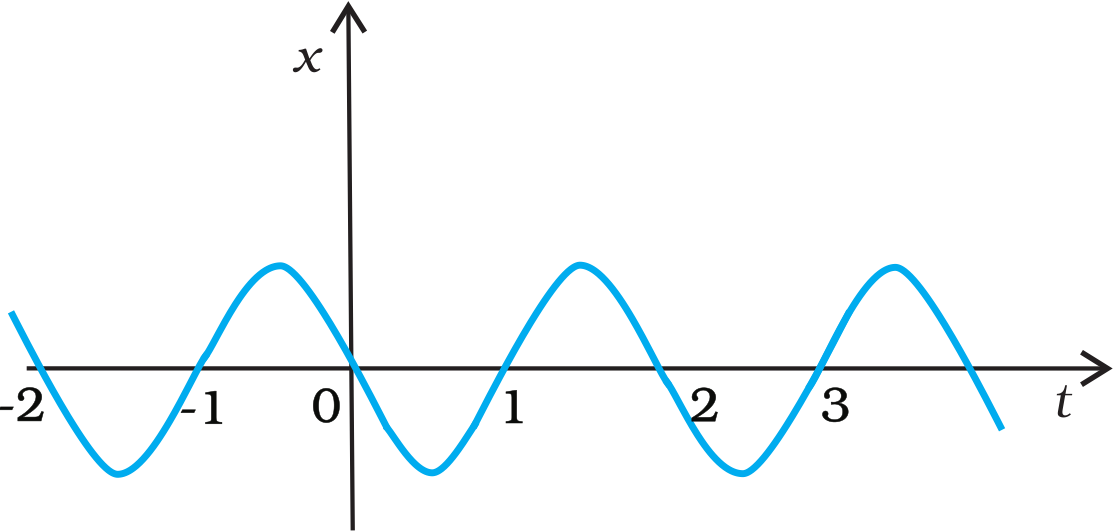
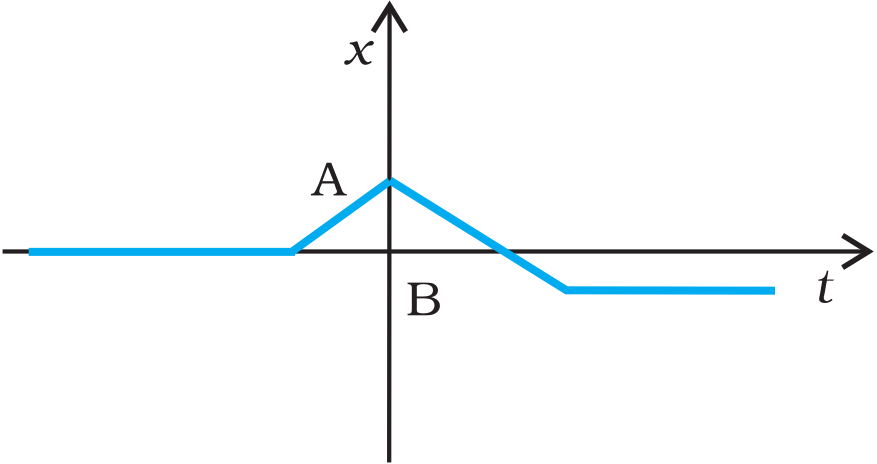
Shows the x-t plot of one-dimensional motion of a particle. Is it correct to say from the graph that the particle moves in a straight line for t < 0 and on a parabolic path for t > 0? If not, suggest a suitable physical context for this graph.

View full solution
A ball is dropped from a height of 90m on a floor. At each collision with the floor, the ball loses one tenth of its speed. Plot the speed-time graph of its motion between t = 0 to 12s.
View full solution
Reaction time : When a situation demands our immediate action, it takes some time before we really respond. Reaction time is the time a person takes to observe, think and act. For example, if a person is driving and suddenly a boy appears on the road, then the time elapsed before he slams the brakes of the car is the reaction time. Reaction time depends on complexity of the situation and on an individual.
You can measure your reaction time by a simple experiment. Take a ruler and ask your friend to drop it vertically through the gap between your thumb and forefinger (Fig. 2.8). After you catch it, find the distance $d$ travelled by the ruler. In a particular case, $d$ was found to be $21.0 cm$. Estimate reaction time.
View full solution
In which of the following examples of motion, can the body be considered approximately a point object:
A spinning cricket ball that turns sharply on hitting the ground.
View full solution
Read statement below carefully and state with reasons and examples, if it is true or false;
A particle in one-dimensional motion.
With zero speed may have non-zero velocity.
View full solution
Q 253 Marks Question3 Marks
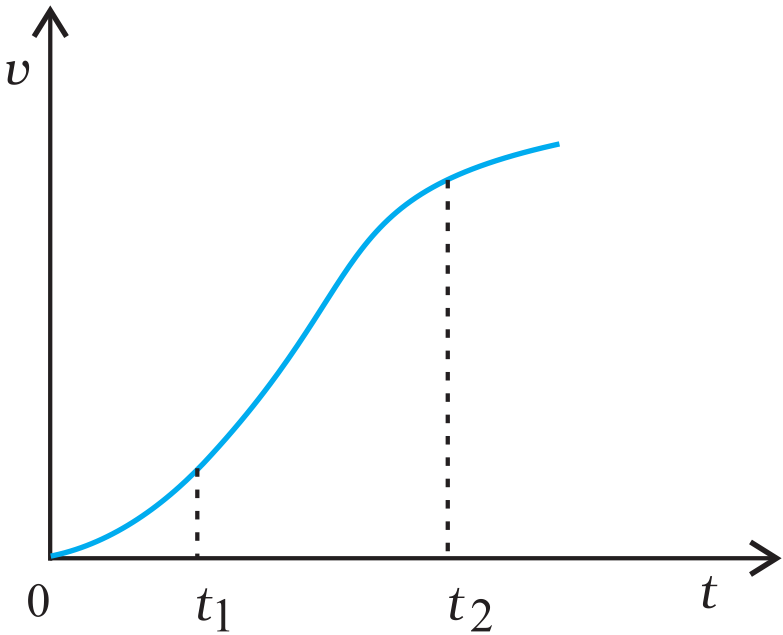
 The velocity-time graph of a particle in one-dimensional motion is shown in:

Which of the following formulae are correct for describing the motion of the particle over the time-interval t1 to t2:

  1. x(t2) = x(t1) + v(t1) (t2 – t1) + (1/2) a(t2 – t1)2

  2. v(t2) = v(t1) + a(t2 – t1)

  3. vaverage = (x(t2) –x(t1))/(t2 – t1)

  4. aaverage = (v(t2) –v(t1))/(t2 – t1)

  5. x(t2) = x(t1) + vaverage (t2 – t1) + (1/2) aaverage (t2 – t1)2

  6. x(t2) – x(t1) = area under the v-t curve bounded by the t-axis and the dotted line shown. 
View full solution
Q 263 Marks Question3 Marks
Explain clearly, with examples, the distinction between:
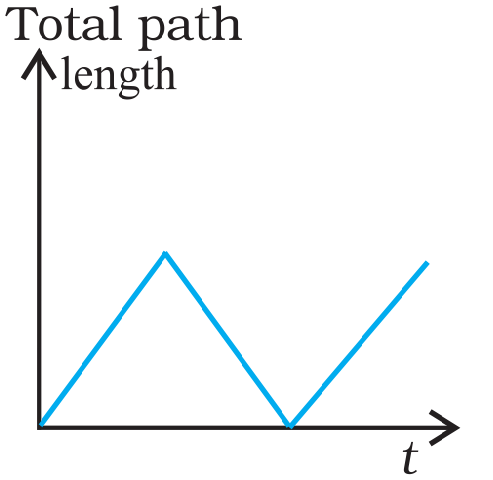
Magnitude of average velocity over an interval of time, and the average speed over the same interval. [Average speed of a particle over an interval of time is defined as the total path length divided by the time interval]. Show in both (a) and (b) that the second quantity is either greater than or equal to the first. When is the equality sign true? [For simplicity, consider one-dimensional motion only]
View full solution
Q 283 Marks Question3 Marks
A player throws a ball upwards with an initial speed of 29.4m s–1.
Choose the x = 0m and t = 0s to be the location and time of the ball at its highest point, vertically downward direction to be the positive direction of x-axis, and give the signs of position, velocity and acceleration of the ball during its upward, and downward motion.
View full solution
Q 293 Marks Question3 Marks
A jet airplane travelling at the speed of 500 km h–1 ejects its products of combustion at the speed of 1500km h–1 relative to the jet plane. What is the speed of the latter with respect to an observer on the ground?
View full solution
Q 304 Marks Question4 Marks
When an object is in motion, its position changes with time. So, the quantity that describes how fast is the position changingm w.r.t. time and in what direction is given by average velocity. It is defined as the change in position or displacement $(\triangle\text{x})$ divided by the time interval $(\triangle\text{t})$ in which that displacement occur. However, the quantity used to describe the rate of motion over the actual path, is average speed. It defined as the total distance travelled by the object divided by the total time taken.

  1. A 250m long train is moving with a uniform velocity of 45kmh-1. The time taken by the train to cross a bridge of length 750m is:
  1. 56s
  2. 68s
  3. 80s
  4. 92s
  1. A truck requires 3hr to complete a journey of 150km. What is average speed?
  1. 50km/h
  2. 25km/h
  3. 15km/h
  4. 10km/h
  1. Average speed of a car between points A and B is 20m/s, between B andC is 15m/s and between C and D is 10m/s. What is the average speed between A and D, if the time taken in the mentioned sections is 20s, 10s and 5s, respectively?
  1. 17.14m/s
  2. 15m/s
  3. 10m/s
  4. 45m/s
  1. A cyclist is moving on a circular track of radius 40m completes half a revolution in 40s. Its average velocity is:
  1. $\text{Zero}$

  2. $2\text{ms}^{-1}$

  3. $4\pi\text{ms}^{-1}$

  4. $8\pi\text{ms}^{-1}$

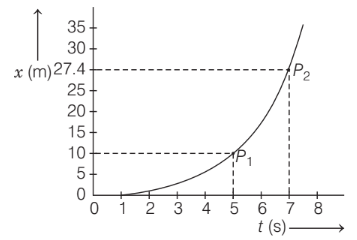
  1. In the following graph, average velocity is geometrically represented by:

  1. Length of the line P1 P2.
  2. Slope of the straight line P1 P2.
  3. Slope of the tangent to the curve at P1.
  4. Slope of the tangent to the curve at P2.
View full solution
Q 314 Marks Question4 Marks
Read the passage given below and answer the following questions from 1 to 5.
When an object moves along a straight line with uniform acceleration, it is possible to relate its velocity, acceleration during motion and the distance covered by it in a certain time interval by a set of equations known as the equations of motion. For convenience, a set of three such equations are given below:
v = u + at
$\text{s}=\text{ut}+\frac{1}{2}\text{at}^2$
 2a s = v2 – u2
Where u is the initial velocity of the object which moves with uniform acceleration a for Time t, v is the final velocity and s is the distance travelled by the object in time.
  1. equation of motions are applicable to motion with
  1. uniform acceleration
  2. non uniform acceleration
  3. constant velocity
  4. none of these
  1. There are 4 equation of motion. True or false?
  1. True
  2. False
  1. The brakes applied to a car produce an acceleration of 10 m/s2 in the opposite direction to the motion. If the car takes 1 s to stop after the application of brakes, calculate the distance traveled during this time by car.
  1. An object is dropped from a tower falls with a constant acceleration of 10 m/s2. Find its speed 10 s after it was dropped.
  1. A bullet hits a Sand box with a velocity of 10 m/s and penetrates it up to a distance of 5 cm. Find the deceleration of the bullet in the sand box
View full solution
Q 324 Marks Question4 Marks
Read the passage given below and answer the following questions from i to v.
If an object moving along the straight line covers equal distances in equal intervals of time, it is said to be in uniform motion along a straight line. Distance and displacement are two quantities that seem to mean the same but are different with different meanings and definitions. Distance is the measure of actual path length travelled by object. It is scalar quantity having SI unit of metre while displacement refers to the shortest distance between initial and final position of object. It is vector quantity. The magnitude of the displacement for a course of motion may be zero but the corresponding path length is not zero. using this data answer following questions.
  1. Can path length be zero for motion of body from one point to other point?
  1. Yes
  2. No
  1. For any given motion from point A to B, displacement =10m and distance = 5m. Is it possible?
  1. Yes
  2. No
  1. For rectilinear motion displacement can be
  1. Positive only
  2. Negative only
  3. Can be zero
  4. All of the above
  1. Define distance and displacement of particle.
  1. Write difference between distance and displacement.
View full solution
Q 334 Marks Question4 Marks
Read the passage given below and answer the following questions from 1 to 5.
The average velocity tells us how fast an object has been moving over a given time interval but does not tell us how fast it moves at different instants of time during that interval. For this, we define instantaneous velocity or simply velocity v at an instant t. The velocity at an instant is defined as the limit of the average velocity as the time interval Dt becomes infinitesimally small. In other words.
$\text{V}=\lim_{\text{dt}-0}\frac{\text{dx}}{\text{dt}}$
$\text{v}=\frac{\text{dx}}{\text{dt}}$
The variation in velocity with time for an object moving in a straight line can be represented by a velocity-time graph. In this graph, time is represented along the x-axis and the velocity is represented along the y-axis. We know that the product of velocity and time give displacement of an object moving with uniform velocity. The area enclosed by velocity-time graph and the time axis will be equal to the magnitude of the displacement and slope of velocity time graph represents acceleration of object.
The variation in distance with time for an object moving in a straight line can be represented by a position-time graph. In this graph, time is represented along the x-axis and the displacement is represented along the y-axis. Answer the following questions based on paragraph given.
  1. The area under velocity time graph gives:
  1. Displacement over given time interval
  2. Acceleration
  3. Velocity
  4. None of these
  1. Slope of velocity time graph gives
  1. Acceleration
  2. Velocity
  3. Distance
  4. Displacement.
  1. Write note on velocity time graph.
  1. Write a note on position time graph
  1. What is instantaneous velocity ?
View full solution
Q 344 Marks Question4 Marks
Read the passage given below and answer the following questions from 1 to 5.
When an object is in motion, its position changes with time. But how fast is the position changing with time and in what direction? To describe this, we define the quantity average velocity. Average velocity is defined as the change in position or displacement (x) divided by the time intervals (t), in which the displacement occurs:
$\text{V}=\frac{\text{x2}-\text{x1}}{\text{t2}-\text{t1}}=\frac{\triangle\text{x}}{\triangle\text{t}}$
Where x2 and x1 are the positions of the object at time t2and t1, respectively. The SI unit for velocity is m/s or m s–1, although km h–1 is used in many everyday applications. Like displacement, average velocity is also a vector quantity. Average speed is defined as the total path length travelled divided by the total time interval during which the motion has taken place:
Average speed = Total path length/ Total time interval.
Average speed has obviously the same unit (m s–1) as that of velocity. But it does not tell us in what direction an object is moving. Thus, it is always positive (in contrast to the average velocity which can be positive or negative). If the motion of an object is along a straight line and in the same direction, the magnitude of displacement is equal to the total path length.
The velocity at an instant is defined as the limit of the average velocity as the time interval Dt becomes infinitesimally small. In other words
$\text{V}=\lim_{\text{dt}-0}\frac{\text{dx}}{\text{dt}}$
$\text{V}=\frac{\text{dx}}{\text{dt}}$
Note that for uniform motion, velocity is the same as the average velocity at all instants. Instantaneous acceleration is defined in the same way as the instantaneous velocity
$\text{A}=\lim_{\text{dt}-0}\frac{\text{dv}}{\text{dt}}$
$\text{A}=\frac{\text{dv}}{\text{dt}}$
  1. For uniform motion instantaneous velocity is same as:
  1. Average velocity
  2. Average acceleration
  3. Instantaneous speed
  4. None of these
  1. If velocity is constant then
  1. Acceleration is zero
  2. Acceleration is positive
  3. Acceleration is negative
  4. None of these
  1. Define average speed
  1. Define instantaneous acceleration
  1. Define average velocity
View full solution
Read statement below carefully and state with reasons and examples, if it is true or false;
A particle in one-dimensional motion.
With positive value of acceleration must be speeding up.
View full solution
Gives the x-t plot of a particle executing one-dimensional simple harmonic motion. (You will learn about this motion in more detail in Chapter 14). Give the signs of position, velocity and acceleration variables of the particle at t = 0.3 s, 1.2 s, – 1.2 s.

View full solution
A car moving along a straight highway with speed of 126km h–1 is brought to a stop within a distance of 200m. What is the retardation of the car (assumed uniform), and how long does it take for the car to stop?
View full solution
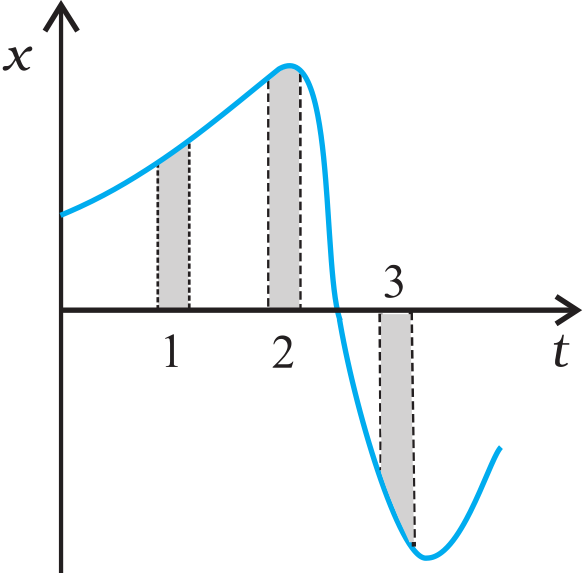
Gives the x-t plot of a particle in one-dimensional motion. Three different equal intervals of time are shown. In which interval is the average speed greatest, and in which is it the least? Give the sign of average velocity for each interval.

View full solution
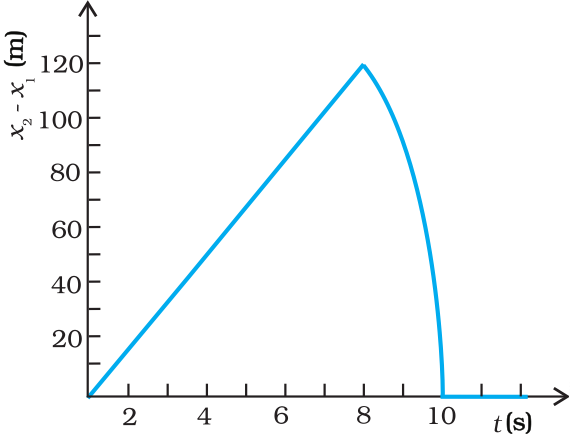
Two stones are thrown up simultaneously from the edge of a cliff 200m high with initial speeds of 15m s–1 and 30m s–1. Verify that the graph shown in correctly represents the time variation of the relative position of the second stone with respect to the first. Neglect air resistance and assume that the stones do not rebound after hitting the ground. Take g = 10m s–2. Give the equations for the linear and curved parts of the plot.

View full solution

Generate a Motion in a Straight Line paper free

Pick question groups from the list above, set marks and difficulty, and export a branded PDF with step-by-step answer keys. First 3 chapters free — no signup.

Download App