MCQ
A bomb explodes at time $t=0$ in a uniform, isotropic medium of density $\rho$ and releases energy $E$, generating a spherical blast wave. The radius $R$ of this blast wave varies with time $t$ as
  • A
    $t$
  • $t^{2 / 5}$
  • C
    $t^{1 / 4}$
  • D
    $t^{3 / 2}$

Answer

Correct option: B.
$t^{2 / 5}$
b
$(b)$ Velocity of propagation of blast wave is $\quad v=\sqrt{\frac{\gamma p}{\rho}} \quad \dots(i)$

$\gamma=\frac{C_{p}}{C_{V}}$, where $p=$ pressure

and $\rho=$ density.

As, $\quad p=\frac{n R T}{V}=\frac{n R T}{\frac{4}{3} \pi r^{3}}$

and $\quad v=\frac{d r}{d t}$

So, by Eq. $(i)$, we have

$\frac{d r}{d t}=\sqrt{\frac{\gamma n R T}{\frac{4}{3} \pi r^{3} \cdot \rho}}$

$\Rightarrow \quad \frac{d r}{d t} =k \cdot r^{-3 / 2}$

$\Rightarrow \quad k d t=r^{3 / 2} d r$

Integrating above equation, we get

$\Rightarrow k \int d t =\int r^{3 / 2} d r$

$\Rightarrow k t =\frac{2}{5} r^{5 / 2}$

So, $\quad r \propto t^{\frac{2}{5}}$

Need a full question paper?

Generate a complete, print-ready paper with questions like this in minutes — across 16+ boards, with answer keys.
Start Generating Free

Similar questions

The equation of motion of a particle is $\text{x = a}\cos(\text{at})^2.$ The motion is:
A boat takes two hours to travel $8 \,km$ and back in still water. If the velocity of water is $4\, km/h$, the time taken for going upstream $8 \,km$ and coming back is
The displacement of a particle varies according to the relation $x = 3 \sin 100 \, t + 8 \cos ^2 50\,t $. Which of the following is/are correct about this motion .
The posttion of an object moving along $x$ -axis ts given by $x=a+b t^{2}$ where $a=8.5\; \mathrm{m}, b=2.5 \;\mathrm{m} \mathrm{s}^{-2}$ and $t$ is measured in seconds. What is the velocity at $t=0\;s$ and $t=2.0 \;s$?
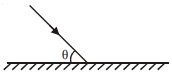
A ball of mass $m$ moving with speed $u$ collides with a smooth horizontal surface at angle $\theta$ with it as shown in figure. The magnitude of impulse imparted to surface by ball is [Coefficient of restitution of collision is $e$]
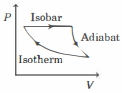
The efficiency of the cycle shown below in the figure (consisting of one isobar, one adiabat and one isotherm) is $50 \%$. The ratio $x$, between the highest and lowest temperatures attained in this cycle obeys (the working substance is an ideal gas)
The ranges and heights for two projectiles projected with the same initial velocity at angles $42^{\circ}$ and $48^{\circ}$ with the horizontal are ${R}_{1}, {R}_{2}$ and ${H}_{1}$, ${H}_{2}$ respectively. Choose the correct option:
An inflated rubber balloon contains one mole of an ideal gas, has a pressure P. volume V and temperature T. If the temperature rises to 1.1 T, and the volume is increased to 1.05V, the final pressure will be:
The mass per unit length of a uniform wire is $0.135\, g / cm$. A transverse wave of the form $y =-0.21 \sin ( x +30 t )$ is produced in it, where $x$ is in meter and $t$ is in second. Then, the expected value of tension in the wire is $x \times 10^{-2} N$. Value of $x$ is . (Round-off to the nearest integer)
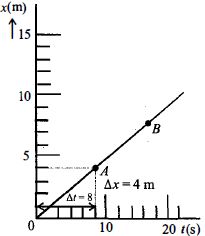
The graph of an object's motion (along the $x-$ axis) is shown in the figure. The instantaneous velocity of the object at points $A$ and $B$ are $v_A$ and $v_B$ respectively. Then