MCQ
A bomb is projected with $200\,m/s$ at an angle $60^o$ with horizontal. At the highest  point, it explodes into three particles of equal masses. One goes vertically upward with  velocity $100\,m/sec$, second particle goes vertically downward with the same velocity as  the first. Then what is the velocity of the third one-
  • A
    $120\, m/sec$ with $60^o$ angle
  • B
    $200 \,m/sec$ with $30^o$ angle
  • C
    $50\, m/sec$, in horizontal direction
  • $300\, m/sec$, in horizontal direction
Answer

Correct option: D.
$300\, m/sec$, in horizontal direction
d
By $COLM$ in $Hz$ $dir^n$

$\mathrm{m}(100)=\frac{\mathrm{m}}{3} \mathrm{v}^{\prime}$

$\mathrm{V}^{\prime}=300 \mathrm{m} / \mathrm{sin} \mathrm{Hz} \mathrm{dir}^{\mathrm{n}}$

Need a full question paper?

Generate a complete, print-ready paper with questions like this in minutes — across 16+ boards, with answer keys.

Start Generating Free

Similar questions

If the length of the second's hand in a stop clock is $3 \,cm$ the angular velocity and linear velocity of the tip is
$Assertion$ : The earth without atmosphere would be inhospitably cold.
$Reason$ : All heat would escape in the absence of atmosphere.
Experimentally it is found that $12.8\,eV$ energy is required to separate a hydrogen atom into a proton and an electron. So the orbital radius of the electron in a hydrogen atom is $\frac{9}{ x } \times 10^{-10}\,m$. The value of the $x$ is $\left(1\,eV =1.6 \times 10^{-19}\,J , \frac{1}{4 \pi \epsilon_0}=9 \times 10^9\,Nm ^2 / C ^2\right.$ and electronic charge $=1.6 \times 10^{-19}\,J\,C$ )
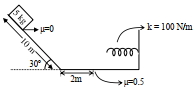
A block is simply released from the top of an inclined plane as shown in the figure above. The maximum compression in the spring when the block hits the spring is :
Assume that a drop of liquid evaporates by decrease in its surface energy, so that its temperature remains unchanged. What should be the minimum radius of the drop for this to be possible? The surface tension is $T$, density of liquid is $\rho$ and $L$ is its latent heat of vaporization.
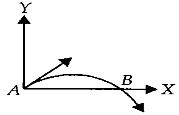
The velocity of projectile at the intial point $A$ is $\left( {2\hat i + 3\hat j} \right)$ $m/s $ . It's velocity $($in $m/s)$ at point $B$ is
A double convex lens has two surfaces of equal radii $15 cm$ and refractive index $\mu=1.5$, its focal length is equal to ..... $cm$
Consider a force $\overrightarrow{\mathrm{F}}=-\mathrm{x} \hat{\mathrm{i}}+\mathrm{y} \hat{\mathrm{j}}$. The work done by this force in moving a particle from point $\mathrm{A}(1,0)$ to $\mathrm{B}(0,1)$ along the line segment is 

(all quantities are in $SI$ units)

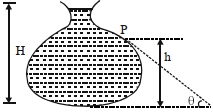
Figure here shows the vertical cross section of a vessel filled with a liquid of density $\rho$. The normal thrust per unit area on the walls of the vessel at the point $P$, as shown, will be
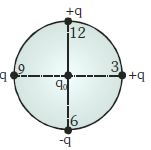
Four charges are placed at the circumference of the dial of a clock as shown in figure. If the clock has only hour hand, then the resultant force on a positive charge $q_0$ placed at the centre, points in the direction which shows the time as