MCQ
$Assertion$ : The earth without atmosphere would be inhospitably cold.
$Reason$ : All heat would escape in the absence of atmosphere.
  • A
    If both Assertion and Reason are correct and the Reason is a correct explanation of the Assertion.
  • If both Assertion and Reason are correct but Reason is not a correct explanation of the Assertion.
  • C
    If the Assertion is correct but Reason is incorrect.
  • D
    If both the Assertion and Reason are incorrect.
Answer

Correct option: B.
If both Assertion and Reason are correct but Reason is not a correct explanation of the Assertion.
b
In the absence of atmosphere, all the heat will escape from earth’s surface which will make earth in hospitably cold.

Need a full question paper?

Generate a complete, print-ready paper with questions like this in minutes — across 16+ boards, with answer keys.

Start Generating Free

Similar questions

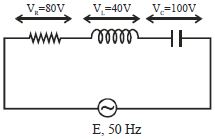
The value of alternating emf $E$ in the given circuit will be......$V$
$A$ copper rod $AB$ of length $L$, pivoted at one end $A$, rotates at constant angular velocity $\omega$ , at right angles to $a$ uniform magnetic field of induction $B$. The $e.m.f$ developed between the mid point $C$ of the rod and end $B$ is
The energy of a particle executing simple harmonic motion is given by $E = Ax^2 + Bv^2$, where $x$ is the displacement from mean position $x = 0$ and $v$ is the velocity of the particle at $x$ then choose the incorrect statement
Find out the work done (in $ \times 10^{-3}\;J$) to expand the soap bubble to radius $R =5\, cm$ (Surface tension of water $=0.1\; N / m )$ 
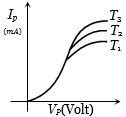
For the diode, the characteristic curves are given at different temperature. The relation between the temperatures is
A copper wire $(Y = 1 \times 10^{11}\, N/m^2)$ of length $6\, m$ and a steel wire $(Y = 2 \times 10^{11}\, N/m^2)$ of length $4\, m$ each of cross section $10^{-5}\, m^2$ are fastened end to end and stretched by a tension of $100\, N$. The elongation produced in the copper wire is ......... $mm$
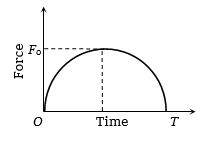
A particle of mass $m$, initially at rest, is acted upon by a variable force $F$ for a brief interval of time $T$. It begins to move with a velocity $u$ after the force stops acting. $F$ is shown in the graph as a function of time. The curve is a semicircle.
A sample contains mixture of helium and oxygen gas. The ratio of root mean square speed of helium and oxygen in the sample, is $:$
A Carnot engine absorbs an amount $Q$ of heat from a reservoir at an abosolute temperature $T$ and rejects heat to a sink at a temperature of $T/3.$ The amount of heat rejected is
Which of the following statements are true regarding Bohr’s model of hydrogen atom ? 
$(I)$ Orbiting speed of electron decreases as it shifts to discrete orbits away from the nucleus
$(II)$ Radii of allowed orbits of electron are proportional to the principal quantum number
$(III)$ Frequency with which electrons orbit around the nucleus in discrete orbits is inversely proportional to the cube of principal quantum number
$(IV)$ Binding force with which the electron is bound to the nucleus increases as it shifts to outer orbits
Select correct answer using the codes given below. Codes