MCQ
A boy’s catapult is made of rubber cord which is $42\, cm$ long, with $6\, mm$ diameter of cross -section and of negligible mass. The boy keeps a stone weighing $0.02\, kg$ on it and stretches the cord by $20\, cm$ by applying a constant force. When released, the stone flies off with a velocity of $20\, ms^{-1}$. Neglect the change in the area of cross section of the cord while stretched. The Young’s modulus of rubber is closest to
  • A
    $10^3\, Nm^{-2}$
  • $10^6\, Nm^{-2}$
  • C
    $10^8\, Nm^{-2}$
  • D
    $10^4\, Nm^{-2}$

Answer

Correct option: B.
$10^6\, Nm^{-2}$
b
$Energy\,of\,catapult = \frac{1}{2} \times {\left( {\frac{{\Delta \ell }}{\ell }} \right)^2} \times Y \times A \times \ell $

$ = Kinetic\,energy\,of\,the\,ball = \frac{1}{2}\,m{V^2}$

$Therefore,\frac{1}{2} \times {\left( {\frac{{20}}{{42}}} \right)^2} \times Y \times \pi  \times {3^2} \times {10^{ - 6}} \times 42 \times {10^{ - 2}}$

$ = \frac{1}{2} \times 2 \times {10^{ - 2}} \times {\left( {20} \right)^2}$

$Y = 3 \times {10^{6\,}}\,N{m^2}$

Need a full question paper?

Generate a complete, print-ready paper with questions like this in minutes — across 16+ boards, with answer keys.

Start Generating Free

Similar questions

A metallic rod $1\,cm$ long with a square cross-section is heated through $1^o C$. If Young’s modulus of elasticity of the metal is $E$ and the mean coefficient of linear expansion is $\alpha$ per degree Celsius, then the compressional force required to prevent the rod from expanding along its length is :(Neglect the change of cross-sectional area)
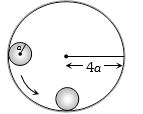
A ring of radius $4a$ is rigidly fixed in vertical position on a table. A small disc of mass $m$ and radius $a$ is released as shown in the fig. When the disc rolls down, without slipping, to the lowest point of the ring, then its speed will be
A particle of mass $1 kg$ is subjected to a force which depends on the position as $\vec{F}=-k(x \hat{i}+y \hat{j}) kgms ^{-2}$ with $k=1 kgs ^{-2}$. At time $t=0$, the particle's position $\vec{r}=\left(\frac{1}{\sqrt{2}} \hat{i}+\sqrt{2} \hat{j}\right) m$ and its velocity $\vec{v}=\left(-\sqrt{2} \hat{i}+\sqrt{2} \hat{j}+\frac{2}{\pi} \hat{k}\right) m s^{-1}$. Let $v_x$ and $v_y$ denote the $x$ and the $y$ components of the particle's velocity, respectively. Ignore gravity. When $z=0.5 m$, the value of $\left(x v_y-y v_x\right)$ is. . . . . $m^2 s^{-1}$
If the gravitational field in the space is given as $\left(-\frac{ K }{ r ^2}\right)$. Taking the reference point to be at $r =2\,cm$ with gravitational potential $V =10\,J / kg$. Find the gravitational potential at $r =3\,cm$ in $SI$ unit (Given, that $K =6\,J cm / kg$ )
A car travelling at a speed of $30\, km/hour$  is brought to a halt in $8\, m$ by applying brakes. If the same car is travelling at $60 \,km/hour$, it can be brought to a halt with the same braking force in ............... $\mathrm{m}$
A tachometer is a device to measure
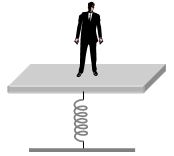
A man weighing $60\, kg$ stands on the horizontal platform of a spring balance. The platform starts executing simple harmonic motion of amplitude $0.1\, m$ and frequency $\frac{2}{\pi }Hz$. Which of the following statement is correct
Consider two rods of same length and different specific heats $\left(S_{1}, S_{2}\right)$, conductivities $\left(K_{1}, K_{2}\right)$ and area of cross-sections $\left(A_{1}, A_{2}\right)$ and both having temperatures $T_{1}$ and $T_{2}$ at their ends. If rate of loss of heat due to conduction is equal, then
A frictionless heat engine can be $100 \%$ efficient only if its exhaust temperature is ............
Dimension formula of $\text{AQ}$, heat supplied to the system is: