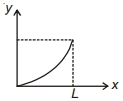
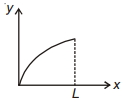
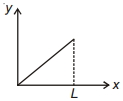
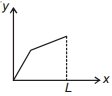
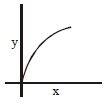
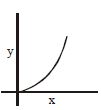
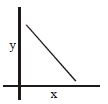
MCQ 11 Mark
The maximum elongation of a steel wire of $1 \mathrm{~m}$ length if the elastic limit of steel and its Young's modulus, respectively, are $8 \times 10^8 \mathrm{~N} \mathrm{~m}^{-2}$ and $2 \times 10^{11} \mathrm{~N} \mathrm{~m}^{-2}$, is:
- A
$0.4 \mathrm{~mm}$
- B
$40 \mathrm{~mm}$
- C
$8 \mathrm{~mm}$
- ✓
$4 \mathrm{~mm}$
AnswerCorrect option: D. $4 \mathrm{~mm}$
d
In the case for maximum elongation,
Stress $=$ Elastic limit
$\delta_{\text {max }}=\frac{\sigma_{\text {elastlc }} \times L}{\text { Young's modulus }}=\frac{8 \times 10^8 \times 1}{2 \times 10^{11}} =4 \times 10^{-3}$
$=4 \mathrm{~mm}$
i.e. maximum elongation is $4 \mathrm{~mm}$
View full question & answer→MCQ 21 Mark
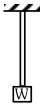
Let a wire be suspended from the ceiling (rigid support) and stretched by a weight $W$ attached at its free end. The longitudinal stress at any point of cross-sectional area $A$ of the wire is :
- A
- B
$2 W / A$
- ✓
$W / A$
- D
$W / 2 A$
AnswerCorrect option: C. $W / A$
c
Stress $=\frac{ IRF }{ A }$
Stress $=\frac{ W }{ A }$
(Here $A$ Cross-sectional Area)
View full question & answer→MCQ 31 Mark
Given below are two statements: One is labelled as Assertion $(A)$ and the other is labelled as Reason $(R)$.
Assertion $(A)$:The stretching of a spring is determined by the shear modulus of the material of the spring.
Reason $(R)$:A coil spring of copper has more tensile strength than a steel spring of same dimensions.
In the light of the above statements, choose the most appropriate answer from the options given below:
- A
Both $(A)$ and $(R)$ are true and $(R)$ is not the correct explanation of $(A)$
- ✓
$(A)$ is true but $(R)$ is false
- C
$(A)$ is false but $(R)$ is true
- D
Both $(A)$ and $(R)$ are true and $(R)$ is the correct explanation of $(A)$
AnswerCorrect option: B. $(A)$ is true but $(R)$ is false
b
In stretching of a spring shape charges therefore shear modulus is used.
$Y _{\text {copper }}< Y _{\text {stoel }}$
View full question & answer→MCQ 41 Mark
A wire of length $L,$ area of cross section $A$ is hanging from a fixed support. The length of the wire changes to $L_{1}$ when mass $M$ is suspended from its free end. The expression for Young's modulus is
AnswerCorrect option: A. $\frac{ MgL }{ A \left( L _{1}- L \right)}$
a
$Y=\frac{F L }{A \Delta L}=\frac{M g L}{A\left(L_{1}-L\right)}$
View full question & answer→MCQ 51 Mark
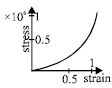
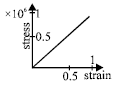
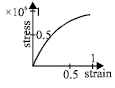
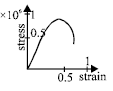
The stress-strain curves are drawn for two different materials $X$ and $Y$. It is observed that the ultimate strength point and the fracture point are close to each other for material $X$ but are far apart for material $Y$. We can say that materials $X$ and $Y$ are likely to be (respectively)
View full question & answer→MCQ 61 Mark
When a block of mass $M$ is suspended by a long wire of length $L$, the length of the wire become $(L+l) .$ The elastic potential energy stoped in the extended wire is :
AnswerCorrect option: C. $\frac{1}{2} Mgl$
c
$\mathrm{U}=\frac{1}{2}$ (force) (elongation)
$=\frac{1}{2}(M g) \ell=\frac{1}{2} M g \ell$
View full question & answer→MCQ 71 Mark
Two wires are made of the same material and have the same volume. The first wire has cross-sectional area $A$ and the second wire has cross-sectional area $3A$. If the length of the first wire is increased by $\Delta l$ on applying a force $F$, how much force is needed to stretch the second wire by the same amount?
Answera
$Young's\,modulus,\,Y = \frac{{Fl}}{{A\Delta l}}$
Since initial volume of wires are same
$\therefore $ Their areas of cross sections are $A$ and $3A$ and lengths are $3l$ and $l$ respectively.
For Wire $1,$
$\Delta l = \left( {\frac{F}{{AY}}} \right)3l\,$ $...(i)$
For wire $2$, let $F'$ force is applied
$\frac{{F'}}{{3A}} = Y\frac{{\Delta l}}{l}$
$ \Rightarrow \Delta l = \left( {\frac{{F'}}{{3AY}}} \right)l$
From eqns $(i)$ and $(ii),$
$\left( {\frac{F}{{AY}}} \right)3l = \left( {\frac{{F'}}{{3AY}}} \right)l \Rightarrow F' = 9F$
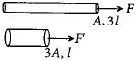
View full question & answer→MCQ 81 Mark
The density of a metal at normal pressure is $\rho$. Its density when it is subjected to an excess pressure $p$ is $\rho^{\prime}$ If $B$ is Bulk modulus of the metal, the ratio of $\frac{{\rho '}}{\rho }$ is
AnswerCorrect option: A. $\frac{1}{{1 - \frac{p}{B}}}$
a
$B =- V \frac{ dP }{ dV }$
Thus, $\Delta V =-\frac{ pV }{ B }$ or $V ^{\prime}- V =-\frac{ pV }{ B }$ Or, $V^{\prime}=V\left(1-\frac{p}{B}\right)$
Now, $\rho^{\prime}=\frac{ m }{ V ^{\prime}}=\frac{ m }{ V \left(1-\frac{ P }{ B }\right)}=\frac{\rho}{\left(1-\frac{ p }{ B }\right)}$
$\frac{\rho^{\prime}}{\rho}=\frac{1}{\left(1-\frac{ p }{ B }\right)}$
View full question & answer→MCQ 91 Mark
The bulk modulus of a spherical object is '$B$'. If it is subjected to uniform pressure '$P$', the fractional decrease in radius is
- A
$\frac{{3P}}{B}$
- ✓
$\;\frac{P}{{3B}}$
- C
$\;\frac{P}{B}$
- D
$\frac{B}{{3P}}$
AnswerCorrect option: B. $\;\frac{P}{{3B}}$
b
Bulk modulus $B$ is given as
$B = \frac{{ - pV}}{{\Delta V}}$ $...(i)$
The volume of a spherical object of radius $r$ is given as
$V = \frac{4}{3}\pi {r^3}\,\,,\,\,\Delta V = \frac{4}{3}\pi \left( {3{r^2}} \right)\Delta r$
$\therefore - \frac{V}{{\Delta V}} = \frac{{\frac{4}{3}\pi {r^3}}}{{\frac{4}{3}\pi 3{r^2}\Delta r}}\,\,or\,\, - \frac{V}{{\Delta V}} = - \frac{r}{{3\Delta r}}$
Put this value in eqn. $(i)$, we get
$B = - \frac{{pr}}{{3\Delta r}}$
Fractional decrease in radius is
$ - \frac{{\Delta r}}{r} = \frac{p}{{3B}}$
View full question & answer→MCQ 101 Mark
A bob of mass $10\, kg$ is attached to wire $0.3\, m$ long. Its breaking stress is $4.8 \times 10^7 N/m^2$. The area of cross section of the wire is $10^{-6} m^2$. The maximum angular velocity with which it can be rotated in a horizontal circle ....... $rad/sec$
Answerb
(b) Centripetal force $=$ breaking force
$⇒\ m{\omega ^2}r = $ breaking stress $\times$ cross sectional area
$⇒\ m{\omega ^2}r = p \times A$
$⇒\ \omega = \sqrt {\frac{{p \times A}}{{mr}}} = \sqrt {\frac{{4.8 \times {{10}^7} \times {{10}^{ - 6}}}}{{10 \times 0.3}}} $
$\omega = 4\,rad/\sec $
View full question & answer→MCQ 111 Mark
$A$ and $B$ are two wires. The radius of $A$ is twice that of $B.$ They are stretched by the some load. Then the stress on $B$ is
- A
Equal to that on $A$
- ✓
Four times that on $A$
- C
Two times that on $A$
- D
Half that on $A$
AnswerCorrect option: B. Four times that on $A$
b
(b) ${\rm{Stress}} = \frac{{{\rm{force}}}}{{{\rm{Area}}}}$
$\therefore$ ${\rm{Stress}} \propto \frac{{\rm{1}}}{{\pi {{\rm{r}}^{\rm{2}}}}}$
$\frac{{{S_B}}}{{{S_A}}} = {\left( {\frac{{{r_A}}}{{{r_B}}}} \right)^2} = {(2)^2} \Rightarrow {S_B} = 4{S_A}$
View full question & answer→MCQ 121 Mark
Two wires of equal lengths are made of the same material. Wire $A$ has a diameter that is twice as that of wire $B$. If identical weights are suspended from the ends of these wires, the increase in length is
- A
Four times for wire $A$ as for wire $B$
- B
Twice for wire $A$ as for wire $B$
- C
Half for wire $A$ as for wire $B$
- ✓
One-fourth for wire $A$ as for wire $B$
AnswerCorrect option: D. One-fourth for wire $A$ as for wire $B$
d
(d) $l = \frac{{FL}}{{AY}}$ $⇒$ $l \propto \frac{1}{{{r^2}}}$ $(F,L$ and $Y$ are same$)$
$\frac{{{l_A}}}{{{l_B}}} = {\left( {\frac{{{r_B}}}{{{r_A}}}} \right)^2}$
$\frac{{{l_A}}}{{{l_B}}} = {\left( {\frac{{{r_B}}}{{2{r_B}}}} \right)^2} = \frac{1}{4}$
$⇒$ ${l_B} = 4{l_A}$
View full question & answer→MCQ 131 Mark
Two wires of copper having the length in the ratio $4 : 1$ and their radii ratio as $1 : 4$ are stretched by the same force. The ratio of longitudinal strain in the two will be
- A
$1:16$
- ✓
$16:1$
- C
$1:64$
- D
$64:1$
AnswerCorrect option: B. $16:1$
b
(b) ${\rm{strain}} \propto {\rm{stress}} \propto \frac{{\rm{F}}}{{\rm{A}}}$
Ratio of strain =$\frac{{{A_2}}}{{{A_1}}} = {\left( {\frac{{{r_2}}}{{{r_1}}}} \right)^2} = {\left( {\frac{4}{1}} \right)^2} = \frac{{16}}{1}$
View full question & answer→MCQ 141 Mark
Which one of the following substances possesses the highest elasticity
Answera
Modulus of elasticity gives the idea of elasticity. For above materials, values of
E are:
Glass: $50 - 90\,GPa$
Rubber:$0.01 - 0.1\,GPa$
Steel:$200\,GPa$
Copper: $117\,GPa$
View full question & answer→MCQ 151 Mark
A substance breaks down by a stress of $10^6 N/m^2$. If the density of the material of the wire is $3×10^3 kg/m^3$, then the length of the wire of the substance which will break under its own weight when suspended vertically, is ......... $m$
- A
$66.6 $
- B
$60$
- ✓
$33.3 $
- D
$30$
AnswerCorrect option: C. $33.3 $
c
(c) $L = \frac{p}{{dg}} = \frac{{{{10}^6}}}{{3 \times {{10}^3} \times 10}} = \frac{{100}}{3} = 33.3m$
View full question & answer→MCQ 161 Mark
If the volume of the given mass of a gas is increased four times, the temperature is raised from $27°C$ to $127°C.$ The elasticity will become
- A
$4$ times
- B
$1/4$ times
- C
$3$ times
- ✓
$1/3$ times
AnswerCorrect option: D. $1/3$ times
d
(d) From the ideal gas equation $\frac{{{P_1}{V_1}}}{{{T_1}}} = \frac{{{P_2}{V_2}}}{{{T_2}}}$
$\frac{{{E_2}}}{{{E_1}}} = \frac{{{P_2}}}{{{P_1}}} = \frac{{{V_1}}}{{{V_2}}} \times \frac{{{T_2}}}{{{T_1}}} = \left( {\frac{1}{4}} \right) \times \left( {\frac{{400}}{{300}}} \right) = \frac{1}{3}$ $⇒$ ${E_2} = \frac{{{E_1}}}{3}$
i.e. elasticity will become $\frac{1}{3}$ times.
View full question & answer→MCQ 171 Mark
The upper end of a wire of radius $4\, mm$ and length $100\, cm$ is clamped and its other end is twisted through an angle of $30°$. Then angle of shear is ..... $^o$
- A
$12$
- ✓
$0.12$
- C
$1.2$
- D
$0.012$
AnswerCorrect option: B. $0.12$
b
(b) Angle of shear $\varphi = \frac{{r\theta }}{L}$$ = \frac{{4 \times {{10}^{ - 1}}}}{{100}} \times {30^o} = {0.12^o}$
View full question & answer→MCQ 181 Mark
To break a wire of one meter length, minimum $40 \,kg \,wt$. is required. Then the wire of the same material of double radius and $6 \,m$ length will require breaking weight ....... $kg \,wt$
Answerd
(d) Breaking force = Breaking stress $\times$ Area of cross
section of wire
$\therefore$ Breaking force $\propto$ $r^2$ (Breaking distance is constant)
If radius becomes doubled then breaking force will become $4$ times i.e. $40 \times 4 = 160\, kg\, wt$
View full question & answer→MCQ 191 Mark
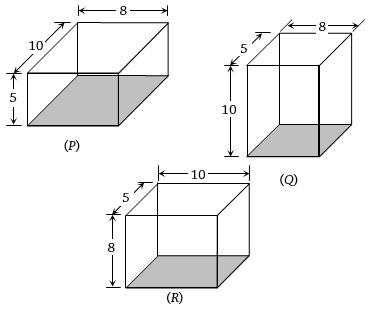
A rectangular block of size $10\,cm \times 8\,cm \times 5\,cm$ is kept in three different positions $P, Q$ and $R$ in turn as shown in the figure. In each case, the shaded area is rigidly fixed and a definite force $F$ is applied tangentially to the opposite face to deform the block. The displacement of the upper face will be
- A
Same in all the three cases
- B
Maximum in $P$ position
- C
Maximum in $Q$ position
- ✓
Maximum in $R$ position
AnswerCorrect option: D. Maximum in $R$ position
d
(d) $\eta = \frac{{F/A}}{{x/L}}$==> $x = \frac{L}{\eta } \times \frac{F}{A}$
If $\eta$ and $F$ are constant then $x \propto \frac{L}{A}$
For maximum displacement area at which force applied should be minimum and vertical side should be maximum, this is given in the $R$ position of rectangular block.
View full question & answer→MCQ 201 Mark
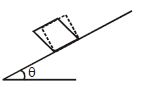
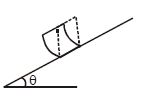
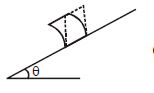
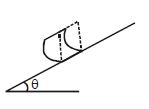
Assume that a block of very low shear modulus is fixed on an inclined plane as shown. Due to elastic forces it will deform. What will be the shape of the block ?
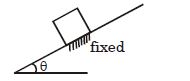
MCQ 211 Mark
When a load $W$ is hung from a wire of length $2\ L$ , it just breaks. Now this wire is completely melted and a new wire of length $L$ is formed. If the load $W$ is hung from this new wire
- A
- ✓
It will definitely not break
- C
- D
AnswerCorrect option: B. It will definitely not break
b
If length halved, area is doubled
$\Rightarrow$ Breaking stress $=\frac{\mathrm{W}}{\mathrm{A}}=\frac{\mathrm{W}^{\prime}}{2 \mathrm{A}}$
to break new wire load $W^{\prime}=2 W$
on applying $W,$ new wire will not break.
View full question & answer→MCQ 221 Mark
A wire can be broken by applying a load of $20\,\,kg$ weight. The force required to break the wire of twice the diameter is ......... $kg\,wt$
Answerc
Breaking stress $=\frac{\mathrm{F}}{\mathrm{A}}=$ constant
$\frac{\mathrm{F}_{1}}{\mathrm{A}_{1}}=\frac{\mathrm{F}_{2}}{\mathrm{A}_{2}} \Rightarrow \mathrm{F}_{2}=\frac{\mathrm{A}_{2}}{\mathrm{A}_{1}} \times \mathrm{F}_{1}=\frac{\pi \mathrm{r}_{2}^{2}}{\pi \mathrm{r}_{1}^{2}} \mathrm{F}_{1}$
$\Rightarrow \mathrm{F}_{2}=\frac{(2)^{2}}{(1)^{2}} \mathrm{F}_{1} \Rightarrow \mathrm{F}_{2}=4 \mathrm{F}_{1}=80 \mathrm{kg}-\mathrm{wt}$
View full question & answer→MCQ 231 Mark
If $\rho $ is the density of the material of a wire and $\sigma $ is breaking stress, the greatest length of the wire that can hang freely without breaking is
- A
$\frac{{2\sigma }}{{\rho g}}$
- B
$\frac{{\rho}}{{\sigma g}}$
- C
$\frac{{\rho g}}{{2\sigma }}$
- ✓
$\frac{{\sigma }}{{\rho g}}$
AnswerCorrect option: D. $\frac{{\sigma }}{{\rho g}}$
d
$\frac{F}{A}=\sigma$
$\frac{(\mathrm{A} \ell) \rho \mathrm{g}}{\mathrm{A}}=\sigma$
$\ell=\frac{\sigma}{\rho g}$
View full question & answer→MCQ 241 Mark
A wire can be broken by applying a load of $20\, kg$ weight. The force required to break the wire of twice the diameter is .......... $kg\, wt$
Answerc
$3.$ Breaking stress $=\frac{\mathrm{F}}{\mathrm{A}}=$ constant $\frac{\mathrm{F}_{1}}{\mathrm{A}_{1}}=\frac{\mathrm{F}_{2}}{\mathrm{A}_{2}} \Rightarrow \mathrm{F}_{2}=\frac{\mathrm{A}_{2}}{\mathrm{A}_{1}} \times \mathrm{F}_{1}=\frac{\pi \mathrm{r}_{2}^{2}}{\pi \mathrm{r}_{1}^{2}} \mathrm{F}_{1} \Rightarrow \mathrm{F}_{2}=\frac{(2)^{2}}{(1)^{2}} \mathrm{F}_{1}$
$\Rightarrow \mathrm{F}_{2}=4 \mathrm{F}_{1}=80 \mathrm{kg}-\mathrm{wt}$
View full question & answer→MCQ 251 Mark
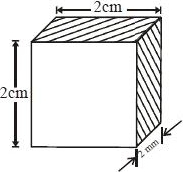
The force required to punch a square hole $2\,cm$ side in steel sheet $2\,mm$ thick is (shearing stress of steel sheet $= 3.5\times 10^8\,\,N/m^2$ )
- ✓
$5.6\times 10^4\,N$
- B
$3.4\times 10^4\,N$
- C
$9.1\times 10^4\,N$
- D
$6.8\times 10^4\,N$
AnswerCorrect option: A. $5.6\times 10^4\,N$
a
Shearing stress will be on the area of boundary of hole
Area of this surface
$=4 \times\left(2 \times 10^{-2}\right) \times\left(0.2 \times 10^{-2}\right) \mathrm{m}^{2}=1.6 \times 10^{-4} \mathrm{m}^{2}$
$S_{\min }=3.5 \times 10^{8}=\frac{\mathrm{F}}{1.6 \times 10^{-4}} \Rightarrow \mathrm{F}=5.6 \times 10^{4} \mathrm{N}$
View full question & answer→MCQ 261 Mark
The upper end of a wire of radius $4\, mm$ and length $100\, cm$ is clamped and its other end is twisted through an angle of $60^o$. Then angle of shear is .......... $^o$
- A
$12$
- B
$0.12$
- C
$1.2$
- ✓
$0.24$
AnswerCorrect option: D. $0.24$
d
Angle of shear $\phi=\frac{\mathrm{r} \theta}{\mathrm{L}}=\frac{4 \times 10^{-1}}{100} \times 60^{\circ}=0.24^{\circ}$
View full question & answer→MCQ 271 Mark
A wire can be broken by applying a load of $200\, N$. The force required to break another wire of the same length and same material, but double in diameter, is .......... $N$
Answerd
Breaking force $=$ Breaking stress $\times$ Area
$\frac{F_{1}}{F_{2}}=\left(\frac{r_{1}}{r_{2}}\right)^{2}$
$\frac{200}{\mathrm{F}_{2}}=\left(\frac{\mathrm{r}}{2 \mathrm{r}}\right)^{2} \Rightarrow \mathrm{F}_{2}=800 \mathrm{N}$
View full question & answer→MCQ 281 Mark
Due to addition of impurities, the modulus of elasticity
Answera
(a)
It depends on the elastic property of impurities if they themselves more elastic, elasticity will increase. If they are less elastic, elasticity will decrease.
View full question & answer→MCQ 291 Mark
The breaking stress of aluminium is $7.5 \times 10^7 \,Nm ^{-2}$. The greatest length of aluminium wire that can hang vertically without breaking is ......... $\times 10^3 \,m$ (Density of aluminium is $2.7 \times 10^3 \,kg m ^{-3}$ )
- A
$283$
- B
$28.3$
- ✓
$2.83$
- D
$0.283$
AnswerCorrect option: C. $2.83$
c
(c)
Breaking stress $=\rho \times g \times L$
Substitute values from the question
Breaking stress $=7.5 \times 10^7 \,Nm ^{-2}$
$\left\{\begin{array}{l}\rho=\text { Density of material } \\ g=\text { Acceleration due to gravity } \\ L=\text { Length of wire that can hang without breaking }\end{array}\right\}$
$\rho=2.7 \times 10^3 \,kg m ^{-3}$
$g=9.8 \,m / s$
$7.5 \times 10^7=2.7 \times 10^3 \times 9.8 \times L$
View full question & answer→MCQ 301 Mark
The Poisson's ratio of a material is $0.5$. If a force is applied to a wire of this material, there is a decrease in the cross-sectional area by $4 \%$. The percentage increase in the length is ........ $\%$
Answerd
(d)
$\frac{\text { Lateral strain }}{\text { Longitudinal strain }}=\eta$
$\frac{\Delta r / r}{\Delta l / I}=0.5$
Substitute $\Delta r / r=2 / 100$
$\frac{\Delta l}{l}=\frac{4}{100}$
$\therefore\% \text { increase }=\frac{\Delta l}{l} \times 100=4 \%$
$\because A \propto r^2$
So $\frac{\Delta A}{A}=\frac{2 \Delta r}{r}$
$\frac{4}{100}=2 \times \frac{\Delta r}{r}$
$\frac{2}{100}=\frac{\Delta r}{r}$
View full question & answer→MCQ 311 Mark
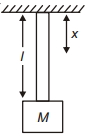
A vertical hanging bar of length $l$ and mass $m$ per unit length carries a load of mass $M$ at lower end, its upper end is clamped to a rigid support. The tensile stress a distance $x$ from support is $(A \rightarrow$ area of cross-section of bar)
- A
$\frac{M g}{A}$
- ✓
$\frac{M g+m g(I-x)}{A}$
- C
$\frac{M g+m g l}{A}$
- D
$\frac{(M+m) g x}{A l}$
AnswerCorrect option: B. $\frac{M g+m g(I-x)}{A}$
b
(b)
Tensile stress $=\frac{\text { Tension at point }}{\text { Area }}$
Tension at distance $x$ from top would be the amount of force acting due to all the weight below it
$=$ Mass per unit length of rod $\times$ length of rod $+M g$ $=m \times(I-x) g+M g$
So Tensile stress $=\frac{m(I-x) g+M g}{A}$
View full question & answer→MCQ 321 Mark
The dimensions of four wires of the same material are given below. In which wire the increase in length will be maximum when the same tension is applied
- A
Length $100 \,cm,$ Diameter $1 \,mm$
- B
Length $200\, cm,$ Diameter $2\, mm$
- C
Length $300$ $cm$, Diameter $3 \,mm$
- ✓
Length $50$ $cm,$ Diameter $0.5$ $mm$
AnswerCorrect option: D. Length $50$ $cm,$ Diameter $0.5$ $mm$
d
(d)$Y = \frac{F}{A}\;\frac{L}{A} \Rightarrow l \propto \frac{L}{A} \propto \frac{L}{{\pi {d^2}}}$
$l \propto \frac{L}{{{d^2}}}$ [As F and Y are constant]
The ratio of $\frac{L}{{{d^2}}}$is maximum for case $(d)$
View full question & answer→MCQ 331 Mark
The ratio of the lengths of two wires $A$ and $B$ of same material is $1 : 2$ and the ratio of their diameter is $2 : 1.$ They are stretched by the same force, then the ratio of increase in length will be
Answerc
(c) $l = \frac{{FL}}{{AY}} \Rightarrow l \propto \frac{L}{{{d^2}}}$==>$\frac{{{l_1}}}{{{l_2}}} = \frac{{{L_1}}}{{{L_2}}} \times {\left( {\frac{{{d_2}}}{{{d_1}}}} \right)^2}$
$ = \frac{1}{2} \times {\left( {\frac{1}{2}} \right)^2} = \frac{1}{8}$
View full question & answer→MCQ 341 Mark
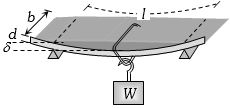
A beam of metal supported at the two ends is loaded at the centre. The depression at the centre is proportional to
- A
${Y^2}$
- B
$Y$
- ✓
$1/Y$
- D
$1/{Y^2}$
Answerc
(c) Depression in beam
$\delta = \frac{{W{L^3}}}{{4Yb{d^3}}}$
$\delta \propto \frac{1}{Y}$
View full question & answer→MCQ 351 Mark
When a certain weight is suspended from a long uniform wire, its length increases by one cm. If the same weight is suspended from another wire of the same material and length but having a diameter half of the first one then the increase in length will be ........ $cm$
Answerc
(c)$l = \frac{{FL}}{{AY}} \Rightarrow l \propto \frac{1}{{{r^2}}}$ $(F, L$ and $Y$ are constant)
$\frac{{{l_2}}}{{{l_1}}} = {\left( {\frac{{{r_1}}}{{{r_2}}}} \right)^2} = {(2)^2} = 4$
$ \Rightarrow {l_2} = 4{l_1} = 4cm$
View full question & answer→MCQ 361 Mark
The area of cross-section of a wire of length $1.1$ metre is $1$ $mm^2$. It is loaded with $1 \,kg.$ If Young's modulus of copper is $1.1 \times {10^{11}}\,N/{m^2}$, then the increase in length will be ......... $mm$ (If $g = 10\,m/{s^2})$
- A
$0.01$
- B
$0.075 $
- ✓
$0.1$
- D
$0. 15$
Answerc
(c) $l = \frac{{mgL}}{{AY}} = \frac{{1 \times 10 \times 1.1}}{{1.1 \times {{10}^{11}} \times {{10}^{ - 6}}}}m = 0.1\;mm$
View full question & answer→MCQ 371 Mark
On increasing the length by $0.5\, mm$ in a steel wire of length $2\, m$ and area of cross-section $2\,m{m^2}$, the force required is $[Y$ for steel$ = 2.2 \times {10^{11}}\,N/{m^2}]$
- A
$1.1 \times {10^5}\,N$
- B
$1.1 \times {10^4}\,N$
- C
$1.1 \times {10^3}\,N$
- ✓
$1.1 \times {10^2}\,N$
AnswerCorrect option: D. $1.1 \times {10^2}\,N$
d
(d) $F = \frac{{YAl}}{L} = \frac{{2.2 \times {{10}^{11}} \times 2 \times {{10}^{ - 6}} \times 5\, \times {{10}^{ - 4}}}}{2}$$ = 1.1 \times {10^2}N$
View full question & answer→MCQ 381 Mark
If Young's modulus of iron is $2 \times {10^{11}}\,N/{m^2}$ and the interatomic spacing between two molecules is $3 \times {10^{ - 10}}$metre, the interatomic force constant is ......... $N/m$
Answera
(a) Interatomic force constant $K = Y \times {r_0}$
$ = 2 \times {10^{11}} \times 3 \times {10^{ - 10}} = 60\;N/m$
View full question & answer→MCQ 391 Mark
The diameter of a brass rod is 4 mm and Young's modulus of brass is $9 \times {10^{10}}\,N/{m^2}$. The force required to stretch by $0.1\%$ of its length is
- ✓
$360\,\pi N$
- B
$36 \,N$
- C
$144\pi \times {10^3}N$
- D
$36\pi \times {10^5}N$
AnswerCorrect option: A. $360\,\pi N$
a
(a)$F = \frac{{YAl}}{L} = \frac{{9 \times {{10}^{10}} \times \pi \times 4 \times {{10}^{ - 6}} \times 0.1}}{{100}} = 360\;\pi \;N$
View full question & answer→MCQ 401 Mark
Steel and copper wires of same length are stretched by the same weight one after the other. Young's modulus of steel and copper are $2 \times {10^{11}}\,N/{m^2}$ and $1.2 \times {10^{11}}\,N/{m^2}$. The ratio of increase in length
- A
$\frac{2}{5}$
- ✓
$\frac{3}{5}$
- C
$\frac{5}{4}$
- D
$\frac{5}{2}$
AnswerCorrect option: B. $\frac{3}{5}$
b
(b)$l = \frac{{FL}}{{AY}} \Rightarrow \frac{{{l_S}}}{{{l_{cu}}}} = \frac{{{Y_{cu}}}}{{{Y_S}}}$($F,L$ and $Y$ are constant)
$\frac{{{l_s}}}{{{l_{cu}}}} = \frac{{1.2 \times {{10}^{11}}}}{{2 \times {{10}^{11}}}} = \frac{3}{5}$
View full question & answer→MCQ 411 Mark
Increase in length of a wire is $1\, mm$ when suspended by a weight. If the same weight is suspended on a wire of double its length and double its radius, the increase in length will be ........ $mm$
Answerb
(b) $l = \frac{{FL}}{{AY}} \Rightarrow l \propto \frac{L}{{{r^2}}}$ ($F$ and $Y$ are same)
$\frac{{{l_2}}}{{{l_1}}} = \frac{{{L_2}}}{{{L_1}}}{\left( {\frac{{{r_1}}}{{{r_2}}}} \right)^2} = 2 \times {\left( {\frac{1}{2}} \right)^2} = \frac{1}{2}$==>${l_2} = \frac{{{l_1}}}{2} = \frac{l}{2} = 0.5mm.$
View full question & answer→MCQ 421 Mark
The temperature of a wire of length $1$ metre and area of cross-section $1\,c{m^2}$ is increased from $0°C$ to $100°C$. If the rod is not allowed to increase in length, the force required will be $(\alpha = {10^{ - 5}}/^\circ C$ and $Y = {10^{11}}\,N/{m^2})$
- A
${10^3}N$
- ✓
${10^4}N$
- C
${10^5}N$
- D
${10^9}N$
AnswerCorrect option: B. ${10^4}N$
b
(b) $F = $force developed$ = YA\alpha (\Delta \theta )$
$ = {10^{11}} \times {10^{ - 4}} \times {10^{ - 5}} \times 100 = {10^4}N$
View full question & answer→MCQ 431 Mark
An aluminum rod (Young's modulus $ = 7 \times {10^9}\,N/{m^2})$ has a breaking strain of $0.2\%$. The minimum cross-sectional area of the rod in order to support a load of ${10^4}$Newton's is
- A
$1 \times {10^{ - 2}}\,{m^2}$
- B
$1.4 \times {10^{ - 3}}\,{m^2}$
- C
$3.5 \times {10^{ - 3}}\,{m^2}$
- ✓
$7.1 \times {10^{ - 4}}\,{m^2}$
AnswerCorrect option: D. $7.1 \times {10^{ - 4}}\,{m^2}$
d
(d) $Y = \frac{{F/A}}{{{\rm{strain}}}} \Rightarrow A = \frac{F}{{Y \times {\rm{strain}}}}$= $\frac{{{{10}^4}}}{{7 \times {{10}^9} \times 0.002}}$
= $\frac{1}{{14}} \times {10^{ - 2}}$$ = 7.1 \times {10^{ - 4}}{m^2}$
View full question & answer→MCQ 441 Mark
Longitudinal stress of $1\,kg/m{m^2}$ is applied on a wire. The percentage increase in length is $(Y = {10^{11}}\,N/{m^2})$
- A
$0.002$
- ✓
$0.01$
- C
$0.003$
- D
$0.001$
AnswerCorrect option: B. $0.01$
b
(b) Stress $=1\,kg/m{m^2}=10^6\;kg/m^2=10^7\;N/m^2$
Longitudinal strain $\frac{l}{L} = \frac{{{\rm{stress}}}}{Y} = \frac{{{{10}^7}}}{{{{10}^{11}}}} = {10^{ - 4}}$
Percentage increase in length $ = {10^{ - 4}} \times 100 = 0.01\% $
View full question & answer→MCQ 451 Mark
The interatomic distance for a metal is $3 \times {10^{ - 10}}\,m$. If the interatomic force constant is $3.6 \times {10^{ - 9}}\,N/{{\buildrel _{\circ} \over {\mathrm{A}}}}$, then the Young's modulus in $N/{m^2}$ will be
AnswerCorrect option: A. $1.2 \times {10^{11}}$
a
(a) $Y = \frac{{3.6 \times {{10}^{ - 9}}N/\mathop A\limits^o }}{{3 \times {{10}^{ - 10}}m}}$$ = 1.2 \times {10^{11}}N/{m^2}$
View full question & answer→MCQ 461 Mark
The force constant of a wire does not depend on
Answerd
(d) $K = \frac{{YA}}{L} = \frac{{Y \times \pi {r^2}}}{L} \Rightarrow K \propto \frac{{Y{r^2}}}{L}$
i.e. force constant of a wire depends on young's modules (nature of the material), radius of the wire and length of the wire.
View full question & answer→MCQ 471 Mark
A force of $200\, N$ is applied at one end of a wire of length $2\, m$ and having area of cross-section ${10^{ - 2}}\,c{m^2}$. The other end of the wire is rigidly fixed. If coefficient of linear expansion of the wire $\alpha = 8 \times 10{^{-6}}°C^{-1}$ and Young's modulus $Y = 2.2 \times {10^{11}}\,N/{m^2}$ and its temperature is increased by $5°C$, then the increase in the tension of the wire will be ........ $N$
- A
$4.2 $
- B
$4.4 $
- C
$2.4$
- ✓
$8.8$
Answerd
(d) Increase in tension of wire $ = YA\alpha \Delta \theta $
$ = 8 \times {10^{ - 6}} \times 2.2 \times {10^{11}} \times {10^{ - 2}} \times {10^{ - 4}} \times 5 = 8.8\;N$
View full question & answer→MCQ 481 Mark
The length of a wire is $1.0\, m$ and the area of cross-section is $1.0 \times {10^{ - 2}}\,c{m^2}$. If the work done for increase in length by $0.2\, cm$ is $0.4\, joule$, then Young's modulus of the material of the wire is
- A
$2.0 \times {10^{10}}\,N/{m^2}$
- B
$4 \times {10^{10}}\,N/{m^2}$
- ✓
$2.0 \times {10^{11}}\,N/{m^2}$
- D
$2 \times {10^{10}}\,N/{m^2}$
AnswerCorrect option: C. $2.0 \times {10^{11}}\,N/{m^2}$
c
(c) $W = \frac{1}{2}\frac{{YA{l^2}}}{L}$ $⇒$ $0.4 = \frac{1}{2} \times \frac{{Y \times {1^{ - 6}} \times {{(0.2 \times {{10}^{ - 2}})}^2}}}{1}$
$ Y$$ = 2 \times {10^{11}}N/{m^2}$
View full question & answer→MCQ 491 Mark
Young's modulus of rubber is ${10^4}\,N/{m^2}$ and area of cross-section is $2\,c{m^2}$. If force of $2 \times {10^5}$ dynes is applied along its length, then its initial length $l$ becomes
Answerc
(c) $Y = {10^4}N/{m^2},A = 2 \times {10^{ - 4}}{m^2},F = 2 \times {10^5}dyne = 2N$
$l = \frac{{FL}}{{AY}} = \frac{{2 \times L}}{{2 \times {{10}^{ - 4}} \times {{10}^4}}} = L$
Final length $=$ initial length $+$ increment $= 2L$
View full question & answer→MCQ 501 Mark
A wire extends by $1 mm$ when a force is applied. Double the force is applied to another wire of same material and length but half the radius of cross-section. The elongation of the wire in mm will be ........
Answera
(a)$l = \frac{{FL}}{{\pi {r^2}r}}$==> $l \propto \frac{F}{{{r^2}}}$ (Y and L are constant)
$\frac{{{l_2}}}{{{l_1}}} = \frac{{{F_2}}}{{{F_1}}} \times {\left( {\frac{{{r_1}}}{{{r_2}}}} \right)^2} = 2 \times {(2)^2} = 8$
${l_2} = 8{l_1} = 8 \times 1 = 8mm$
View full question & answer→MCQ 511 Mark
Two wires of the same material have lengths in the ratio 1 : 2 and their radii are in the ratio $1:\sqrt 2 $. If they are stretched by applying equal forces, the increase in their lengths will be in the ratio
- A
$2:\sqrt 2 $
- B
$\sqrt 2 :2$
- ✓
- D
Answerc
(c)$l = \frac{{FL}}{{\pi {r^2}Y}}$$ \Rightarrow l \propto \frac{L}{{{r^2}}}$ (F and Y are constant)
$\frac{{{l_1}}}{{{l_2}}} = \frac{{{L_1}}}{{{L_2}}}{\left( {\frac{{{r_2}}}{{{r_1}}}} \right)^2} = \frac{1}{2}{\left( {\sqrt 2 } \right)^2}$
$\frac{{{l_1}}}{{{l_2}}} = 1:1$
View full question & answer→MCQ 521 Mark
When a weight of $10\, kg$ is suspended from a copper wire of length $3$ metres and diameter $0.4\, mm,$ its length increases by $2.4\, cm$. If the diameter of the wire is doubled, then the extension in its length will be ........ $cm$
- A
$9.6$
- B
$4.8 $
- C
$1.2$
- ✓
$0.6$
Answerd
(d) $l \propto \frac{1}{{{r^2}}}$ $(F,L$ and $Y$ are constant$)$
$\frac{{{l_2}}}{{{l_1}}} = {\left( {\frac{{{r_1}}}{{{r_2}}}} \right)^2} = {\left( {\frac{1}{2}} \right)^2} \Rightarrow {l_2} = \frac{{{l_1}}}{4} = \frac{{2.4}}{4}$$ \Rightarrow {l_2} = 0.6\;cm$
View full question & answer→MCQ 531 Mark
A force of ${10^3}$ newton stretches the length of a hanging wire by $1$ millimetre. The force required to stretch a wire of same material and length but having four times the diameter by $1$ millimetre is
AnswerCorrect option: B. $16 \times {10^3}N$
b
(b) $F = Y \times A \times \frac{l}{L}$ $⇒$ $F \propto {r^2}$ $(Y,l$ and $L$ are constant$)$
If diameter is made four times then force required will be $16$ times. i.e. $16 \times 10^3 N$
View full question & answer→MCQ 541 Mark
Two wires $‘A’$ and $‘B’$ of the same material have radii in the ratio $2 : 1$ and lengths in the ratio $4 : 1$. The ratio of the normal forces required to produce the same change in the lengths of these two wires is
Answera
(a) $F = Y \times A \times \frac{l}{L}$ $⇒$ $F \propto \frac{{{r^2}}}{L}$ $(Y$ and $l$ are constant$)$
$\frac{{{F_1}}}{{{F_2}}} = {\left( {\frac{{{r_1}}}{{{r_2}}}} \right)^2}\left( {\frac{{{L_2}}}{{{L_1}}}} \right) = {\left( {\frac{2}{1}} \right)^2}\left( {\frac{1}{4}} \right) = 1$ $⇒$ $\frac{{{F_1}}}{{{F_2}}} = 1:1$
View full question & answer→MCQ 551 Mark
Density of rubber is $d$. $ A$ thick rubber cord of length $L$ and cross-section area $A$ undergoes elongation under its own weight on suspending it. This elongation is proportional to
- A
$dL$
- B
$Ad/L$
- C
$Ad/{L^2}$
- ✓
$d{L^2}$
AnswerCorrect option: D. $d{L^2}$
d
(d) Increment in length $l = \frac{{{L^2}dg}}{{2Y}}$ $\therefore$ $l \propto {L^2}d$
View full question & answer→MCQ 561 Mark
A fixed volume of iron is drawn into a wire of length $L.$ The extension $x$ produced in this wire by a constant force $F$ is proportional to
- A
$\frac{1}{{{L^2}}}$
- B
$\frac{1}{L}$
- ✓
${L^2}$
- D
$L$
AnswerCorrect option: C. ${L^2}$
c
(c) $l = \frac{{FL}}{{AY}} = \frac{{F{L^2}}}{{(AL)Y}} = \frac{{F{L^2}}}{{VY}}$.
If volume is fixed then $l \propto {L^2}$
View full question & answer→MCQ 571 Mark
A wire of cross-sectional area $3\,m{m^2}$ is first stretched between two fixed points at a temperature of $20°C$. Determine the tension when the temperature falls to $10°C$. Coefficient of linear expansion $\alpha = {10^{ - 5}} { ^\circ}{C^{ - 1}}$ and $Y = 2 \times {10^{11}}\,N/{m^2}$ ........ $N$
Answerc
(c) $F = YA\alpha \Delta t$$ = 2 \times {10^{11}} \times 3 \times {10^{ - 6}} \times {10^{ - 5}} \times (20 - 10) = 60\,N$
View full question & answer→MCQ 581 Mark
A wire is stretched by $0.01$ $m$ by a certain force $F.$ Another wire of same material whose diameter and length are double to the original wire is stretched by the same force. Then its elongation will be
- ✓
$0.005$ $m$
- B
$0.01$ $m$
- C
$0.02$ $m$
- D
$0.002$ $m$
AnswerCorrect option: A. $0.005$ $m$
a
(a) $l = \frac{{FL}}{{\pi {r^2}Y}}$
$l \propto \frac{L}{{{r^2}}}$ $(Y$ and $F$ are constant$)$
$\frac{{{l_2}}}{{{l_1}}} = \frac{{{L_2}}}{{{L_1}}} \times {\left( {\frac{{{r_1}}}{{{r_2}}}} \right)^2} = (2) \times {\left( {\frac{1}{2}} \right)^2} = \frac{1}{2}$
==> ${l_2} = \frac{{{l_1}}}{2} = \frac{{0.01m}}{2} = 0.005m$
View full question & answer→MCQ 591 Mark
The extension of a wire by the application of load is $3$ $mm.$ The extension in a wire of the same material and length but half the radius by the same load is..... $mm$
Answera
(a) $l = \frac{{FL}}{{AY}} \Rightarrow l \propto \frac{1}{{{r^2}}}$ $(F,L$ and $Y$ are constant$)$
$\frac{{{l_2}}}{{{l_1}}} = {\left( {\frac{{{r_1}}}{{{r_2}}}} \right)^2} = {(2)^2} \Rightarrow {l_2} = 4{l_1} = 4 \times 3 = 12mm$
View full question & answer→MCQ 601 Mark
A rubber pipe of density $1.5 \times {10^3}\,N/{m^2}$ and Young's modulus $5 \times {10^6}\,N/{m^2}$ is suspended from the roof. The length of the pipe is $8 \,m$. What will be the change in length due to its own weight
- A
$9.6\, m$
- B
$9.6 \times {10^3}\,m$
- C
$19.2 \times {10^{ - 2}}\,m$
- ✓
$9.6 \times {10^{ - 2}}\,m$
AnswerCorrect option: D. $9.6 \times {10^{ - 2}}\,m$
d
(d) $l = \frac{{{L^2}dg}}{{2Y}}$$ = \frac{{{{(8)}^2} \times 1.5 \times {{10}^3} \times 10}}{{2 \times 5 \times {{10}^6}}} = 9.6 \times {10^{ - 2}}m$
View full question & answer→MCQ 611 Mark
In which case there is maximum extension in the wire, if same force is applied on each wire
- A
$L = 500\, cm, d = 0.05\, mm$
- B
$L = 200 \,cm, d = 0.02 \,mm$
- C
$L = 300 \,cm, d = 0.03 \,mm$
- ✓
$L = 400\, cm, d = 0.01\, mm$
AnswerCorrect option: D. $L = 400\, cm, d = 0.01\, mm$
d
(d) $l \propto \frac{L}{{{r^2}}}$ $(Y$ and $F$ are constant$)$
Maximum extension takes place in that wire for which the ratio of $\frac{L}{{{r^2}}}$ will be maximum.
View full question & answer→MCQ 621 Mark
A steel wire of lm long and $1\,m{m^2}$ cross section area is hang from rigid end. When weight of $1\,kg$ is hung from it then change in length will be given ..... $mm$ $(Y = 2 \times {10^{11}}N/{m^2})$
AnswerCorrect option: C. $0.05$
c
(c) $l = \frac{{MgL}}{{YA}} = \frac{{1 \times 10 \times 1}}{{2 \times {{10}^{11}} \times {{10}^{ - 6}}}} = 0.05\;mm$
View full question & answer→MCQ 631 Mark
A load $W$ produces an extension of $1mm$ in a thread of radius $r.$ Now if the load is made $4W$ and radius is made $2r$ all other things remaining same, the extension will become..... $mm$
Answerc
(c) $l = \frac{{FL}}{{AY}}\therefore l \propto \frac{F}{{{r^2}}}$
$\frac{{{l_1}}}{{{l_2}}} = \frac{{{F_2}}}{{{F_1}}}{\left( {\frac{{{r_1}}}{{{r_2}}}} \right)^2} = (4) \times {\left( {\frac{1}{2}} \right)^2} = 1$
${l_2} = {l_1} = 1mm$
View full question & answer→MCQ 641 Mark
Two similar wires under the same load yield elongation of $0.1$ $mm$ and $0.05$ $mm$ respectively. If the area of cross- section of the first wire is $4m{m^2},$ then the area of cross section of the second wire is..... $mm^2$
Answerb
(b) $l = \frac{{FL}}{{AY}}\therefore l \propto \frac{1}{A}$ $(F,L$ and $Y$ are constant$)$
$\frac{{{A_2}}}{{{A_1}}} = \frac{{{l_1}}}{{{l_2}}} \Rightarrow {A_2} = {A_1}\left( {\frac{{0.1}}{{0.05}}} \right)$= $2{A_1} = 2 \times 4 = 8m{m^2}$
View full question & answer→MCQ 651 Mark
On applying a stress of $20 \times {10^8}N/{m^2}$ the length of a perfectly elastic wire is doubled. Its Young’s modulus will be
- A
$40 \times {10^8}N/{m^2}$
- ✓
$20 \times {10^8}N/{m^2}$
- C
$10 \times {10^8}N/{m^2}$
- D
$5 \times {10^8}N/{m^2}$
AnswerCorrect option: B. $20 \times {10^8}N/{m^2}$
b
(b) Young’s modules =$\frac{{{\rm{stress}}}}{{{\rm{strain}}}}$
As the length of wire get doubled therefore strain $= 1$
$Y =$ strain $= 20 \times 10^8 N/ m^2$
View full question & answer→MCQ 661 Mark
When a uniform wire of radius $r$ is stretched by a $2kg$ weight, the increase in its length is $2.00\, mm$. If the radius of the wire is $r/2$ and other conditions remain the same, the increase in its length is .......... $mm$
- A
$2.00$
- B
$4.00$
- C
$6.00$
- ✓
$8.00$
AnswerCorrect option: D. $8.00$
d
(d) $l = \frac{{FL}}{{\pi {r^2}Y}}\therefore l \propto \frac{1}{{{r^2}}}$ $(F,L$ and $Y$ are constant$)$
$\frac{{{l_2}}}{{{l_1}}} = {\left( {\frac{{{r_1}}}{{{r_2}}}} \right)^2} = {(2)^2} \Rightarrow {l_2} = 4{l_1} = 4 \times 2 = 8\;mm.$
View full question & answer→MCQ 671 Mark
If the interatomic spacing in a steel wire is $3.0Å$ and ${Y_{steel}}$= $20 \times {10^{10}}N/{m^2}$ then force constant is
- A
$6 \times {10^{ - 2}}\,N/{Å}$
- ✓
$6 \times {10^{ - 9}}N/{Å}$
- C
$4 \times {10^{ - 5}}\,N/{Å}$
- D
$6 \times {10^{ - 5}}N/{Å}$
AnswerCorrect option: B. $6 \times {10^{ - 9}}N/{Å}$
b
(b)$K = Y{r_0} = 20 \times {10^{10}} \times 3 \times {10^{ - 10}} = 60\;N/m$
$ = 6 \times {10^{ - 9}}N/{Å}$
View full question & answer→MCQ 681 Mark
The mean distance between the atoms of iron is $3 \times {10^{ - 10}}m$ and interatomic force constant for iron is $7\,N\,/m$The Young’s modulus of elasticity for iron is
- A
$2.33 \times {10^5}\,N/{m^2}$
- B
$23.3 \times {10^{10}}\,N/{m^2}$
- C
$233 \times {10^{10}}\,N/{m^2}$
- ✓
$2.33 \times {10^{10}}\,N/{m^2}$
AnswerCorrect option: D. $2.33 \times {10^{10}}\,N/{m^2}$
d
(d)$Y = \frac{k}{{{r_0}}} = \frac{7}{{3 \times {{10}^{ - 10}}}} = 2.33 \times {10^{10}}N/{m^2}$
View full question & answer→MCQ 691 Mark
Two wires $A$ and $B$ are of same materials. Their lengths are in the ratio $1 : 2$ and diameters are in the ratio $2 : 1$ when stretched by force ${F_A}$ and ${F_B}$ respectively they get equal increase in their lengths. Then the ratio ${F_A}/{F_B}$ should be
Answerd
(d) $F = Y \times A \times \frac{l}{L}$$⇒$ $F \propto \frac{{{r^2}}}{L}$ $(Y$ and $l$ are constant$)$
$\frac{{{F_A}}}{{{F_B}}} = {\left( {\frac{{{r_A}}}{{{r_B}}}} \right)^2} \times \left( {\frac{{{L_B}}}{{{L_A}}}} \right) = {\left( {\frac{2}{1}} \right)^2} \times \left( {\frac{2}{1}} \right) = \frac{8}{1}$
View full question & answer→MCQ 701 Mark
A wire of length $2\, m$ is made from $10\;c{m^3}$ of copper. A force $F$ is applied so that its length increases by $2\, mm.$ Another wire of length 8 m is made from the same volume of copper. If the force $F$ is applied to it, its length will increase by......... $cm$
Answerd
(d) $l = \frac{{FL}}{{AY}} = \frac{{F{L^2}}}{{(AL)Y}} = \frac{{F{L^2}}}{{VY}}$
$l \propto {L^2}$ If volume of the wire remains constant
$\frac{{{l_2}}}{{{l_1}}} = {\left( {\frac{{{L_2}}}{{{L_1}}}} \right)^2} = {\left( {\frac{8}{2}} \right)^2} = 16$
${l_2} = 16 \times {l_1} = 16 \times 2 = 32mm = 3.2cm$
View full question & answer→MCQ 711 Mark
A wire of cross section $4 \;mm^2$ is stretched by $0.1\, mm$ by a certain weight. How far (length) will be wire of same material and length but of area $8 \;mm^2$ stretch under the action of same force......... $mm$
- ✓
$0.05$
- B
$0.10$
- C
$0.15$
- D
$0.20$
AnswerCorrect option: A. $0.05$
a
(a) $l = \frac{{FL}}{{AY}}$
$l \propto \frac{1}{A}$ $(F,L$ and $Y$ are constant$)$
$\frac{{{l_2}}}{{{l_1}}} = \frac{{{A_1}}}{{{A_2}}} = \frac{4}{8} = \frac{1}{2}$$ \Rightarrow {l_2} = \frac{{{l_1}}}{2} = \frac{{0.1}}{2} = 0.05mm$
View full question & answer→MCQ 721 Mark
A rubber cord $10\, m$ long is suspended vertically. How much does it stretch under its own weight $($Density of rubber is $1500\, kg/m^3, Y = 5×10^8 N/m^2, g = 10 m/s^2$$)$
- ✓
$15×10^{-4} m$
- B
$7.5×10^{-4} m$
- C
$12×10^{-4} m$
- D
$25×10^{-4} m$
AnswerCorrect option: A. $15×10^{-4} m$
a
(a) $l = \frac{{{L^2}dg}}{{2Y}} = \frac{{{{(10)}^2} \times 1500 \times 10}}{{2 \times 5 \times {{10}^8}}} = 15 \times {10^{ - 4}}m$
View full question & answer→MCQ 731 Mark
Four identical rods are stretched by same force. Maximum extension is produced in
- A
$L = 10cm,\,\,D = 1\,mm$
- ✓
$L = 100\,cm,\,D = \,2mm$
- C
$L = 200\,cm,\,D = \,3mm$
- D
$L = 300\,cm,\,D = \,4\,mm$
AnswerCorrect option: B. $L = 100\,cm,\,D = \,2mm$
b
(b) $l = \frac{{FL}}{{\pi {r^2}Y}}$ $l \propto \frac{L}{{{r^2}}}$
Ratio of $\frac{L}{{{r^2}}}$ is maximum for wire in option $(b).$
View full question & answer→MCQ 741 Mark
There are two wires of same material and same length while the diameter of second wire is $2$ times the diameter of first wire, then ratio of extension produced in the wires by applying same load will be
Answerd
(d) $l = \frac{{FL}}{{AY}}$ $\Rightarrow$ $l \propto \frac{1}{{{r^2}}}$ $(F, L$ and $Y$ are constant$)$
$\frac{{{l_1}}}{{{l_2}}} = {\left( {\frac{{{r_2}}}{{{r_1}}}} \right)^2} = {(2)^2} = 4$
View full question & answer→MCQ 751 Mark
A wire of area of cross-section ${10^{ - 6}}{m^2}$ is increased in length by $0.1\%$. The tension produced is $1000 N$. The Young's modulus of wire is
- ✓
${10^{12}}\,N/{m^2}$
- B
${10^{11}}\,N/{m^2}$
- C
${10^{10}}\,N/{m^2}$
- D
${10^9}\,N/{m^2}$
AnswerCorrect option: A. ${10^{12}}\,N/{m^2}$
a
(a) $Y = \frac{{FL}}{{Al}} = \frac{{1000 \times 100}}{{{{10}^{ - 6}} \times 0.1}} = {10^{12}}N/{m^2}$
View full question & answer→MCQ 761 Mark
On all the six surfaces of a unit cube, equal tensile force of $F$ is applied. The increase in length of each side will be ($Y =$ Young's modulus, $\sigma $= Poission's ratio)
- A
$\frac{F}{{Y(1 - \sigma )}}$
- B
$\frac{F}{{Y(1 + \sigma )}}$
- ✓
$\frac{{F(1 - 2\sigma )}}{Y}$
- D
$\frac{F}{{Y(1 + 2\sigma )}}$
AnswerCorrect option: C. $\frac{{F(1 - 2\sigma )}}{Y}$
c
(c) Tensile strain on each face$ = \frac{F}{Y}$
Lateral strain due to the other two forces acting on perpendicular faces$ = \frac{{ - 2\sigma F}}{Y}$
Total increase in length $ = (1 - 2\sigma )\frac{F}{Y}$
View full question & answer→MCQ 771 Mark
Two exactly similar wires of steel and copper are stretched by equal forces. If the difference in their elongations is $0.5$ cm, the elongation $(l)$ of each wire is ${Y_s}({\rm{steel}}) = 2.0 \times {10^{11}}\,N/{m^2}$${Y_c}({\rm{copper}}) = 1.2 \times {10^{11}}\,N/{m^2}$
- ✓
${l_s} = 0.75\,cm,\;{l_c} = 1.25\,cm$
- B
${l_s} = 1.25\,cm,\;{l_c} = 0.75\,cm$
- C
${l_s} = 0.25\,cm,\;{l_c} = 0.75\,cm$
- D
${l_s} = 0.75\,cm,\;{l_c} = 0.25\,cm$
AnswerCorrect option: A. ${l_s} = 0.75\,cm,\;{l_c} = 1.25\,cm$
a
(a) $l \propto \frac{1}{Y} \Rightarrow \frac{{{Y_s}}}{{{Y_c}}} = \frac{{{l_c}}}{{{l_s}}} \Rightarrow \frac{{{l_c}}}{{{l_s}}} = \frac{{2 \times {{10}^{11}}}}{{1.2 \times {{10}^{11}}}} = \frac{5}{3}$…(i)
Also ${l_c} - {l_s} = 0.5$…(ii)
On solving (i) and (ii) ${l_c} = 1.25\;cm$ and ${l_s} = 0.75\;cm$.
View full question & answer→MCQ 781 Mark
Four uniform wires of the same material are stretched by the same force. The dimensions of wire are as given below. The one which has the minimum elongation has
- A
radius $3\ mm$, length $3\ m$
- B
radius $0.5\ mm$, length $0.5\ m$
- C
radins $2\ mm$, length $2\ m$
- ✓
radius $3\ mm$, length $2\ m$
AnswerCorrect option: D. radius $3\ mm$, length $2\ m$
d
$\Delta \ell=\frac{\mathrm{F} \ell}{\pi \mathrm{r}^{2} \mathrm{y}} \Rightarrow \Delta e \frac{\ell}{\mathrm{r}^{2}}$
Only option 'radius $3 \mathrm{mm},$ length $2 \mathrm{m}$ ' is satisfying the above relation.
View full question & answer→MCQ 791 Mark
A composite rod made up of two rods $AB$ and $BC$ are joined at $B$ . The rods are of equal length at room temperature and have equal masses. The coefficient of linear expansion a of $AB$ is more than that of $BC$. The composite rod is suspended horizontal by means of a thread at $B$. When the rod is heated
AnswerCorrect option: B. It tilts down on the side of $AB$
View full question & answer→MCQ 801 Mark
The following four wires of length $L$ and radius $r$ are made of the same material. Which of these will have the largest extension, when the same tension is applied?
- ✓
$L = 100\ cm, r = 0.2\ mm$
- B
$L = 200\ cm, r = 0.4\ mm$
- C
$L = 300\ cm, r = 0.6\ mm$
- D
$L = 400\ cm, r = 0.8\ mm$
AnswerCorrect option: A. $L = 100\ cm, r = 0.2\ mm$
a
$\Delta \ell=\frac{\ell \mathrm{T}}{\mathrm{A} \mathrm{Y}}=\frac{\ell \mathrm{T}}{\pi \mathrm{r}^{2} \mathrm{Y}}=\left(\frac{\mathrm{T}}{\pi \mathrm{Y}}\right) \times \frac{\ell}{\mathrm{r}^{2}}$
$\frac{\ell}{\mathrm{r}^{2}} \rightarrow \max$ for $\mathrm{L}=100 \mathrm{cm}$
$\& r=0.2 \mathrm{mm}$
View full question & answer→MCQ 811 Mark
To determine Young's modulus of a wire, the formula is $Y = \frac{F}{A}.\frac{L}{{\Delta L}}$ where $F/A$ is the stress and $L/\Delta L$ is the strain. The conversion factor to change $Y$ from $CGS$ to $MKS$ system is
Answerc
$\mathrm{y}=\frac{\mathrm{F}}{\mathrm{A}} \cdot \frac{\Delta \mathrm{L}}{\mathrm{L}}$
$[\mathrm{Y}]=\frac{\mathrm{MLT}^{-2}}{\mathrm{L}^{2}}=\mathrm{ML}^{-1} \mathrm{T}^{-2}$
Conversion factor from $CGS$ to $MKS$ is $0.1 .$
View full question & answer→MCQ 821 Mark
When a certain weight is suspended from a long uniform wire, its length increases by one $cm$. If the same weight is suspended from another wire of the same material and length but having a diameter half of the first one, the increase in length will be ......... $cm$
Answerc
$\mathrm{y}=\frac{\mathrm{Fl}}{\alpha \Delta \mathrm{l}}$ or $\Delta \mathrm{l} \propto \frac{1}{\alpha} ; \Delta 1 \propto \frac{1}{\mathrm{D}^{2}}$
$\frac{\Delta \mathrm{l}_{2}}{\Delta \mathrm{l}_{1}}=\frac{\mathrm{D}_{1}^{2}}{\mathrm{D}_{2}^{2}}=4$ or $\Delta \mathrm{l}_{2}=4 \Delta \mathrm{l}_{1}=4 \mathrm{cm}$
View full question & answer→MCQ 831 Mark
A stress of $1.5\,kg.wt/mm^2$ is applied to a wire of Young's modulus $5 \times 10^{11}\,N/m^2$ . The percentage increase in its length is
- A
$3 \times 10^{-4}$
- ✓
$3 \times 10^{-3}$
- C
$3 \times 10^{-5}$
- D
$3 \times 10^{-2}$
AnswerCorrect option: B. $3 \times 10^{-3}$
b
Stress $=1.5 \mathrm{kg} . \mathrm{wt} / \mathrm{mm}^{2}$
$Y=5 \times 10$
$\frac{\Delta \ell}{\ell}=\frac{\text { Stress }}{\mathrm{Y}}$
$\frac{\Delta \ell}{\ell}=\frac{1.5 \times 10^{6} \times 10}{5 \times 10^{11}} \times 100$
$\frac{\Delta \ell}{\ell}=3 \times 10^{-3} \%$
View full question & answer→MCQ 841 Mark
The area of a cross-section of steel wire is $0.1\,\,cm^2$ and Young's modulus of steel is $2\,\times \,10^{11}\,\,N\,\,m^{-2}.$ The force required to stretch by $0.1\%$ of its length is ......... $N$.
- A
$1000$
- ✓
$2000$
- C
$4000$
- D
$5000$
AnswerCorrect option: B. $2000$
b
Here,
$A=0.1 \mathrm{cm}^{2}=0.1 \times 10^{-4} \mathrm{m}^{2}$
$Y=2 \times 10^{11} \mathrm{N} / \mathrm{m}^{-2}$
$\frac{\Delta \mathrm{L}}{\mathrm{L}}=0.1 \%=\frac{0.1}{100}=0.1 \times 10^{-2}$
$\mathrm{As} \mathrm{Y}=\frac{\mathrm{F} / \mathrm{A}}{\Delta \mathrm{L} / \mathrm{L}}$
$\therefore \quad F=Y \frac{\Delta L}{L} A$
$=2 \times 10^{11} \mathrm{Nm}^{-2} \times 0.1 \times 10^{-2} \times 0.1 \times 10^{-4} \mathrm{m}^{2}$
$=2 \times 10^{3} \mathrm{N}=2000 \mathrm{N}$
View full question & answer→MCQ 851 Mark
A brass rod of length $2\,m$ and cross-sectional area $2.0\,cm^2$ is attached end to end to a steel rod of length $L$ and cross-sectional area $1.0\,cm^2$ . The compound rod is subjected to equal and opposite pulls of magnitude $5 \times 10^4\,N$ at its ends. If the elongations of the two rods are equal, then length of the steel rod $(L)$ is ........... $m$ $(Y_{Brass}=1.0\times 10^{11}\,N/m^2$ and $Y_{Steel} = 2.0 \times 10^{11}\,N/m^2)$
Answerd
$\ell_{\mathrm{B}}=2 \mathrm{m} \quad \ell_{\mathrm{S}}=\mathrm{L}$
$A_{B}=2 c m^{2} A_{s}=1 \mathrm{cm}^{2}$
$\Delta \ell_{\mathrm{B}}=\Delta \ell_{\mathrm{s}}$
$\frac{\mathrm{F}}{\mathrm{A}_{\mathrm{B}}} \frac{\ell_{\mathrm{B}}}{\mathrm{Y}_{\mathrm{B}}}=\frac{\mathrm{F}}{\mathrm{A}_{\mathrm{S}}} \frac{\ell_{\mathrm{S}}}{\mathrm{Y}_{\mathrm{S}}}$
$\mathrm{L}=\frac{\mathrm{A}_{\mathrm{s}} \mathrm{Y}_{\mathrm{s}}}{\mathrm{A}_{\mathrm{B}} \mathrm{Y}_{\mathrm{B}}} \ell_{\mathrm{B}}=\frac{1}{2} \times \frac{2 \times 10^{11}}{10^{11}} \times 2=2$
View full question & answer→MCQ 861 Mark
Stress required in a wire to produce $0.1\%$ strain is $4 \times10^8\, N/m^2$. Its yound modulus is $Y_1$. If stress required in other wire to produce $0.3\%$ strain is $6 \times 10^8\, N/m^2$. Its young modulus is $Y_2$. Which relation is correct
- A
$Y_1 = Y_2$
- ✓
$Y_1 = 2Y_2$
- C
$Y_1 = 1.5Y_2$
- D
$Y_1 = 3Y_2$
AnswerCorrect option: B. $Y_1 = 2Y_2$
b
$y=\frac{\text { stress }}{\text { strain }}$
$\mathrm{y}_{1}=\frac{4 \times 10^{8}}{0.1 / 100}=4 \times 10^{11}$
$\mathrm{y}_{2}=\frac{6 \times 10^{8}}{0.3 / 100}=2 \times 10^{11}$
$\Rightarrow \mathrm{y}_{1}=2 \mathrm{y}_{2}$
View full question & answer→MCQ 871 Mark
The following four wires are made of same material. Which one will have the largest elongation when subjected to the same tension ?
- A
Length $500\,cm,$ diameter $0.05\,mm$
- B
Length $200\,cm,$ diameter $0.02\,mm$
- C
Length $300\,cm,$ diameter $0.03\,mm$
- ✓
Length $400\,cm,$ diameter $0.01\,mm$
AnswerCorrect option: D. Length $400\,cm,$ diameter $0.01\,mm$
d
$F=\frac{Y_{\mathrm{A}} \Delta L}{\mathrm{L}}$
or $\Delta \mathrm{L}=\frac{\mathrm{FL}}{\mathrm{AY}}\left\{\mathrm{A}=\pi \mathrm{r}^{2}\right\}$
$\Rightarrow$ More $L/A,$ more elongation
View full question & answer→MCQ 881 Mark
The ratio of diameters of two wires of same material is $n : 1$. The length of wires are $4\, m$ each. On applying the same load, the increase in length of thin wire will be
- ✓
$n^2\, times$
- B
$n\, times$
- C
$2n\, times$
- D
AnswerCorrect option: A. $n^2\, times$
a
$1 \propto \frac{\mathrm{FL}}{\mathrm{r}^{2} \mathrm{Y}} \Rightarrow 1 \propto \frac{1}{\mathrm{r}^{2}}[\mathrm{F}, \mathrm{L} \text { and } \mathrm{Y} \text { are constant }]$
$\frac{1_{2}}{\mathrm{l}_{1}}=\left(\frac{\mathrm{r}_{1}}{\mathrm{r}_{2}}\right)^{2}=(\mathrm{n})^{2} \Rightarrow 1_{2}=\mathrm{n}^{2} \mathrm{l}_{1}$
View full question & answer→MCQ 891 Mark
Two wires are made of the same material and have the same volume. However wire $1$ has crosssectional area $A$ and wire $2$ has cross-section area $3A$. If the length of wire $1$ increases by $\Delta x$ on applying force $F$, how much force is needed to stretch wire $2$ by the same amount?
- A
$F$
- B
$4\,F$
- C
$6\,F$
- ✓
$9\,F$
AnswerCorrect option: D. $9\,F$
d
$\mathrm{F}=\frac{\mathrm{YA} \Delta \mathrm{x}}{\mathrm{L}}=\frac{\mathrm{YA}^{2} \Delta \mathrm{x}}{\mathrm{V}}$
$F \propto A^{2}$
View full question & answer→MCQ 901 Mark
The following four wires are made of the same material. Which of these will have the largest extension when the same tension is applied ?
- ✓
Length $50\,cm$ and diameter $0.5\,mm$
- B
Length $100\,cm$ and diameter $1\,mm$
- C
Length $200\,cm$ and diameter $2\,mm$
- D
Length $300\,cm$ and diameter $3\,mm$
AnswerCorrect option: A. Length $50\,cm$ and diameter $0.5\,mm$
a
$\mathrm{y}=\frac{\mathrm{F} / \mathrm{A}}{\Delta \ell / \ell}$
$F=\mathrm{Ay} \cdot \frac{\Delta \ell}{\ell}$
$\Delta \ell=\frac{\mathrm{F} \ell}{\mathrm{Ay}}=\frac{4 \mathrm{F} \ell}{\pi \mathrm{d} 2 \mathrm{y}}$
$\Delta \ell \propto \frac{\ell}{\mathrm{d}^{2}}$
View full question & answer→MCQ 911 Mark
A copper wire $(Y = 1 \times 10^{11}\, N/m^2)$ of length $6\, m$ and a steel wire $(Y = 2 \times 10^{11}\, N/m^2)$ of length $4\, m$ each of cross section $10^{-5}\, m^2$ are fastened end to end and stretched by a tension of $100\, N$. The elongation produced in the copper wire is ......... $mm$
Answerc
$\Delta \mathrm{L}=\frac{\mathrm{FL}}{\mathrm{YA}}$
$\Delta \mathrm{L}=\frac{(100)(6)}{10^{11}\left(10^{-5}\right)}=0.6 \times 10^{-3} \mathrm{m}$
View full question & answer→MCQ 921 Mark
Column$-II$ is related to Column$-I$. Join them appropriately :
| Column $-I$ |
Column $-II$ |
| $(a)$ When temperature raised Young’s modulus of body |
$(i)$ Zero |
| $(b)$ Young’s modulus for air |
$(ii)$ Infinite |
| |
$(iii)$ Decreases |
| |
$(iv)$Increases |
- A
$(a-ii),(b-i)$
- ✓
$(a-iii),(b-i)$
- C
$(a-ii),(b-iv)$
- D
$(a-iii),(b-ii)$
AnswerCorrect option: B. $(a-iii),(b-i)$
b
$(\mathrm{a}-\mathrm{iii}),(\mathrm{b}-\mathrm{i})$
View full question & answer→MCQ 931 Mark
A steel wire of diameter $2 \,mm$ has a breaking strength of $4 \times 10^5 \,N$.the breaking force ......... $\times 10^5 \,N$ of similar steel wire of diameter $1.5 \,mm$ ?
Answera
(a)
We know
$\frac{\text { Force } \times \text { Length }}{\text { Area } \times \text { young's modulus }}=$ elongation $\quad\left\{\frac{F L}{A y}=\Delta x\right\}$
$\Rightarrow F=\left(\frac{\Delta x \cdot y}{L}\right) A$
$F=\left(\frac{\Delta x \cdot y}{L} \cdot \frac{\pi}{4}\right) d^2$
We can say $F \propto d^2$
So we can use
$\frac{F_1}{F_2}=\frac{d_1^2}{d_2^2}$ $\left\{\begin{array}{l}F_1=4 \times 10^5 N \\ d_1=2 mm \\ F_2=? \\ d_2=1.5 mm \end{array}\right\}$
Substituting values
$\frac{4 \times 10^5}{F_2}=\frac{(2)^2}{(1.5)^2}$
$F_2=2.3 \times 10^5 \,N$
View full question & answer→MCQ 941 Mark
A steel wire is $1 \,m$ long and $1 \,mm ^2$ in area of cross-section. If it takes $200 \,N$ to stretch this wire by $1 \,mm$, how much force will be required to stretch a wire of the same material as well as diameter from its normal length of $10 \,m$ to a length of $1002 \,cm$ is ........ $N$
- A
$1000$
- B
$200$
- ✓
$400$
- D
$2000$
Answerc
(c)
$\frac{F L}{A Y}=\Delta x$
Since $A, Y$ remain constant in given case We can say
$F L \propto \Delta x$
or $\frac{F_1 L_1}{F_2 L_2}=\frac{\Delta x_1}{\Delta x_2}$ $\left\{\begin{array}{l}F_1=200 \,N \\ \Delta x_1=1 \,mm \\ \Delta x_2=10.02 \,m -10 \,m =0.02 \,m =20 \,mm \\ L_1=1 \,m \\ L_2=10 \,m \end{array}\right.$
Substitute the values
$\frac{200 \times 1}{F_2 \times 10}=\frac{1 \,mm }{20 \,mm }$
$F_2=400 \,N$
View full question & answer→MCQ 951 Mark
What is the percentage increase in length of a wire of diameter $2.5 \,mm$, stretched by a force of $100 \,kg$ wt is .................. $\%$ ( Young's modulus of elasticity of wire $=12.5 \times 10^{11} \,dyne / cm ^2$ )
- ✓
$0.16$
- B
$0.32$
- C
$0.08$
- D
$0.12$
AnswerCorrect option: A. $0.16$
a
(a)
$Y=\frac{F L}{A \Delta L} \Rightarrow \text { Percentage increase } \frac{\Delta L}{L} \times 100=\frac{F}{A Y} \times 100$
$\text { Diameter }=2.5 \,mm$
$d=\frac{2.5}{1000} \,m$
Area $=\frac{\pi d^2}{4} \quad Y=12.5 \times 10^{11} \,dyne / cm ^2$ $\left\{\frac{1 \text { dyne }}{ cm ^2}=\frac{0.1 \,N }{ m ^2}\right\}$
$\Rightarrow A=\frac{\pi \times(2.5)^2}{4} \quad F=100 \times 10=1000 \,N$
$\Rightarrow \frac{1000 \times L}{\frac{3.14 \times(2.5)^2}{4 \times(1000)^2} \times 12.5 \times 10^{11} \times 0.1}=\frac{\Delta L}{L} \times 100$
$=0.16 \%$
View full question & answer→MCQ 961 Mark
Two exactly similar wires of steel and copper are stretched by equal forces. If the total elongation is $2 \,cm$, then how much is the elongation in steel and copper wire respectively? Given, $Y_{\text {steel }}=20 \times 10^{11} \,dyne / cm ^2$, $Y_{\text {copper }}=12 \times 10^{11} \,dyne / cm ^2$
- A
$1.25 \,cm ; 0.75 \,cm$
- ✓
$0.75 \,cm ; 1.25 \,cm$
- C
$1,15 \,cm , 0.85 \,cm$
- D
$0.85 \,cm ; 1.15 \,cm$
AnswerCorrect option: B. $0.75 \,cm ; 1.25 \,cm$
b
(b)
Let us say that elongation in copper $=x$
Than elongation in steel $=2-x$
We know
$\frac{F L}{A Y}=\Delta x$
$\because F, A, L$ are same only material is different We can say
$\frac{1}{Y} \propto \Delta x$
$\frac{Y_2}{Y_1}=\frac{\Delta x_1}{\Delta x_2}$ $\left\{\begin{array}{l}\text { Where } \\ Y_2=Y_{\text {steel }} \\ Y_1=Y_{\text {copper }} \\ \Delta x_1=\text { elongation in copper }=x \\ \Delta x_2=2-x\end{array}\right.$
Substituting values
$\frac{20 \times 10^{11}}{12 \times 10^{11}}=\frac{x}{2-x}$
$x=1.25 \,cm$
So $\Delta x_{\text {copper }}=1.25 \,cm , \Delta x_{\text {sleel }}=0.75 \,cm$
View full question & answer→MCQ 971 Mark
A steel rod has a radius $10 \,mm$ and a length of $1.0 \,m$. A force stretches it along its length and produces a strain of $0.32 \%$. Young's modulus of the steel is $2.0 \times 10^{11} \,Nm ^{-2}$. What is the magnitude of the force stretching the rod is ........ $kN$
- A
$100.5$
- ✓
$201$
- C
$78$
- D
$150$
Answerb
(b)
$\text { Strain }=0.32 \%$
$\Rightarrow \frac{\Delta L}{L} \times 100=0.32$
$\Rightarrow \frac{\Delta L}{L}=\frac{0.32}{100}$
$A=\pi r^2=3.14 \times\left(\frac{10}{1000}\right)^2$
$Y=2 \times 10^{11} \,Nm ^2$
We know
$\frac{F L}{A Y}=\Delta L$
$F=\left(\frac{\Delta L}{L}\right) \times A \times Y$
Substituting values
$F=\frac{0.32}{100} \times 3.14 \times\left(\frac{10}{1000}\right)^2 \times 2 \times 10^{11}$
$F=201 \,kN$
View full question & answer→MCQ 981 Mark
The proportional limit of steel is $8 \times 10^8 \,N / m ^2$ and its Young's modulus is $2 \times 10^{11} \,N / m ^2$. The maximum elongation, a one metre long steel wire can be given without exceeding the elastic limit is ...... $mm$
Answerb
(b)
At proportional limit
Stress $\propto$ strain
Stress $=Y \times$ strain $\{Y=$ Young's Modulus $\}$
Stress $=Y \times \frac{\Delta L}{L}$ $\left\{\begin{array}{l}\text { Stress }=8 \times 10^8 \,N / m ^2 \\ Y=2 \times 10^{11} \,N / m ^2 \\ L=1 \,m \end{array}\right.$
Substituting values
$\frac{8 \times 10^8 \times 1}{2 \times 10^{11}}=\Delta L$
$4 \,mm=\Delta L$
View full question & answer→MCQ 991 Mark
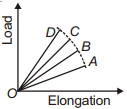
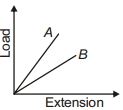
The load versus elongation graph for four wires of same length and the same material is shown in figure. The thinnest wire is represented by line
Answerc
(c)
For the same load wire with maximum elongation has minimum cross-section area
As $\frac{F L}{A Y}=\Delta x$
$F, L, Y$ are fixed so $\frac{1}{A} \propto \Delta x$
$\Rightarrow O A$ is the thinnest.
View full question & answer→MCQ 1001 Mark
If in case $A$, elongation in wire of length $L$ is $l$, then for same wire elongation in case $B$ will be ......
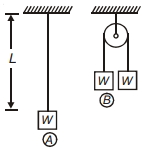
Answerc
(c)
Since tension in both cases is same and all other parametrs $(Y, A, L)$ are also same $\Rightarrow$ Elongation will be same in both cases.
View full question & answer→MCQ 1011 Mark
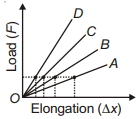
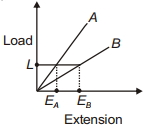
In the given figure, if the dimensions of the two wires are same but materials are different, then Young's modulus is ........
- ✓
More for $A$ than $B$
- B
More for $B$ than $A$
- C
Equal for $A$ and $B$
- D
AnswerCorrect option: A. More for $A$ than $B$
a
(a)
At same value of load
$A$ has less elongation than $B \quad \ldots (1)$
$\frac{F L}{A Y}=\Delta L$ $\left\{\begin{array}{l}\because L, A \text { are same } \\ F \text { - Load is also taken same }\end{array}\right\}$
So $\frac{1}{Y} \propto \Delta L \quad \ldots (2)$
Using conditions $(1)$ and $(2)$
We can say
$Y_A > Y_B$ $\{$ Young's modulus of $A$ greater than $B\}$
View full question & answer→MCQ 1021 Mark
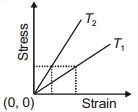
Figure shows graph between stress and strain for a uniform wire at two different femperatures. Then
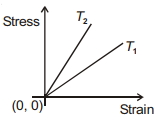
- A
$T_2 > T_1$
- ✓
$T_1 > T_2$
- C
$T_1 = T_2$
- D
AnswerCorrect option: B. $T_1 > T_2$
b
(a)
From the graph we can see young's modulus is less for $T_1$ as compared to $T_2$ ( $Y=$ slope of stress-strain curve)
As $T$ increases $Y$ decreases
So $T_1 > T_2$
View full question & answer→MCQ 1031 Mark
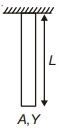
A uniform rod of length $L$ has a mass per unit length $\lambda$ and area of cross-section $A$. If the Young's modulus of the rod is $Y$. Then elongation in the rod due to its own weight is ...........
- A
$\frac{2 \lambda g L^2}{A Y}$
- ✓
$\frac{\lambda g L^2}{2 A Y}$
- C
$\frac{\lambda g L^2}{4 A Y}$
- D
$\frac{\lambda g L^2}{A Y}$
AnswerCorrect option: B. $\frac{\lambda g L^2}{2 A Y}$
b
(b)
Total mass can be assumed to be concentrated at center of mass at distance $\frac{L}{2}$ from top
$\frac{M}{L}=\lambda$
$M=\lambda L$
$\Delta x=\frac{F L / 2}{A Y}=\frac{1}{2} \times \frac{\lambda L^2 g}{A Y}$
View full question & answer→MCQ 1041 Mark
Two wire $A$ and $B$ are stretched by same force. If, for $A$ and $B, Y_A: Y_B=1: 2, r_A: r_B=3: 1$ and $L_A: L_B=4: 1$, then ratio of their extension $\left(\frac{\Delta L_A}{\Delta L_B}\right)$ will be .............
- A
$10: 13$
- ✓
$8: 9$
- C
$11: 7$
- D
$6: 5$
AnswerCorrect option: B. $8: 9$
b
(b)
$\Delta x=\frac{F L}{A Y}$
For wire $A$
$\Delta L_A=\frac{F \cdot L_A}{\pi r_A^2 \cdot Y_A} \ldots (1)$
For wire $B$
$\Delta L_B=\frac{F \cdot L_B}{\pi r_B^2 \cdot Y_B} \ldots (2)$
Divide $(1)$ by $(2)$
$\frac{\Delta L_A}{\Delta L_B}=\frac{F \cdot L_A}{\pi r_A^2 \cdot Y_A} \times \frac{\pi r_B^2 \cdot Y_B}{F \times L_B}=\frac{L_A}{L_B} \times\left(\frac{r_B}{r_A}\right)^2 \times \frac{Y_B}{Y_A}$
Substituting the value of ratio's
$\frac{\Delta L_A}{\Delta L_B}=\frac{4}{1} \times\left(\frac{1}{3}\right)^2 \times \frac{2}{1}=\frac{8}{9}$
View full question & answer→MCQ 1051 Mark
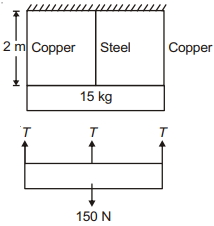
A rigid bar of mass $15\,kg$ is supported symmetrically by three wire each of $2 \,m$ long. These at each end are of copper and middle one is of steel. Young's modulus of elasticity for copper and steel are $110 \times 10^9 \,N / m ^2$ and $190 \times 10^9 \,N / m ^2$ respectively. If each wire is to have same tension, ratio of their diameters will be ............
- A
$\sqrt{\frac{11}{19}}$
- B
$\sqrt{\frac{30}{11}}$
- ✓
$\sqrt{\frac{19}{11}}$
- D
$\sqrt{\frac{11}{30}}$
AnswerCorrect option: C. $\sqrt{\frac{19}{11}}$
c
(c)
Tension is same (given)
From free body diagram
$3 T=150 \,N$
$T=50 \,N$
Since the bar has to be supported symmetrically Therefore extension in each wire will be same
We know $\Delta x=\frac{F L}{A Y}$
Compare $1$ copper wire with another steel wire
$\frac{F L}{A_C Y_C}=\frac{F L}{A_S Y_S}$
$\Rightarrow \frac{A_S}{A_C}=\frac{Y_C}{Y_S}$ $\left\{\begin{array}{l}\text { Where, } \\ A_C-\text { Area of copper wire } \\ Y_C-\text { Young's modulus copper } \\ A_S-\text { Area of steel wire } \\ Y_S-\text { Young's modulus steel }\end{array}\right.$
Substitutuing value of $Y_C$ and $Y_s$
$\frac{\pi d_S^2}{4 \times \frac{\pi}{4} \times d_C^2}=\frac{110 \times 10^9}{190 \times 10^9}$
$\frac{d_S}{d_C}=\sqrt{\frac{11}{19}}$ $\left\{\begin{array}{l}d_S \text {-diameter of steel wire } \\ d_C \text {-diameter of copper wire }\end{array}\right.$
$\frac{d_C}{d_S}=\sqrt{\frac{19}{11}}$
View full question & answer→MCQ 1061 Mark
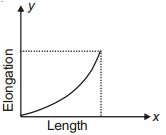
Which of the following curve represents the correctly distribution of elongation $(y)$ along heavy rod under its own weight $L \rightarrow$ length of rod, $x \rightarrow$ distance of point from lower end?
Answera
(a)
For elongation of rod under its own weight
We know $\Delta x=\frac{\rho g x^2}{2 Y}$ $\left\{\begin{array}{l}\text { Where, } \\ \Delta x=\text { Elongation } \\ \rho=\text { Density of rod } \\ Y=\text { Young's modulus } \\ L=\text { Length } \\ g=\text { Acceleration due to gravity } \\ x=\text { Distance of point from lower end }\end{array}\right.$
We can clearly see that elongation $\propto\left(x^2\right)$
So graph of $\Delta x$ vs $x$ should be a upward parabola.
View full question & answer→MCQ 1071 Mark
A uniform copper rod of length $50 \,cm$ and diameter $3.0 \,mm$ is kept on a frictionless horizontal surface at $20^{\circ} C$. The coefficient of linear expansion of copper is $2.0 \times 10^{-5} \,K ^{-1}$ and Young's modulus is $1.2 \times 10^{11} \,N / m ^2$. The copper rod is heated to $100^{\circ} C$, then the tension developed in the copper rod is .......... $\times 10^3 \,N$
Answerd
(d)
Since the rod is not bounded, No compressive stress hence no tensions
View full question & answer→MCQ 1081 Mark
A steel wire of length ' $L$ ' at $40^{\circ}\,C$ is suspended from the ceiling and then a mass ' $m$ ' is hung from its free end. The wire is cooled down from $40^{\circ}\,C$ to $30^{\circ}\,C$ to regain its original length ' $L$ '. The coefficient of linear thermal expansion of the steel is $10^{-5} { }^{\circ}\,C$, Young's modulus of steel is $10^{11}\, N /$ $m ^2$ and radius of the wire is $1\, mm$. Assume that $L \gg $ diameter of the wire. Then the value of ' $m$ ' in $kg$ is nearly
Answerc
(c)
$Y=\frac{m g / A}{\Delta \ell / \ell}=\frac{m g \ell}{A \Delta \ell}$
Also $\Delta \ell=\ell \alpha \Delta T$
From (1) and (2)
$Y=\frac{m g \ell}{A \ell \alpha \Delta T}=\frac{m g}{A \alpha \Delta T}$
$\therefore m=\frac{Y A \alpha \Delta T}{g}$
$=\frac{10^{11} \times \pi\left(10^{-3}\right)^2 \times 10^{-5} \times 10}{10}=\pi \approx 3$
View full question & answer→MCQ 1091 Mark
The compressibility of water is $4 \times {10^{ - 5}}$ per unit atmospheric pressure. The decrease in volume of $100$ cubic centimeter of water under a pressure of $100$ atmosphere will be ......... $cc$
- ✓
$0.4 $
- B
$4 \times {10^{ - 5}}$
- C
$0.025$
- D
$0.004$
AnswerCorrect option: A. $0.4 $
a
(a) $C = \frac{1}{K} = \frac{{\Delta V/V}}{{\Delta P}}$$\Rightarrow $ $\Delta V = C \times \Delta P \times V$
$ = 4 \times {10^{ - 5}} \times 100 \times 100 = 0.4cc$
View full question & answer→MCQ 1101 Mark
A uniform cube is subjected to volume compression. If each side is decreased by $1\%,$ then bulk strain is
- A
$0.01$
- B
$0.06$
- C
$0.02$
- ✓
$0.03$
AnswerCorrect option: D. $0.03$
d
(d) If side of the cube is $L$ then $V = {L^3}$ ==> $\frac{{dV}}{V} = 3\frac{{dL}}{L}$
$\%$ change in volume $= 3 \times (\% $ change in length$)$
$= 3 \times 1\% = 3\%$ $\therefore$ Bulk strain $\frac{{\Delta V}}{V} = 0.03$
View full question & answer→MCQ 1111 Mark
A ball falling in a lake of depth $200\, m$ shows $0.1\%$ decrease in its volume at the bottom. What is the bulk modulus of the material of the ball
- ✓
$19.6 \times {10^8}\,N/{m^2}$
- B
$19.6 \times {10^{ - 10}}\,N/{m^2}$
- C
$19.6 \times {10^{10}}\,N/{m^2}$
- D
$19.6 \times {10^{ - 8}}\,N/{m^2}$
AnswerCorrect option: A. $19.6 \times {10^8}\,N/{m^2}$
a
(a) $B = \frac{{\Delta p}}{{\Delta V/V}} = \frac{{h\rho g}}{{0.1/100}} = \frac{{200 \times {{10}^3} \times 9.8}}{{1/1000}}$
$ = 19.6 \times {10^8}N/{m^2}$
View full question & answer→MCQ 1121 Mark
The pressure of a medium is changed from $1.01 × 10^5$ $Pa$ to $1.165 × 10^5$ $Pa$ and change in volume is $10\% $ keeping temperature constant. The Bulk modulus of the medium is
- A
$204.8 \times 10^5 Pa$
- B
$102.4 \times 10^5 Pa$
- C
$51.2 \times 10^5 Pa$
- ✓
$1.55 \times 10^5 Pa$
AnswerCorrect option: D. $1.55 \times 10^5 Pa$
d
(d) $K = \frac{{\Delta p}}{{\Delta V/V}}$$ = \frac{{(1.165 - 1.01) \times {{10}^5}}}{{10/100}} = \frac{{0.155 \times {{10}^5}}}{{1/10}}$
$ = 1.55 \times {10^5}pa$
View full question & answer→MCQ 1131 Mark
An object is taken $1.0\,km$ deep in sea. Density of sea $= 1.025 \times 10^3\,kg/m^3$ , Bulk modulus of object $= 1.6 \times 10^6\, KPa$ Find out percentage change in density of object....... $\%$
- A
$0.36$
- ✓
$0.64$
- C
$0.40$
- D
$0.60$
AnswerCorrect option: B. $0.64$
b
$\mathrm{B}=\frac{-\mathrm{P}}{\frac{\Delta \mathrm{V}}{\mathrm{V}}} \quad \begin{array}{l}{\rho \mathrm{V}=\mathrm{const}} \\ {\frac{\Delta \rho}{\rho}=-\frac{\Delta \mathrm{V}}{\mathrm{V}}}\end{array}$
$\frac{\Delta \rho}{\rho}=\frac{\mathrm{P}}{\mathrm{B}}=\frac{\mathrm{dgh}}{\mathrm{B}}=\frac{1.025 \times 10^{3} \times 10 \times 10^{3}}{1.6 \times 10^{6} \times 10^{3}}=0.64 \times 10^{-2}$
$\%$ change $=\frac{\Delta \rho}{\rho} \times 100=0.64 \%$
View full question & answer→MCQ 1141 Mark
The bulk modulus of rubber is $9.1 \times 10^8\,N/m^2$. To what depth a rubber ball be taken in a lake so that its volume is decreased by $0.1\%$ ? ....... $m$
Answerb
$\mathrm{K}=\frac{\Delta \mathrm{P}}{\left(-\frac{\Delta \mathrm{V}}{\mathrm{V}}\right)}=\frac{\mathrm{h} \rho \mathrm{g}}{\left(-\frac{\Delta \mathrm{V}}{\mathrm{V}}\right)}$
$9.1 \times 10^{8}=\frac{\mathrm{h} \times 10^{3} \times 10}{\left(\frac{0.1}{100}\right)} \quad \Rightarrow \mathrm{h}=91 \mathrm{m}$
View full question & answer→MCQ 1151 Mark
Match the type of elasticity involved
| $(i)$ Suspension fibre of galvanometer |
$(a)$ Linear |
| $(ii)$ Bending of beam |
$(b)$ Shear |
| $(iii)$ cutting piece of paper |
$(c)$ Bulk |
| $(iv)$ mechanical waves in fluid |
$(d)$ Shear |
- A
$(i) - a\, (ii) - b\, (iii) - b\, (iv) - c$
- ✓
$(i) - b\, (ii) - a\, (iii) - d\, (iv) - c$
- C
$(i) - a\, (ii) - b\, (iii) - d\, (iv) - c$
- D
$(i) - c\, (ii) - a\, (iii) - d\, (iv) - c$
AnswerCorrect option: B. $(i) - b\, (ii) - a\, (iii) - d\, (iv) - c$
View full question & answer→MCQ 1161 Mark
An increases in pressure required to decreases the $200\,\,litres$ volume of a liquid by $0.004\%$ in container is ........... $kPa$. (Bulk modulus of the liquid $= 2100\,\,MPa$ )
Answerd
$B=\frac{\Delta P}{\left(-\frac{\Delta V}{V}\right)}$
$\Rightarrow \Delta \mathrm{P}=\mathrm{B}\left(-\frac{\Delta \mathrm{V}}{\mathrm{V}}\right)$
$\Rightarrow \Delta \mathrm{P}=\left(2100 \times 10^{6}\right)\left(\frac{0.004}{100}\right)$
$\left(\text { As }-\frac{\Delta \mathrm{V}}{\mathrm{V}} \times 100=0.004\right)$
$\Rightarrow \Delta \mathrm{P}=84 \times 10^{3} \mathrm{P}_{\mathrm{a}}$
View full question & answer→MCQ 1171 Mark
Find the depth of lake at which density of water is $1\%$ greater than at the surface. Given compressibility ........... $km$ . $K = 50\times10^{-6}/atm$ ?
Answerb
$\frac{1}{\mathrm{K}}=\frac{-\Delta \mathrm{P}}{\frac{\Delta \mathrm{V}}{\mathrm{V}}}$ $\left(\therefore \frac{\Delta \mathrm{V}}{\mathrm{V}}=-\frac{\Delta \rho}{\rho}\right)$
$\frac{10^{5}}{50 \times 10^{-6}}=\frac{\rho \mathrm{gh} \times 100}{1}$
$h=2 \mathrm{km}$
View full question & answer→MCQ 1181 Mark
An increases in pressure required to decreases the $200\,litres$ volume of a liquid by $0.004\%$ in container is ............ $kPa$ (Bulk modulus of the liquid $= 2100\,MPa$ )
Answerd
$B=\frac{\Delta P}{\left(-\frac{\Delta V}{V}\right)}$
$\Rightarrow \Delta \mathrm{P}=\mathrm{B}\left(-\frac{\Delta \mathrm{V}}{\mathrm{V}}\right)$
$\Rightarrow \Delta \mathrm{P}=\left(2100 \times 10^{6}\right)\left(\frac{0.004}{100}\right)$
$\Rightarrow\left(\text { As }-\frac{\Delta \mathrm{V}}{\mathrm{V}} \times 100=0.004\right)$
$\Rightarrow \Delta \mathrm{P}=84 \times 10^{3} \mathrm{P_a}$
View full question & answer→MCQ 1191 Mark
A rubber ball is taken to a $100\, m$ deep lake and its volume changes by $0.1\%$. The bulk modulus of rubber is nearly
- A
$1\times10^{-6} \,N/m^2$
- B
$1\times10^{-8} \,N/m^2$
- C
$1\times10^{7} \,N/m^2$
- ✓
$1\times10^{9} \,N/m^2$
AnswerCorrect option: D. $1\times10^{9} \,N/m^2$
d
$\beta=\frac{\Delta \mathrm{P}}{\left(\frac{-\Delta \mathrm{V}}{\mathrm{V}}\right)}=\frac{\mathrm{h} \rho \mathrm{g}}{\frac{-\Delta \mathrm{V}}{\mathrm{V}}}=\frac{100 \times 10^{3} \times 10}{10^{-3}}=10^{9} \mathrm{N} / \mathrm{m}^{2}$
View full question & answer→MCQ 1201 Mark
A sample of a liquid has an initial volume of $1.5\,L$ . The volume is reduced by $0.2\,mL$ , when the pressure increases by $140\,kP$ . What is the bulk modulus of the liquid
AnswerCorrect option: B. $1.05 \times 10^9\,Pa$
b
$B=-\frac{\Delta P}{\Delta V / V}=-\frac{V \Delta P}{\Delta V}=-\frac{1.5 \times 140 \times 10^{3}}{-0.2 \times 10^{-3}}$
$=1.05 \times 10^{9} \mathrm{Pa}$
View full question & answer→MCQ 1211 Mark
The Bulk Modulus for an incompressible liquid is
Answerc
We know that the bulk modulus is,
$\mathrm{B}=-\frac{\mathrm{dpV}}{\Delta \mathrm{V}}$
Here $\mathrm{p}=$ Pressure (stress)
$-\frac{\Delta \mathrm{V}}{\mathrm{V}}=\text { Volume strain }$
But liquid is incompressible, so
${\Delta \mathrm{V}=0} $
Hence, ${\mathrm{B}=-\frac{\mathrm{pV}}{0}=\infty}$
or $\mathrm{B}=\infty$ (infinity)
View full question & answer→MCQ 1221 Mark
A glass slab is subjected to a pressure of $10\, atm$. The fractional change in its volume is (Bulk modulus of glass $= 37 \times 10^9\, N\, m^{-2}$, $1\, atm = 1 \times 10^5\, N\, m^{-2}$)
- A
$2.7 \times {10^{ - 2}}$
- B
$2.7 \times {10^{ - 3}}$
- C
$2.7 \times {10^{ - 4}}$
- ✓
$2.7 \times {10^{ - 5}}$
AnswerCorrect option: D. $2.7 \times {10^{ - 5}}$
d
Bulk modulus, $\mathrm{B}=\frac{\mathrm{P}}{\Delta \mathrm{V} / \mathrm{V}}$
Fractional change in volume, $\frac{\Delta \mathrm{V}}{\mathrm{V}}=\frac{\mathrm{P}}{\mathrm{B}}$
Here, $P=10$ atm $=10 \times 1 \times 10^{5} \mathrm{N} \mathrm{m}^{-2}$
$\mathrm{B}=37 \times 10^{9} \mathrm{N} \mathrm{m}^{-2}$
$\therefore \quad \frac{\Delta \mathrm{V}}{\mathrm{V}}=\frac{1 \times 10^{6} \mathrm{Nm}^{-2}}{37 \times 10^{9} \mathrm{Nm}^{-2}}=0.027 \times 10^{-3}$
$=2.7 \times 10^{-5}$
View full question & answer→MCQ 1231 Mark
An increases in pressure required to decreases the $200$ litres volume of a liquid by $0.004\%$ in container is .......... $kPa$ (Bulk modulus of the liquid $= 2100\, MPa$)
Answerd
$B=\frac{\Delta P}{\left(-\frac{\Delta V}{V}\right)}$
$\Rightarrow \Delta \mathrm{P}=\mathrm{B}\left(-\frac{\Delta \mathrm{V}}{\mathrm{V}}\right)$
$\Rightarrow \Delta \mathrm{P}=\left(2100 \times 10^{6}\right)\left(\frac{0.004}{100}\right)$
$\Rightarrow\left(\text { As }-\frac{\Delta \mathrm{V}}{\mathrm{V}} \times 100=0.004\right)$
$\Rightarrow \Delta \mathrm{P}=84 \times 10^{3} \mathrm{P}_{a}$
View full question & answer→MCQ 1241 Mark
The bulk modulus of rubber is $9.1\times 10^8\,N/m^2$. To ......... $m$ depth a rubber ball be taken in a lake so that its volume is decreased by $0.1\,\%$ .
Answerb
$K = \frac{{\rho gh}}{{\Delta V/V}}\, \Rightarrow \,9.1 \times {10^8} = \frac{{{{10}^3} \times 10 \times h}}{{0.1/100}}$
$h = 91\,m$
View full question & answer→MCQ 1251 Mark
A copper solid cube of $60\,\, mm$ side is subjected to a pressure of $2.5 \times 10^7\, Pa$. If the bulk modulus of copper is $1.25 \times 10^{11}\, N/m^2$, the change in the volume of cube is
- A
$-43.2\, m^3$
- ✓
$-43.2\, mm^3$
- C
$-43.2\, cm^3$
- D
$-432\, mm^3$
AnswerCorrect option: B. $-43.2\, mm^3$
b
$\mathrm{B}=-\frac{\Delta \mathrm{PV}}{\Delta \mathrm{V}} \Rightarrow \Delta \mathrm{V}=-\frac{\Delta \mathrm{PV}}{\mathrm{B}}$
$=-\frac{2.5 \times 10^{7}}{1.25 \times 10^{11}} \times(60)^{3} \mathrm{mm}^{3}=-43.2 \mathrm{mm}^{3}$
View full question & answer→MCQ 1261 Mark
Compressibility per unit atm. pressure of water is $'\sigma '$ and if due to pressure $P$ there is decrement in volume $V$, find change is volume
- A
$\sigma\, P/V$
- ✓
$\sigma\, PV$
- C
$\sigma /PV$
- D
$\sigma \,V/P$
AnswerCorrect option: B. $\sigma\, PV$
b
$\mathrm{K}=\frac{\mathrm{PV}}{\Delta \mathrm{V}}$
$\frac{1}{\sigma}=\frac{\mathrm{PV}}{\Delta \mathrm{V}} $
$ \Rightarrow \Delta {\rm{V}} = \sigma {\rm{PV}}$
View full question & answer→MCQ 1271 Mark
$1\, m^3$ water is brought inside the lake upto $200$ metres depth from the surface of the lake. What will be change in the volume when the bulk modulus of elastically of water is $22000$ atmosphere? (density of water is $1\times10^3\, kg/m^3$ atmosphere pressure $= 10^5\, N/m^2$ and $g = 10\, m/s^2$)
- A
$8.9\times10^{-3}\, m^3$
- B
$7.8\times10^{-3}\, m^3$
- ✓
$9.1\times10^{-4}\, m^3$
- D
$8.7\times10^{-4}\, m^3$
AnswerCorrect option: C. $9.1\times10^{-4}\, m^3$
c
$K = \frac{P}{{\Delta V/V}}$ $\therefore \Delta V = \frac{{PV}}{K}$
$p = h\rho g = 200 \times {10^3} \times 10N/{m^2}$
$k = 22000\,atm = 22000 \times {10^5}N/{m^2}$
$V = 1{m^3}$
$\Delta V = \frac{{200 \times {{10}^3} \times 10 \times 1}}{{22000 \times {{10}^5}}} = 9.1 \times {10^{ - 4}}{m^3}$
View full question & answer→MCQ 1281 Mark
When the temperature of a gas is $20^{\circ} C$ and pressure is changed from $P_1=1.01 \times 10^5 \,Pa$ to $P_2=1.165 \times$ $10^5 \,Pa$, then the volume changes by $10 \%$. The Bulk modulus is .........$\times 10^5 \,Pa$
- ✓
$1.55$
- B
$1.01$
- C
$1.4$
- D
$0.115$
AnswerCorrect option: A. $1.55$
a
(a)
$\frac{\Delta V}{V}=\frac{-\Delta P}{B}$ $\left\{\begin{array}{l}\Delta V=10 \% \text { of } V \text { ( } \because \text { Pressure increases volume must } \\ \text { If } \begin{array}{l}\text { decreases by } 10 \% \text { so we will use a +ve sign) }\end{array} \\ \begin{array}{rl}\Rightarrow \Delta V & =100 cc \\ \Delta P & =P_2-P_1 \\ & =1.165 \times 10^5-1.01 \times 10^5\end{array}\end{array}\right.$
Substituting the values
$\frac{-10}{100}=\frac{-\left(1.165 \times 10^6-1.01 \times 10^6\right)}{B}$
$\frac{1}{10}=\frac{.155 \times 10^5}{B}$
$B=1.55 \times 10^5 \,Pa$
View full question & answer→MCQ 1291 Mark
A uniform cubical block is subjected to volumetric compression, which decreases its each side by $2 \%$. The Bulk strain produced in it is ............
- A
$0.03$
- B
$0.02$
- ✓
$0.06$
- D
$0.12$
AnswerCorrect option: C. $0.06$
c
(c)
Volume $=(\text { side })^3$
$v=(a)^3$
So $\frac{\Delta V}{V}=\frac{3 \Delta a}{a}$ $\left\{\operatorname{given} \frac{\Delta a}{a}=-2 \%\right\}$
$\therefore \frac{\Delta v}{v}=3 \times-2 \quad \text { Side decreases solve used (-)ve sign }$
$=-6 \%$
We know
$\frac{\Delta v}{v}=-\frac{P}{B}$
Substituting value of $\Delta v / v$
$-\frac{6}{100}=-\frac{P}{B}$
So bulk strain produced is $0.06$
View full question & answer→MCQ 1301 Mark
When a rubber ball is taken to the bottom of a sea of depth $1400 \,m$, its volume decreases by $2 \%$. The Bulk modulus of rubber ball is .................. $\times 10^8 N / m ^2$ [density of water is $1 \,g cc$ and $g=10 \,m / s ^2$ ]
Answerc
(c)
Pressure at the bottom of sea $=\rho_w g h=1000 \,kg / m ^3 \times 10 \,m / s ^2 \times 1400 \,m =14000000 \,N / m ^2$
Also we know
$\frac{\Delta v}{v}=-\frac{P}{B} \quad\left\{\frac{\Delta v}{v}=\frac{-2}{100}\right\}$
$\frac{-2}{100}=\frac{-14000000}{B}$
$B=7 \times 10^8 \,N / m ^2$
View full question & answer→MCQ 1311 Mark
A steel plate of face area $1 \,cm ^2$ and thickness $4 \,cm$ is fixed rigidly at the lower surface. A tangential force $F=10 \,kN$ is applied on the upper surface as shown in the figure. The lateral displacement $x$ of upper surface w.r.t. the lower surface is .............. $m$ (Modulus of rigidity for steel is $8 \times 10^{11} \,N / m ^2$ )
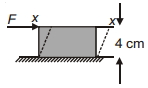
- A
$5 \times 10^{-5}$
- ✓
$5 \times 10^{-6}$
- C
$2.5 \times 10^{-3}$
- D
$2.5 \times 10^{-4}$
AnswerCorrect option: B. $5 \times 10^{-6}$
b
(b)
$\text { Modulus of rigidity }(G)=\frac{\text { Force } \times \text { Length }}{\text { Area } \times \text { Lateral displacement }}=\frac{F L}{A \times \Delta x}$
$F=10 \,kN =10 \times 10^3 \,N$
$L=4 \,cm =0.04 \,m$
$A=1 \,cm ^2=1 \times 10^{-4} \,m ^2$
$G=8 \times 10^{11}\,N / m ^2$
Substituting values
$8 \times 10^{11}=\frac{10 \times 10^3 \times 0.04}{1 \times 10^{-4} \times \Delta x}$
$\Delta x=\frac{10 \times 10^3 \times 0.04}{1 \times 10^{-4} \times 8 \times 10^{11}}=5 \times 10^{-6} \,m$
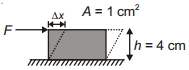
View full question & answer→MCQ 1321 Mark
Two wires $A$ and $B$ of same length and of same material have radii $r_1$ and $r_2$ respectively. Their one end is fixed with a rigid support and at other end equal twisting couple is applied. Then ratio of the angle of twist at the end of $A$ and the angle of twist at the end of $B$ will be ..............
- A
$\frac{r_1^2}{r_2^2}$
- ✓
$\frac{r_2^4}{r_1^4}$
- C
$\frac{r_2^2}{r_1^2}$
- D
$\frac{r_1^4}{r_2^4}$
AnswerCorrect option: B. $\frac{r_2^4}{r_1^4}$
b
(b)
$r_1^4 \phi_1=r_2^4 \phi_2$
$\frac{\phi_A}{\phi_B}=\frac{\left(r_B\right)^4}{\left(r_A\right)^4}=\left(\frac{r_2}{r_1}\right)^4$
View full question & answer→MCQ 1331 Mark
If the potential energy of a spring is $V$ on stretching it by $2\, cm$, then its potential energy when it is stretched by $10 \,cm$ will be
Answerd
(d) $U = \frac{1}{2}\left( {\frac{{YA}}{L}} \right)\,{l^2}$ $\Rightarrow$ $U \propto {l^2}$
$\frac{{{U_2}}}{{{U_1}}} = {\left( {\frac{{{l_2}}}{{{l_1}}}} \right)^2} = {\left( {\frac{{10}}{2}} \right)^2} = 25$ $\Rightarrow$ ${U_2} = 25{U_1}$
i.e. potential energy of the spring will be $25 \,V$
View full question & answer→MCQ 1341 Mark
Calculate the work done, if a wire is loaded by $'Mg'$ weight and the increase in length is $'l'$
- A
$Mgl$
- B
$Zero$
- ✓
$Mgl/2$
- D
$2Mgl$
AnswerCorrect option: C. $Mgl/2$
c
(c) Work done $=$ $\frac{1}{2}Fl = \frac{{Mgl}}{2}$
View full question & answer→MCQ 1351 Mark
Two wires of same diameter of the same material having the length $l$ and $2l.$ If the force $ F$ is applied on each, the ratio of the work done in the two wires will be
Answera
(a)$W = \frac{1}{2}Fl$ $\therefore$ $W \propto l$ $(F$ is constant$)$
$\frac{{{W_1}}}{{{W_2}}} = \frac{{{l_1}}}{{{l_2}}} = \frac{l}{{2l}} = \frac{1}{2}$
View full question & answer→MCQ 1361 Mark
A $5$ metre long wire is fixed to the ceiling. A weight of $10\, kg$ is hung at the lower end and is $1$ metre above the floor. The wire was elongated by $1\, mm$. The energy stored in the wire due to stretching is ......... $ joule$
AnswerCorrect option: B. $0.05$
b
(b) $W = \frac{1}{2} \times F \times l = \frac{1}{2}mgl$
$ = \frac{1}{2} \times 10 \times 10 \times 1 \times {10^{ - 1}} = 0.05\;J$
View full question & answer→MCQ 1371 Mark
If the force constant of a wire is $K,$ the work done in increasing the length of the wire by $l$ is
- A
$Kl/2$
- B
$Kl$
- ✓
$K{l^2}/2$
- D
$K{l^2}$
AnswerCorrect option: C. $K{l^2}/2$
c
(c) $K = \frac{F}{l}$and $W = \frac{1}{2}Fl = \frac{1}{2}Kl \times l = \frac{1}{2}K{l^2}$
View full question & answer→MCQ 1381 Mark
A brass rod of cross-sectional area $1\,c{m^2}$ and length $0.2\, m$ is compressed lengthwise by a weight of $5\, kg$. If Young's modulus of elasticity of brass is $1 \times {10^{11}}\,N/{m^2}$ and $g = 10\,m/{\sec ^2}$, then increase in the energy of the rod will be
- A
${10^{ - 5}}\,J$
- ✓
$2.5 \times {10^{ - 5}}\,J$
- C
$5 \times {10^{ - 5}}\,J$
- D
$2.5 \times {10^{ - 4}}$ $J$
AnswerCorrect option: B. $2.5 \times {10^{ - 5}}\,J$
b
(b) $U = \frac{1}{2} \times \frac{{{{{\rm{(stress)}}}^{\rm{2}}}}}{Y} \times {\rm{volume}}$$=$ $\frac{1}{2} \times \frac{{{F^2} \times A \times L}}{{{A^2} \times Y}}$
$=$$\frac{1}{2} \times \frac{{{F^2}L}}{{AY}} = \frac{1}{2} \times \frac{{{{(50)}^2} \times 0.2}}{{1 \times {{10}^{ - 4}} \times 1 \times {{10}^{11}}}}$$=$ $2.5 \times {10^{ - 5}}J$
View full question & answer→MCQ 1391 Mark
If one end of a wire is fixed with a rigid support and the other end is stretched by a force of $10 \,N,$ then the increase in length is $0.5\, mm$. The ratio of the energy of the wire and the work done in displacing it through $1.5\, mm$ by the weight is
- A
$\frac{1}{3}$
- B
$\frac{1}{4}$
- ✓
$\frac{1}{2}$
- D
$1$
AnswerCorrect option: C. $\frac{1}{2}$
c
(c) Work done in stretching a wire
$W = \frac{1}{2}Fl = \frac{1}{2} \times 10 \times 0.5 \times {10^{ - 3}}$= $2.5 \times {10^{ - 3}}J$
Work done to displace it through $1.5 \,mm$
$W = F \times l = 5 \times {10^{ - 3}}J$
The ratio of above two work $= 1 : 2$
View full question & answer→MCQ 1401 Mark
A wire is suspended by one end. At the other end a weight equivalent to $20\, N$ force is applied. If the increase in length is $1.0\, mm$, the increase in energy of the wire will be ....... $joule$
- ✓
$0.01$
- B
$0.02$
- C
$0.04$
- D
$1.00$
AnswerCorrect option: A. $0.01$
a
(a) Increase in energy $ = \frac{1}{2} \times 20 \times 1 \times {10^{ - 3}} = 0.01J$
View full question & answer→MCQ 1411 Mark
A wire is suspended by one end. At the other end a weight equivalent to $20\, N$ force is applied. If the increase in length is $1.0\, mm,$ the ratio of the increase in energy of the wire to the decrease in gravitational potential energy when load moves downwards by $1\, mm,$ will be
- A
$1$
- B
$\frac{1}{4}$
- C
$\frac{1}{3}$
- ✓
$\frac{1}{2}$
AnswerCorrect option: D. $\frac{1}{2}$
d
(d) Ratio of work done $=$ $\frac{{1/2Fl}}{{Fl}} = \frac{1}{2}$
View full question & answer→MCQ 1421 Mark
The ratio of Young's modulus of the material of two wires is $2 : 3.$ If the same stress is applied on both, then the ratio of elastic energy per unit volume will be
Answera
(a) Energy per unit volume $=$ $\frac{{{{({\rm{stress)}}}^{\rm{2}}}}}{{2Y}}$
$\frac{{{E_1}}}{{{E_2}}} = \frac{{{Y_2}}}{{{Y_1}}}$ (Stress is constant)
$\frac{{{E_1}}}{{{E_2}}} = \frac{3}{2}$
View full question & answer→MCQ 1431 Mark
The length of a rod is $20\, cm$ and area of cross-section $2\,c{m^2}$. The Young's modulus of the material of wire is $1.4 \times {10^{11}}\,N/{m^2}$. If the rod is compressed by $5\, kg-wt$ along its length, then increase in the energy of the rod in joules will be
- ✓
$8.57 \times {10^{ - 6}}$
- B
$22.5 \times {10^{ - 4}}$
- C
$9.8 \times {10^{ - 5}}$
- D
$45.0 \times {10^{ - 5}}$
AnswerCorrect option: A. $8.57 \times {10^{ - 6}}$
a
(a) Energy = $\frac{1}{2}Fl = \frac{1}{2} \times F \times \left( {\frac{{FL}}{{AY}}} \right) = \frac{1}{2} \times \frac{{{F^2}L}}{{AY}}$
$ = \frac{1}{2} \times \frac{{{{(50)}^2} \times 20 \times {{10}^{ - 2}}}}{{2 \times {{10}^{ - 4}} \times 1.4 \times {{10}^{11}}}}$$ = 8.57 \times {10^{ - 6}}J$
View full question & answer→MCQ 1441 Mark
On stretching a wire, the elastic energy stored per unit volume is
- ✓
$Fl/2AL$
- B
$FA/2L$
- C
$FL/2A$
- D
$FL/2$
AnswerCorrect option: A. $Fl/2AL$
a
(a) Energy stored per unit volume $=$ $\frac{1}{2}\left( {\frac{F}{A}} \right)\;\left( {\frac{l}{L}} \right)$ $=$ $\frac{{Fl}}{{2AL}}$
View full question & answer→MCQ 1451 Mark
When a force is applied on a wire of uniform cross-sectional area $3 \times {10^{ - 6}}\,{m^2}$ and length $4m$, the increase in length is $1\, mm.$ Energy stored in it will be $(Y = 2 \times {10^{11}}\,N/{m^2})$
- A
$6250\, J$
- B
$0.177 \,J$
- ✓
$0.075\, J$
- D
$0.150 \,J$
AnswerCorrect option: C. $0.075\, J$
c
(c) $U = \frac{1}{2} \times \frac{{YA{l^2}}}{L}$$ = \frac{1}{2} \times \frac{{2 \times {{10}^{11}} \times 3 \times {{10}^{ - 6}} \times {{(1 \times {{10}^{ - 3}})}^2}}}{4}$
$ = 0.075\;J$
View full question & answer→MCQ 1461 Mark
$K$ is the force constant of a spring. The work done in increasing its extension from ${l_1}$ to ${l_2}$ will be
AnswerCorrect option: D. $\frac{K}{2}(l_2^2 - l_1^2)$
d
(d) At extension ${l_1}$, the stored energy $ = \frac{1}{2}Kl_1^2$
At extension ${l_2}$, the stored energy$ = \frac{1}{2}Kl_2^2$
Work done in increasing its extension from ${l_1}$ to ${l_2}$
$ = \frac{1}{2}K(l_2^2 - l_1^2)$
View full question & answer→MCQ 1471 Mark
When a $4\, kg$ mass is hung vertically on a light spring that obeys Hooke's law, the spring stretches by $2\, cms$. The work required to be done by an external agent in stretching this spring by $5\, cms$ will be ......... $joule$ $(g = 9.8\,metres/se{c^2})$
- A
$4.90$
- ✓
$2.45$
- C
$0.495$
- D
$0.245$
AnswerCorrect option: B. $2.45$
b
(b) $K = \frac{F}{x}$$ = \frac{{40}}{{2 \times {{10}^{ - 2}}}} = 0.2\;N/m$
Work done$ = \frac{1}{2}K{x^2} = \frac{1}{2} \times (0.2) \times {(0.05)^2} = 2.5\;J$
View full question & answer→MCQ 1481 Mark
A wire of length $L$ and cross-sectional area $A$ is made of a material of Young's modulus $Y.$ It is stretched by an amount $x$. The work done is
- A
$\frac{{YxA}}{{2L}}$
- B
$\frac{{Y{x^2}A}}{L}$
- ✓
$\frac{{Y{x^2}A}}{{2L}}$
- D
$\frac{{2Y{x^2}A}}{L}$
AnswerCorrect option: C. $\frac{{Y{x^2}A}}{{2L}}$
c
(c) Work done is equal to the potential energy stored in the wire.
$\therefore \quad W=U=\frac{1}{2} \times$ Stress $\times$ Strain $\times$ Volume
OR $\quad W=\frac{1}{2} \times Y(\text { Strain })^{2} \times$ Volume $……(1)$
$(\text {Strain}=Y \times$Strain)
Strain $=\frac{x}{L}$and volume $=A L$
$\therefore W=\frac{1}{2} \times Y \times \frac{x^{2}}{L^{2}} \times A L \quad \Longrightarrow W=\frac{Y x^{2} A}{2 L}$
View full question & answer→MCQ 1491 Mark
A wire of length $50\, cm$ and cross sectional area of $1$ sq. mm is extended by $1\, mm.$ The required work will be $(Y = 2 \times {10^{10}}\,N{m^{ - 2}})$
- A
$6 \times {10^{ - 2}}\,J$
- B
$4 \times {10^{ - 2}}\,J$
- ✓
$2 \times {10^{ - 2}}\,J$
- D
$1 \times {10^{ - 2}}\,J$
AnswerCorrect option: C. $2 \times {10^{ - 2}}\,J$
c
(c) $W = \frac{{YA{l^2}}}{{2L}} = \frac{{2 \times {{10}^{10}} \times {{10}^{ - 6}} \times {{({{10}^{ - 3}})}^2}}}{{2 \times 50 \times {{10}^{ - 2}}}}$$ = 2 \times {10^{ - 2}}\;J$
View full question & answer→MCQ 1501 Mark
The work per unit volume to stretch the length by $1\%$ of a wire with cross sectional area of $1\,m{m^2}$ will be. $[Y = 9 \times {10^{11}}\,N/{m^2}]$
AnswerCorrect option: B. $4.5 \times {10^7}\,J$
b
(b) $U = \frac{1}{2} \times Y \times {({\rm{Strain}})^2} = \frac{1}{2} \times 9 \times {10^{11}} \times {\left( {\frac{1}{{100}}} \right)^2}$
$ = 4.5 \times {10^7}\;J$
View full question & answer→MCQ 1511 Mark
When load of $5\,kg$ is hung on a wire then extension of $3\,m$ takes place, then work done will be ....... $joule$
Answera
(a) $W = \frac{1}{2}Fl = \frac{1}{2} \times Mg \times l = \frac{1}{2} \times 5 \times 10 \times 3 = 75\;Joule$
View full question & answer→MCQ 1521 Mark
Wires $A$ and $B$ are made from the same material. $A$ has twice the diameter and three times the length of $B.$ If the elastic limits are not reached, when each is stretched by the same tension, the ratio of energy stored in $A$ to that in $B$ is
Answerb
(b) $U = \frac{1}{2}Fl = \frac{{{F^2}L}}{{2AY}}$. $U \propto \frac{L}{{{r^2}}}$ $(F$ and $Y$ are constant$)$
$\frac{{{U_A}}}{{{U_B}}} = \left( {\frac{{{L_A}}}{{{L_B}}}} \right) \times {\left( {\frac{{{r_A}}}{{{r_B}}}} \right)^2}$= $(3) \times {\left( {\frac{1}{2}} \right)^2} = \frac{3}{4}$
View full question & answer→MCQ 1531 Mark
A wire suspended vertically from one of its ends is stretched by attaching a weight of $200\ N$ to the lower end. The weight stretches the wire by $1\ mm$. Then the elastic energy stored in the wire ......... $J$
Answera
Elastic energy $=\frac{1}{2} \times F \times x$
$F=200 N, x=1 m m=10^{-3} m$
$\therefore E=\frac{1}{2} \times 200 \times 1 \times 10^{-3}=0.1 J$
View full question & answer→MCQ 1541 Mark
A suspended long metal wire is stretched a small distance $x$ by a load $W$ in newton suspended at the other end. Select the best answer out of the following
AnswerCorrect option: C. The energy per unit volume stored in the wire $ = \frac{1}{2}Wx$
View full question & answer→MCQ 1551 Mark
A uniform metal rod of $2\,\,mm^2$ cross section fixed between two walls is heated from $0\,^oC$ to $20\,^oC$ . The coefficient of linear expansion of rod is $12\,\,\times\,\,10^{-6}\,/^oC$ . Its Young's modulus of elasticity is $10^{11}\,\,N/m^2$ . The energy stored per unit volume of rod will be ....... $J/m^3$
- ✓
$2880$
- B
$1500$
- C
$5760$
- D
$1440$
AnswerCorrect option: A. $2880$
a
Energy per unit volume $=\frac{1}{2} \times \mathrm{Y} \times(\text { strain })^{2}$
$=\frac{1}{2} \times \mathrm{Y} \times(\alpha \Delta \theta)^{2}$
$=\frac{1}{2} \times 10^{11} \times\left(12 \times 10^{-6} \times 20\right)^{2}=2880 \mathrm{J} / \mathrm{m}^{3}$
View full question & answer→MCQ 1561 Mark
A uniform metal rod of $2\, mm^2$ cross section fixed between two walls is heated from $0\,^oC$ to $20\,^oC$. The coefficient of linear expansion of rod is $12\times10^{-6}/^oC$. Its Young's modulus of elasticity is $10^{11} \,N/m^2$. The energy stored per unit volume of rod will be ....... $J/m^3$
- ✓
$2880$
- B
$1500$
- C
$5760$
- D
$1440$
AnswerCorrect option: A. $2880$
a
Energy per unit volume $=\frac{1}{2} \times \mathrm{Y} \times(\text { strain })^{2}$
$=\frac{1}{2} \times Y \times(\alpha \Delta \theta)^{2}$
$=\frac{1}{2} \times 10^{11} \times\left(12 \times 10^{-6} \times 20\right)^{2}=2880 \mathrm{J} / \mathrm{m}^{3}$
View full question & answer→MCQ 1571 Mark
A block of mass $M$ is suspended from a wire of length $L$, area of cross-section $A$ and Young's modulus $Y$. The elastic potential energy stored in the wire is
- ✓
$\frac{1}{2}\frac{{{M^2}{g^2}L}}{{AY}}$
- B
$\frac{1}{2}\frac{{Mg}}{{AYL}}$
- C
$\frac{1}{2}\frac{{{M^2}{g^2}A}}{{YL}}$
- D
$\frac{1}{2}\frac{{MgY}}{{AL}}$
AnswerCorrect option: A. $\frac{1}{2}\frac{{{M^2}{g^2}L}}{{AY}}$
a
$U=\frac{1}{2}(\text { stress })$ (strain) (volume) $=\frac{1}{2}$ (stress)
$\left[\frac{\text { stress }}{Y}\right]$ (volume) $=\frac{1}{2}\left[\frac{\text { stress }^{2}}{Y}\right] \times$ volume
$=\frac{1}{2}\left[\frac{M g}{A}\right]^{2} \cdot\left[\frac{1}{Y}\right](A L)=\frac{1}{2} \frac{M^{2} g^{2} L}{A Y}$
View full question & answer→MCQ 1581 Mark
The work done in increasing the length of a $1$ $metre$ long wire of cross-section area $1\, mm^2$ through $1\, mm$ will be ....... $J$ $(Y = 2\times10^{11}\, Nm^{-2})$
Answera
$\mathrm{W}=\frac{1}{2} \frac{\mathrm{YA}}{\ell}(\Delta \ell)^{2}$
$=\frac{1}{2} \times \frac{2 \times 10^{11} \times 1 \times 10^{-6}}{1} \times\left(10^{-3}\right)^{2}=0.1 \mathrm{J}$
View full question & answer→MCQ 1591 Mark
The work done per unit volume to stretch the length of area of cross-section $2 \,mm ^2$ by $2 \%$ will be ....... $MJ / m ^3$ $\left[Y=8 \times 10^{10} \,N / m ^2\right]$
Answerb
(b)
Work done $=$ Force $\times$ elongation
$W=F \cdot \Delta x \ldots .$ $\left\{F=\Delta x \cdot \frac{A Y}{L}\right\}$
$\Rightarrow W=\frac{A Y}{L} \times \Delta x^2$
Multiply and divide by $L$
We get
$W=\frac{\text { Volume } \cdot Y}{L^2} \Delta x^2$
Cross multiply ( $L \cdot A)$ volume
$\frac{W}{L \cdot A}=Y \cdot\left(\frac{\Delta x}{L}\right)^2$
Work done per unit volume
Substitute values
$=8 \times 10^{10} \cdot\left(\frac{2}{100}\right)^2$
$=32 \,MJ / m ^3$
View full question & answer→MCQ 1601 Mark
The strain energy stored in a body of volume $V$ due to shear strain $\phi$ is (shear modulus is $\eta$ )
- A
$\frac{\phi^2 V}{2 \eta}$
- B
$\frac{\phi V^2}{2 \eta}$
- C
$\frac{\phi^2 V}{\eta}$
- ✓
$\frac{1}{2} \eta \phi^2 V$
AnswerCorrect option: D. $\frac{1}{2} \eta \phi^2 V$
d
(d)
Shear modulus $=\frac{\text { Shear } \text { stress }}{\text { Shear } \text { stress }}$
$\eta=\frac{\text { Shear stress }}{\phi}$
$\eta \phi=$ Shear stress
Strain energy per unit volume $=\frac{1}{2} \times$ shear stress $\times$ shear strain $\Rightarrow \frac{\text { Strain energy }}{\text { Volume }}=\frac{1}{2} \times \eta \phi \times \phi \quad$ (Cross multiply volume)
Strain energy $=\frac{1}{2} \eta \phi^2 V$
View full question & answer→MCQ 1611 Mark
A metal wire having Poisson's ratio $1 / 4$ and Young's modulus $8 \times 10^{10} \,N / m ^2$ is stretched by a force, which produces a lateral strain of $0.02 \%$ in it. The elastic potential energy stored per unit volume in wire is [in $\left.J / m ^3\right]$
- ✓
$2.56 \times 10^4$
- B
$1.78 \times 10^6$
- C
$3.72 \times 10^2$
- D
$2.18 \times 10^5$
AnswerCorrect option: A. $2.56 \times 10^4$
a
(a)
$\frac{\text { Lateral strain }}{\text { Longitudinal strain }}=$ Poisson's ratio
$\frac{0.02 / 100}{\Delta l / l}=\frac{1}{4}$ $\left\{\begin{array}{l}Y=\text { (Young's modulus) } \\ \quad=8 \times 10^{10} \text { (given) } \\ \text { Poission's ratio }=\frac{1}{4} \text { (given) } \\ \text { Lateral strain }=0.02 \% \text { (given) }\end{array}\right.$
$\frac{\Delta l}{l}=\frac{0.08}{100}$
$\Delta U$ (Elastic potential energy per unit volume $=\frac{1}{2} \times Y \times($ Longitudinal strain $\left.)\right)$
Substituting values
$\Delta U=\frac{1}{2} \times 8 \times 10^{10} \times\left(\frac{0.08}{100}\right)^2$
$\Delta U=2.56 \times 10^4 \,J / m ^3$
View full question & answer→MCQ 1621 Mark
A uniform wire of length $L$ and radius $r$ is twisted by an angle $\alpha$. If modulus of rigidity of the wire is $\eta$, then the elastic potential energy stored in wire, is .........
- A
$\frac{\pi \eta r^4 \alpha}{2 L^2}$
- B
$\frac{\pi \eta r^4 \alpha}{4 L^2}$
- ✓
$\frac{\pi \eta r^4 \alpha^2}{4 L}$
- D
$\frac{\pi \eta r^4 \alpha^2}{2 L}$
AnswerCorrect option: C. $\frac{\pi \eta r^4 \alpha^2}{4 L}$
c
(c)
$U=$ work done
We know
Work done $=\frac{\pi S r^4 \phi^2}{4 L}$ $\left\{\begin{array}{l}\text { Where, } \\ \phi=\text { Angle of twist }=\alpha \\ S=\text { Modulus of rigidity }=4\end{array}\right.$
Substituting values
$U=\frac{\pi \eta r^4 \alpha^2}{4 L}$
View full question & answer→MCQ 1631 Mark
For silver, Young's modulus is $7.25 \times {10^{10}}\,N/{m^2}$ and Bulk modulus is $11 \times {10^{10}}\,N/{m^2}$. Its Poisson's ratio will be
- A
$-1$
- B
$0.5$
- ✓
$0.39$
- D
$0.25$
AnswerCorrect option: C. $0.39$
c
(c) $Y = 3K(1 - 2\sigma )$
$\sigma = \frac{{3K - Y}}{{6K}}$=$\frac{{3 \times 11 \times {{10}^{10}} - 7.25 \times {{10}^{10}}}}{{6 \times 11 \times {{10}^{10}}}}$$ \Rightarrow \sigma = 0.39$
View full question & answer→MCQ 1641 Mark
Which is correct relation
- A
$Y < \sigma $
- ✓
$Y > \sigma $
- C
$Y = \sigma $
- D
$\sigma = + 1$
AnswerCorrect option: B. $Y > \sigma $
View full question & answer→MCQ 1651 Mark
A material has Poisson's ratio $0.50.$ If a uniform rod of it suffers a longitudinal strain of $2 \times {10^{ - 3}}$, then the percentage change in volume is
Answerb
(b) $\frac{{dV}}{V} = (1 + 2\sigma )\frac{{dL}}{L}$
$\frac{{dV}}{V} = 2 \times 2 \times {10^{ - 3}} = 4 \times {10^{ - 3}}$
Percentage change in volume =$4 \times {10^{ - 1}} = 0.4\% $
View full question & answer→MCQ 1661 Mark
For a given material, the Young's modulus is $2.4$ times that of rigidity modulus. Its Poisson's ratio is
Answerd
(d) $Y = 2\eta (1 + \sigma )$
$2.4\eta = 2\eta (1 + \sigma ) \Rightarrow 1.2 = 1 + \sigma \Rightarrow \sigma = 0.2$
View full question & answer→MCQ 1671 Mark
There is no change in the volume of a wire due to change in its length on stretching. The poisson's ratio of the material of the wire is
- ✓
$+ 0.50$
- B
$-0.50$
- C
$0.25$
- D
$-0.25$
AnswerCorrect option: A. $+ 0.50$
a
$\therefore$ Volume $=$ constant $\quad \mathrm{K}=\frac{\mathrm{PV}}{\Delta \mathrm{V}}=\infty$
$Y=3 K(1-2 \sigma)$
$\Rightarrow 1-2 \sigma=\frac{Y}{3 K}=0 \Rightarrow \sigma=\frac{1}{2}$
View full question & answer→MCQ 1681 Mark
A material has Poisson's ratio $0.5$. If a uniform rod of it suffers a longitudinal strain of $3 \times 10^{-3}$, what will be percentage increase in volume is .......... $\%$
Answerd
(d)
$\frac{\text { Lateral strain }}{\text { Longitudinal strain }}=\eta=0.5$
$\frac{-\Delta r / r}{\Delta l / l}=\frac{1}{2}$
$\frac{-2 \Delta r}{r}=\frac{\Delta l}{l}$
Magnitute wise both are equal but sign's would be different as both quantities cannot increase
Now volume $\propto$ area $\times$ length $v \propto r^2 \cdot L$
$\frac{\Delta V}{V}=\frac{2 \Delta r}{r}+\frac{\Delta L}{L}$
Substituting value of $\frac{\Delta L}{L}$
$\frac{\Delta V}{V}=0$
$\therefore$ No change in volume.
View full question & answer→MCQ 1691 Mark
The strain-stress curves of three wires of different materials are shown in the figure. $P, Q$ and $R$ are the elastic limits of the wires. The figure shows that
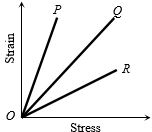
- A
Elasticity of wire $P$ is maximum
- B
Elasticity of wire $Q$ is maximum
- C
Tensile strength of $ R$ is maximum
- ✓
None of the above is true
AnswerCorrect option: D. None of the above is true
d
(d) As stress is shown on $x-$axis and strain on $y-$axis
So we can say that $Y = \cot \theta = \frac{1}{{\tan \theta }} = \frac{1}{{{\rm{slope}}}}$
So elasticity of wire $P$ is minimum and of wire $R$ is maximum
View full question & answer→MCQ 1701 Mark
The diagram shows a force-extension graph for a rubber band. Consider the following statements
$I.$ It will be easier to compress this rubber than expand it
$II.$ Rubber does not return to its original length after it is stretched
$III.$ The rubber band will get heated if it is stretched and released
Which of these can be deduced from the graph
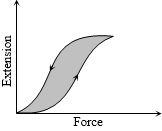
- ✓
$III$ only
- B
$II$ and $III$
- C
$I$ and $III$
- D
$I$ only
AnswerCorrect option: A. $III$ only
a
(a) Area of hysterisis loop gives the energy loss in the process of stretching and unstretching of rubber band and this loss will appear in the form of heating.
View full question & answer→MCQ 1711 Mark
The stress versus strain graphs for wires of two materials $A$ and $B$ are as shown in the figure. If ${Y_A}$ and ${Y_B}$ are the Young ‘s modulii of the materials, then
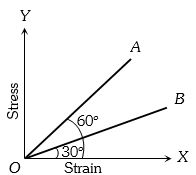
- A
${Y_B} = 2{Y_A}$
- B
${Y_A} = {Y_B}$
- C
${Y_B} = 3{Y_A}$
- ✓
${Y_A} = 3{Y_B}$
AnswerCorrect option: D. ${Y_A} = 3{Y_B}$
d
(d) $\frac{{{Y_A}}}{{{Y_B}}} = \frac{{\tan {\theta _A}}}{{\tan {\theta _B}}} = \frac{{\tan 60}}{{\tan 30}} = \frac{{\sqrt 3 }}{{1/\sqrt 3 }} = 3 \Rightarrow {Y_A} = 3{Y_B}$
View full question & answer→MCQ 1721 Mark
The graph shows the behaviour of a length of wire in the region for which the substance obeys Hook’s law. $P$ and $Q$ represent
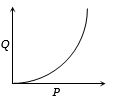
- A
$P =$ applied force, $Q =$ extension
- B
$P =$ extension, $Q =$ applied force
- ✓
$P =$ extension, $Q =$ stored elastic energy
- D
$P =$ stored elastic energy, $Q =$ extension
AnswerCorrect option: C. $P =$ extension, $Q =$ stored elastic energy
c
(c) Graph between applied force and extension will be straight line because in elastic range,
Applied force $\propto$ extension
but the graph between extension and stored elastic energy will be parabolic in nature
As $U = 1/2\,\,k{x^2}$or $U \propto {x^2}$.
View full question & answer→MCQ 1731 Mark
The value of force constant between the applied elastic force $F$ and displacement will be
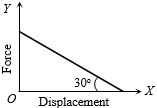
- A
$\sqrt 3 $
- ✓
$\frac{1}{{\sqrt 3 }}$
- C
$\frac{1}{2}$
- D
$\frac{{\sqrt 3 }}{2}$
AnswerCorrect option: B. $\frac{1}{{\sqrt 3 }}$
b
(b) Force constant, $K = tan 30° =$ $1/\sqrt 3 $
View full question & answer→MCQ 1741 Mark
Which one of the following is the Young’s modulus $($in $N/m^2)$ for the wire having the stress-strain curve shown in the figure
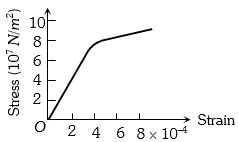
- A
$24 \times {10^{11}}$
- B
$8.0 \times {10^{11}}$
- C
$10 \times {10^{11}}$
- ✓
$2.0 \times {10^{11}}$
AnswerCorrect option: D. $2.0 \times {10^{11}}$
d
(d) Young’s modulus is defined only in elastic region and
$Y = \frac{{{\rm{Stress}}}}{{{\rm{Strain}}}} = \,\frac{{8 \times {{10}^7}}}{{4 \times {{10}^{ - 4}}}} = 2 \times {10^{11}}\,\,N/{m^2}$
View full question & answer→MCQ 1751 Mark
The stress-strain curves for brass, steel and rubber are shown in the figure. The lines $A, B$ and $C$ are for
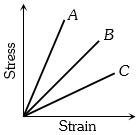
- A
Rubber, brass and steel respectively
- B
Brass, steel and rubber respectively
- ✓
Steel, brass and rubber respectively
- D
Steel, rubber and brass respectively
AnswerCorrect option: C. Steel, brass and rubber respectively
c
(c) $Y = \tan \theta $. According to figure ${\theta _A} > {\theta _B} > {\theta _C}$
i.e. $\tan {\theta _A} > \tan {\theta _B} > \tan {\theta _C}$
or ${Y_A} > {Y_B} > {Y_C}$
$ A, B,$ and $C$ graph are for steel, brass and rubber respectively.
View full question & answer→MCQ 1761 Mark
The load versus strain graph for four wires of the same material is shown in the figure. The thickest wire is represented by the line
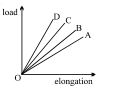
Answerc
If $\mathrm{F}, \mathrm{L}, \mathrm{Y}$ are constant then $\ell \propto(1 / \mathrm{A})$
i.e. $\ell \propto\left(1 / r^{2}\right)$
i.e. for same load, thickest wire (radius is more) will show minimum elongation.
From the graph, minimum elongation is shown by graph $OD.$
Hence OD must be thickness wire's graph.
View full question & answer→MCQ 1771 Mark
The stress versus strain graphs for wires of two materials $A$ and $B$ are as shown in the figure. If $Y_A$ and $Y_B$ are the Young's modulus of the materials, then
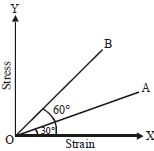
- A
$Y_B = 2Y_A$
- B
$Y_A = Y_B$
- ✓
$Y_B = 3Y_A$
- D
$Y_A = 3Y_B$
AnswerCorrect option: C. $Y_B = 3Y_A$
c
$\frac{{{Y_A}}}{{{Y_B}}} = \frac{{\tan \,{\theta _A}}}{{\tan \,{\theta _B}}} = \frac{{\tan \,{{30}^o}}}{{\tan \,{{60}^o}}} = \frac{{1/\sqrt 3 }}{{\sqrt 3 }} = \frac{1}{3} \Rightarrow {Y_B} = 3{Y_A}$
View full question & answer→MCQ 1781 Mark
Stress vs strain curve for the elastic tissue of the aorta, the large tube (vessel) carrying blood from the heart, will be : [stress is proportional to square of the strain for the elastic tissue of the aorta]
Answera
As stress $ \propto $ $strain^2$ hence graph $(a)$ correctly dipicts.
View full question & answer→MCQ 1791 Mark
Consider two wires of same material having their ratio of radii to be $2: 1$. If these two wires are stretched by equal force, then the ratio of stress produced in them is
- ✓
$\frac{1}{4}$
- B
$\frac{1}{2}$
- C
$\frac{3}{4}$
- D
$1$
AnswerCorrect option: A. $\frac{1}{4}$
a
(a)
Let $r_1$ and $r_2$ be the radii of two wires, then
$\frac{r_1}{r_2}=\frac{2}{1}$
(given)
We know that,stress $=\frac{F}{A}$
As force applied is same, so
$\frac {(Stress)_1}{(Stress)_2}$=$\frac {A_2}{A_1}=\frac {\pi r_2^2}{\pi r_1^2}$
$=\left(\frac{r_2}{r_1}\right)^2=\left(\frac{1}{2}\right)^2=\frac{1}{4}$
View full question & answer→MCQ 1801 Mark
A metal rod of cross-sectional area $10^{-4} \,m ^{2}$ is hanging in a chamber kept at $20^{\circ} C$ with a weight attached to its free end. The coefficient of thermal expansion of the rod is $2.5 \times 10^{-6} \,K ^{-1}$ and its Young's modulus is $4 \times 10^{12} \,N / m ^{2}$. When the temperature of the chamber is lowered to $T$, then a weight of $5000 \,N$ needs to be attached to the rod, so that its length is unchanged. Then, $T$ is ............ $^{\circ} C$
Answera
$(a)$ Length of rod given remains unchanged. This means contraction due to cooling is equals to elongation due to hanging of weight.
As, thermal strain $=$ strain caused by
$\alpha \Delta \theta=\frac{\Delta l}{l}$
$\Rightarrow \Delta \theta=\frac{\Delta l}{l\alpha}=\frac{F}{Y A} \quad\left(\because Y=\frac{F l }{A\Delta l}\right)$
$\Rightarrow \Delta \theta=\frac{5000}{4 \times 10^{12} \times 10^{-4} \times 2.5 \times 10^{-6}}=5^{\circ} C$
Note $\Delta \theta$ in $K$ is same as $\Delta \theta$ in ${ }^{\circ} C$.
$\therefore 20-T=5^{\circ} C \text { or } T=15^{\circ} C$
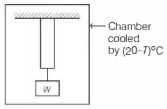
View full question & answer→MCQ 1811 Mark
A horizontal steel railroad track has a length of $100 \,m$, when the temperature is $25^{\circ} C$. The track is constrained from expanding or bending. The stress on the track on a hot summer day, when the temperature is $40^{\circ} C$ is ............. $\times 10^7\,Pa$ (Note : The linear coefficient of thermal expansion for steel is $1.1 \times 10^{-5} /{ }^{\circ} C$ and the Young's modulus of steel is $2 \times 10^{11} \,Pa$ )
Answerc
(c)
As the steel rail is contrained from expansion, the expansion pressure causes stress in the steel rail.
Thermal stress depends upon coefficient of expansion $\alpha$ and rise of temperature $\Delta T$.
$\therefore$ 'Thermal stress, $\sigma \propto \alpha \Delta T$
$\Rightarrow \sigma=Y \cdot \alpha \cdot \Delta T$ (where, $Y=$ Young's modulus)
$\therefore \sigma =2 \times 10^{11} \times 11 \times 10^{-5} \times(40-25)$
$=3.3 \times 10^7 \,Pa$
View full question & answer→MCQ 1821 Mark
One end of a slack wire (Young's modulus $Y$, length $L$ and cross-sectional area $A$ ) is clamped to a rigid wall and the other end to a block (mass $m$ ), which rests on a smooth horizontal plane. The block is set in motion with a speed $v$. What is the maximum distance, then the block will travel after the wire becomes taut?
- ✓
$v \sqrt{\frac{m L}{A Y}}$
- B
$v \sqrt{\frac{2 m L}{A Y}}$
- C
$v \sqrt{\frac{m L}{2 A Y}}$
- D
$L \sqrt{\frac{m v}{A Y}}$
AnswerCorrect option: A. $v \sqrt{\frac{m L}{A Y}}$
a
(a)
Kinetic energy of block is converted into potential energy of stretched wire.
$\Rightarrow \quad \frac{1}{2} m v^2=\frac{1}{2} \text { Stress } \times \text { Strain } \times \text { Volume }$
$\Rightarrow m v^2=\frac{\text { Stress }}{\text { Strain }} \times(\text { Strain })^2 \times \text { Volume }$
$\Rightarrow m v^2=Y \times \frac{\Delta l^2}{L^2} \times A \times L \Rightarrow \Delta l^2=\frac{m v^2 L}{A Y}$
$\therefore \quad \Delta l=v \sqrt{\frac{m L}{A Y}}$
So, distance travelled by block in stretching the wire is $\Delta l=v \sqrt{\frac{m L}{A Y}}$.
View full question & answer→MCQ 1831 Mark
A solid expands upon heating because
- ✓
the potential energy of interaction between atoms in the solid is asymmetric about the equilibrium positions of atoms
- B
the frequency of vibration of the atoms increases
- C
the heating generates a thermal gradient between opposite sides
- D
a fluid called the caloric flows into the interatomic spacing of the solid during heating there by expanding it
AnswerCorrect option: A. the potential energy of interaction between atoms in the solid is asymmetric about the equilibrium positions of atoms
a
(a)
Potential energy versus separation plot for two atoms in a solid is as shown below.
From above graph, we see that as temperature rises $\left(T_3 > T_2 > T_1\right)$, total energy of atoms also increases $\left(E_3 > E_2 > E_1\right)$
As a result, mean separation between atoms also increases $\left(r_3 > r_2 > r_1\right)$.
Hence, crystalline solids in general expands on heating.
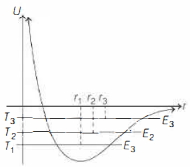
View full question & answer→MCQ 1841 Mark
The bulk modulus of a gas is defined as $B=-V d p / d V$. For an adiabatic process the variation of $B$ is proportional to $p^n$. For an ideal gas $n$ is
Answerb
(b)
Adiabatic bulk modulus for an ideal gas is
$\quad K=\frac{d p}{-d V / V}=-V\left(\frac{d p}{d V}\right)$
$\quad=\gamma P \quad \dots(i)$
Now given,
$\quad K \propto p^n \quad \dots(ii)$
$\therefore$ From Eqs. $(i)$ and $(ii)$, we have
$\Rightarrow \quad n=1$
View full question & answer→MCQ 1851 Mark
Given below are two statements: one is labelled as Assertion$(A)$ and the other is labelled as Reason $(R).$
$Assertion$ $(A)$ : In Vernier calliper if positive zero error exists, then while taking measurements, the reading taken will be more than the actual reading.
$Reason$ $(R)$ : The zero error in Vernier Calliper might have happened due to manufacturing defect or due to rough handling.
In the light of the above statements, choose the correct answer from the options given below :
- A
Both $(A)$ and $(R)$ are correct and $(R)$ is the correct explanation of $(A)$
- ✓
Both $(A)$ and $(R)$ are correct but $(R)$ is not the correct explanation of $(A)$
- C
$(A)$ is true but $(R)$ is false
- D
$(A)$ is false but $(R)$ is true
AnswerCorrect option: B. Both $(A)$ and $(R)$ are correct but $(R)$ is not the correct explanation of $(A)$
b
Assertion Reason both are correct Theory
View full question & answer→MCQ 1861 Mark
Two blocks of mass $2 \mathrm{~kg}$ and $4 \mathrm{~kg}$ are connected by a metal wire going over a smooth pulley as shown in figure. The radius of wire is $4.0 \times 10^{-5}$ $\mathrm{m}$ and Young's modulus of the metal is $2.0 \times 10^{11} \mathrm{~N} / \mathrm{m}^2$. The longitudinal strain developed in the wire is $\frac{1}{\alpha \pi}$. The value of $\alpha$ is [Use $\mathrm{g}=10 \mathrm{~m} / \mathrm{s}^2$ )
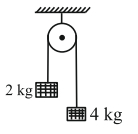
Answerd
$\mathrm{T}=\left(\frac{2 \mathrm{~m}_1 \mathrm{~m}_2}{\mathrm{~m}_1+\mathrm{m}_2}\right) \mathrm{g}=\frac{80}{3} \mathrm{~N}$
$\mathrm{~A}=\pi \mathrm{r}^2=16 \pi \times 10^{-10} \mathrm{~m}^2$
$\text { Strain }=\frac{\Delta \ell}{\ell}=\frac{\mathrm{F}}{\mathrm{AY}}=\frac{\mathrm{T}}{\mathrm{AY}}$
$=\frac{80 / 3}{16 \pi \times 10^{-10} \times 2 \times 10^{11}}=\frac{1}{12 \pi}$
$\alpha=12$
View full question & answer→MCQ 1871 Mark
The density and breaking stress of a wire are $6 \times$ $10^4 \mathrm{~kg} / \mathrm{m}^3$ and $1.2 \times 10^8 \mathrm{~N} / \mathrm{m}^2$ respectively. The wire is suspended from a rigid support on a planet where acceleration due to gravity is $\frac{1^{\text {rd }}}{3}$ of the value on the surface of earth. The maximum length of the wire with breaking is ............ $\mathrm{m}$ (take, $\mathrm{g}=$ $\left.10 \mathrm{~m} / \mathrm{s}^2\right)$
Answera
$\mathrm{T}=\mathrm{mg}$
$\sigma=\frac{\mathrm{T}}{\mathrm{A}}=\frac{\mathrm{mg}}{\mathrm{A}}$
$\frac{(\sigma \mathrm{A} \ell) \mathrm{g}}{\mathrm{A}}$
$\Rightarrow \ell=\frac{\sigma}{\rho \mathrm{g}}=\frac{1.2 \times 10^8 \times 3}{6 \times 10^4 \times 10}=600$
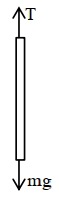
View full question & answer→MCQ 1881 Mark
A wire of length $L$ and radius $r$ is clamped at one end. If its other end is pulled by a force $F$, its length increases by $l$. If the radius of the wire and the applied force both are reduced to half of their original values keeping original length constant, the increase in length will become.
- A
$3$ times
- B
$3 / 2$ times
- C
$4$ times
- ✓
$2$ times
AnswerCorrect option: D. $2$ times
d
$ \mathrm{Y}=\frac{\text { stress }}{\text { strain }} $
$ \mathrm{Y}=\frac{\frac{\mathrm{F}}{\mathrm{r}^2}}{\frac{\ell}{\mathrm{L}}} $
$ \mathrm{F}=\mathrm{Y} \pi \mathrm{r}^2 \times \frac{\ell}{\mathrm{L}} $ $...........(i)$
$ \mathrm{Y}=\frac{\frac{\pi \mathrm{r}^2 / 4}{\Delta \ell}}{\mathrm{L}} $
$ \mathrm{F}=\mathrm{Y} \frac{\Delta \ell}{\mathrm{L}} \times 2 \times \frac{\pi \mathrm{r}^2}{4} $
$ \text { From }(\mathrm{i}) $
$ \mathrm{Y} \pi \mathrm{r}^2 \frac{\ell}{\mathrm{L}}=\mathrm{Y} \frac{\Delta \ell}{\mathrm{L}} \frac{\pi \mathrm{r}^2}{2} $
$ \Delta \ell=2 \ell$
View full question & answer→MCQ 1891 Mark
Two metallic wires $P$ and $Q$ have same volume and are made up of same material. If their area of cross sections are in the ratio $4: 1$ and force $F_1$ is applied to $\mathrm{P}$, an extension of $\Delta l$ is produced. The force which is required to produce same extension in $Q$ is $\mathrm{F}_2$.The value of $\frac{\mathrm{F}_1}{\mathrm{~F}_2}$ is__________.
Answera
$ \mathrm{Y}=\frac{\text { Stress }}{\text { Strain }}=\frac{\mathrm{F} / \mathrm{A}}{\Delta \ell / \ell}=\frac{\mathrm{F} \ell}{\mathrm{A} \Delta \ell} $
$ \Delta \ell=\frac{\mathrm{F} \ell}{\mathrm{AY}} $
$ \mathrm{V}=\mathrm{A} \ell \Rightarrow \ell=\frac{\mathrm{V}}{\mathrm{A}} $
$ \Delta \ell=\frac{\mathrm{FV}}{\mathrm{A}^2 \mathrm{Y}}$
$Y$ & $V$ is same for both the wires
$ \Delta \ell \propto \frac{\mathrm{F}}{\mathrm{A}^2} $
$ \frac{\Delta \ell_1}{\Delta \ell_2}=\frac{\mathrm{F}_1}{\mathrm{~A}_1^2} \times \frac{\mathrm{A}_2^2}{\mathrm{~F}_2} $
$ \Delta \ell_1=\Delta \ell_2 $
$ \mathrm{~F}_1 \mathrm{~A}_2^2=\mathrm{F}_2 \mathrm{~A}_1^2 $
$ \frac{\mathrm{F}_1}{\mathrm{~F}_2}=\frac{\mathrm{A}_1^2}{\mathrm{~A}_2^2}=\left(\frac{4}{1}\right)^2=16$
View full question & answer→MCQ 1901 Mark
Young's modules of material of a wire of length ' $L$ ' and cross-sectional area $A$ is $Y$. If the length of the wire is doubled and cross-sectional area is halved then Young's $modules$ will be :
- A
$\frac{Y}{4}$
- B
$4\ Y$
- ✓
$\mathrm{Y}$
- D
$2\ \mathrm{Y}$
AnswerCorrect option: C. $\mathrm{Y}$
c
Young's modulus depends on the material not length and cross sectional area. So young's modulus remains same.
View full question & answer→MCQ 1911 Mark
Each of three blocks $P$, $Q$ and $R$ shown in figure has a mass of $3 \mathrm{~kg}$. Each of the wire $A$ and $B$ has cross-sectional area $0.005 \mathrm{~cm}^2$ and Young's modulus $2 \times 10^{11} \mathrm{~N} \mathrm{~m}^{-2}$. Neglecting friction, the longitudinal strain on wire $B$ is____________ $\times 10^{-4}$. $\left(\right.$ Take $\mathrm{g}=10 \mathrm{~m} / \mathrm{s}^2$ )
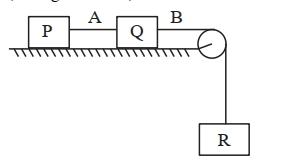
Answerd
$ a=\frac{10}{3} \mathrm{~m} / \mathrm{s}^2 $
$ 30-T_1=3 \times a $
$ T_1=20 \mathrm{~N} $
$ \text { strain }=\frac{\text { stress }}{Y} $
$ =2 \times 10^{-4}$
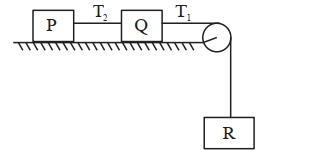
View full question & answer→MCQ 1921 Mark
With rise in temperature, the Young's modulus of elasticity
MCQ 1931 Mark
One end of a metal wire is fixed to a ceiling and a load of $2 \mathrm{~kg}$ hangs from the other end. A similar wire is attached to the bottom of the load and another load of $1 \mathrm{~kg}$ hangs from this lower wire. Then the ratio of longitudinal strain of upper wire to that of the lower wire will be____________.
[Area of cross section of wire $=0.005 \mathrm{~cm}^2$, $\mathrm{Y}=2 \times 10^{11}\ \mathrm{Nm}^{-2}$ and $\left.\mathrm{g}=10 \mathrm{~ms}^{-2}\right]$
Answerd
$\Delta \mathrm{L}=\frac{\mathrm{FL}}{\mathrm{AY}}$
$\frac{\Delta \mathrm{L}}{\mathrm{L}}=\frac{\mathrm{F}}{\mathrm{AY}}$
$\frac{\frac{\Delta \mathrm{L}_1}{\mathrm{~L}_1}}{\frac{\Delta \mathrm{L}_2}{\mathrm{~L}_2}}=\frac{\mathrm{F}_1}{\mathrm{~F}_2}=\frac{30}{10}=3$
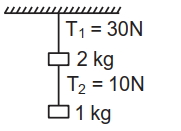
View full question & answer→MCQ 1941 Mark
A wire of cross sectional area $A$, modulus of elasticity $2 \times 10^{11} \mathrm{Nm}^{-2}$ and length $2 \mathrm{~m}$ is stretched between two vertical rigid supports. When a mass of $2 \mathrm{~kg}$ is suspended at the middle it sags lower from its original position making angle $\theta=\frac{1}{100}$ radian on the points of support. The value of $A$ is. . . . . . $\times 10^{-4} \mathrm{~m}^2$ (consider $\mathrm{x}<\mathrm{L}$ ).
(given: $\mathrm{g}=10 \mathrm{~m} / \mathrm{s}^2$ )
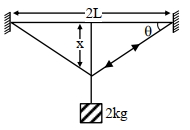
Answerc
In vertical derection $2 \mathrm{~T} \sin \theta=20$
using small angle approximation $\sin \theta=\theta$
$\theta=\frac{1}{100}$
$\therefore \quad \mathrm{T}=\frac{10}{\theta}$
$T=1000 \mathrm{~N}$
Change in length $\Delta \mathrm{L} \quad=2 \sqrt{\mathrm{x}^2+\mathrm{L}^2}-2 \mathrm{~L}$
$=2 \mathrm{~L}\left[1+\frac{\mathrm{x}^2}{2 \mathrm{~L}^2}-1\right]$
$\Delta \mathrm{L} =\frac{\mathrm{x}^2}{\mathrm{~L}}$
$\therefore$ Modulus of elasticity $=\frac{\text { stress }}{\text { strain }}$
$2 \times 10^{11}=\frac{10^3}{\mathrm{~A} \times \frac{\mathrm{x}^2}{\mathrm{~L}}} \times 2 \mathrm{~L}$
$\therefore \quad \mathrm{A}=1 \times 10^{-4} \mathrm{~m}^2$
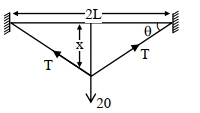
View full question & answer→MCQ 1951 Mark
Young's modulus is determined by the equation given by $\mathrm{Y}=49000 \frac{\mathrm{m}}{\ell} \frac{\text { dyne }}{\mathrm{cm}^2}$ where $\mathrm{M}$ is the mass and $\ell$ is the extension of wre used in the experiment. Now error in Young modules $(\mathrm{Y})$ is estimated by taking data from $M-\ell$ plot in graph paper. The smallest scale divisions are $5 \mathrm{~g}$ and $0.02$ $\mathrm{cm}$ along load axis and extension axis respectively. If the value of $M$ and $\ell$ are $500 \mathrm{~g}$ and $2 \mathrm{~cm}$ respectively then percentage error of $\mathrm{Y}$ is :
- A
$0.2 \%$
- B
$0.02 \%$
- ✓
$2 \%$
- D
$0.5 \%$
AnswerCorrect option: C. $2 \%$
c
$\frac{\Delta \mathrm{Y}}{\mathrm{Y}} =\frac{\Delta \mathrm{m}}{\mathrm{m}}+\frac{\Delta \ell}{\ell}$
$=\frac{5}{500}+\frac{0.02}{2}=0.01+0.01$
$\frac{\Delta \mathrm{Y}}{\mathrm{Y}} =0.02 \Rightarrow \% \frac{\Delta \mathrm{Y}}{\mathrm{Y}}=2 \%$
View full question & answer→MCQ 1961 Mark
Two persons pull a wire towards themselves. Each person exerts a force of $200 \mathrm{~N}$ on the wire. Young's modulus of the material of wire is $1 \times 10^{11} \mathrm{~N} \mathrm{~m}^{-2}$. Original length of the wire is $2 \mathrm{~m}$ and the area of cross section is $2 \mathrm{~cm}^2$. The wire will extend in length by . . . . . . . .$\mu \mathrm{m}$.
Answerc
$\frac{\mathrm{F}}{\mathrm{A}}=\mathrm{Y} \frac{\Delta \ell}{\ell} \Rightarrow \Delta \ell=\frac{\mathrm{F} \ell}{\mathrm{AY}}$
$\Delta \ell=\frac{200 \times 2}{2 \times 10^{-4} \times 10^{11}}=2 \times 10^{-5}=20 \mu$

View full question & answer→MCQ 1971 Mark
If average depth of an ocean is $4000 \mathrm{~m}$ and the bulk modulus of water is $2 \times 10^9 \mathrm{Nm}^{-2}$, then fractional compression $\frac{\Delta V}{V}$ of water at the bottom of ocean is $\alpha \times 10^{-2}$. The value of $\alpha$ is ___________(Given, $\mathrm{g}=10 \mathrm{~ms}^{-2}, \rho=1000 \mathrm{~kg} \mathrm{~m}^{-3}$ )
Answerb
$ \mathrm{B}=-\frac{\Delta \mathrm{P}}{\left(\frac{\Delta \mathrm{V}}{\mathrm{V}}\right)} $
$ -\left(\frac{\Delta \mathrm{V}}{\mathrm{V}}\right)=\frac{\rho \mathrm{gh}}{\mathrm{B}}=\frac{1000 \times 10 \times 4000}{2 \times 10^9} $
$ =2 \times 10^{-2}[-\mathrm{ve} \text { sign represent compression }]$
View full question & answer→MCQ 1981 Mark
The depth below the surface of sea to which a rubber ball be taken so as to decrease its volume by $0.02 \%$ is______ $\mathrm{m}$.
(Take density of sea water $=10^3 \mathrm{kgm}^{-3}$, Bulk modulus of rubber $=9 \times 10^8 \mathrm{Nm}^{-2}$, and $\mathrm{g}=10 \mathrm{~ms}^{-2}$ )
Answerd
$\beta=\frac{-\Delta \mathrm{P}}{\frac{\Delta \mathrm{V}}{\mathrm{V}}}$
$\Delta \mathrm{P}=-\beta \frac{\Delta \mathrm{V}}{\mathrm{V}}$
$\rho \mathrm{gh}=-\beta \frac{\Delta \mathrm{V}}{\mathrm{V}}$
$10^3 \times 10 \times \mathrm{h}=-9 \times 10^8 \times\left(-\frac{0.02}{100}\right)$
$\Rightarrow \mathrm{h}=18 \mathrm{~m}$
View full question & answer→MCQ 1991 Mark
Match List-$I$ with List-$II$ :
| List-$I$ |
List-$II$ |
| $(A)$ A force thatrestores anelastic body of unit area to its original state |
$(I)$ Bulkmodulus |
| $(B)$ Two equal andopposite forcesparallel toopposite faces |
$(II)$Young'smodulus |
| $(C)$Forcesperpendiculareverywhere tothe surface perunit areasameeverywhere |
$(III)$ Stress |
| $(D)$Two equal andopposite forceperpendicular toopposite faces |
$(IV)$ Shearmodulus |
Choose the correct answer from the options given below:
- A
$(A)-(II), (B)-(IV), (C)-(I), (D)-(III) $
- B
$(A)-(IV), (B)-(II), (C)-(III), (D)-(I) $
- ✓
$(A)-(III), (B)-(IV), (C)-(I), (D)-(II) $
- D
$(A)-(III), (B)-(I), (C)-(II), (D)-(IV)$
AnswerCorrect option: C. $(A)-(III), (B)-(IV), (C)-(I), (D)-(II) $
c
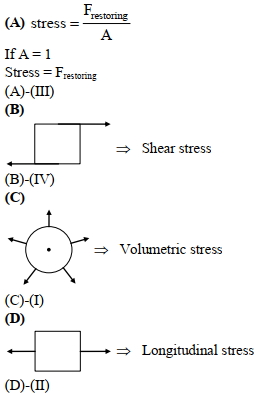
View full question & answer→MCQ 2001 Mark
A metal block of mass $m$ is suspended from a rigid support through a metal wire of diameter $14\,mm$. The tensile stress developed in the wire under equilibrium state is $7 \times 10^5\,Nm ^{-2}$. The value of mass $m$ is $......kg$.
(Take, $g =9.8\,ms ^{-2}$ and $\left.\pi=\frac{22}{7}\right)$
Answerc
Tensile stress, $\sigma=\frac{F}{A}=\frac{4 m g}{\pi D^2}$
$\therefore m=\frac{\pi D^2 \sigma}{4 g}$
$=\frac{22}{7} \times \frac{\left(14 \times 10^{-3}\right)^2 \times 7 \times 10^5}{4 \times 9.8}$
$=11\,kg$
View full question & answer→MCQ 2011 Mark
A force is applied to a steel wire ' $A$ ', rigidly clamped at one end. As a result elongation in the wire is $0.2\,mm$. If same force is applied to another steel wire ' $B$ ' of double the length and a diameter $2.4$ times that of the wire ' $A$ ', the elongation in the wire ' $B$ ' will be $............\times 10^{-2}\,mm$ (wires having uniform circular cross sections)
- A
$6.06$
- B
$2.77$
- C
$3.0$
- ✓
$6.9$
Answerd
$Y =\frac{ F / A }{\frac{\Delta \ell}{\ell}}$
$\Rightarrow F =\frac{ YA }{\ell} \Delta \ell$
$\left(\frac{ A \Delta \ell}{\ell}\right)_1=\left(\frac{ A \Delta \ell}{\ell}\right)_2$ $\Rightarrow \frac{\Delta \ell_2}{\Delta \ell_1}=\frac{ A _1}{ A _2} \times \frac{\ell_2}{\ell_1}$
$\Rightarrow \frac{\Delta \ell_2}{0.2}=\frac{1}{2.4 \times 2.4} \times \frac{2}{1}$ $\Rightarrow \Delta \ell_2=6.9 \times 10^{-2}\,mm$
View full question & answer→MCQ 2021 Mark
Under the same load, wire $A$ having length $5.0\,m$ and cross section $2.5 \times 10^{-5}\,m ^2$ stretches uniformly by the same amount as another wire $B$ of length $6.0\,m$ and a cross section of $3.0 \times 10^{-5}\,m ^2$ stretches. The ratio of the Young's modulus of wire $A$ to that of wire $B$ will be
- A
$1:4$
- ✓
$1:1$
- C
$1:10$
- D
$1:2$
View full question & answer→MCQ 2031 Mark
The Young's modulus of a steel wire of length $6\,m$ and cross-sectional area $3\,mm ^2$, is $2 \times 11^{11}\,N / m ^2$. The wire is suspended from its support on a given planet. A block of mass $4\,kg$ is attached to the free end of the wire. The acceleration due to gravity on the planet is $\frac{1}{4}$ of its value on the earth. The elongation of wire is (Take $g$ on the earth $=10$ $\left.m / s ^2\right):$
- A
$1\,cm$
- B
$1\,mm$
- ✓
$0.1\,mm$
- D
$0.1\,cm$
AnswerCorrect option: C. $0.1\,mm$
c
$\text { Tension }( F )= mg$
$=4 \times \frac{10}{4}=10\,N$
$\Delta L =\frac{ FL }{ AY }$
$=\frac{10 \times 6}{3 \times 10^{-6} \times 2 \times 10^{11}}$
$=10^{-4}\,m =0.1\,mm$
View full question & answer→MCQ 2041 Mark
Young's moduli of the material of wires $A$ and $B$ are in the ratio of $1: 4$, while its area of cross sections are in the ratio of $1: 3$. If the same amount of load is applied to both the wires, the amount of elongation produced in the wires $A$ and $B$ will be in the ratio of
[Assume length of wires $A$ and $B$ are same]
- A
$36: 1$
- ✓
$12: 1$
- C
$1: 36$
- D
$1: 12$
AnswerCorrect option: B. $12: 1$
b
$\Delta L =\frac{ FL }{ AY }$
$\frac{\Delta L_{ A }}{\Delta L _{ B }}=\frac{ A _{ B }}{ A _{ A }} \frac{Y_{ B }}{Y_{ A }}=12$
View full question & answer→MCQ 2051 Mark
The length of wire becomes $l_1$ and $l_2$ when $100\,N$ and $120\,N$ tensions are applied respectively. If $10l_2=11l_1$, the natural length of wire will be $\frac{1}{x} l_1$. Here the value of $x$ is ........
Answerb
Let the original length be ' $\ell_0$ '
When $T _1=100\,N$, Extension $=\ell_1-\ell_0$
When $T _2=120\,N$, Extension $=\ell_2-\ell_0$
Then $100= K \left(\ell_1-\ell_0\right)$
And $120= K \left(\ell_2-\ell_0\right)$
$\frac{1}{2} \Rightarrow \frac{5}{6}=\frac{\ell_1-\ell_0}{\ell_2-\ell_0}$
$5 \ell_2-5 \ell_0=6 \ell_1-6 \ell_0$
$\ell_0=6 \ell_1-5 \ell_2$
$\ell_0=6 \ell_1-5\left(\frac{11 \ell_1}{10}\right)$
$\ell_0=6 \ell_1-\frac{11 \ell_1}{2}$
$\ell_0=\frac{\ell_1}{2}$
$\therefore x=2$
View full question & answer→MCQ 2061 Mark
A wire of length $L$ and radius $r$ is clamped rigidly at one end. When the other end of the wire is pulled by a force $f$, its length increases by $l$. Another wire of same material of length $2 L$ and radius $2 r$ is pulled by a force $2 f$. Then the increase in its length will be
- A
$2\,l$
- ✓
$l$
- C
$4 \ l$
- D
$l / 2$
Answerb
$\frac{2 f }{\pi(2 r )^2}= Y \frac{\ell^{\prime}}{2 L }$
$\Rightarrow \frac{2}{1}=\frac{2 \ell^{\prime}}{\ell} \Rightarrow \ell^{\prime}=\ell$
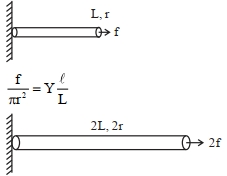
View full question & answer→MCQ 2071 Mark
A certain pressure $P$ is applied to $1$ litre of water and $2$ litre of a liquid separately. Water gets compressed to $0.01 \%$ whereas the liquid gets compressed to $0.03 \%$. The ratio of Bulk modulus of water to that of the liquid is $\frac{3}{x}$. The value of $x$ is $...........$
Answerb
$B_{\text {water }}=\frac{-\Delta P}{\left(\frac{\Delta V}{V}\right)}=\frac{-\Delta P}{\frac{0.01}{100}}$
$B_{\text {liquid }}=\frac{-\Delta P}{\frac{0.03}{100}}$
$\frac{B_{\text {water }}}{B_{\text {liquid }}}=3$
$x=1$
View full question & answer→MCQ 2081 Mark
The elastic potential energy stored in a steel wire of length $20\,m$ stretched through $2 \,m$ is $80\,J$. The cross sectional area of the wire is $.........\,mm ^2$ (Given, $y =2.0 \times 10^{11}\,Nm ^{-2}$ )
Answerc
Energy per unit volume $=\frac{1}{2} \text { stress } \times \text { strain }$
Energy $=\frac{1}{2} \text { stress } \times \text { strain } \times \text { volume }$
$80=\frac{1}{2} \times Y \times \text { strain }^2 A \times \ell$
$80=\frac{1}{2} \times 2 \times 10^{11} \times \frac{\left(2 \times 10^{-2}\right)^2}{400} \times A \times 20$
$20=\frac{10^{+\prime}}{20} \times A$
$40 \times 10^{-6} m ^2=A$
$A=40\,mm ^2$
View full question & answer→MCQ 2091 Mark
Choose the correct relationship between Poisson ratio $(\sigma)$. bulk modulus $( K )$ and modulus of rigidity $(\eta)$ of a given solid object:
- ✓
$\sigma=\frac{3 K -2 \eta}{6 K +2 \eta}$
- B
$\sigma=\frac{6 K +2 \eta}{3 K -2 \eta}$
- C
$\sigma=\frac{3 K+2 \eta}{6 K+2 \eta}$
- D
$\sigma=\frac{6 K -2 \eta}{3 K -2 \eta}$
AnswerCorrect option: A. $\sigma=\frac{3 K -2 \eta}{6 K +2 \eta}$
a
$Y =3 \eta(1+\sigma)$
$Y =3 K (1-\sigma)$
$\Rightarrow 2 \eta(1+\sigma)=3 K (1-2 \sigma)$
$\Rightarrow \sigma=\left(\frac{3 K -2 \eta}{6 K +2 \eta}\right)$
View full question & answer→MCQ 2101 Mark
Given below are two statements: one is labelled as Assertion $A$ and the other is labelled as Reason $R$
Assertion $A$: Steel is used in the construction of buildings and bridges.
Reason $R:$ Steel is more elastic and its elastic limit is high.
In the light of above statements, choose the most appropriate answer from the options given below
- A
Both $A$ and $R$ are correct but $R$ is NOT the correct explanation of $A$
- B
$A$ is not correct but $R$ is correct
- ✓
Both $A$ and $R$ are correct and $R$ is the correct explanation of $A$
- D
$A$ is correct but $R$ is not correct
AnswerCorrect option: C. Both $A$ and $R$ are correct and $R$ is the correct explanation of $A$
View full question & answer→MCQ 2111 Mark
A $100\,m$ long wire having cross-sectional area $6.25 \times 10^{-4}\,m ^2$ and Young's modulus is $10^{10}\,Nm ^{-2}$ is subjected to a load of $250\,N$, then the elongation in the wire will be :
- A
$6.25 \times 10^{-3}\,m$
- B
$4 \times 10^{-4}\,m$
- C
$6.25 \times 10^{-6}\,m$
- ✓
$4 \times 10^{-3}\,m$
AnswerCorrect option: D. $4 \times 10^{-3}\,m$
d
Elongation in wire $\delta=\frac{ F \ell}{ AY }$
$\delta=\frac{250 \times 100}{6.25 \times 10^{-4} \times 10^{10}}$
$\delta=4 \times 10^{-3}\,m$
View full question & answer→MCQ 2121 Mark
As shown in the figure, in an experiment to determine Young's modulus of a wire, the extension-load curve is plotted. The curve is a straight line passing through the origin and makes an angle of $45^{\circ}$ with the load axis. The length of wire is $62.8\,cm$ and its diameter is $4\,mm$. The Young's modulus is found to be $x \times$ $10^4\,Nm ^{-2}$. The value of $x$ is
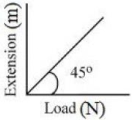
Answerd
From graph:
$F =\Delta L$
$Y =\frac{ FL }{ A \Delta L }$
$Y =\frac{ L }{ A }$
$Y =\frac{62.8 \times 10^{-2}}{\pi\left(2 \times 10^{-3}\right)^2}$
$Y =5 \times 10^4\,N / m ^2$
View full question & answer→MCQ 2131 Mark
A steel rod has a radius of $20\,mm$ and a length of $2.0\,m$. A force of $62.8\,kN$ stretches it along its length. Young's modulus of steel is $2.0 \times 10^{11}\,N / m ^2$. The longitudinal strain produced in the wire is $..........\times 10^{-5}$
Answerd
$\text {Strain}=\frac{\text { stress }}{Y}=\frac{\frac{62.8 \times 10^3}{\pi \times(0.02)^2}}{2 \times 10^{11}}$
$=\frac{62.8 \times 10^3}{3.14 \times 4 \times 10^{-4} \times 2 \times 10^{11}}$
$=2.5 \times 10^{-4}$
$=25 \times 10^{-5}$
View full question & answer→MCQ 2141 Mark
A steel rod of length $1\,m$ and cross sectional area $10^{-4}\,m ^2$ is heated from $0^{\circ}\,C$ to $200^{\circ}\,C$ without being allowed to extend or bend. The compressive tension produced in the rod is $........\times 10^4\,N$ (Given Young's modulus of steel $=2 \times 10^{11}\,Nm ^{-2}$, coefficient of linear expansion $=10^{-5}\, K ^{-1}$.
Answera
$\text { Stress }=Y \times \text { strain }$
$\text { Stress }=Y \times \frac{\Delta \ell}{\ell}$
$= Y \times \frac{\ell \alpha \Delta T }{\ell}= Y \alpha \Delta T$
$\text { Compressive Tension }=\text { Stress } \times \text { Area of cross section }$
$= YA \alpha \Delta T =4 \times 10^4\,N$
View full question & answer→MCQ 2151 Mark
An aluminium rod with Young's modulus $Y =7.0$ $\times 10^{10} N / m ^2$ undergoes elastic strain of $0.04 \%$. The energy per unit volume stored in the rod in SI unit is:
- ✓
$5600$
- B
$8400$
- C
$2800$
- D
$11200$
AnswerCorrect option: A. $5600$
a
$Y =7 \times 10^{10}\,N / m ^2$
$\text { Strain }=\frac{0.04}{100}$
$\text { Energy }=\frac{1}{2}\left(\frac{ YA }{l}\right) \Delta x ^2$
$\text { Energy }=\frac{1}{2} YA \left(\frac{\Delta x }{l}\right)^2 \times l$
$\frac{ E }{ V }=\frac{1}{2} \times Y \times \operatorname{strain}{ }^2$
$=\frac{1}{2} \times 7 \times 10^{10} \times \frac{0.04 \times 0.04}{10^4}=56 \times 10^2$
View full question & answer→MCQ 2161 Mark
Two wires each of radius $0.2\,cm$ and negligible mass, one made of steel and other made of brass are loaded as shown in the figure. The elongation of the steel wire is $.........\times 10^{-6}\,m$. [Young's modulus for steel $=2 \times 10^{11}\,Nm ^{-2}$ and $g =10\,ms ^{-2}$ ]
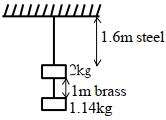
Answerd
Tension in steel wire $\quad T _2=2 g + T _1$
$T _2=20+11.4$
$=31.4\,N$
Elongation in steel wire $\Delta L =\frac{ T _2 L }{ Ay }$
$\Delta L =\frac{31.4 \times 1.6}{\pi\left(0.2 \times 10^{-2}\right)^2 \times 2 \times 10^{11}}$
$\Delta L =\frac{16}{2 \times 4 \times 10^{-5} \times 10^{11}}$
$=2 \times 10^{-5}\,m$
$=20 \times 10^{-6}\,m$
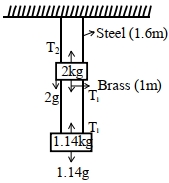
View full question & answer→MCQ 2171 Mark
The area of cross section of the rope used to lift a load by a crane is $2.5 \times 10^{-4} m ^{2}$. The maximum lifting capacity of the crane is $10$ metric tons. To increase the lifting capacity of the crane to $25$ metric tons, the required area of cross section of the rope should be.$.........\times 10^{-4} \,m ^{2}$ (take $g =10\, ms ^{-2}$ )
AnswerCorrect option: A. $6.25$
a
Since breaking stress (Maximum lifting capacity) is the property of material so it will remain same. breaking stress $=\frac{\text { Maximum lifting capacity }}{\text { Area of cross section of rope }}$ $\frac{10}{2.5 \times 10^{-4}}=\frac{25}{ A }$
$A =625 \times 10^{-6}$
$=6.25 \times 10^{-4} m ^{2}$
View full question & answer→MCQ 2181 Mark
The elongation of a wire on the surface of the earth is $10^{-4} \; m$. The same wire of same dimensions is elongated by $6 \times 10^{-5} \; m$ on another planet. The acceleration due to gravity on the planet will be $\dots \; ms ^{-2}$. (Take acceleration due to gravity on the surface of earth $=10 \; m / s ^{-2}$ )
Answerd
$\Delta \ell \propto g$
$\frac{\Delta \ell_{\text {earth }}}{\Delta \ell_{\text {planet }}}=\frac{g_{\text {earth }}}{g_{\text {planet }}}=\frac{10^{-4}}{6 \times 10^{-5}}$
$g_{planet} = 6 \; m / s ^{-2}$
Ans. $6.00$
View full question & answer→MCQ 2191 Mark
A wire of length $L$ and radius $r$ is clamped rigidly at one end. When the other end of the wire is pulled by a force $F$, its length increases by $5\,cm$. Another wire of the same material of length $4 L$ and radius $4\,r$ is pulled by a force $4\,F$ under same conditions. The increase in length of this wire is $....cm$.
Answerd
$\Delta \ell_{1}=\frac{ F \ell}{ AY }=\frac{ F \ell}{\pi r ^{2} Y }=5\,cm$
$\Delta \ell_{2}=\frac{4 F 4 \ell}{\pi 16 r ^{2} Y }=\frac{ F \ell}{\pi r ^{2} Y }=5\,cm$
View full question & answer→MCQ 2201 Mark
A steel wire of length $3.2 m \left( Y _{ S }=2.0 \times 10^{11}\,Nm ^{-2}\right)$ and a copper wire of length $4.4\,M$ $\left( Y _{ C }=1.1 \times 10^{11}\,Nm ^{-2}\right)$, both of radius $1.4\,mm$ are connected end to end. When stretched by a load, the net elongation is found to be $1.4\,mm$. The load applied, in Newton, will be. (Given $\pi=\frac{22}{7}$)
- A
$360$
- B
$180$
- C
$1080$
- ✓
$154$
Answerd
$\Delta \ell_{1}+\Delta \ell_{2}=\Delta \ell$
$\frac{ F \ell_{1}}{ A _{1} y _{1}}+\frac{ F \ell_{2}}{ A _{2} y _{2}}=\Delta \ell$
$F =\frac{\Delta \ell}{\frac{\ell_{1}}{ A _{1} y _{1}}+\frac{\ell_{2}}{ A _{2} y _{2}}}=1.54 \times 10^{2}=154$
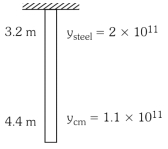
View full question & answer→MCQ 2211 Mark
In an experiment to determine the Young's modulus, steel wires of five different lengths $(1,2,3,4$ and $5\,m )$ but of same cross section $\left(2\,mm ^{2}\right)$ were taken and curves between extension and load were obtained. The slope (extension/load) of the curves were plotted with the wire length and the following graph is obtained. If the Young's modulus of given steel wires is $x \times 10^{11}\,Nm ^{-2}$, then the value of $x$ is
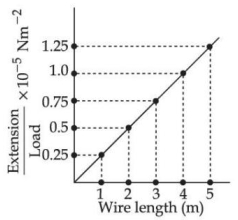
Answerb
Slope $=\frac{\Delta l / W }{ L }=\frac{\Delta l / L }{ w }=\frac{1}{ YA }$
$Y =\frac{1}{\text { (slope) A }}$
$Y =\frac{1}{2 \times 10^{-6}\left(0.25 \times 10^{-5}\right)}$
$Y =2 \times 10^{11} N / m ^{2}$
View full question & answer→MCQ 2221 Mark
The elastic behaviour of material for linear streass and linear strain, is shown in the figure. The energy density for a linear strain of $5 \times 10^{-4}$ is $\dots \; kJ / m ^{3}$. Assume that material is elastic upto the linear strain of $5 \times 10^{-4}$.
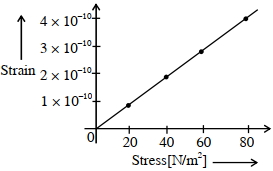
Answerc
$y =\frac{\text { stress }}{\text { strain }}=2.0 \times 10^{10}$
Energy density $=\frac{1}{2} \; stress \; \times \; strain$
$=\frac{1}{2}(\text { strain })^{2} y =\frac{1}{2}\left(5 \times 10^{-4}\right)^{2} \times 20 \times 10^{10}$
$=25 \times 10^{2} \times 10=25 \frac{ kJ }{ m ^{3}}$
Ans. $25$
View full question & answer→MCQ 2231 Mark
The force required to stretch a wire of crosssection $1 cm ^{2}$ to double its length will be ........ $ \times 10^{7}\,N$
(Given Yong's modulus of the wire $=2 \times 10^{11}\,N / m ^{2}$ )
Answerc
$F =Y A \frac{\Delta l}{l}$
$=2 \times 10^{11} \times 10^{-4}\left(\frac{2 l-l}{l}\right)$
$=2 \times 10^{7}\,N$
View full question & answer→MCQ 2241 Mark
If the length of a wire is made double and radius is halved of its respective values. Then, the Young's modules of the material of the wire will :
- ✓
- B
Become $8$ times its initial value
- C
Become $\frac{1^{\text {th }}}{4}$ of its initial value
- D
Become $4$ times its initial value
Answera
$Y$ depends on material of wire
View full question & answer→MCQ 2251 Mark
A square aluminium (shear modulus is $25 \times 10^{9}\,Nm ^{-2}$ ) slab of side $60\,cm$ and thickness $15\,cm$ is subjected to a shearing force (on its narrow face) of $18.0 \times 10^{4}\,N$. The lower edge is riveted to the floor. The displacement of the upper edge is $.......\mu\,m$.
Answerc
$\frac{ F }{ A }=\eta \frac{ x }{\ell} \Rightarrow \frac{ F \ell}{ An }= x$
$x =\frac{18 \times 10^{4} \times 60 \times 10^{-2}}{60 \times 10^{-2} \times 15 \times 10^{-2} \times 25 \times 10^{9}}$
$=48 \times 10^{-6}\,m =48\,\mu m$
View full question & answer→MCQ 2261 Mark
A wire of length $L$ is hanging from a fixed support. The length changes to $L _{1}$ and $L _{2}$ when masses $1 \,kg$ and $2 \,kg$ are suspended respectively from its free end. Then the value of $L$ is equal to ..................
AnswerCorrect option: C. $2 L _{1}- L _{2}$
c
By Hooke's Law
so $F \alpha \Delta L$
$\frac{ F _{1}}{ F _{2}}=\frac{\Delta L _{1}}{\Delta L _{2}}$
$\frac{10}{20}=\frac{\left(L_{1}-L\right)}{\left(L_{2}-L\right)}$
$L =2 L _{1}- L _{2}$
View full question & answer→MCQ 2271 Mark
A metal wire of length $0.5 m$ and cross-sectional area $10^{-4}\; m ^{2}$ has breaking stress $5 \times 10^{8}\; Nm ^{-2}$. A block of $10\; kg$ is attached at one end of the string and is rotating in a horizontal circle. The maximum linear velocity of block will be $ms ^{-1}$.
Answerd
$T =\frac{ mv ^{2}}{\ell}=\frac{10 \times v ^{2}}{0.5}=20\,v ^{2}$
$T _{\max }=$ Breaking stress $\times$ Area
$=5 \times 10^{8} \times 10^{-4}=5 \times 10^{4}$
$20\,V ^{2}=5 \times 10^{4}$
$V=\sqrt{\frac{1}{4} 10^{4}}=50\,m / s$
View full question & answer→MCQ 2281 Mark
A uniform heavy rod of mass $20\,kg$. Cross sectional area $0.4\,m ^{2}$ and length $20\,m$ is hanging from a fixed support. Neglecting the lateral contraction, the elongation in the rod due to its own weight is $x \times 10^{-9} m$. The value of $x$ is
(Given. Young's modulus $Y =2 \times 10^{11} Nm ^{-2}$ અને $\left.g=10\, ms ^{-2}\right)$
Answerb
$Y =\frac{ T }{ A } \frac{ dx }{ dy }$
$m =20\,kg$
$A =0.4\,m^{2}$
$1=20\,m$
let extension is $dy$ in length $dx$
$Y =\frac{\text { stress }}{\text { strain }}$
$Y =\frac{\frac{ T }{ A }}{\frac{ d }{ dx }}=\frac{ T }{ A } \cdot \frac{ dx }{ dy }$
$dy =\frac{ Tdx }{ AY }$
Tension at a distance $x$ from lower end $=\frac{ mg }{\ell} x$
So. $\int_{0}^{\Delta l} dy =\int_{0}^{\ell} \frac{ mg }{\ell} x \frac{ dx }{ AY }$
$\Delta \ell=\frac{ mg }{\ell AY }\left[\frac{ x ^{2}}{2}\right]_{0}^{\ell}$
$\Delta \ell=\frac{ mg \ell}{2\,AY }$
$\Delta \ell=\frac{20 \times 10 \times 20}{2 \times 0.4 \times 2 \times 10^{11}}$
$2500 \times 10^{-11}$
$\Delta \ell=25 \times 10^{-9}$
$= x \times 10^{-9}$
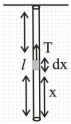
View full question & answer→MCQ 2291 Mark
A string of area of cross-section $4\,mm ^{2}$ and length $0.5$ is connected with a rigid body of mass $2\,kg$. The body is rotated in a vertical circular path of radius $0.5\,m$. The body acquires a speed of $5\,m / s$ at the bottom of the circular path. Strain produced in the string when the body is at the bottom of the circle is $\ldots . . \times 10^{-5}$. (Use Young's modulus $10^{11}\,N / m ^{2}$ and $g =10\,m / s ^{2}$ )
Answerc
Strain $=$ F/AY
$=\frac{ mg +\frac{ mv ^{2}}{ R }}{ AY }$
$=\frac{20+\frac{2(5)^{2}}{0.5}}{3 \times 10^{-6} \times 10^{11}}=30 \times 10^{-5}$
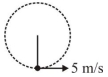
View full question & answer→MCQ 2301 Mark
Two separate wires $A$ and $B$ are stretched by $2 \,mm$ and $4\, mm$ respectively, when they are subjected to a force of $2\, N$. Assume that both the wires are made up of same material and the radius of wire $B$ is 4 times that of the radius of wire $A$. The length of the wires $A$ and $B$ are in the ratio of $a : b$. Then $a / b$ can be expressed as $1 / x$ where $x$ is
Answerd
For $A \frac{ E }{\pi r ^{2}}= y \frac{2 mm }{ a }$ $......(1)$
For B $\frac{ E }{\pi \cdot 16 r ^{2}}= y \frac{4 mm }{ b }$ $..........(2)$
$\therefore(1) /(2)$
$16=\frac{2 b }{4 a }$
$\frac{ a }{ b }=\frac{1}{32}$
$=32$
View full question & answer→MCQ 2311 Mark
A uniform metallic wire is elongated by $0.04\, m$ when subjected to a linear force $F$. The elongation, if its length and diameter is doubled and subjected to the same force will be ..... $cm .$
Answera
$F = Y.A \frac{\Delta \ell}{\ell}$
$\Delta \ell=\frac{ F }{ Y.A } \cdot \ell$
$\Delta \ell=\frac{ F \ell}{ Y \cdot \pi r ^{2}}$
$\Delta \ell \propto \frac{\ell}{ r ^{2}}$
$\frac{\Delta \ell_{2}}{\Delta \ell_{1}}=\left(\frac{\ell_{2}}{\ell_{1}}\right)\left(\frac{ r _{1}}{ r _{2}}\right)^{2}$
$=(2)(\frac{1}{2})^2$
$\frac{\Delta \ell_{2}}{\Delta \ell_{1}}=\frac{1}{2}$
$\Delta \ell_{2}=\frac{\Delta \ell_{1}}{2}$
$=\frac{0.04}{2}$
$=0.02\, m$
$\Delta \ell_{2}=2\, cm$
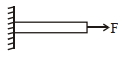
View full question & answer→MCQ 2321 Mark
Two wires of same length and radius are joined end to end and loaded. The Young's modulii of the materials of the two wires are $Y_{1}$ and $Y_{2}$. The combination behaves as a single wire then its Young's modulus is:
- A
$y=\frac{Y_{1} Y_{2}}{Y_{1}+Y_{2}}$
- B
$y=\frac{2 Y_{1} Y_{2}}{3\left(Y_{1}+Y_{2}\right)}$
- ✓
$Y=\frac{2 Y_{1} Y_{2}}{Y_{1}+Y_{2}}$
- D
${Y}=\frac{{Y}_{1} {Y}_{2}}{2\left({Y}_{1}+{Y}_{2}\right)}$
AnswerCorrect option: C. $Y=\frac{2 Y_{1} Y_{2}}{Y_{1}+Y_{2}}$
c
In series combination $\Delta l =l_{1}+l_{2}$
$Y =\frac{ F / A }{\Delta l / l} \Rightarrow \Delta l=\frac{ F l}{ AY }$
$\Rightarrow \Delta l \propto \frac{l}{ Y }$
Equivalent length of rod after joining is $=2 l$
As, lengths are same and force is also same in series
$\Delta l=\Delta l_{1}+\Delta l_{2}$
$\frac{l \text { eq }}{ Y _{\text {eq }}}=\frac{l}{ Y _{1}}+\frac{l}{ Y _{2}}$ $\Rightarrow \frac{2 l}{ Y }=\frac{l}{ Y _{1}}+\frac{l}{ Y _{2}}$
$\therefore Y=\frac{2 Y_{1} Y_{2}}{Y_{1}+Y_{2}}$
View full question & answer→MCQ 2331 Mark
If $Y, K$ and $\eta$ are the values of Young's modulus, bulk modulus and modulus of rigidity of any material respectively. Choose the correct relation for these parameters.
- A
$Y =\frac{9 K \eta}{3 K -\eta} N / m ^{2}$
- B
$\eta=\frac{3 YK }{9 K + Y } N / m ^{2}$
- C
$Y =\frac{9 K \eta}{2 \eta+3 K } N / m ^{2}$
- ✓
$K =\frac{ Y\eta }{9 \eta-3 Y } N / m ^{2}$
AnswerCorrect option: D. $K =\frac{ Y\eta }{9 \eta-3 Y } N / m ^{2}$
d
$Y-$ Younge modulus, $K$ - Bulk modulus,
$\eta$ - modulus of rigidity
We know that
$y=3 k(1-2 \sigma)$
$\sigma=\frac{1}{2}\left(1-\frac{ y }{3 k }\right)$ $.........(i)$
$y =2 \eta(1+\sigma)$
$\sigma=\frac{y}{2 \eta}-1$ $........(ii)$
From Eq.$(i)$ and Eq. $(ii)$
$\frac{1}{2}\left(1-\frac{ Y }{3 k }\right)=\frac{ y }{2 \eta}-1$
$1-\frac{y}{3 k}=\frac{y}{\eta}-2$
$\frac{y}{3 k}=3-\frac{y}{\eta}$
$\frac{y}{3 k}=\frac{3 \eta-y}{\eta}$
$\frac{\eta y }{3 k }=3 \eta- y$
$k =\frac{\eta y }{9 \eta-3 y }$
View full question & answer→MCQ 2341 Mark
The area of cross-section of a railway track is $0.01\, {m}^{2}$. The temperature variation is $10^{\circ} {C}$. Coefficient of linear expansion of material of track is $10^{-5} /{ }^{\circ} {C}$. The energy stored per meter in the track is ...... ${J} / {m} .$
(Young's modulus of material of track is $10^{11} \,{Nm}^{-2}$ ))
Answerb
Elastic energy $=\frac{Y}{2}(\text { strain })^{2} \times$ Area $\times$ length
Elastic energy per unit length $=\frac{Y}{2}(\text { strain })^{2} \times$ Area
$\left(\text { strain }=\frac{\Delta \ell}{\ell}=\alpha \Delta T=10^{-5} \times 10=10^{-4}\right)$
$=\frac{10^{11}}{2} \times\left(10^{-4}\right)^{2} \times 10^{-2}=5\, {J} / {m}$
View full question & answer→MCQ 2351 Mark
A stone of mass $20\, {g}$ is projected from a rubber catapult of length $0.1\, {m}$ and area of cross section $10^{-6} \,{m}^{2}$ stretched by an amount $0.04\, {m}$. The velocity of the projected stone is $....\,m\,/s.$ (Young's modulus of rubber $=0.5 \times 10^{9}\, {N} / {m}^{2}$ )
Answerd
$\frac{1}{2} \cdot k \cdot x ^{2}=\frac{1}{2} \cdot \frac{ YA }{ L }\cdot x ^{2}$
By energy conservation
$\frac{1}{2} \cdot \frac{ YA }{ L } \cdot x ^{2}=\frac{1}{2} mv ^{2}$
$\frac{0.5 \times 10^{9} \times 10^{-6} \times(0.04)^{2}}{0.1}=\frac{20}{1000} v ^{2}$
$\therefore \quad v ^{2}=400$
$ v =20 m / s$
View full question & answer→MCQ 2361 Mark
Two blocks of masses $3 \,{kg}$ and $5\, {kg}$ are connected by a metal wire going over a smooth pulley. The breaking stress of the metal is $\frac{24}{\pi} \times 10^{2}\, {Nm}^{-2}$. What is the minimum radius of the wire? (Take $\left.g=10\, {ms}^{-2}\right)$ (in $cm$)
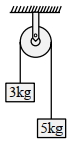
- A
$125$
- B
$1250$
- ✓
$12.5$
- D
$1.25$
AnswerCorrect option: C. $12.5$
c
${T}=\frac{2 {m}_{1} {m}_{2} {g}}{{m}_{1}+{m}_{2}}=\frac{2 \times 3 \times 5 \times 10}{8}$
$=\frac{75}{2}$
Stress $=\frac{{T}}{{A}}$
$\frac{24}{\pi} \times 10^{2}=\frac{75}{2 \times \pi {R}^{2}}$
${R}^{2}=\frac{75}{2 \times 24 \times 100}=\frac{3}{8 \times 24}$
$\Rightarrow {R}=0.125\, {m}$
${R}=12.5\, {cm}$
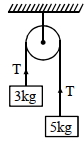
View full question & answer→MCQ 2371 Mark
Wires ${W}_{1}$ and ${W}_{2}$ are made of same material having the breaking stress of $1.25 \times 10^{9} \,{N} / {m}^{2}$ ${W}_{1}$ and ${W}_{2}$ have cross-sectional area of $8 \times 10^{-7}\, {m}^{2}$ and $4 \times 10^{-7}\, {m}^{2}$, respectively. Masses of $20 \,{kg}$ and $10\, {kg}$ hang from them as shown in the figure. The maximum mass that can be placed in the pan without breaking the wires is $.....{kg}$ (Use $\left.{g}=10\, {m} / {s}^{2}\right)$
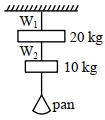
Answerb
${B} \cdot {S}_{1}=\frac{{T}_{\operatorname{lmax}}}{8 \times 10^{-7}} \Rightarrow {T}_{1 {max}}=8 \times 1.25 \times 100$
$=1000\, {N}$
${B} \cdot {S}_{2}=\frac{{T}_{2 \max }}{4 \times 10^{-7}} \Rightarrow {T}_{2 \max }=4 \times 1.25 \times 100$
$=500\, {N}$
${m}=\frac{500-100}{10}=40\, {kg}$
View full question & answer→MCQ 2381 Mark
A uniform heavy rod of weight $10\, {kg} {ms}^{-2}$, crosssectional area $100\, {cm}^{2}$ and length $20\, {cm}$ is hanging from a fixed support. Young modulus of the material of the rod is $2 \times 10^{11} \,{Nm}^{-2}$. Neglecting the lateral contraction, find the elongation of rod due to its own weight. (In $\times 10^{-10} {m}$)
Answerd
We know,
$\Delta \ell=\frac{{WL}}{2 {AY}}$
$\Delta \ell=\frac{10 \times 1}{2 \times 5} \times 100 \times 10^{-4} \times 2 \times 10^{11}$
$\Delta \ell=\frac{1}{2} \times 10^{-9}=5 \times 10^{-10}\, {m}$
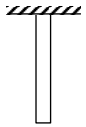
View full question & answer→MCQ 2391 Mark
Four identical hollow cylindrical columns of mild steel support a big structure of mass $50 \times 10^{3} {kg}$, The inner and outer radii of each column are $50\; {cm}$ and $100 \;{cm}$ respectively. Assuming uniform local distribution, calculate the compression strain of each column. [Use $\left.{Y}=2.0 \times 10^{11} \;{Pa}, {g}=9.8\; {m} / {s}^{2}\right]$
- A
$3.60 \times 10^{-8}$
- ✓
$2.60 \times 10^{-7}$
- C
$1.87 \times 10^{-3}$
- D
$7.07 \times 10^{-4}$
AnswerCorrect option: B. $2.60 \times 10^{-7}$
b
Force on each column $=\frac{{mg}}{4}$
$\text { Strain } =\frac{{mg}}{4 {AY}}$
$=\frac{50 \times 10^{3} \times 9.8}{4 \times \pi(1-0.25) \times 2 \times 10^{11}}$
$=2.6 \times 10^{-7}$
View full question & answer→MCQ 2401 Mark
The normal density of a material is $\rho$ and its bulk modulus of elasticity is $K$. The magnitude of increase in density of material, when a pressure $P$ is applied uniformly on all sides, will be
- A
$\frac{\rho K }{ P }$
- ✓
$\frac{\rho P }{ K }$
- C
$\frac{ K }{\rho P }$
- D
$\frac{ PK }{\rho}$
AnswerCorrect option: B. $\frac{\rho P }{ K }$
b
$\rho=\frac{M}{V}$
$\frac{ d \rho}{\rho}=-\frac{ dV }{ V }$
$K=-\frac{ P }{\frac{ d V }{ V }}$
$-\frac{ d V }{ V }=\frac{ P }{K}$
$\frac{ d \rho}{\rho}=\frac{ P }{ K } \Rightarrow d \rho=\frac{\rho P }{ K}$
View full question & answer→MCQ 2411 Mark
The length of metallic wire is $\ell_{1}$ when tension in it is $T _{1}$. It is $\ell_{2}$ when the tension is $T _{2}$. The original length of the wire will be ...... .
- A
$\frac{\ell_{1}+\ell_{2}}{2}$
- B
$\frac{ T _{2} \ell_{1}+ T _{1} \ell_{2}}{ T _{1}+ T _{2}}$
- ✓
$\frac{ T _{2} \ell_{1}- T _{1} \ell_{2}}{ T _{2}- T _{1}}$
- D
$\frac{ T _{1} \ell_{1}- T _{2} \ell_{2}}{ T _{2}- T _{1}}$
AnswerCorrect option: C. $\frac{ T _{2} \ell_{1}- T _{1} \ell_{2}}{ T _{2}- T _{1}}$
c
Assuming Hooke's law to be valid.
$T \propto(\Delta \ell)$
$T = k (\Delta \ell)$
Let, $\ell_{0}=$ natural length (original length)
$\Rightarrow T = k \left(\ell-\ell_{0}\right)$
so, $T _{1}= k \left(\ell_{1}-\ell_{0}\right)$ And $T _{2}= k \left(\ell_{2}-\ell_{0}\right)$
$\Rightarrow \frac{ T _{1}}{ T _{2}}=\frac{\ell_{1}-\ell_{0}}{\ell_{2}-\ell_{0}}$
$\Rightarrow \ell_{0}=\frac{ T _{2} \ell_{1}- T _{1} \ell_{2}}{ T _{2}- T _{1}}$
View full question & answer→MCQ 2421 Mark
A body of mass $\mathrm{m}=10\; \mathrm{kg}$ is attached to one end of a wire of length $0.3\; \mathrm{m} .$ The maximum angular speed (in $rad \;s^{-1}$ ) with which it can be rotated about its other end in space station is (Breaking stress of wire $=4.8 \times 10^{7} \;\mathrm{Nm}^{-2}$ and area of cross-section of the wire $=10^{-2}\; \mathrm{cm}^{2}$ ) is
Answerd
$\mathrm{T}=\mathrm{m\omega}^{2} \ell$
Breaking stress $=\frac{\mathrm{T}}{\mathrm{A}}=\frac{\mathrm{mo}^{2} \ell}{\mathrm{A}}$
$\Rightarrow \omega^{2}=\frac{4.8 \times 10^{7} \times\left(10^{-2} \times 10^{-4}\right)}{10 \times 0.3}=16$
$\Rightarrow \omega=4$
View full question & answer→MCQ 2431 Mark
A cube of metal is subjected to a hydrostatic pressure of $4\;GPa.$ The percentage change in the length of the side of the cube is close to.......$\%$
(Given bulk modulus of metal, $B =8 \times 10^{10}\, Pa$ )
AnswerCorrect option: B. $1.67$
b
$B =-\frac{\Delta P }{\frac{\Delta V }{ V }}$
$\left|\frac{\Delta V }{ V }\right|=\frac{\Delta P }{ B }$
$=\frac{4 \times 10^{9}}{8 \times 10^{10}}=\frac{1}{20}$
$\frac{\Delta \ell}{\ell}=\frac{1}{3} \times \frac{\Delta V }{ V }=\frac{1}{60}$
Percentage change $=\frac{\Delta \ell}{\ell} \times 100 \%$
$=\frac{100}{60} \%=1.67 \%$
View full question & answer→MCQ 2441 Mark
Two steel wires having same length are suspended from a ceiling under the same load. If the ratio of their energy stored per unit volume is $1: 4,$ the ratio of their diameters is
- A
$1: \sqrt{2}$
- B
$1: 2$
- C
$2:1$
- ✓
$\sqrt{2}: 1$
AnswerCorrect option: D. $\sqrt{2}: 1$
d
$\frac{\text { Energystored }}{\text { Volume }}=\frac{1}{2} \frac{(\text { Stress })^{2}}{\mathrm{Y}}$
$\frac{\mathrm{u}_{1}}{\mathrm{u}_{2}}=\frac{1}{4} \Rightarrow 4 \mathrm{u}_{1}=\mathrm{u}_{2}$
$4 \frac{1}{2 \mathrm{Y}}\left[\frac{\mathrm{W} \cdot 4}{\pi \mathrm{d}_{1}^{2}}\right]^{2}=\frac{1}{2 \mathrm{Y}}\left[\frac{\mathrm{W} \cdot 4}{\pi \mathrm{d}_{2}^{2}}\right]^{2}$
$4=\left(\frac{\mathrm{d}_{1}}{\mathrm{d}_{2}}\right)^{4}$
$\Rightarrow \frac{\mathrm{d}_{1}}{\mathrm{d}_{2}}=\sqrt{2}: 1$
View full question & answer→MCQ 2451 Mark
A steel wire having a radius of $2.0\, mm$, carrying a load of $4\, kg$, is hanging from a ceiling. Given that $g = 3.1\pi \,m{s^{ - 2}}$ , what will be the tensile stress that would be developed in the wire?
- A
$6.2 \times {10^6}\,N{m^{ - 2}}$
- B
$4.8 \times {10^6}\,N{m^{ - 2}}$
- C
$5.2 \times {10^6}\,N{m^{ - 2}}$
- ✓
$3.1 \times {10^6}\,N{m^{ - 2}}$
AnswerCorrect option: D. $3.1 \times {10^6}\,N{m^{ - 2}}$
d
Tensile stress in wire will be
$ = \frac{{Tensile\,force}}{{Cross\,section\,Area}}$
$ = \frac{{mg}}{{\pi {R^2}}} = \frac{{4 \times 3.1\pi }}{{\pi \times 4 \times {{10}^{ - 6}}}}N{m^{ - 2}} = 3.1 \times {10^6}N{m^{ - 2}}$
View full question & answer→MCQ 2461 Mark
The elastic limit of brass is $379\,MPa.$ .......... $mm$ should be the minimum diameter of a brass rod if it is to support a $400\,N$ load without exceeding its elastic limit .
- A
$1$
- ✓
$1.16$
- C
$0.90$
- D
$1.36$
AnswerCorrect option: B. $1.16$
b
$\frac{{400}}{{\frac{\pi }{4}{d^2}}} = 379 \times {10^6}$
${d^2} = \frac{{4 \times 400 \times {{10}^{ - 6}}}}{{\pi \times 379}} = 0.336 \times {10^{ - 6}} \times 4$
$d = 2\sqrt {0.336} \times {10^{ - 3}}M \simeq 1.16\,mm$
View full question & answer→MCQ 2471 Mark
A rod of length $L$ at room temperature and uniform area of cross section $A$, is made of a metal having coefficient of linear expansion $\alpha {/^o}C$. It is observed that an external compressive force $F$, is applied on each of its ends, prevents any change in the length of the rod, when it temperature rises by $\Delta \,TK$. Young’s modulus, $Y$, for this metal is
- ✓
$\frac{F}{{A\alpha \,\Delta T}}$
- B
$\frac{F}{{A\alpha \,\left( {\Delta T - 273} \right)}}$
- C
$\frac{F}{{2A\,\alpha \,\Delta T}}$
- D
$\frac{2F}{{A\,\alpha \,\Delta T}}$
AnswerCorrect option: A. $\frac{F}{{A\alpha \,\Delta T}}$
a
$\Delta L = L \propto \Delta T$
$Strain = \frac{{\Delta L}}{L} = \propto \Delta T\,\,;\,\,Y = \frac{F}{{A \propto \Delta T}}$
View full question & answer→MCQ 2481 Mark
A boy’s catapult is made of rubber cord which is $42\, cm$ long, with $6\, mm$ diameter of cross -section and of negligible mass. The boy keeps a stone weighing $0.02\, kg$ on it and stretches the cord by $20\, cm$ by applying a constant force. When released, the stone flies off with a velocity of $20\, ms^{-1}$. Neglect the change in the area of cross section of the cord while stretched. The Young’s modulus of rubber is closest to
- A
$10^3\, Nm^{-2}$
- ✓
$10^6\, Nm^{-2}$
- C
$10^8\, Nm^{-2}$
- D
$10^4\, Nm^{-2}$
AnswerCorrect option: B. $10^6\, Nm^{-2}$
b
$Energy\,of\,catapult = \frac{1}{2} \times {\left( {\frac{{\Delta \ell }}{\ell }} \right)^2} \times Y \times A \times \ell $
$ = Kinetic\,energy\,of\,the\,ball = \frac{1}{2}\,m{V^2}$
$Therefore,\frac{1}{2} \times {\left( {\frac{{20}}{{42}}} \right)^2} \times Y \times \pi \times {3^2} \times {10^{ - 6}} \times 42 \times {10^{ - 2}}$
$ = \frac{1}{2} \times 2 \times {10^{ - 2}} \times {\left( {20} \right)^2}$
$Y = 3 \times {10^{6\,}}\,N{m^2}$
View full question & answer→MCQ 2491 Mark
Young’s moduli of two wires $A$ and $B$ are in the ratio $7 : 4$. Wire $A$ is $2\, m$ long and has radius $R$. Wire $A$ is $2\, m$ long and has radius $R$. Wire $B$ is $1.5\, m$ long and has radius $2\, mm$. If the two wires stretch by the same length for a given load, then the value of $R$ is close to ......... $mm$
Answerc
Given:
$\frac{{{Y_A}}}{{{Y_B}}} = \frac{7}{4}\,\,\,{L_A} = 2m\,\,\,{A_A} = \pi {R^2}$
${L_B} = 1.5\,m\,\,\,\,\,\,\,\,{A_B} = \pi {\left( {2mm} \right)^2}$
$\frac{F}{A} = Y\left( {\frac{\ell }{L}} \right)$
$given\,F\,and\,\ell \,are\,same \Rightarrow \frac{{AY}}{L}\,is\,same$
$\frac{{{A_A}{Y_A}}}{{{L_A}}} = \frac{{{A_B}{Y_B}}}{{{L_B}}}$
$ \Rightarrow \frac{{\left( {\pi {R^2}} \right)\left( {\frac{7}{4}{Y_B}} \right)}}{2} = \frac{{\pi {{\left( {2\,mm} \right)}^2}.{Y_B}}}{{1.5}}$
$R = 1.74\,mm$
View full question & answer→MCQ 2501 Mark
In an experiment, brass and steel wires of length $1\,m$ each with areas of cross section $1\,mm^2$ are used. The wires are connected in series and one end of the combined wire is connected to a rigid support and other end is subjected to elongation. The stress requires to produced a new elongation of $0.2\,mm$ is [Given, the Young’s Modulus for steel and brass are respectively $120\times 10^9\,N/m^2$ and $60\times 10^9\,N/m^2$ ]
- A
$1.8\times 10^6\,N/m^2$
- B
$0.2\times 10^6\,N/m^2$
- C
$1.2\times 10^6\,N/m^2$
- ✓
Answerd
$\ell = 1\,M$
$A = {10^{ - 6}}{M^2}$
$stress = \frac{F}{A}$ ${Y_s} = 120 \times {10^9}$
$Stress = \frac{{Stress}}{Y}$
$\Delta \ell = \frac{{\ell \times F}}{{AY}}$
$\Delta {\ell _1} + \Delta {\ell _2} = \frac{{{\ell _1}F}}{{A{Y_1}}} + \frac{{{\ell _2}F}}{{A{Y_2}}} = 0.2 \times {10^{ - 3}}$
$\frac{F}{A} = \frac{{0.2 \times {{10}^{ - 3}}}}{{\frac{\ell }{{{Y_1}}} + \frac{\ell }{{{Y_2}}}}}$
$ = \frac{{0.2 \times {{10}^{ - 3}}}}{{\frac{1}{{120 \times {{10}^9}}} + \frac{1}{{60 \times {{10}^9}}}}} = \frac{{0.2 \times {{10}^{ - 3}} \times {{10}^9} \times 120}}{{1 + 2}}$
$ = \frac{{0.2 \times {{10}^6} \times 120}}{3} = 8 \times {10^6}$

View full question & answer→MCQ 2511 Mark
A solid sphere of radius $r$ made of a soft material of bulk modulus $K$ is surrounded by a liquid in a cylindrical container. A massless piston of area $a$ floats on the surface of the liquid, covering entire crosssection of cylindrical container. When a mass $m$ is placed on the surface of the piston to compress the liquid, the fractional decrement in the radius of the sphere, $\left( {\frac{{dr}}{r}} \right)$ is
- A
$\frac{{Ka}}{{3mg}}$
- ✓
$\frac{{mg}}{{3Ka}}$
- C
$\frac{{mg}}{{ka}}$
- D
$\frac{{Ka}}{{mg}}$
AnswerCorrect option: B. $\frac{{mg}}{{3Ka}}$
b
$\Delta P = \frac{{mg}}{a}$
$k = - \frac{{\frac{{mg}}{A}}}{{\frac{{4\pi {r^2}dr}}{{\frac{4}{3}\pi {r^3}}}}}$
$\frac{{dr}}{r} = - \frac{{mg}}{{3KA}}$
View full question & answer→MCQ 2521 Mark
As shown in the figure, forces of $10^5\,N$ each are applied in opposite directions, on the upper and lower faces of a cube of side $10\,cm$, shifting the upper face parallel to itself by $0.5\,cm$ . If the side of another cube of the same material is, $20\,cm$ then under similar conditions as above, the displacement will be......... $cm$
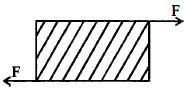
- A
$1.00$
- ✓
$0.25$
- C
$0.37$
- D
$0.75$
AnswerCorrect option: B. $0.25$
b
For same material teh ratio of stress to strain is same
For first cube
$Stres{s_1} = \frac{{force}}{{force}} = \frac{{{{10}^5}}}{{\left( {{{0.1}^2}} \right)}}$
$Strai{n_1} = \frac{{change\,in\,lengt{h_1}}}{{original\,lengt{h_1}}} = \frac{{0.5 \times {{10}^{ - 2}}}}{{0.1}}$
For second block,
$Stres{s_2} = \frac{{forc{e_2}}}{{are{a_2}}} = \frac{{{{10}^5}}}{{\left( {{{0.2}^2}} \right)}}$
$Strai{n_2} = \frac{{change\,in\,lengt{h_2}}}{{original\,lengt{h_2}}} = \frac{x}{{0.2}}$
$x$ is the displacement for second block.
$For\,same\,material,\frac{{Stress_1}}{{Strai{n_1}}} = \frac{{Stress_2}}{{Strai{n_2}}}$
$or,\frac{{\frac{{10.5}}{{{{\left( {0.1} \right)}^2}}}}}{{\frac{{0.5 \times {{10}^{ - 2}}}}{{0.1}}}} = \frac{{\frac{{{{10}^5}}}{{{{\left( {0.2} \right)}^2}}}}}{{\frac{x}{{0.2}}}}$
$Solving\,we\,get,\,x = 0.25\,cm$
View full question & answer→MCQ 2531 Mark
A man grows into a giant such that his linear dimensions increase by a factor of $9$. Assuming that his density remains same, the stress in the leg will change by a factor of
- ✓
$9$
- B
$\frac{1}{9}$
- C
$81$
- D
$\frac{1}{{81}}$
Answera
As liner dimension increases by a factor of $9$
$\frac{{{v_f}}}{{{v_i}}} = {9^3}$
Density remains same
So, mass $\propto$ Volume
$\frac{{{m_f}}}{{{m_i}}} = {9^3}\,\,\, \Rightarrow \,\,\,\frac{{{{\left( {Aera} \right)}_f}}}{{{{\left( {Aera} \right)}_i}}} = {9^2}$
$Stress\left( \sigma \right) = \frac{{force}}{{area}} = \frac{{\left( {mass} \right) \times g}}{{area}}$
$\frac{{{\sigma _2}}}{{{\sigma _1}}} = \left( {\frac{{{m_f}}}{{{m_i}}}} \right)\left( {\frac{{{A_i}}}{{{A_f}}}} \right) = \frac{{{9^3}}}{{{9^2}}} = 9$
View full question & answer→MCQ 2541 Mark
A compressive force, $F$ is applied at the two ends of a long thin steel rod. It is heated, simultaneously, such that its temperature increases by $\Delta T$. The net change in its length is zero. Let $l$ be the length of the rod, $A$ its area of cross- section, $Y$ its Young's modulus, and $\alpha $ its coefficient of linear expansion. Then, $F$ is equal to
AnswerCorrect option: C. $A\,Y\alpha \Delta T$
c
Due to thermal exp., change in length $\left( {\Delta l} \right)$
$ = l\alpha \Delta T$ $...(i)$
$Young's\,modulus (Y)$
$ = \frac{{Normal\,stress}}{{Longitudinal\,strain}}$
$Y = \frac{{F/A}}{{\Delta l/l}} \Rightarrow \frac{{\Delta l}}{l} = \frac{F}{{AY}}$
$\Delta l = \frac{{Fl}}{{AY}}$
$From\,e{q^n}(i),\,\frac{{Fl}}{{AY}} = l\,\alpha \,\Delta T$
$F = AY\,\alpha \,\Delta T$
View full question & answer→MCQ 2551 Mark
A uniformly tapering conical wire is made from a material of Young's modulus $Y$ and has a normal, unextended length $L.$ The radii, at the upper and lower ends of this conical wire, have values $R$ and $3R,$ respectively. The upper end of the wire is fixed to a rigid support and a mass $M$ is suspended from its lower end. The equilibrium extended length, of this wire, would equal
- A
$L\left( {1 + \frac{2}{9}\frac{{Mg}}{{\pi Y{R^2}}}} \right)$
- B
$L\left( {1 + \frac{1}{9}\frac{{Mg}}{{\pi Y{R^2}}}} \right)$
- ✓
$L\left( {1 + \frac{1}{3}\frac{{Mg}}{{\pi Y{R^2}}}} \right)$
- D
$L\left( {1 + \frac{2}{3}\frac{{Mg}}{{\pi Y{R^2}}}} \right)$
AnswerCorrect option: C. $L\left( {1 + \frac{1}{3}\frac{{Mg}}{{\pi Y{R^2}}}} \right)$
c
Consider a small element $dx$ of radius $r$,
$r = \frac{{2R}}{L}x + R$
At equilibrium change in length of the wire
$\int\limits_0^l {dL = \int {\frac{{Mgdx}}{{\pi {{\left[ {\frac{{2R}}{L}x + R} \right]}^2}y}}} } $
Taking limit from $0$ to $L$
$\Delta L = \frac{{Mg}}{{\pi y}} - \frac{1}{{\left[ {\frac{{2Rx}}{L} + R} \right]_0^L}} \times \frac{L}{{2R}} = \frac{{MgL}}{{3\pi {R^2}y}}$
The equilibrium extended length of wire
$ = L + \Delta L$
$ = L + \frac{{MgL}}{{3\pi {R^2}Y}} = L\left( {1 + \frac{1}{3}\frac{{Mg}}{{\pi Y{R^2}}}} \right)$
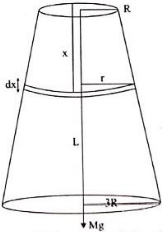
View full question & answer→MCQ 2561 Mark
A thin $1 \,m$ long rod has a radius of $5\, mm$. A force of $50\,\pi kN$ is applied at one end to determine its Young's modulus. Assume that the force is exactly known. If the least count in the measurement of all lengths is $0.01\, mm$, which of the following statements is false ?
- ✓
The maximum value of $Y$ that can be determined is $10^{14}\,N/m^2$
- B
$\frac{{\Delta Y}}{Y}$ gets minimum contribution from the uncertainty in the length
- C
$\frac{{\Delta Y}}{Y}$ gets its maximum contribution from the uncertainty in strain
- D
The figure of merit is the largest for the length of the rod.
AnswerCorrect option: A. The maximum value of $Y$ that can be determined is $10^{14}\,N/m^2$
a
$Young's\,modulus\,Y = \frac{F}{A}/\frac{{\Delta \ell }}{\ell }$
$Y = \frac{{Fl}}{{\pi {r^2}\Delta l}}$
$Given,\,radius = 5mm,forceF = 50\pi KN,$
$\frac{\ell }{{\Delta \ell }} = 0.01\,mm$
$\therefore \,Y = \frac{F}{{\pi {r^2}}}\frac{\ell }{{\Delta \ell }} = 2 \times {10^{14}}N/{m^2}.$
View full question & answer→MCQ 2571 Mark
A bottle has an opening of radius $a$ and length $b$. A cork of length band radius $\left( {a + \Delta a} \right)$ where $\left( {\Delta a < < a} \right)$ is compressed to fit into the opening completely (see figure). If the bulk modulus of cork is $B$ and frictional coefficient between the bottle and cork is $\mu $ then the force needed to push the cork into the bottle is
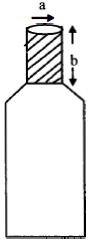
- A
$\left( {\pi \mu Bb} \right)\,a$
- B
$\left( {2\pi \mu Bb} \right)\,\Delta a$
- C
$\left( {\pi \mu Bb} \right)\,\Delta a$
- ✓
$\left( {4\pi \mu Bb} \right)\,\Delta a$
AnswerCorrect option: D. $\left( {4\pi \mu Bb} \right)\,\Delta a$
d
$Stress = \frac{{Normal\,force}}{{Area}} = \frac{N}{A} = \frac{N}{{\left( {2\pi a} \right)b}}$
$Stress = B \times strain$
$\frac{N}{{\left( {2\pi a} \right)b}} = B\frac{{2\pi a\Delta a \times b}}{{\pi {a^2}b}}$
$ \Rightarrow N = B\frac{{{{\left( {2\pi a} \right)}^2}\Delta a{b^2}}}{{\pi {a^2}b}}$
Force needed to push the cork.
$f = \mu N = \mu 4\pi b\Delta aB = \left( {4\pi \mu Bb} \right)\Delta a$
View full question & answer→MCQ 2581 Mark
The pressure that has to be applied to the ends of a steel wire of length $10\ cm$ to keep its length constant when its temperature is raised by $100^o C$ is: (For steel Young's modulus is $2 \times 10^{11}$ $Nm^{-1}$ and coefficient of thermal expansion is $1.1 \times 10^{-5}$ $K^{-1}$ )
- A
$2.2 \times 10^9 $ $Pa$
- B
$2.2 \times 10^7$ $ Pa$
- C
$2.2 \times 10^6 $ $Pa$
- ✓
$2.2 \times 10^8$ $ Pa$
AnswerCorrect option: D. $2.2 \times 10^8$ $ Pa$
d
$Young's\,modulus\,Y = \frac{{stress}}{{strain}}$
$stress = Y \times strain$
$Stress\,in\,steel\,wire = Applied\,pressure$
$pressure = stress = Y \times strain$
$strain = \frac{{\Delta L}}{L} = \alpha \Delta T\left( {As\,length\,is\,constant} \right)$
$ = 2 \times {10^{11}} \times 1.1 \times {10^{ - 5}} \times 100$
$ = 2.2 \times {10^8}Pa$
View full question & answer→MCQ 2591 Mark
The bulk moduli of ethanol, mercury and water are given as $0.9, 25$ and $2 .2$ respectively in units of $10^9\, Nm^{-2}$ . For a given value of pressure, the fractional compression in volume is $\frac{{\Delta V}}{V}$. Which of the following statements about $\frac{{\Delta V}}{V}$ for these three liquids is correct ?
- ✓
Ethanol $>$ Water $>$ Mercury
- B
Water $>$ Ethanol $>$ Mercury
- C
Mercury $>$ Ethanol $>$ Water
- D
Ethanol $>$ Mercury $>$ Water
AnswerCorrect option: A. Ethanol $>$ Water $>$ Mercury
a
$Compressibility = \frac{1}{{Bulk\,modulus}}$
As bulk modulus is least for ethanol $(0.9)$ and maximum for mercury $(25)$ among ehtanol, mercury and water. Hence
compression in volume $\frac{{\Delta V}}{V}$
$Ethanol>Water>Mercury$
View full question & answer→MCQ 2601 Mark
In materials like aluminium and copper, the correct order of magnitude of various elastic modulii is
- A
Young's modulus $<$ shear modulus $<$ bulk modulus
- B
Bulk modulus $<$ shear modulus $<$ Young's modulus
- ✓
Shear modulus $<$ Young's modulus $<$ bulk modulus
- D
Bulk modulus $<$ Young's modulus $<$ shear modulus
AnswerCorrect option: C. Shear modulus $<$ Young's modulus $<$ bulk modulus
c
Poisson's ratio,
$\sigma = \frac{{Iateral\,strain\left( \beta \right)}}{{longitudinal\,strain\left( \alpha \right)}}$
For material like copper, $\sigma = 0.33$
$And,\,y = 3k\left( {1 - 2\sigma } \right)$
$Also,\frac{9}{y} = \frac{1}{k} + \frac{3}{n}$
$y = 2n\left( {1 + \sigma } \right)$
$Hence,n < y < k$
View full question & answer→MCQ 2611 Mark
Steel ruptures when a shear of $3 .5 \times 10^8\,\,N\,m^{-2}$ is applied. The force needed to punch a $1\,cm$ diameter hole in a steel sheet $0.3\,cm$ thick is nearly
- A
$1.4\,\times 10^4\,N$
- B
$2.7\,\times 10^4\,N$
- ✓
$3.3\,\times 10^4\,N$
- D
$1.1\,\times 10^4\,N$
AnswerCorrect option: C. $3.3\,\times 10^4\,N$
c
Shearing strain is created along the side surface of the punched disk. Note that the forces exerted on the disk are exerted along
the circum ference of the disk, and the total force exerted on its center only.
Letus assume that the shearing stress along the side surface of the disk is uniform, then
$F > \int\limits_{Surface} {d{F_{\max }} = \int\limits_{surface} {{\sigma _{\max }}dA = {\sigma _{\max }}} \int\limits_{surface} {dA} } $
$ = \int {{\sigma _{\max }}} .A = {\sigma _{\max }}.2\pi \left( {\frac{D}{2}} \right)h$
$ = 3.5 \times {10^8} \times \left( {\frac{1}{2} \times {{10}^{ - 2}}} \right) \times 0.3 \times {10^{ - 2}} \times 2\pi $
$ = 3.297 \times {10^4} = 3.3 \times {10^4}N$
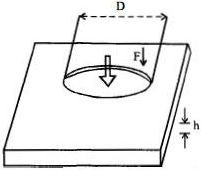
View full question & answer→MCQ 2621 Mark
A uniform wire (Young's modulus $2 \times 10^{11}\, Nm^{-2}$ ) is subjected to longitudinal tensile stress of $5 \times 10^7\,Nm^{-2}$ . If the over all volume change in the wire is $0.02\%,$ the fractional decrease in the radius of the wire is close to
- A
$1.0\times 10^{-4}$
- B
$1.5\times 10^{-4}$
- ✓
$0.25\times 10^{-4}$
- D
$5\times 10^{-4}$
AnswerCorrect option: C. $0.25\times 10^{-4}$
c
$Given,\,y = 2 \times {10^{11}}N{m^{ - 2}}$
$Stress\left( {\frac{F}{A}} \right) = 5 \times {10^7}N{m^{ - 2}}$
$\Delta V = 0.02\% = 2 \times {10^{ - 4}}{m^3}$
$\frac{{\Delta r}}{r} = ?$
$\gamma = \frac{{stress}}{{strain}} \Rightarrow strain\left( {\frac{{\Delta \ell }}{{{\ell _0}}}} \right) = \frac{\gamma }{{stress}}\,\,...\left( i \right)$
$\Delta V = 2\pi {\ell _0}\Delta r - \pi {r^2}\Delta \ell $ $...\left( {ii} \right)$
From eqns $(i)$ and $(ii)$ putting the value of
$\Delta \ell ,{\ell _0}\,and\,\Delta V\,and\,solving\,we\,get$
$\frac{{\Delta r}}{r} = 0.25 \times {10^{ - 4}}$
View full question & answer→MCQ 2631 Mark
A copper wire of length $1.0\, m$ and a steel wire of length $0.5\, m$ having equal cross-sectional areas are joined end to end. The composite wire is stretched by a certain load which stretches the copper wire by $1\, mm$. If the Young's modulii of copper and steel are respectively $1.0\times10^{11}\, Nm^{-2}$ and $2.0\times10^{11}\, Nm^{- 2}$, the total extension of the composite wire is ........ $mm$
- A
$1.75$
- B
$2$
- C
$1.50$
- ✓
$1.25$
AnswerCorrect option: D. $1.25$
d
${Y_c} \times \left( {\Delta {L_c}/{L_c}} \right) = {Y_s} \times \left( {\Delta {L_s}/{L_s}} \right)$
$ \Rightarrow 1 \times {10^{11}} \times \left( {\frac{{1 \times {{10}^{ - 3}}}}{1}} \right) = 2 \times {10^{11}} \times \left( {\frac{{\Delta {L_s}}}{{0.5}}} \right)$
$\therefore \Delta {L_s} = \frac{{0.5 \times {{10}^{ - 3}}}}{2} = 0.25\,mm$
Therefore, total extension of the composite
$wire = \Delta {L_c} + \Delta {L_s}$
$ = 1\,mm + 0.25\,m = 1.25\,m$
View full question & answer→MCQ 2641 Mark
If the ratio of lengths, radii and Young's moduli of steel and brass wires in the figure are $a, b$ and $c$ respectively, then the corresponding ratio of increase in their lengths is
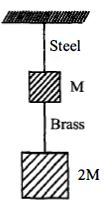
- A
$\frac{{3c}}{{2a{b^2}}}$
- B
$\frac{{2{a^2}c}}{b}$
- ✓
$\frac{{3a}}{{2{b^2}c}}$
- D
$\frac{{2ac}}{{{b^2}}}$
AnswerCorrect option: C. $\frac{{3a}}{{2{b^2}c}}$
c
According to questions,
$\frac{{{\ell _s}}}{{{\ell _b}}} = a,\frac{{{r_s}}}{{{r_b}}} = b,\frac{{{y_s}}}{{{y_b}}} = c,\frac{{\Delta \ell s}}{{\Delta {\ell _b}}} = ?$
$As,y = \frac{{F\ell }}{{A\Delta \ell }} \Rightarrow \Delta \ell = \frac{{F\ell }}{{Ay}}$
$\Delta {\ell _s} = \frac{{3mg{\ell _s}}}{{\pi _s^2.{y_s}}}\left[ {{F_s} = \left( {M + 2M} \right)g} \right]$
$\Delta {\ell _b} = \frac{{2Mg{\ell _b}}}{{\pi r_b^2{y_b}}}\left[ {{F_b} = 2Mg} \right]$
$\therefore \frac{{\Delta {\ell _s}}}{{\Delta {\ell _b}}} = \frac{{\frac{{3Mg{\ell _s}}}{{\pi r_s^2.{y_s}}}}}{{\frac{{2Mg.{\ell _b}}}{{\pi {b^2}.{y_b}}}}} = \frac{{3a}}{{2{b^2}C}}$
View full question & answer→MCQ 2651 Mark
Two blocks of masses $m$ and $M$ are connected by means of a metal wire of cross-sectional area $A$ passing over a frictionless fixed pulley as shown in the figure. The system is then released. If $M = 2\, m$, then the stress produced in the wire is
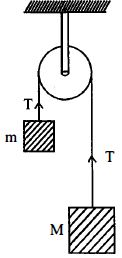
- A
$\frac{{2mg}}{{3A}}$
- ✓
$\frac{{4mg}}{{3A}}$
- C
$\frac{{mg}}{{A}}$
- D
$\frac{{3mg}}{{4A}}$
AnswerCorrect option: B. $\frac{{4mg}}{{3A}}$
b
Tension in the wire, $T = \left( {\frac{{2mM}}{{m + M}}} \right)g.$
$Stress = \frac{{Force/Tension}}{{Area}} = \frac{{2mM}}{{A\left( {m + M} \right)}}g$
$ = \frac{{2\left( {m \times 2m} \right)g}}{{A\left( {m + 2m} \right)}}\left( {M = 2m\,given} \right)$
$ = \frac{{4{m^2}}}{{3mA}}g = \frac{{4mg}}{{3A}}$
View full question & answer→MCQ 2661 Mark
A cubical solid aluminium (bulk modulus $=-V \frac{ dP }{ dV }=70 GPa$ ) block has an edge length of $1 m$ on the surface of the earth. It is kept on the floor of a $5 km$ deep ocean. Taking the average density of water and the acceleration due to gravity to be $10^3 kg m ^{-3}$ and $10 ms ^{-2}$, respectively, the change in the edge length of the block in $mm$ is . . . . .
- A
$2.20$
- ✓
$2.38$
- C
$2.40$
- D
$2.45$
AnswerCorrect option: B. $2.38$
b
$\frac{d V}{V}=\frac{3 d a}{a}$
$B=-V \frac{d P}{d V}=\frac{-V(\rho g h)}{d V}=\frac{-\rho g h}{3 da } a$
$70 \times 10^9=\frac{1 \times 5000 \times 10^3 \times 10 \times 1}{3 \times da }$
$da =\Delta a =\frac{5}{21} \times 10^{-2} m =2.38 mm$
View full question & answer→MCQ 2671 Mark
A block of weight $100 N$ is suspended by copper and steel wires of same cross sectional area $0.5 cm ^2$ and, length $\sqrt{3} m$ and $1 m$, respectively. Their other ends are fixed on a ceiling as shown in figure. The angles subtended by copper and steel wires with ceiling are $30^{\circ}$ and $60^{\circ}$, respectively. If elongation in copper wire is $\left(\Delta \ell_{ C }\right)$ and elongation in steel wire is $\left(\Delta \ell_{ s }\right)$, then the ratio $\frac{\Delta \ell_{ C }}{\Delta \ell_{ S }}$ is. . . . . .
[Young's modulus for copper and steel are $1 \times 10^{11} N / m ^2$ and $2 \times 10^{11} N / m ^2$ respectively]
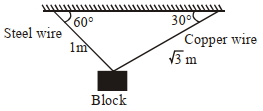
Answerc
Let $T_S=$ tension in steel wire $T _{ C }=$ Tension in copper wire in $x$ direction
$T _{ C } \cos 30^{\circ}= T _{ S } \cos 60^{\circ}$
$T _{ C } \times \frac{\sqrt{3}}{2}= T _{ S } \times \frac{1}{2}$
$\sqrt{3} T _{ C }= T _{ S } \ldots . \text { (i) }$
in $y$ direction
$T _{ C } \sin 30^{\circ}+ T _{ S } \sin 60^{\circ}=100$
$\frac{ T _{ C }}{2}+\frac{ T _{ S } \sqrt{3}}{2}=100 \ldots . \text { (ii) }$
Solving equation $(i)$ & $(ii)$
$T _{ C }=50 N$
$T _{ S }=50 \sqrt{3} N$
We know
$\Delta L =\frac{ FL }{ AY }$
$=\frac{\Delta L _{ C }}{\Delta L _{ S }}=\frac{ T _{ C } L _{ C }}{ A _{ C } Y _{ C }} \times \frac{ A _{ S } Y _{ S }}{ T _{ S } L _{ S }}$
On solving above equation
$\frac{\Delta L _{ C }}{\Delta L _{ S }}=2$
Ans. $2.00$
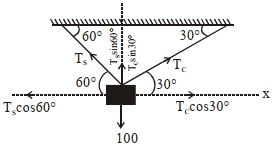
View full question & answer→MCQ 2681 Mark
Consider a thin square plate floating on a viscous liquid in a large tank. The height $h$ of the liquid in the tank is much less than the width of the tank. The floating plate is pulled horizontally with a constant velocity $u_0$. Which of the following statements is (are) true?
$(A)$ The resistive force of liquid on the plate is inversely proportional to $h$
$(B)$ The resistive force of liquid on the plate is independent of the area of the plate
$(C)$ The tangential (shear) stress on the floor of the tank increases with $u _0$
$(D)$ The tangential (shear) stress on the plate varies linearly with the viscosity $\eta$ of the liquid
- A
$A,B,C$
- B
$A,B$
- ✓
$A,C,D$
- D
$A,C$
AnswerCorrect option: C. $A,C,D$
c
Viscous force $F =-\eta A \frac{ dv }{ dh }$
$F =\eta A \left(\frac{u_0}{ h }\right)$
$\Rightarrow F \propto \frac{1}{ h }$
Shear stress $=\frac{ F }{ A } \propto u _0$
$\frac{ F }{ A } \propto \eta$
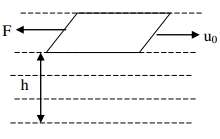
View full question & answer→MCQ 2691 Mark
A steel wire of diameter $0.5 mm$ and Young's modulus $2 \times 10^{11} N m ^{-2}$ carries a load of mass $M$. The length of the wire with the load is $1.0 m$. A vernier scale with $10$ divisions is attached to the end of this wire. Next to the steel wire is a reference wire to which a main scale, of least count $1.0 mm$, is attached. The $10$ divisions of the vernier scale correspond to $9$ divisions of the main scale. Initially, the zero of vernier scale coincides with the zero of main scale. If the load on the steel wire is increased by $1.2 kg$, the vernier scale division which coincides with a main scale division is. . . . Take $g =10 m s ^{-2}$ and $\pi=3.2$.
Answera
Diameter $ d =0.5 mm$
$Y =2 \times 10^{11} N / m ^2$
Strain $=\frac{\text { Stress }}{ Y }$
$\frac{\Delta L }{ L }=\frac{ F }{ AY }$
$\Delta L =\frac{ FL }{ AY }=\frac{1.2 \times 10 \times 1}{3.2 \times \frac{\left(0.5 \times 10^{-3}\right)^2}{4} \times 2 \times 10^{11}}$
$\Delta L =\frac{12}{1.6 \times 0.25 \times 10^5}=30 \times 10^{-5}=0.3 mm$
$L.C.$ of Vernier scale $=0.1 mm$ Number of division which coincide with main scale $=3$.
View full question & answer→MCQ 2701 Mark
In plotting stress versus strain curves for two materials $P$ and $Q$, a student by mistake puts strain on the $y$-axis and stress on the $x$-axis as shown in the figure. Then the correct statement$(s)$ is(are)
$(A)$ $P$ has more tensile strength than $Q$
$(B)$ $P$ is more ductile than $Q$
$(C)$ $P$ is more brittle than $Q$
$(D)$ The Young's modulus of $P$ is more than that of $Q$
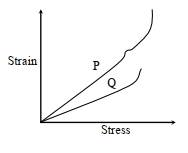
- ✓
$(A,B)$
- B
$(A,C)$
- C
$(B,C)$
- D
$(B,D)$
AnswerCorrect option: A. $(A,B)$
a
$Y=\frac{\text { stress }}{\text { strain }}$
$\Rightarrow \frac{1}{Y}=\frac{\text { strain }}{\text { stress }} \Rightarrow \frac{1}{Y_P}>\frac{1}{Y_\theta} \Rightarrow Y_P$
View full question & answer→MCQ 2711 Mark
One end of a horizontal thick copper wire of length $2 L$ and radius $2 R$ is welded to an end of another horizontal thin copper wire of length $L$ and radius $R$. When the arrangement is stretched by a applying forces at two ends, the ratio of the elongation in the thin wire to that in the thick wire is :
- A
$0.25$
- B
$0.50$
- ✓
$2.00$
- D
$4.00$
AnswerCorrect option: C. $2.00$
c
$Y=\frac{\left(\frac{F}{A}\right)}{\frac{\Delta \ell_1}{L}} $ ...............$(i)$
$Y=\frac{\left(\frac{F}{4 A }\right)}{\frac{\Delta \ell_2}{2 L}} $ .................$(ii)$
$\frac{\Delta \ell_1}{\Delta \ell_2}=2$
View full question & answer→MCQ 2721 Mark
A $0.1 \mathrm{~kg}$ mass is suspended from a wire of negligible mass. The length of the wire is $1 \mathrm{~m}$ and its crosssectional area is $4.9 \times 10^{-7} \mathrm{~m}^2$. If the mass is pulled a little in the vertically downward direction and released, it performs simple harmonic motion of angular frequency $140 \ \mathrm{rad} \mathrm{s}^{-1}$. If the Young's modulus of the material of the wire is $\mathrm{n} \times 10^9 \mathrm{Nm}^{-2}$, the value of $\mathrm{n}$ is
Answerc
$\omega=\sqrt{\frac{\mathrm{YA}}{\mathrm{mL}}}$
View full question & answer→MCQ 2731 Mark
The adjacent graph shows the extension $(\Delta l)$ of a wire of length $1m$ suspended from the top of a roof at one end with a load $W$ connected to the other end. If the cross sectional area of the wire is ${10^{ - 6}}{m^2},$ calculate the young’s modulus of the material of the wire
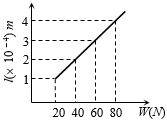
- ✓
$2 \times {10^{11\,}}N/{m^2}$
- B
$2 \times {10^{ - 11}}N/{m^2}$
- C
$3 \times {10^{ - 12}}N/{m^2}$
- D
$2 \times {10^{ - 13}}N/{m^2}$
AnswerCorrect option: A. $2 \times {10^{11\,}}N/{m^2}$
a
(a)From the graph $l = {10^{ - 4}}m,\;F = 20N$
$A = {10^{ - 6}}{m^2},\;L = 1m$
$Y = \frac{{FL}}{{Al}}$$ = \frac{{20 \times 1}}{{{{10}^{ - 6}} \times {{10}^{ - 4}}}} = 20 \times {10^{10}} = 2 \times {10^{11}}N/{m^2}$
View full question & answer→MCQ 2741 Mark
One end of a uniform wire of length $L$ and of weight $W$ is attached rigidly to a point in the roof and a weight ${W_1}$ is suspended from its lower end. If $S$ is the area of cross-section of the wire, the stress in the wire at a height $3L/4$ from its lower end is
AnswerCorrect option: C. $\frac{{{W_1} + (3W/4)}}{S}$
c
(c) Total force at height $3L/4$ from its lower end
$=$ Weight suspended $+$ Weight of $3/4$ of the chain
$ = {W_1} + (3W/4)$
Hence stress $ = \frac{{{W_1} + (3W/4)}}{S}$
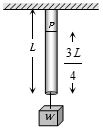
View full question & answer→MCQ 2751 Mark
An elastic material of Young's modulus $Y$ is subjected to a stress $S$. The elastic energy stored per unit volume of the material is
- A
$\frac{{2Y}}{{{S^2}}}$
- ✓
$\frac{{{S^2}}}{{2Y}}$
- C
$\frac{S}{{2Y}}$
- D
$\frac{{{S^2}}}{Y}$
AnswerCorrect option: B. $\frac{{{S^2}}}{{2Y}}$
b
(b) Given,
Young's modulus $=Y$
Streaching stress $=S$ Energy stored per unit volume is, $=\frac{1}{2} \times$ stress $\times$ strian
We know that, stress $=$ strain $\times Y$
Therefore energy per unit volume will be
$E=\frac{1}{2} \times S \times \frac{S}{Y}=\frac{S^{2}}{2 Y}$
View full question & answer→MCQ 2761 Mark
Two rods of different materials having coefficients of linear expansion ${\alpha _1},\,{\alpha _2}$ and Young's moduli ${Y_1}$ and ${Y_2}$ respectively are fixed between two rigid massive walls. The rods are heated such that they undergo the same increase in temperature. There is no bending of rods. If ${\alpha _1}:{\alpha _2} = 2:3$, the thermal stresses developed in the two rods are equally provided ${Y_1}:{Y_2}$ is equal to
Answerc
(c) Thermal stress = $Y\alpha \Delta \theta $.
If thermal stress and rise in temperature are equal then
$Y \propto \frac{1}{\alpha }$ $\Rightarrow$ $\frac{{{Y_1}}}{{{Y_2}}} = \frac{{{\alpha _2}}}{{{\alpha _1}}} = \frac{3}{2}$
View full question & answer→MCQ 2771 Mark
The increase in length is $l$ of a wire of length $L$ by the longitudinal stress. Then the stress is proportional to
- A
$L/l$
- ✓
$l/L$
- C
$l \times L$
- D
${l^2} \times L$
Answerb
(b) Stress $\propto$ Strain$ \Rightarrow $Stress$ \propto \frac{l}{L}$
View full question & answer→MCQ 2781 Mark
View full question & answer→MCQ 2791 Mark
A wire is loaded by $6\, kg$ at its one end, the increase in length is $12\, mm.$ If the radius of the wire is doubled and all other magnitudes are unchanged, then increase in length will be ......... $mm$
Answerb
(b) $l \propto \frac{1}{{{r^2}}}$.
If radius of the wire is doubled then increment in length will become $\frac{1}{4}$ times i.e. $\frac{{12}}{4} = 3mm$
View full question & answer→MCQ 2801 Mark
The material which practically does not show elastic after effect is
Answerd
(d) Quartz is the substance which shows practically no$-$elastic after effect.
View full question & answer→MCQ 2811 Mark
A force $F$ is needed to break a copper wire having radius $R.$ The force needed to break a copper wire of radius $2R$ will be
Answerc
(c) Breaking Force $\propto$ Area of cross section of wire ($\pi r^2$)
If radius of wire is double then breaking force will become four times.
View full question & answer→MCQ 2821 Mark
In a wire of length $L,$ the increase in its length is $l.$ If the length is reduced to half, the increase in its length will be
AnswerCorrect option: C. $\frac{l}{2}$
c
(c) $l \propto L$ i.e. if length is reduced to half then increase in length will be $\frac{l}{2}.$
View full question & answer→MCQ 2831 Mark
If the length of a wire is reduced to half, then it can hold the ......... load
Answerb
(b) Breaking force $\propto$ Area of cross section of wire
i.e. load hold by the wire does not depend upon the length of the wire.
View full question & answer→MCQ 2841 Mark
The spring balance does not read properly after its long use, because
- A
The elasticity of spring increases
- ✓
- C
Its plastic power decreases
- D
Its plastic power increases
Answerb
(b)Due to elastic fatigue its elastic property decreases.
View full question & answer→MCQ 2851 Mark
Why the spring is made up of steel in comparison of copper
- A
Copper is more costly than steel
- B
Copper is more elastic than steel
- ✓
Steel is more elastic than copper
- D
AnswerCorrect option: C. Steel is more elastic than copper
c
(c) A spring will be better one, if a large restoring force is setup in it on being deformed, which in turm depends upon the elasticity of the material of the spring. since the Young's modulus of elastivity of steel is more than that of copper. Hence steel is prefferred in making the spring.
View full question & answer→MCQ 2861 Mark
If a load of $9$ $kg$ is suspended on a wire, the increase in length is $4.5\, mm$. The force constant of the wire is
- A
$0.49 \times {10^4}\,N/m$
- ✓
$1.96 \times {10^4}\,N/m$
- C
$4.9 \times {10^4}\,N/m$
- D
$0.196 \times {10^4}\,N/m$
AnswerCorrect option: B. $1.96 \times {10^4}\,N/m$
b
(b) $F = Kx \Rightarrow K = \frac{F}{x} = \frac{{9 \times 9.8}}{{4.5 \times {{10}^{ - 3}}}} = 1.96 \times {10^4}N/m$
View full question & answer→MCQ 2871 Mark
Two identical wires of rubber and iron are stretched by the same weight, then the number of atoms in the iron wire will be
- A
- B
Less than that of the rubber
- ✓
More than that of the rubber
- D
AnswerCorrect option: C. More than that of the rubber
View full question & answer→MCQ 2881 Mark
- A
Increases with temperature rise
- B
Decreases with temperature rise
- ✓
Does not depend on temperature
- D
AnswerCorrect option: C. Does not depend on temperature
c
Invar is a $Fe - Ni$ alloy stul which does not experience any thermal expansion in the extremely low tempratur environment. Or the above room temprature. environment.
since, temprature effect on it is very less, it is tough and ductile and hence its elasticity rimains constant when temprature is changed.
View full question & answer→MCQ 2891 Mark
After effects of elasticity are maximum for
MCQ 2901 Mark
When compared with solids and liquids, the gases have
- ✓
Minimum volume elasticity
- B
Maximum volume elasticity
- C
- D
Maximum modulus of rigidity
AnswerCorrect option: A. Minimum volume elasticity
a
(a)A small change in pressure produces a large change in volume.
View full question & answer→MCQ 2911 Mark
The quality of the material which opposes the change in shape, volume or length is called
Answerd
(d) elasticity of a material resists change in shape, size and volume of material
example:as soon as we change the shape of rubber band, internal restoring force is developed within the band which opposes the external pull
therefore immediately after removing external force... rubber is acted by internal restoring force and regains it's original shape
View full question & answer→MCQ 2921 Mark
The longitudinal strain is only possible in
MCQ 2931 Mark
The elastic limit for a gas
- ✓
- B
Exists only at absolute zero
- C
- D
View full question & answer→MCQ 2941 Mark
Which one of the following quantities does not have the unit of force per unit area
- A
- ✓
- C
Young's modulus of elasticity
- D
Answerb
(b)Because strain is a dimensionless and unitless quantity.
View full question & answer→MCQ 2951 Mark
A copper wire and a steel wire of the same diameter and length are connected end to end and a force is applied, which stretches their combined length by $1\, cm$. The two wires will have
- A
Different stresses and strains
- B
The same stress and strain
- C
The same strain but different stresses
- ✓
The same stress but different strains
AnswerCorrect option: D. The same stress but different strains
d
(d) ${\rm{Stress}} = \frac{{{\rm{Force}}}}{{{\rm{area}}}}$.
In the present case, force applied and area of cross-section of wires are same, therefore stress has to be the same.
${\rm{Strain}} = \frac{{{\rm{Stress}}}}{Y}$
Since the Young’s modulus of steel wire is greater than the copper wire, therefore, strain in case of steel wire is less than that in case of copper wire.
View full question & answer→MCQ 2961 Mark
To keep constant time, watches are fitted with balance wheel made of
Answera
(a)Because dimension of invar does not varies with temperature.
View full question & answer→MCQ 2971 Mark
If a spring is extended to length $l,$ then according to Hook's law
- ✓
$F = kl$
- B
$F = \frac{k}{l}$
- C
$F = {k^2}l$
- D
$F = \frac{{{k^2}}}{l}$
AnswerCorrect option: A. $F = kl$
a
(a) $\frac{\text { stress }}{\text { sbrain }}=k=E$
$\frac{F L}{A l}=E$
$\frac{E A}{L}=k$
$F=\frac{E A}{L} \times l$
$F=k l$
View full question & answer→MCQ 2981 Mark
In solids, inter-atomic forces are
AnswerCorrect option: C. Combination of $(a)$ and $(b)$
c
(c) The interatomic forces in solids are both attractive and repulsive.
View full question & answer→MCQ 2991 Mark
Under elastic limit the stress is
- A
Inversely, proportional to strain
- ✓
Directly proportional to strain
- C
- D
AnswerCorrect option: B. Directly proportional to strain
View full question & answer→MCQ 3001 Mark
Stress to strain ratio is equivalent to
Answera
Stress divided by strain at any load or deflection. Below the elastic limit of a material, it is equal to tangent modulus of elasticity. An alternate term is the secant modulus of elasticity.
View full question & answer→MCQ 3011 Mark
According to Hook’s law force is proportional to
- A
$\frac{1}{x}$
- B
$\frac{1}{{{x^2}}}$
- ✓
$x$
- D
${x^2}$
Answerc
(c)
According to Hooke's law, within elastic limit for elastic material, material act as a spring, which reforms its shape after we deform it by some external force. Hence, a restoring force occurs
$\therefore F =- kx \quad k =$ spring constant
$\therefore F \propto x$
View full question & answer→MCQ 3021 Mark
A wire of diameter $1mm$ breaks under a tension of $1000\, N.$ Another wire, of same material as that of the first one, but of diameter $2\, mm$ breaks under a tension of ...... $N$
- A
$500$
- B
$1000$
- C
$10000 $
- ✓
$4000$
AnswerCorrect option: D. $4000$
d
(d) Breaking force $\propto r^2$
If diameter becomes double then breaking force will become four times i.e. $1000 \times 4 = 4000\, N$
View full question & answer→MCQ 3031 Mark
Modulus of rigidity of diamond is
MCQ 3041 Mark
When a spiral spring is stretched by suspending a load on it, the strain produced is called
Answera
(a)A small part of the spring bear tangential stress, causing straining strain.
View full question & answer→MCQ 3051 Mark
A cube of aluminium of sides $0.1\, m$ is subjected to a shearing force of $100\, N$. The top face of the cube is displaced through $0.02 \,cm$ with respect to the bottom face. The shearing strain would be
- A
$0.02$
- B
$0.1$
- C
$0.005$
- ✓
$0.002$
AnswerCorrect option: D. $0.002$
d
(d) Shearing strain $\varphi = \frac{x}{L} = \frac{{0.02cm}}{{10cm}}$
$\varphi = 0.002$
View full question & answer→MCQ 3061 Mark
The reason for the change in shape of a regular body is
Answerb
(b) A body undergoes a change in shape without change in volume.
View full question & answer→MCQ 3071 Mark
The lower surface of a cube is fixed. On its upper surface, force is applied at an angle of $30°$ from its surface. The change will be of the type
Answerd
(d) There will be both shear stress and normal stress.
View full question & answer→MCQ 3081 Mark
- A
Sliding of molecular layer is much easier than compression or expansion
- B
Reciprocal of bulk modulus of elasticity is called compressibility
- ✓
It is difficult to twist a long rod as compared to small rod
- D
Hollow shaft is much stronger than a solid rod of same length and same mass
AnswerCorrect option: C. It is difficult to twist a long rod as compared to small rod
c
(c) For twisting, Angle of shear $\varphi \propto \frac{1}{L}$
i.e. if $L$ is more then $\varphi $ will be small.
View full question & answer→MCQ 3091 Mark
A $2\, m$ long rod of radius $1\, cm$ which is fixed from one end is given a twist of $0.8$ radians. The shear strain developed will be
- A
$0.002$
- ✓
$0.004$
- C
$0.008$
- D
$0.016$
AnswerCorrect option: B. $0.004$
b
(b) $r\theta = L\varphi \Rightarrow {10^{ - 2}} \times 0.8 = 2 \times \varphi \Rightarrow \varphi = 0.004$
View full question & answer→MCQ 3101 Mark
Shearing stress causes change in
Answerc
(c) Shearing stress causes change in shape.
View full question & answer→MCQ 3111 Mark
The breaking stress of a wire of length $L$ and radius $r$ is $5$ $kg - wt/{m^2}$. The wire of length $2l$ and radius $2r$ of the same material will have breaking stress in $kg - wt/{m^2}$
Answera
(a) Breaking stress depends on the material of wire.
View full question & answer→MCQ 3121 Mark
If the breaking force for a given wire is $F$, then the breaking force of two wires of same magnitude will be
Answerd
(d) Breaking force $\propto$ Area of cross section
If area is double then breaking force will become two times.
View full question & answer→MCQ 3131 Mark
If the breaking force for a given wire is $F$, If the thickness of the wire is doubled, then the breaking force will be
Answerb
(b) Breaking force $\propto$ $\pi {r^2}$
If thickness (radius) of wire is doubled then breaking force will become four times.
View full question & answer→MCQ 3141 Mark
The correct increasing order for modulus of elasticity for copper, steel, glass and rubber is
- ✓
Rubber, glass, copper and steel
- B
Glass, rubber, copper and steel
- C
Steel, copper, rubber and glass
- D
Rubber, glass, steel and copper
AnswerCorrect option: A. Rubber, glass, copper and steel
a
rubber, glass, copper, steel
View full question & answer→MCQ 3151 Mark
Join details of Column$-II$ with given information in Column$-I$ appropriately
| Column $-I$ |
Column $-II$ |
|
$(a)$ Stress is proportional to strain.
|
$(i)$ Elastic limit |
| $(b)$ When the load of the wire is removed, the body does regain its original dimension. |
$(ii)$ Limit of pro-portionality |
| |
$(iii)$ Plastic deformation |
- A
$(a-iii),(b-ii)$
- B
$(a-i),(b-ii)$
- ✓
$(a-ii),(b-i)$
- D
$(a-ii),(b-iii)$
AnswerCorrect option: C. $(a-ii),(b-i)$
c
$(a-i i),(b-i)$
View full question & answer→MCQ 3161 Mark
The shear strain is possible in .............
Answera
(A)
Shear strain is possible in solids only, as only solids have a definite surface.
View full question & answer→MCQ 3171 Mark
The ratio of radii of two wires of same material is $2: 1$. If these wires are stretched by equal force, the ratio of stresses produced in them is .............
- A
$2: 1$
- B
$1: 2$
- ✓
$1: 4$
- D
$4: 1$
AnswerCorrect option: C. $1: 4$
c
(c)
We know,
$\text { Stress }=\frac{\text { Force }}{\text { Area }}$
So, Stress $\times$ Area $=$ Force
$S \times A=F$
$\left\{\begin{array}{l}S=\text { Stress } \\ F=\text { Force } \\ A=\text { Area } \\ r=\text { radius }\end{array}\right\}$
$\because$ (Since) Force applied on the wires is equal we can relate two conditions as
$S_1 A_1=S_2 A_2$
$\frac{S_1}{S_2}=\frac{A_2}{A_1}=\frac{\pi r_2^2}{\pi r_1^2}$
$\frac{S_1}{S_2}=\frac{r^2}{(2 r)^2}=\frac{r^2}{4 r^2}=\frac{1}{4}$
$\left\{\begin{array}{l}\text { Where } \\ S_1-\text { Stress in } 1^{\text {st }} \text { wire } \\ A_1-\text { Area of } 1^{\text {st }} \text { wire } \\ r_1-\text { Radius of } 1^{\text {st }} \text { wire } \\ S_2-\text { Stress in } 2^{\text {nd }} \text { wire } \\ A_2-\text { Area of } 2^{\text {nd }} \text { wire } \\ r_2-\text { Radius of } 2^{\text {nd }} \text { wire }\end{array}\right\}$
View full question & answer→MCQ 3181 Mark
In a series combination of copper and steel wires of same length and same diameter, a force is applied at one of their ends while the other end is kept fixed. The combined length is increased by $2\, cm$. The wires will have ..........
- A
Same stress and same strain
- B
Different stress and different strain
- C
Different stress and same strain
- ✓
Same stress and different strain
AnswerCorrect option: D. Same stress and different strain
d
(d)
Stress $=\frac{F}{A}$
Force is same, $A$ is same
So same stress
Strain $=\frac{\Delta L}{L}$
$L$ is same, but due to different young's modulus (Material's different)
$\Delta L$ would be different so strain is different
View full question & answer→MCQ 3191 Mark
Hooke's law is applicable for ....
Answera
(a)
Hooke's law is applicable only for elastic materials as only they follow the stress-strain proportionality.
View full question & answer→MCQ 3201 Mark
When a load of $10 \,kg$ is suspended on a metallic wire, its length increase by $2 \,mm$. The force constant of the wire is ........ $N / m$
- A
$3 \times 10^4$
- B
$2.5 \times 10^3$
- ✓
$5 \times 10^4$
- D
$7.5 \times 10^3$
AnswerCorrect option: C. $5 \times 10^4$
c
(c)
Force constant $(K)=\frac{\text { Force }}{\text { Elongation }}=\frac{F}{\Delta x}$ $\left\{\begin{array}{l}F=10 \,kg =100 \,N \\ \Delta x=2 \,mm =0.002 \,m \end{array}\right.$
Substituting values
$K=\frac{100}{0.002}=5 \times 10^4 \,N / m$
View full question & answer→MCQ 3211 Mark
A force $F$ is applied on a square area of side $L$. If the percentage error in the measurement of $L$ is $2 \%$ and that in $F$ is $4 \%$, what is the maximum percentage error in pressure?
Answerd
(d)
$P =\frac{ F }{ L ^2}$
$\frac{\delta P }{ P }=\frac{\delta F }{ F }+2 \frac{\delta L }{ L }$
$\frac{\delta P }{ P }=4 \%+2 \times 2 \%=8 \%$
View full question & answer→MCQ 3221 Mark
Two different types of rubber are found to have the stress-strain curves as shown. Then
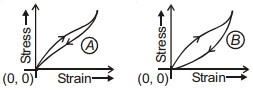
- A
$A$ is suitable for shock absorber
- B
$B$ is suitable for car tyres
- ✓
$B$ is suitable for shock absorber
- D
AnswerCorrect option: C. $B$ is suitable for shock absorber
c
(c)
One with higher hysterysis loss suitable for shock absorber because high hysterysis loss will lead to dampen shocks in a easy manner.
One with lower hysterysis loss suitable for types because it will have low relaxation time.
Area between loop gives amount of hysterysis loss. More area more loss, less area less.
Therefore, $B$ is suitable for shock absorber and $A$ for types.
View full question & answer→MCQ 3231 Mark
The substances having very short plastic region are
Answerb
(b)
Substances with short plastic region are brittle because less amount of permanent deformation could be done in them.
View full question & answer→MCQ 3241 Mark
A wire of length $5 \,m$ is twisted through $30^{\circ}$ at free end. If the radius of wire is $1 \,mm$, the shearing strain in the wire is ..........,.
- A
$30^{\circ}$
- B
$0.18^{\circ}$
- C
$1^{\circ}$
- ✓
$0.36^{\prime}$
AnswerCorrect option: D. $0.36^{\prime}$
d
(d)
$\theta=\frac{r}{L} \phi$
$\theta=\frac{1 \times 10^{-3} \times 30^{\circ}}{5}$ $\left\{\begin{array}{l}\text { Where } \\ \theta=\text { Angle of shear } \\ \phi=\text { Angle of twist } \\ r=\text { Radius of rod } \\ I=\text { length or rod }\end{array}\right.$
$\theta=6 \times 10^{-3}$
$=0.36^{\prime}$
View full question & answer→MCQ 3251 Mark
The upper end of a wire of diameter $12\,mm$ and length $1\,m$ is clamped and its other end is twisted through an angle of $30^{\circ}$. The angle of shear is$........^{\circ}$
AnswerCorrect option: B. $0.18$
b
(b)
$r \theta=\ell \phi \Rightarrow \phi=\frac{ r \theta}{\ell}=\frac{6 mm \times 30^{\circ}}{1 m }=0.18^{\circ}$
View full question & answer→MCQ 3261 Mark
The elastic limit of brass is $3.5 \times 10^{10}\,N / m ^2$. Find the maximum load that can be applied to a brass wire of $0.75\,mm$ diameter without exceeding the elastic limit$.......\times 10^4\,N$
- A
$4.12$
- B
$5.15$
- C
$0.55$
- ✓
$1.55$
AnswerCorrect option: D. $1.55$
d
(d)
Stress $=\frac{ F }{ A } ;$ For elastic limit, stress $=3.5 \times 10^{10} N / m ^2$ (given).
Thus, $F=\left(\pi r^2\right) \times$ stress
$=3.14 \times\left(\frac{0.75}{2} \times 10^{-3}\right)^2 \times 3.5 \times 10^{10}$
$=3.14 \times \frac{(0.75)^2}{4} \times 3.5 \times 10^4=1.55 \times 10^4\,N$
View full question & answer→MCQ 3271 Mark
The length of an iron wire is $L$ and area of cross-section is $A$. The increase in length is $l$ on applying the force $F$ on its two ends. Which of the statement is correct
- A
Increase in length is inversely proportional to its length $L$
- B
Increase in length is proportional to area of cross-section $A$
- ✓
Increase in length is inversely proportional to $A$
- D
Increase in length is proportional to Young's modulus
AnswerCorrect option: C. Increase in length is inversely proportional to $A$
c
(c) $l = \frac{{FL}}{{YA}} \Rightarrow l \propto \frac{1}{A}$
View full question & answer→MCQ 3281 Mark
The Young's modulus of a wire of length $L$ and radius $r$ is $Y$ $N/m^2$. If the length and radius are reduced to $L/2$ and $r/2,$ then its Young's modulus will be
Answerb
(b) Young's modulus of wire does not varies with dimension of wire.
It is the property of given material.
View full question & answer→MCQ 3291 Mark
In $CGS$ system, the Young's modulus of a steel wire is $2 \times {10^{12}}$. To double the length of a wire of unit cross-section area, the force required is
AnswerCorrect option: B. $2 \times {10^{12}}$ dynes
b
(b)To double the length of wire,
Stress = Young's modulus
$\frac{F}{A} = 2 \times {10^{12}}\frac{{dyne}}{{c{m^2}}}.$
If $A = 1$ then $F = 2 × 10^{12}$ dyne
View full question & answer→MCQ 3301 Mark
To double the length of a iron wire having $0.5\,c{m^2}$ area of cross-section, the required force will be $(Y = {10^{12}}\,dyne/c{m^2})$
- A
$1.0 \times {10^{ - 7}}N$
- B
$1.0 \times {10^7}N$
- C
$0.5 \times {10^{ - 7}}N$
- ✓
$0.5 \times {10^{12}}$dyne
AnswerCorrect option: D. $0.5 \times {10^{12}}$dyne
d
(d) If length of wire doubled then strain $= 1$
$Y = {\rm{stress}}$ ==> $F = Y \times A$$ = {10^{12}} \times 0.5$$ = 0.5 \times {10^{12}}dyne$
View full question & answer→MCQ 3311 Mark
An area of cross-section of rubber string is $2\,c{m^2}$. Its length is doubled when stretched with a linear force of $2 \times {10^5}$dynes. The Young's modulus of the rubber in $dyne/c{m^2}$ will be
- A
$4 \times {10^5}$
- ✓
$1 \times {10^5}$
- C
$2 \times {10^5}$
- D
$1 \times {10^4}$
AnswerCorrect option: B. $1 \times {10^5}$
b
(b) If length of the wire is doubled then strain $= 1$
Y = ${\rm{Stress}} = \frac{{{\rm{Force}}}}{{{\rm{Area}}}}$= $\frac{{2 \times {{10}^5}}}{2} = {10^5}\frac{{dyne}}{{c{m^2}}}$
View full question & answer→MCQ 3321 Mark
A rod of length $l$ and area of cross-section $A$ is heated from $0°C$ to $100°C$. The rod is so placed that it is not allowed to increase in length, then the force developed is proportional to
- A
$l$
- B
${l^{ - 1}}$
- ✓
$A$
- D
${A^{ - 1}}$
Answerc
(c) $F = YA\alpha \Delta \theta \,\,\,\therefore F \propto A$
View full question & answer→MCQ 3331 Mark
A weight of $200 \,kg$ is suspended by vertical wire of length $600.5\, cm$. The area of cross-section of wire is $1\,m{m^2}$. When the load is removed, the wire contracts by $0.5 \,cm$. The Young's modulus of the material of wire will be
- ✓
$2.35 \times {10^{12}}\,N/{m^2}$
- B
$1.35 \times {10^{10}}\,N/{m^2}$
- C
$13.5 \times {10^{11}}\,N/{m^2}$
- D
$23.5 \times {10^9}\,N/{m^2}$
AnswerCorrect option: A. $2.35 \times {10^{12}}\,N/{m^2}$
a
(a) $F = 2000N,\;L = 6m,\;l = 0.5\;cm,A = {10^{ - 6}}{m^2}$
$Y = \frac{{FL}}{{Al}} = \frac{{2000 \times 6}}{{{{10}^{ - 6}} \times 0.5 \times {{10}^{ - 2}}}} = 2.35 \times {10^{12}}\;N/{m^2}$
View full question & answer→MCQ 3341 Mark
A steel wire is stretched with a definite load. If the Young's modulus of the wire is $Y$. For decreasing the value of $Y$
- A
Radius is to be decreased
- B
Radius is to be increased
- C
Length is to be increased
- ✓
Answerd
(d) It is the specific property of a particular metal at a given temperature which can be changed only by temperature variations.
View full question & answer→MCQ 3351 Mark
In suspended type moving coil galvanometer, quartz suspension is used because
- A
It is good conductor of electricity
- ✓
Elastic after effects are negligible
- C
Young's modulus is greater
- D
There is no elastic limit
AnswerCorrect option: B. Elastic after effects are negligible
View full question & answer→MCQ 3361 Mark
If the density of the material increases, the value of Young's modulus
- ✓
- B
- C
First increases then decreases
- D
First decreases then increases
Answera
(a)If density of the material increases then more force (stress) is required for same deformation i.e. the value of young's modulus increases.
View full question & answer→MCQ 3371 Mark
If Young's modulus for a material is zero, then the state of material should be
Answerb
(b) $Y$ is defined for solid only and for powders, $Y = 0$
View full question & answer→MCQ 3381 Mark
In steel, the Young's modulus and the strain at the breaking point are $2 \times {10^{11}}\,N{m^{ - 2}}$ and $0.15$ respectively. The stress at the breaking point for steel is therefore
- A
$1.33 \times {10^{11}}\,N{m^{ - 2}}$
- B
$1.33 \times {10^{12}}\,N{m^{ - 2}}$
- C
$7.5 \times {10^{ - 13}}\,N{m^{ - 2}}$
- ✓
$3 \times {10^{10}}\,N{m^{ - 2}}$
AnswerCorrect option: D. $3 \times {10^{10}}\,N{m^{ - 2}}$
d
(d) Breaking stress $=$ strain $\times$ Young's modulus
$ = 0.15 \times 2{ \times ^{11}} = 3 \times {10^{10}}\;N{m^{ - 2}}$
View full question & answer→MCQ 3391 Mark
Which of the following statements is correct
- ✓
Hooke's law is applicable only within elastic limit
- B
The adiabatic and isothermal elastic constants of a gas are equal
- C
Young's modulus is dimensionless
- D
Stress multiplied by strain is equal to the stored energy
AnswerCorrect option: A. Hooke's law is applicable only within elastic limit
a
(a) In accordance with Hooke’s law.
View full question & answer→MCQ 3401 Mark
The force required to stretch a steel wire of $1\,c{m^2}$ cross-section to $1.1$ times its length would be $(Y = 2 \times {10^{11}}\,N{m^{ - 2}})$
AnswerCorrect option: A. $2 \times {10^6}\,N$
a
(a) $F = A \times Y \times {\rm{strain}}$=$1 \times {10^{ - 4}} \times 2 \times {10^{11}} \times 0.1 = 2 \times {10^6}N$
View full question & answer→MCQ 3411 Mark
A rod is fixed between two points at $20°C$. The coefficient of linear expansion of material of rod is $1.1 \times {10^{ - 5}}/^\circ C$ and Young's modulus is $1.2 \times {10^{11}}\,N/m$. Find the stress developed in the rod if temperature of rod becomes $10°C$
- ✓
$1.32 \times {10^7}\,N/{m^2}$
- B
$1.10 \times {10^{15}}\,N/{m^2}$
- C
$1.32 \times {10^8}\,N/{m^2}$
- D
$1.10 \times {10^6}\,N/{m^2}$
AnswerCorrect option: A. $1.32 \times {10^7}\,N/{m^2}$
a
(a)Thermal stress =$Y\alpha \Delta \theta $
$ = 1.2 \times {10^{11}} \times 1.1 \times {10^{ - 5}} \times (20 - 10)$$ = 1.32 \times {10^7}\;N/{m^2}$
View full question & answer→MCQ 3421 Mark
An iron rod of length $2m$ and cross section area of $50\,m{m^2}$, stretched by $0.5\, mm$, when a mass of $250\, kg$ is hung from its lower end. Young's modulus of the iron rod is
- ✓
$19.6 \times {10^{10}}\,N/{m^2}$
- B
$19.6 \times {10^{15}}\,N/{m^2}$
- C
$19.6 \times {10^{18}}\,N/{m^2}$
- D
$19.6 \times {10^{20}}\,N/{m^2}$
AnswerCorrect option: A. $19.6 \times {10^{10}}\,N/{m^2}$
a
(a) $Y = \frac{{MgL}}{{Al}} = \frac{{250 \times 9.8 \times 2}}{{50 \times {{10}^{ - 6}} \times 0.5 \times {{10}^{ - 3}}}}$
$ = 19.6 \times {10^{10}}N/{m^2}$
View full question & answer→MCQ 3431 Mark
A force $F$ is applied on the wire of radius $r$ and length $L$ and change in the length of wire is $l.$ If the same force $F$ is applied on the wire of the same material and radius $2r$ and length $2L,$ Then the change in length of the other wire is
Answerc
(c) $l = \frac{{FL}}{{AY}} \Rightarrow l \propto \frac{L}{{{r^2}}}$ $(F$ and $Y$ are constant$)$
$\frac{{{l_2}}}{{{l_1}}} = \frac{{{L_2}}}{{{L_1}}} \times {\left( {\frac{{{r_1}}}{{{r_2}}}} \right)^2} = 2 \times {\left( {\frac{1}{2}} \right)^2} = \frac{1}{2}$
$\therefore {l_2} = \frac{{{l_1}}}{2}$
i.e. the change in the length of other wire is $\frac{l}{2}$
View full question & answer→MCQ 3441 Mark
The modulus of elasticity is dimensionally equivalent to
Answerb
(b) Hookes law establishes the relationship between stress and strain
Stress$:$ The force per unit area
Strain$:$ The elongation or contraction per unit length (dimensionless)
The ratio of stress to strain is known as the elastic modulus of the material
Elastic Modulus $=\frac{\text {stress}}{\text {strain}}$ Hence, the modulus of elasticity is dimensionally equivalent to the stress
View full question & answer→MCQ 3451 Mark
The units of Young ‘s modulus of elasticity are
- A
$N{m^{ - 1}}$
- B
$N-m$
- ✓
$N{m^{ - 2}}$
- D
$N{\rm{ - }}{m^2}$
AnswerCorrect option: C. $N{m^{ - 2}}$
c
Young's Modulus $=\frac{\text { stress }}{\text { strain }}=\frac{ ML ^{-1} T ^{-2}}{ L ^0}= M ^1 L ^{-1} T ^{-2}$
$\frac{\text { Force }}{\text { Area }}= N / m ^2$
View full question & answer→MCQ 3461 Mark
How much force is required to produce an increase of $0.2\%$ in the length of a brass wire of diameter $0.6\, mm$ (Young’s modulus for brass = $0.9 \times {10^{11}}N/{m^2}$)
- A
Nearly $17 \,N$
- B
Nearly $34 \,N$
- ✓
Nearly $51 \,N$
- D
Nearly $68\, N$
AnswerCorrect option: C. Nearly $51 \,N$
c
(c) $F = \frac{{YAl}}{L}$$ = 0.9 \times {10^{11}} \times \pi \times {(0.3 \times {10^{ - 3}})^2} \times \frac{{0.2}}{{100}} = 51\,N$
View full question & answer→MCQ 3471 Mark
A copper wire of length $4.0m$ and area of cross-section $1.2\,c{m^2}$ is stretched with a force of $4.8 \times {10^3}$ $N.$ If Young’s modulus for copper is $1.2 \times {10^{11}}\,N/{m^2},$ the increase in the length of the wire will be
- ✓
$1.33 \,mm$
- B
$1.33 \,cm$
- C
$2.66\, mm$
- D
$2.66\, cm$
AnswerCorrect option: A. $1.33 \,mm$
a
(a) $l = \frac{{FL}}{{AY}} = \frac{{4.8 \times {{10}^3} \times 4}}{{1.2 \times {{10}^{ - 4}} \times 1.2 \times {{10}^{11}}}} = 1.33\;mm$
View full question & answer→MCQ 3481 Mark
A uniform plank of Young’s modulus $Y $ is moved over a smooth horizontal surface by a constant horizontal force $F.$ The area of cross section of the plank is $A.$ The compressive strain on the plank in the direction of the force is
- ✓
$F/AY$
- B
$2F/AY$
- C
$\frac{1}{2}(F/AY)$
- D
$3F/AY$
AnswerCorrect option: A. $F/AY$
a
(a) $Y = \frac{{F/A}}{{{\rm{Strain}}}} \Rightarrow {\rm{strain}} = \frac{F}{{Ay}}$
View full question & answer→MCQ 3491 Mark
The area of cross section of a steel wire $(Y = 2.0 \times {10^{11}}N/{m^2})$ is $0.1\;c{m^2}$. The force required to double its length will be
- A
$2 \times {10^{12}}N$
- B
$2 \times {10^{11}}N$
- C
$2 \times {10^{10}}N$
- ✓
$2 \times {10^6}N$
AnswerCorrect option: D. $2 \times {10^6}N$
d
(d) When the length of wire is doubled then $l = L$ and
strain $= 1$$\Rightarrow\, Y$ $=$ strain $=\frac{F}{A}$
Force $= Y \times A $ $= 2 \times {10^{11}} \times 0.1 \times {10^{ - 4}}$$ = 2 \times {10^6}N$
View full question & answer→MCQ 3501 Mark
In the Young’s experiment, If length of wire and radius both are doubled then the value of $Y$ will become
Answerc
(c) Young's modulus of e material is a material property of a object.
it does not depend upon shape and size of material.
View full question & answer→MCQ 3511 Mark
Young’s modulus of perfectly rigid body material is
- A
- ✓
- C
${\rm{1}} \times {\rm{1}}{{\rm{0}}^{{\rm{10}}}}\,N/{m^2}$
- D
${\rm{10}} \times {\rm{1}}{{\rm{0}}^{{\rm{10}}}}\,N/{m^2}$
Answerb
(b) From Hooke's law, Young modulus $Y=\frac{S t r e s s}{S t r a i n}$
The Strain produced in a perfectly rigid body is zero i.e Strain$=0$
$\therefore Y=\frac{S t r e s s}{0} \quad \Longrightarrow Y=\infty$
Thus the Young's modulus of perfectly rigid body material is infinite.
View full question & answer→MCQ 3521 Mark
Two wires $A$ and $B$ of same length, same area of cross-section having the same Young's modulus are heated to the same range of temperature. If the coefficient of linear expansion of $A$ is $3/2$ times of that of wire $B$. The ratio of the forces produced in two wires will be
Answerd
(d) $F = YA\alpha \Delta \theta $
If $Y, A$ and $\Delta \theta$ are constant then $\frac{{{F_A}}}{{{F_B}}} = \frac{{{\alpha _A}}}{{{\alpha _B}}} = \frac{3}{2}$
View full question & answer→MCQ 3531 Mark
The mass and length of a wire are $M$ and $L$ respectively. The density of the material of the wire is $d$. On applying the force $F$ on the wire, the increase in length is $l$, then the Young's modulus of the material of the wire will be
- A
$\frac{{Fdl}}{{Ml}}$
- B
$\frac{{FL}}{{Mdl}}$
- C
$\frac{{FMl}}{{dl}}$
- ✓
$\frac{{Fd{L^2}}}{{Ml}}$
AnswerCorrect option: D. $\frac{{Fd{L^2}}}{{Ml}}$
d
(d) $Y = \frac{F}{A}\frac{L}{l}$ $ = \frac{{Fd{L^2}}}{{Ml}}$
As $M =$ volume $\times$ density $ = A \times L \times d$ $\therefore$ $A = \frac{M}{{Ld}}$
View full question & answer→MCQ 3541 Mark
The Young's modulus of a wire of length $L$ and radius $r$ is $Y$. If the length is reduced to $\frac{L}{2}$ and radius is $\frac{r}{2}$ , then the Young's modulus will be
- A
$\frac{Y}{2}$
- ✓
$Y$
- C
$2Y$
- D
$4Y$
Answerb
Young's modulus depends upon the nature of the material and not on geometrical dimensions
View full question & answer→MCQ 3551 Mark
A wire of area of cross-section $10^{-6}\,m^2$ is increased in length by $0.1\%$. The tension produced is $1000\, N$. The Young's modulus of wire is
- ✓
$10^{12}\, N/m^2$
- B
$10^{11}\, N/m^2$
- C
$10^{10}\, N/m^2$
- D
$10^{9}\, N/m^2$
AnswerCorrect option: A. $10^{12}\, N/m^2$
a
$Y = \frac{{FL}}{{Al}} = \frac{{1000 \times 100}}{{{{10}^{ - 6}} \times 0.1}} = {10^{12}}\,N/{m^2}$
View full question & answer→MCQ 3561 Mark
Young's modulus of elasticity of material depends upon
MCQ 3571 Mark
The Young's modulus of a wire is $y$. If the energy per unit volume is $E$, then the strain will be
AnswerCorrect option: A. $\sqrt {\frac{{2E}}{y}} $
a
$E = \frac{1}{2}\,y\,{{\rm{(strain)}}^2}$
strain $ = \sqrt {\frac{{2E}}{y}} $
View full question & answer→MCQ 3581 Mark
A load of $2 \,kg$ produces an extension of $1 \,mm$ in a wire of $3 \,m$ in length and $1 \,mm$ in diameter. The Young's modulus of wire will be .......... $Nm ^{-2}$
- A
$3.25 \times 10^{10}$
- B
$7.48 \times 10^{12}$
- ✓
$7.48 \times 10^{10}$
- D
$7.48 \times 10^{-10}$
AnswerCorrect option: C. $7.48 \times 10^{10}$
c
(c)
We know
$\frac{\text { Force } \times \text { Length }}{\text { Area of cross-section } \times \text { elongation }}=$ Young's Modulus
$\frac{F \times L}{A \times \Delta L}=Y$ $\left\{\begin{array}{l}F=2 \times 10 N , A=\pi \times(1 / 2)^2 \times 10^{-6} \,m ^2 \\ L=3 \,m \quad, \Delta L=1 \times 10^{-3} \,m \end{array}\right\}$
Substituting values
$\frac{20 \times 3}{\pi \times \frac{1}{4} \times 10^{-6} \times 1 \times 10^{-3}}=Y$
$\frac{20 \times 3 \times 4}{3.14 \times 10^{-9}}=Y$
$7.48 \times 10^{10} \,Nm ^{-2}=Y$
View full question & answer→MCQ 3591 Mark
Young's modulus depends upon
- A
Stress applied on material
- B
Strain produced in material
- ✓
- D
Answerc
(c)
Young's modulus is a material property and it also depends on temperature of material.
View full question & answer→MCQ 3601 Mark
The value of Young's modulus for a perfectly rigid body is ...........
Answerd
(d)
For perfectly rigid body the condition is that there should not be any elognation $(\Delta L=0)$ for any value of force
So from the formulae we know $\frac{F L}{A \cdot \Delta L}=Y$
If we put $\Delta L=0$
We get $Y$ as $\infty$
View full question & answer→MCQ 3611 Mark
A rod of uniform cross-sectional area $A$ and length $L$ has a weight $W$. It is suspended vertically from a fixed support. If Young's modulus for rod is $Y$, then elongation produced in rod is ......

- A
$\frac{W L}{Y A}$
- ✓
$\frac{W L}{2 Y A}$
- C
$\frac{W L}{4 Y A}$
- D
$\frac{3 W L}{4 Y A}$
AnswerCorrect option: B. $\frac{W L}{2 Y A}$
b
(b)
Center of mass is at $\frac{L}{2}$ distance from top so it can be assumed for easy calculation that $W$ weight is hanged to a $\frac{L}{2}$ length string
Now use $\frac{F L}{A Y} \cdot \Delta L$
$\Delta L=\frac{W \times L}{2 A Y}$

View full question & answer→MCQ 3621 Mark
Two wires $A$ and $B$ of same material have radii in the ratio $2: 1$ and lengths in the ratio $4: 1$. The ratio of the normal forces required to produce the same change in the lengths of these two wires is .......
- ✓
$1: 1$
- B
$2: 1$
- C
$1: 2$
- D
$1: 4$
AnswerCorrect option: A. $1: 1$
a
(a)
From $\frac{F L}{A Y}=\Delta x$ $\{\because \Delta x, Y$ same $\}$
We using $F \propto \frac{L}{A} \propto \frac{L}{r^2}$
So $\frac{F_1}{F_2}=\frac{L_1}{r_1^2} \times \frac{r_2^2}{L_2}=\left(\frac{L_1}{L_2}\right) \times\left(\frac{r_2}{r_1}\right)^2$
Substitute the ratio's
We get $\frac{F_1}{F_2}=\frac{1}{1} \quad$ or $F_1: F_2:: 1: 1$
View full question & answer→MCQ 3631 Mark
If the temperature of a wire of length $2 \,m$ and area of cross-section $1 \,cm ^2$ is increased from $0^{\circ} C$ to $80^{\circ} C$ and is not allowed to increase in length, then force required for it is ............$N$ $\left\{Y=10^{10} \,N / m ^2, \alpha=10^{\left.-6 /{ }^{\circ} C \right\}}\right.$
Answera
(a)
Thermal expansion would be $=L \propto \Delta T$
Where $L=$ original length
$\alpha=$ coefficient of linear expansion
$\Delta T=$ Change in temperature
So substituting values
$\Delta L=2 \times 10^{-6} \times 80$
$\Delta L=1.6 \times 10^{-4} \,m$
Now $\Delta L=\frac{F L}{A Y}$
$\frac{\Delta L \times A Y}{L}=F$
Substitute values
$\frac{1.6 \times 10^{-4} \times 10^{10} \times 1}{2 \times 10000}=F$
$80 \,N = F$
View full question & answer→MCQ 3641 Mark
Three bars having length $l, 2l$ and $3l$ and area of cross-section $A, 2 A$ and $3 A$ are joined rigidly end to end. Compound rod is subjected to a stretching force $F$. The increase in length of rod is (Young's modulus of material is $Y$ and bars are massless)
- A
$\frac{13 F l}{2 A Y}$
- B
$\frac{F l}{A Y}$
- ✓
$\frac{3 F l}{A Y}$
- D
$\frac{9 F l}{A Y}$
AnswerCorrect option: C. $\frac{3 F l}{A Y}$
c
(c)
If extension of $\operatorname{rod}=x$
$x=x_1+x_2+x_3$
$x_1=\frac{F l}{A Y}, \quad x_2=\frac{2 F l}{2 A Y}, \quad x_3=\frac{3 F l}{3 A Y}$
So $x=\frac{3 F l}{A Y}$
View full question & answer→MCQ 3651 Mark
A thick rope of density $\rho$ and length $L$ is hung from a rigid support. The Young's modulus of the material of rope is $Y$. The increase in length of the rope due to its own weight is
AnswerCorrect option: B. $(1 / 2) \rho g L ^2 / Y$
b
(b)
$\Delta \ell=\frac{ F ( L / 2)}{ AY }=\frac{( AL \rho g )( L / 2)}{ AY }$
$=\left(\frac{1}{2}\right) \rho g L ^2 / Y$
View full question & answer→MCQ 3661 Mark
The isothermal elasticity of a gas is equal to
Answerc
(c) Isothermal elasticity ${K_i} = P$
View full question & answer→MCQ 3671 Mark
The adiabatic elasticity of a gas is equal to
AnswerCorrect option: C. $\gamma \times $pressure
c
(c)Adiabatic elasticity ${K_a} = \gamma \,P$
View full question & answer→MCQ 3681 Mark
The specific heat at constant pressure and at constant volume for an ideal gas are ${C_p}$ and ${C_v}$ and its adiabatic and isothermal elasticities are ${E_\varphi }$ and ${E_\theta }$ respectively. The ratio of ${E_\varphi }$ to ${E_\theta }$ is
- A
${C_v}/{C_p}$
- ✓
${C_p}/{C_v}$
- C
${C_p}{C_v}$
- D
$1/{C_p}{C_v}$
AnswerCorrect option: B. ${C_p}/{C_v}$
b
(b) Ratio of adiabatic and isothermal elasticities
$\frac{{E\varphi }}{{E\theta }} = \frac{{\gamma \,P}}{P} = \gamma = \frac{{{C_p}}}{{{C_v}}}$
View full question & answer→MCQ 3691 Mark
The only elastic modulus that applies to fluids is
Answerd
(d) $B = \frac{{\frac{{ - dv}}{{dv}}}}{v}\,\,\,\frac{{ - dp}}{{dv}} \times v$
View full question & answer→MCQ 3701 Mark
The ratio of the adiabatic to isothermal elasticities of a triatomic gas is
Answerb
(b) For triatomic gas $\gamma = \frac{4}{3}$
View full question & answer→MCQ 3711 Mark
The compressibility of a material is
- A
Product of volume and its pressure
- B
The change in pressure per unit change in volume strain
- ✓
The fractional change in volume per unit change in pressure
- D
AnswerCorrect option: C. The fractional change in volume per unit change in pressure
c
(c)$\frac{1}{K} = $compressibility $ = \left( {\frac{{ - \Delta V/V}}{{\Delta P}}} \right)$
View full question & answer→MCQ 3721 Mark
When a pressure of $100$ atmosphere is applied on a spherical ball, then its volume reduces to $0.01\%$. The bulk modulus of the material of the rubber in $dyne/c{m^2}$ is
- A
$10 \times {10^{12}}$
- B
$100 \times {10^{12}}$
- ✓
$1 \times {10^{12}}$
- D
$20 \times {10^{12}}$
AnswerCorrect option: C. $1 \times {10^{12}}$
c
(c) $K = \frac{{100}}{{0.01/100}} = {10^6}atm = {10^{11}}\;N/{m^2} = {10^{12}}\;dyne/c{m^2}$
View full question & answer→MCQ 3731 Mark
In the three states of matter, the elastic coefficient can be
- A
- ✓
Coefficient of volume elasticity
- C
- D
AnswerCorrect option: B. Coefficient of volume elasticity
b
(b) $B = K = \frac{{ - dp}}{{\frac{{dv}}{v}}}$
View full question & answer→MCQ 3741 Mark
Bulk modulus was first defined by
Answerc
(c) Bulk modulus was first defined by maxwell
View full question & answer→MCQ 3751 Mark
The bulk modulus of an ideal gas at constant temperature
AnswerCorrect option: C. Is equal to its pressure $p$
c
(c) Isothermal bulk modulus $=$ Pressure of gas
View full question & answer→MCQ 3761 Mark
The Bulk modulus for an incompressible liquid is
Answerc
(c) For incompressible fluid, $\Delta V=0$
Bulk modulus $B=-V \frac{d P}{d V}=\frac{1}{0}=\infty$
Hence, option $C$ is correct.
View full question & answer→MCQ 3771 Mark
For a constant hydraulic stress on an object, the fractional change in the object's volume $\left( {\frac{{\Delta V}}{V}} \right)$ and its bulk modulus $(B)$ are related as
- A
$\frac{{\Delta V}}{V} \propto B$
- ✓
$\frac{{\Delta V}}{V} \propto \frac{1}{B}$
- C
$\frac{{\Delta V}}{V} \propto {B^2}$
- D
$\frac{{\Delta v}}{v} \propto {B^{ - 2}}$
AnswerCorrect option: B. $\frac{{\Delta V}}{V} \propto \frac{1}{B}$
b
(b) $B = \frac{{\Delta p}}{{\Delta V/V}}$ $⇒$ $\frac{1}{B} \propto \frac{{\Delta V}}{V}$
$[\Delta p = $constant]
View full question & answer→MCQ 3781 Mark
If the compressibility of water is $\sigma $ per unit atmospheric pressure, then the decrease in volume $V$ due to $P$ atmospheric pressure will be
- A
$\sigma P/V$
- ✓
$\sigma PV$
- C
$\sigma /PV$
- D
$\sigma V/P$
AnswerCorrect option: B. $\sigma PV$
b
(b) Compressibility = $\frac{{\Delta V/V}}{P}$ ==>$\sigma = \frac{{\Delta V}}{{PV}}$==> $\Delta V = \sigma PV$
View full question & answer→MCQ 3791 Mark
$A$ current of $(2.5 \pm 0.05)$ $A$ flows through a wire and develops a potential difference of $(10 \pm 0.1)$ $\mathrm{volt}.$ Resistance of the wire in $\mathrm{ohm},$ is
- ✓
$4 \pm 0.12$
- B
$4 \pm 0.04$
- C
$4 \pm 0.08$
- D
$4 \pm 0.02$
AnswerCorrect option: A. $4 \pm 0.12$
a
$R=\frac{10}{2.5}=4 \pm \Delta R$
$\Delta R=0.03 \times 4=0.12$
View full question & answer→MCQ 3801 Mark
A spherical ball contracts in volume by $0.02 \%$, when subjected to a normal uniform pressure of $50$ atmosphere. The Bulk modulus of its material is ............. $Nm ^{-2}$
- ✓
$1.01 \times 10^{11}$
- B
$1.01 \times 10^{12}$
- C
$1.01 \times 10^{10}$
- D
$1.0 \times 10^{13}$
AnswerCorrect option: A. $1.01 \times 10^{11}$
a
(a)
We know $\frac{\Delta V}{V}=-\frac{P}{B}$
Substituting values
$\frac{-\frac{0.01}{100} \times V}{V}=\frac{-100}{B} \times 1.01 \times 10^5$ $\left\{1 \,atm =1.01 \times 10^5 \,Pa\right.$ or $\left.Nm ^{-2}\right\}$
$B=1.01 \times 10^{11} \,Nm ^{-2}$
View full question & answer→MCQ 3811 Mark
A spherical ball contracts in volume by $0.02 \%$, when subjected to a normal uniform pressure of $50$ atmosphere. The Bulk modulus of its material is ............... $N / m ^2$
- A
$1 \times 10^{11}$
- B
$2\times 10^{10}$
- C
$1\times 10^{13}$
- ✓
$2.5\times 10^{10}$
AnswerCorrect option: D. $2.5\times 10^{10}$
d
(d)
$\frac{\Delta v}{v}=-\frac{P}{B} \quad\left\{\frac{\Delta v}{v}=\frac{-0.02}{100}\right\}$
$P=50 \,atm =50 \times 1.01 \times 10^5 \,Pa$ or $N / m ^2$
So $B=50 \times 1.01 \times 10^5 \times \frac{100}{0.02}$
$=2.5 \times 10^{10} \,N / m ^2$
View full question & answer→MCQ 3821 Mark
Correct pair is ..........
- A
Change in shape - Longitudinal strain
- B
Change in volume - Shear strain
- C
Change in length - Bulk strain
- ✓
Reciprocal of Bulk modulus - Compressibility
AnswerCorrect option: D. Reciprocal of Bulk modulus - Compressibility
d
(d)
$B=$ bulk modulus
and $\frac{1}{B}$ is defined as compressibility
View full question & answer→MCQ 3831 Mark
A sphere contracts in volume by $0.01 \%$ when taken to the bottom of sea $1 \,km$ deep. Find Bulk modulus of the material of sphere ........... $N / m ^2$
- A
$9.8 \times 10^6$
- B
$1.2 \times 10^{10}$
- ✓
$9.8 \times 10^{10}$
- D
$9.8 \times 10^{11}$
AnswerCorrect option: C. $9.8 \times 10^{10}$
c
(c)
Pressure at bottom of sea $=\rho_w g h$
$\rho_w=1000 \,kg / m ^3=1 \,g / cc , \quad g=9.8 \,m / s ^2, h=1000 \,m$
$P=10^3 \times 9.8 \times 1000 \,N / m ^2$
$\text { Now } \frac{-\Delta V}{V}=\frac{P}{B} \quad\left\{\frac{-\Delta V}{V}=\frac{0.01}{100}\right. \text { (given) }$
$\frac{0.01}{100}=\frac{10^3 \times 9.8 \times 1000}{B}$
$B=9.8 \times 10^{10} \,N / m ^2$
View full question & answer→MCQ 3841 Mark
A solid cube of copper of edge $10 \,cm$ subjected to a hydraulic pressure of $7 \times 10^6\, pascal$. If Bulk modulus of copper is $140 \,GPa$, then contraction in its volume will be ................ $m ^3$
- A
$4 \times 10^{-8}$
- ✓
$5 \times 10^{-8}$
- C
$2 \times 10^{-8}$
- D
$10^8$
AnswerCorrect option: B. $5 \times 10^{-8}$
b
(b)
Initial volume $V=(\text { side })^3=\left(10 \times 10^{-2}\right)^3$
$P=7 \times 10^6 \,Pa$
$B=140 \times 10^9 \,Pa$
We know
$\frac{-\Delta V}{V}=\frac{P}{B} \quad\{-\Delta V=\text { Contraction in volume }\}$
$\frac{-\Delta V}{10^{-3}}=\frac{7 \times 10^6}{140 \times 10^9}$
$-\Delta V=5 \times 10^{-8} \,m ^3$
View full question & answer→MCQ 3851 Mark
If the temperature increases, the modulus of elasticity
Answera
(a) Because due to increase in temperature intermolecular forces decreases.
View full question & answer→MCQ 3861 Mark
The ratio of lengths of two rods $A$ and $B$ of same material is $1 : 2$ and the ratio of their radii is $2 : 1$, then the ratio of modulus of rigidity of $A$ and $B$ will be
- A
$4:1$
- B
$16:1$
- C
$8: 1$
- ✓
$1:1$
Answerd
(d) Modulus of rigidity is the property of material.
View full question & answer→MCQ 3871 Mark
Modulus of rigidity of a liquid
Answerc
(c) The Modulus of rigidity or Shear modulus, for water is zero.
As for any applied stress, water will start to flowing and strain will become very large.
View full question & answer→MCQ 3881 Mark
The work done in stretching an elastic wire per unit volume is
- A
$Stress$ $ \times $ $Strain$
- ✓
$\frac{1}{2} \times $$Stress$ $ \times $$Strain$
- C
$2 \times {\rm{strain}} \times {\rm{stress}}$
- D
$Stress$$/$$Strain$
AnswerCorrect option: B. $\frac{1}{2} \times $$Stress$ $ \times $$Strain$
b
(b) Factual question. $u=\frac{1}{2}$ stress $\times$ strain
View full question & answer→MCQ 3891 Mark
If the tension on a wire is removed at once, then
- A
- B
Its temperature will reduce
- C
There will be no change in its temperature
- ✓
Its temperature increases
AnswerCorrect option: D. Its temperature increases
d
(d) Due to tension, intermolecular distance between atoms is increased and therefore potential energy of the wire is increased and with the removal of force interatomic distance is reduced and so is the potential energy.
This change in potential energy appears as heat in the wire and thereby increases the temperature.
View full question & answer→MCQ 3901 Mark
When strain is produced in a body within elastic limit, its internal energy
Answerc
(c)Due to increase in intermolecular distance.
View full question & answer→MCQ 3911 Mark
When shearing force is applied on a body, then the elastic potential energy is stored in it. On removing the force, this energy
- A
Converts into kinetic energy
- ✓
Converts into heat energy
- C
Remains as potential energy
- D
AnswerCorrect option: B. Converts into heat energy
b
(b) On appliying force , $PE$ stores in it.
On removing force , $PE$ stored in it decreases
There is a drop in $PE$ $\&$ this energy wii appear in the torm of heat in the body
View full question & answer→MCQ 3921 Mark
The Young's modulus of a wire is $Y.$ If the energy per unit volume is $E$, then the strain will be
AnswerCorrect option: A. $\sqrt {\frac{{2E}}{Y}} $
a
(a) Energy per unit volume $ = \frac{1}{2} \times {\rm{Y}} \times {({\rm{strain)}}^{\rm{2}}}$
$\therefore {\rm{strain}} = \sqrt {\frac{{{\rm{2}}E}}{Y}} $
View full question & answer→MCQ 3931 Mark
The elastic energy stored in a wire of Young's modulus $Y$ is
- A
$Y \times \frac{{{\rm{Strai}}{{\rm{n}}^{\rm{2}}}}}{{{\rm{Volume}}}}$
- B
Stress $ \times $ Strain $ \times $ Volume
- ✓
$\frac{{{\rm{Stres}}{{\rm{s}}^{\rm{2}}} \times {\rm{Volume}}}}{{2Y}}$
- D
$\frac{1}{2}Y \times $ Stress $ \times $ Strain $ \times $ Volume
AnswerCorrect option: C. $\frac{{{\rm{Stres}}{{\rm{s}}^{\rm{2}}} \times {\rm{Volume}}}}{{2Y}}$
c
When a wire is stretched work is done against the interatomic forces. This work is stored in the wire in the form of elastic potential energy.
$W=\frac{1}{2} \times$ stress $\times$ strain $\times$ volume of wire
Also, when strain in small, ratio of longitudinal stress to corresponding longitudinal strain is called Young's modulus of material of body.
$Y=\frac{\text { longitudinal stress }}{\text { longitudinal strain }}$
$W=\frac{1}{2} \times \text { stress } \times \frac{\text { stress }}{Y} \times \text { volume }$
$W=\frac{(\text {stress)}^2 \times \text { volume }}{2 Y}$
View full question & answer→MCQ 3941 Mark
Which of the following is true for elastic potential energy density
- ✓
Energy density $=$ $\frac{1}{2} \times {\rm{strain}} \times {\rm{stress}}$
- B
Energy density $=$ ${{\rm{(strain)}}^2} \times {\rm{volume}}$
- C
Energy density $=$ $strain$ $\times$ $volume$
- D
Energy density $=$ $stress$ $\times$ $volume$
AnswerCorrect option: A. Energy density $=$ $\frac{1}{2} \times {\rm{strain}} \times {\rm{stress}}$
a
(a) Elastic potential energy per unit volume is given by
$u=\frac{1}{2} \times$ stress $\times$ strain
View full question & answer→MCQ 3951 Mark
A wire $2 \,m$ in length suspended vertically stretches by $10 \,mm$ when mass of $10 \,kg$ is attached to the lower end. The elastic potential energy gain by the wire is ...... $J$ (take $g=10 \,m / s ^2$ )
Answera
(a)
Potential energy per unit volume $=\frac{1}{2} \times$ stress $\times$ strain
$=\frac{1}{2} \times \frac{F}{A} \times \frac{\Delta L}{L}$
So, Potential energy $=$ potential energy per unit volume $\times$ volume
$=\frac{1}{2} \times \frac{F \cdot \Delta L}{A \cdot L} \times A \cdot L$ $\{$ Volume $=$ Length $\times$ cross-sectional area $\}$
$\Delta U=\frac{1}{2} \cdot F \cdot \Delta L$ $\left\{\begin{array}{l}F=10 \times 10 \,N \\ \Delta L=10 \,mm =10 \times 10^{-3} \,m \end{array}\right.$
Substituting values
$\Delta U=\frac{1}{2} \times 100 \times \frac{10}{1000}$
$\Delta U=0.5 \,J$
View full question & answer→MCQ 3961 Mark
Work done by restoring force in a string within elastic limit is $-10 \,J$. Maximum amount of heat produced in the string is .......... $J$
Answera
(a)
Within elastic limit there is no loss of energy in deforming because no permanent deformation.
$\therefore$ We can say
Work done by external force $=$ heat produced
Or (-)ve of work done by restoring force $=$ heat produced
$-1 \times-10 \,J =\Delta H$
$10 \,J =\Delta H$
View full question & answer→MCQ 3971 Mark
A metallic rod of length $I$ and cross-sectional area $A$ is made of a material of Young's modulus $Y$. If the rod is elongated by an amount $y$, then the work done is proportional to ......
- A
$y$
- B
$\frac{1}{y}$
- ✓
$y^2$
- D
$\frac{1}{y^2}$
Answerc
(c)
Work done = energy stored
$W=\frac{1}{2} \times \text { force } \times \text { elongation }$ $\left\{\right.$ Force $=\frac{\Delta L}{L} \cdot A Y$
$W=\frac{1}{2} \times \frac{\Delta L}{L} \times A \times Y \times \Delta L$
$W=\frac{1}{2} \frac{A Y}{L} \times \Delta L^2$
$W \propto \Delta L^2$
View full question & answer→MCQ 3981 Mark
A wire suspended vertically from one end is stretched by attaching a weight $200 \,N$ to the lower end. The weight stretches the wire by $1 \,mm$. The elastic potential energy gained by the wire is ....... $J$
Answera
(a)
Elastic potential energy $=\frac{1}{2} \times$ force $\times$ elongation
$=\frac{1}{2} \times 200 \times \frac{1}{1000}=0.1 \,J$
View full question & answer→MCQ 3991 Mark
Liquids have no Poisson's ratio, because
- ✓
- B
- C
It has lesser density than solid
- D
View full question & answer→MCQ 4001 Mark
The possible value of Poisson's ratio is
Answerd
(d) Poisson’s ratio varies between -$1$ and $ 0.5$
View full question & answer→MCQ 4011 Mark
Minimum and maximum values of Poisson’s ratio for a metal lies between
AnswerCorrect option: D. $0$ to $0.5$
d
(d)
It is always tre because if we apply force in longitudinal direetion, lateral strain alway decreases. for metals. It lies between $0$ to $0.5$
View full question & answer→MCQ 4021 Mark
The Poisson's ratio cannot have the value
Answera
(a) Value of Poisson’s ratio lie in range of $ - 1$ to $\frac{1}{2}$
View full question & answer→MCQ 4031 Mark
The increase in length on stretching a wire is $0.05\%$. If its Poisson's ratio is $0.4$, then its diameter
- ✓
Reduce by $0.02\%$
- B
Reduce by $0.1\%$
- C
Increase by $0.02\%$
- D
Decrease by $0.4\%$
AnswerCorrect option: A. Reduce by $0.02\%$
a
(a) Poisson’s ratio$ = \frac{{{\rm{Lateral strain}}}}{{{\rm{Longitudinal strian}}}}$
$\therefore $ Lateral strain$ = 0.4 \times \frac{{0.05}}{{100}}$
So reduced by $0.02\%.$
View full question & answer→MCQ 4041 Mark
If Poission's ratio $\sigma $ is $ - \frac{1}{2}$ for a material, then the material is
Answera
(a) $\frac{{dV}}{V} = (1 + 2\sigma )\frac{{dL}}{{dL}}$
if $\sigma = - \frac{1}{2}$ then $\frac{{dV}}{V} = 0 $ i.e. $K = \infty$
View full question & answer→MCQ 4051 Mark
Join the relation of physical quantities in Column$-I$ to the details given in Column$-II$ appropriately :
| Column $-I$ |
Column $-II$ |
| $(a)$ Stress $\propto $ Strain |
$(i)$ $M^1\,L^{-1}\,T^{-2}$ |
| $(b)$ Dimensional formula for compressibility |
$(ii)$ $M^{-1}\,L^{1}\,T^{-2}$ |
| |
$(iii)$ Poisson’s ratio |
| |
$(iv)$ Hooke’s law |
- ✓
$(a - iv), (b - ii)$
- B
$(a - iv), (b - i)$
- C
$(a - iii), (b - ii)$
- D
$(a - iii), (b - i)$
AnswerCorrect option: A. $(a - iv), (b - ii)$
a
$(a - iv), (b - ii)$
View full question & answer→MCQ 4061 Mark
A graph is shown between stress and strain for a metal. The part in which Hooke's law holds good is
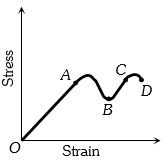
Answera
(a) In the region $OA,$ stress $\propto$ strain i.e. Hooke's law hold good.
View full question & answer→MCQ 4071 Mark
In the below graph, point $B$ indicates
View full question & answer→MCQ 4081 Mark
In the below graph, point $D$ indicates
View full question & answer→MCQ 4091 Mark
The load versus elongation graph for four wires of the same material is shown in the figure. The thickest wire is represented by the line
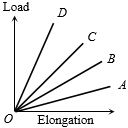
Answera
(a) $l = \frac{{FL}}{{AY}}$ $\Rightarrow$ $l \propto \frac{1}{{{r^2}}}$ $(Y, L$ and $F$ are constant$)$
i.e. for the same load, thickest wire will show minimum elongation. So graph $D$ represent the thickest wire.
View full question & answer→MCQ 4101 Mark
The graph is drawn between the applied force $F$ and the strain $(x)$ for a thin uniform wire. The wire behaves as a liquid in the part
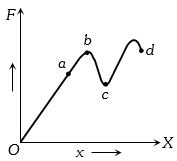
Answerb
(b) At point $b$, yielding of material starts.
View full question & answer→MCQ 4111 Mark
The diagram shows the change $x$ in the length of a thin uniform wire caused by the application of stress $F$ at two different temperatures $T_1$ and $T_2$. The variations shown suggest that
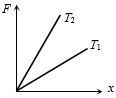
- ✓
${T_1} > {T_2}$
- B
${T_1} < {T_2}$
- C
${T_1} = {T_2}$
- D
AnswerCorrect option: A. ${T_1} > {T_2}$
a
(a) Elasticity of wire decreases at high temperature i.e. at higher temperature slope of graph will be less.
So we can say that ${T_1} > {T_2}$
View full question & answer→MCQ 4121 Mark
A student plots a graph from his reading on the determination of Young’s modulus of a metal wire but forgets to label. The quantities on $X$ and $Y$ axes may be respectively.
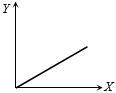
- A
Weight hung and length increased
- B
Stress applied and length increased
- ✓
Stress applied and strain developed
- D
Length increased and weight hung
AnswerCorrect option: C. Stress applied and strain developed
View full question & answer→MCQ 4131 Mark
Which of the following is the graph showing stress-strain variation for elastomers?
Answerc
(c)
In elastomers stress varies exponentially with strain e.g. Rubber
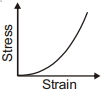
View full question & answer→MCQ 4141 Mark
The ratio of two specific heats of gas ${C_p}/{C_v}$ for argon is $1.6$ and for hydrogen is $1.4$. Adiabatic elasticity of argon at pressure $P$ is $E.$ Adiabatic elasticity of hydrogen will also be equal to $E$ at the pressure
- A
$P$
- ✓
$\frac{8}{7}P$
- C
$\frac{7}{8}P$
- D
$1.4 \,P$
AnswerCorrect option: B. $\frac{8}{7}P$
b
(b) Adiabatic elasticity $E = \gamma P$
For argon ${E_{Ar}} = 1.6\;P$….$(i)$
For hydrogen${E_{H2}} = 1.4P'$….$(ii)$
As elasticity of hydrogen and argon are equal
$1.6P = 1.4P'$ $⇒$ $P' = \frac{8}{7}P$
View full question & answer→MCQ 4151 Mark
A steel rod is projecting out of rigid wall. The shearing strength of steel is $345 \,\,MN/m^2.$ The dimensions $AB = 5\,\, cm,\,BC = BE = 2\,\, cm.$ The maximum load that can be put on the face $ABCD$ is .......... $kg$ (neglect bending of the rod) $(g = 10\,\, m/s^2)$
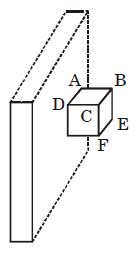
- A
$3450$
- B
$1380$
- ✓
$13800$
- D
$345$
AnswerCorrect option: C. $13800$
c
$345 \times 10^{6} \times 2 \times 10^{-2} \times 2 \times 10^{-2}=\mathrm{F}=\mathrm{mg}$
$13800 \mathrm{kg}=\mathrm{m}$
View full question & answer→MCQ 4161 Mark
A light rod acted upon by three forces, is in equilibrium. Which of the following diagram shows the possible position and direction of the forces?
Answerb
Net force and net torque should be zero
View full question & answer→MCQ 4171 Mark
One end of a uniform rod of mass $m_1$ and crosssectional area $A$ is hung from a ceiling. The other end of the bar is supporting mass $m_2$. The stress at the midpoint is
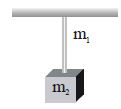
- A
$\frac{{g\left( {{m_2} + 2{m_1}} \right)}}{{2A}}$
- B
$\frac{{g\left( {{m_2} + {m_1}} \right)}}{{2A}}$
- ✓
$\frac{{g\left( {2{m_2} + {m_1}} \right)}}{{2A}}$
- D
$\frac{{g\left( {{m_2} + {m_1}} \right)}}{{A}}$
AnswerCorrect option: C. $\frac{{g\left( {2{m_2} + {m_1}} \right)}}{{2A}}$
c
According to qestion.
Weight of suspended mass:
$W_1=m_1\,g$
only half of the weight of the rod acting at the mid point,
$W _2=\frac{ m _2 g }{2}$
strees at the mid point :
$\text { Stress } =\frac{ W _1+ W _2}{ A }$
$\Rightarrow \frac{ m _1 g +\frac{ m _2 g }{2}}{ A }$
$\Rightarrow \frac{\frac{2 m _1 g + m _2 g }{2}}{ A }$
$\therefore \frac{ g \left(2 m _1+ m _2\right)}{2 A }$
View full question & answer→MCQ 4181 Mark
A composite heavy rope of two materials is suspended vertically from a high ceiling. The ratios of different quantities for upper to lower rope are length $\frac{{{L_u}}}{{{L_l}}} = \frac{1}{2}$ , cross sectional area $\frac{{{A_u}}}{{{A_l}}} = \frac{2}{1}$ ,density $\frac{{{d_u}}}{{{d_l}}} = \frac{2}{3}$ .What is the ratio of maximum stress in the two ropes
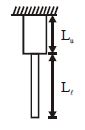
- A
$\frac{2}{3}$
- B
$\frac{3}{4}$
- ✓
$\frac{5}{6}$
- D
$\frac{4}{5}$
AnswerCorrect option: C. $\frac{5}{6}$
c
Stress $=\frac{\mathrm{mg}}{\mathrm{A}}$
$\frac{(\text { stress })_{\mathrm{u}}}{(\text { stress })_{\ell}}=\frac{\left(\mathrm{m}_{\mathrm{u}}+\mathrm{m}_{\ell}\right) \mathrm{g} / \mathrm{A}_{\mathrm{u}}}{\left(\mathrm{m}_{\ell}\right) \mathrm{g} / \mathrm{A}_{\ell}}$
$=\frac{\left(\mathrm{d}_{\mathfrak{u}} \mathrm{A}_{\mathfrak{u}} \mathrm{L}_{\mathfrak{u}}+\mathrm{d}_{\ell} \mathrm{A}_{\ell} \mathrm{L}_{\ell}\right) / \mathrm{A}_{\mathfrak{u}}}{\left(\mathrm{d}_{\ell} \mathrm{A}_{\ell} \mathrm{L}_{\ell}\right) / \mathrm{A}_{\ell}}$
$=\left(\frac{\mathrm{d}_{\mathrm{u}} \mathrm{A}_{\mathrm{u}} \mathrm{L}_{\mathrm{u}}}{\mathrm{d}_{\ell} \mathrm{A}_{\ell} \mathrm{L}_{\ell}}+1\right) \frac{\mathrm{A}_{\ell}}{\mathrm{A}_{\mathrm{u}}}=\frac{5}{6}$
View full question & answer→MCQ 4191 Mark
The breaking stress of wire going over a smooth pully is $2 \times 10^9\, N/m^2$. What would be the minimum radius of wire used if it is not to break?
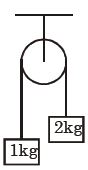
- A
$0.46 \times {10^{ - 6}}\,m$
- ✓
$0.46 \times {10^{ - 4}}\,m$
- C
$0.46 \times {10^{ 8}}\,m$
- D
$0.46 \times {10^{ - 11}}\,m$
AnswerCorrect option: B. $0.46 \times {10^{ - 4}}\,m$
b
$20-T=2 a$ $...(1)$
$\mathrm{T}-10=1 \mathrm{a}$ $...(2)$
$\Rightarrow \mathrm{T}=\frac{40}{3} \mathrm{N}$
Stress $=\frac{\mathrm{T}}{\mathrm{A}} \Rightarrow 2 \times 10^{9}=\frac{40 / 3}{\mathrm{A}}$
$A=\frac{20}{3} \times 10^{-9} \mathrm{m}^{2}$
$\pi r^{2}=\frac{20}{3} \times 10^{-9}$
$r=\left(\frac{20}{3} \times \frac{10^{-9}}{3.14}\right)^{1 / 2}=0.46 \times 10^{-4} \mathrm{m}$
View full question & answer→MCQ 4201 Mark
A bar of cross-sectional area $A$ is subjected two equal and opposite tensile forces at its ends as shown in figure. Consider a plane $BB'$ making an angle $\theta $ with the length The ratio of tensile stress to the shearing stress on the plane $BB'$ is
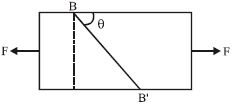
- ✓
$tan\, \theta $
- B
$sec\, \theta $
- C
$cot\, \theta $
- D
$cos\, \theta $
AnswerCorrect option: A. $tan\, \theta $
a
Consider the equilibrium of the plane $\mathrm{BB'}$
A force $F$ must be acting on this plane making an angle $\left(90^{\circ}-\theta\right)$ with the normal $ON.$ Resolving $F$ into two compoents, along the plane and normal to the plane.
Component of force $\mathrm{F}$ along the plane.
$\therefore \quad \mathrm{F}_{\mathrm{P}}=\mathrm{F} \cos \theta$
component of force $\mathrm{F}$ normal to the plane.
$\mathrm{F}_{\mathrm{N}}=\mathrm{F} \cos \left(90^{\circ}-\theta\right)=\mathrm{F} \sin \theta$
Let the area of the face $\mathrm{BB}^{\prime}$ be $\mathrm{A}^{\prime}$. Then
$\frac{\mathrm{A}}{\mathrm{A}^{\prime}}=\sin \theta \quad \therefore \quad \mathrm{A}^{\prime}=\frac{\mathrm{A}}{\sin \theta}$
Tensile stress $=\frac{\mathrm{F} \sin \theta}{\mathrm{A}^{\prime}}=\frac{\mathrm{F}}{\mathrm{A}} \sin ^{2} \theta$
Shearing stress $=\frac{\mathrm{F} \cos \theta}{\mathrm{A}^{\prime}}$
$=\frac{\mathrm{F}}{\mathrm{A}} \cos \theta \sin \theta$
Their corresponding ratio is
$\frac{\text { Tensilestress }}{\text { Shearing stress }}=\frac{F}{A} \sin ^{2} \theta \times \frac{A}{F \sin \theta \cos \theta}=\tan \theta$
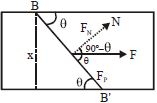
View full question & answer→MCQ 4211 Mark
An elevator cable can have a maximum stress of $7 \times 10^7\,N/m^2$ for appropriate safety factors. Its maximum upward acceleration is $1.5\,m/s^2$ . If the cable has to support the total weight of $2000\,kg$ of a loaded elevator, the minimum area of crosssection of the cable should be ....... $cm^2$ $(g = 10\,m/s^2)$
- ✓
$3.28$
- B
$2.38$
- C
$0.328$
- D
$8.23$
AnswerCorrect option: A. $3.28$
a
$\frac{\mathrm{F}}{\mathrm{A}}=7 \times 10^{7}$
$\mathrm{F}=\mathrm{A} \times 7 \times 10^{7}$
$\mathrm{F}-2000 \mathrm{g}=2000 \times \mathrm{a}$
$\left(7 \times 10^{7}\right) \mathrm{A}=2000(\mathrm{a}+\mathrm{g})$
$\mathrm{A}=\frac{2000}{7 \times 10^{7}}(10+1.5)$
$\mathrm{A}=3.28 \times 10^{-4} \mathrm{m}^{2}$
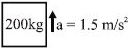
View full question & answer→MCQ 4221 Mark
The upper end of a wire $1\,m$ long and $4\,mm$ radius is clamped. The lower end is twisted by an angle of $30^o$. The angle of shear is ...... $^o$
- A
$12$
- B
$1.2$
- ✓
$0.12$
- D
$0.012$
AnswerCorrect option: C. $0.12$
c
$\mathrm{BB}^{\prime}=\mathrm{r} \theta=\mathrm{L} \phi$
$\phi=$ Angle of shear
$\theta \therefore$ Angle of twist
$\phi=\frac{r \theta}{L}=\frac{0.4 \times 30^{\circ}}{100}=0.12^{\circ}$
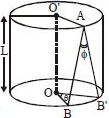
View full question & answer→MCQ 4231 Mark
The length of a metal wire is $l_1$, when the tension in it is $T_1$ and is $l_2$ when the tension is $T_2$. The unstretched length of the wire is
- A
$\sqrt {{l_1}{l_2}} $
- B
$\frac{{{l_1} + {l_2}}}{2}$
- ✓
$\frac{{{l_1}{T_2} - {l_2}{T_1}}}{{{T_2} - {T_1}}}$
- D
$\frac{{{l_1}{T_2} + {l_2}{T_1}}}{{{T_2} + {T_1}}}$
AnswerCorrect option: C. $\frac{{{l_1}{T_2} - {l_2}{T_1}}}{{{T_2} - {T_1}}}$
c
$F=\mathrm{k} x$
$\mathrm{T}_{1}=\mathrm{k}\left(\ell_{1}-\ell_{0}\right)$ $...(1)$
$\mathrm{T}_{2}=\mathrm{k}\left(\ell_{2}-\ell_{0}\right)$ $...(2)$
$(1) /(2)$
$\frac{\mathrm{T}_{1}}{\mathrm{T}_{2}}=\frac{\ell_{1}-\ell_{0}}{\ell_{2}-\ell_{0}}$
$\mathrm{T}_{1} \ell_{2}-\mathrm{T}_{1} \ell_{0}=\mathrm{T}_{2} \ell_{1}-\mathrm{T}_{2} \ell_{0}$
$\ell_{0}=\frac{\mathrm{T}_{1} \ell_{2}-\mathrm{T}_{2} \ell_{1}}{\mathrm{T}_{1}-\mathrm{T}_{2}}=\frac{\mathrm{T}_{2} \ell_{1}-\mathrm{T}_{1} \ell_{2}}{\mathrm{T}_{2}-\mathrm{T}_{1}}$
View full question & answer→MCQ 4241 Mark
A pendulum consisting of a small sphere of mass $m$ suspended by an inextensible and massless string of length $l$ is made to swing in a vertical plane. If the breaking strength of the string is $2mg$ , then the maximum angular amplitude of the displacement from the vertical can be ....... $^o$
Answerc
Let the maximum angular amplitude be $\theta .$ When the pendulum bob moves from $\mathrm{B}$ to $\mathrm{A}$, the decrease in potential energy $=$ the increase in kinetic energy at $A$
${\mathop{\rm mg}\nolimits} ({\rm{PA}}) = \frac{1}{2}{\rm{m}}{{\rm{v}}^2}{\rm{;mgh}} = \frac{1}{2}{\rm{m}}{{\rm{v}}^2}$
$v^{2}=2 g(P A)=2 g(O A-O P)$
${v^2} = 2g(l - l\cos \theta )$
${T-m g=\frac{m v^{2}}{l}} $
${T-m g=\frac{m}{l} \cdot 2 g((1-\cos \theta)}$
${T-m g=2 m g(1-\cos \theta)}$ ......$(i)$
At $A, \quad T=T_{\max }=2 m g$
On putting this value of $\mathrm{T}$ in eq. $(i).$ we get
${2 m g-m g=2 m g(1-\cos \theta)} $
or ${1-\cos \theta=\frac{1}{2}}$
$ \cos \theta =\frac{1}{2} $
$ \theta =60^{\circ} $
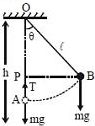
View full question & answer→MCQ 4251 Mark
A steel ring of radius $r$ and cross-section area $‘A’$ is fitted on to a wooden disc of radius $R(R > r)$. If Young's modulus be $E,$ then the force with which the steel ring is expanded is
AnswerCorrect option: B. $AE\left( {\frac{{R - r}}{r}} \right)$
b
(b) Initial length (circumference) of the ring $= 2$$\pi$$r$
Final length (circumference) of the ring $= 2$$\pi$$R $
Change in length $= 2$$\pi$$R -2$$\pi$$r.$
${\rm{strain}} = \frac{{{\rm{change in length}}}}{{{\rm{original length}}}}$$ = \frac{{2\pi (R - r)}}{{2\pi r}}$$ = \frac{{R - r}}{r}$
Now Young's modulus $E = \frac{{F/A}}{{l/L}} = \frac{{F/A}}{{(R - r)/r}}$
$\Rightarrow $ $F = AE\left( {\frac{{R - r}}{r}} \right)$
View full question & answer→MCQ 4261 Mark
A $5\, m$ long aluminium wire ($Y = 7 \times {10^{10}}N/{m^2})$ of diameter $3\, mm$ supports a $40\, kg$ mass. In order to have the same elongation in a copper wire $(Y = 12 \times {10^{10}}N/{m^2})$ of the same length under the same weight, the diameter should now be, in $mm.$
Answerc
(c) $l = \frac{{FL}}{{\pi {r^2}Y}} \Rightarrow {r^2} \propto \frac{1}{Y}$ $(F,L$ and $l$ are constant$)$
$\frac{{{r_2}}}{{{r_1}}} = {\left( {\frac{{{Y_1}}}{{{Y_2}}}} \right)^{1/2}} = {\left( {\frac{{7 \times {{10}^{10}}}}{{12 \times {{10}^{10}}}}} \right)^{1/2}}$
$⇒$ ${r_2} = 1.5 \times {\left( {\frac{7}{{12}}} \right)^{1/2}}$$= 1.145 mm$
dia $ = 2.29 mm$
$⇒$
View full question & answer→MCQ 4271 Mark
The length of an elastic string is a metre when the longitudinal tension is $4\, N$ and $b$ metre when the longitudinal tension is $5\, N$. The length of the string in metre when the longitudinal tension is $9\, N$ is
- A
$a - b$
- ✓
$5b - 4a$
- C
$2b - \frac{1}{4}a$
- D
$4a - 3b$
AnswerCorrect option: B. $5b - 4a$
b
(b) Let $L$ is the original length of the wire and $K$ is force constant of wire.
Final length $=$ initial length $+$ elongation
$L' = L + \frac{F}{K}$
For first condition $a = L + \frac{4}{K}$…$(i)$
For second condition $b = L + \frac{5}{K}$…$(ii)$
By solving $(i)$ and $(ii)$ equation we get
$L = 5a - 4b$ and $K = \frac{1}{{b - a}}$
Now when the longitudinal tension is $9N,$
length of the string $=$ $L + \frac{9}{K}$= $5a - 4b + 9(b - a)$$x = 5b - 4a$.
View full question & answer→MCQ 4281 Mark
A pan with set of weights is attached with a light spring. When disturbed, the mass-spring system oscillates with a time period of $0.6$ $s.$ When some additional weights are added then time period is $0.7s.$ The extension caused by the additional weights is approximately given by ......... $cm$
- A
$1.38$
- ✓
$3.5 $
- C
$1.75$
- D
$2.45$
AnswerCorrect option: B. $3.5 $
b
(b) $2\pi \sqrt {\frac{m}{k}} = 0.6$ …$(i)$ and $2\pi \sqrt {\frac{{m + m'}}{k}} = 0.7$ …$(ii)$
Dividing $(ii)$ by $(i)$ we get ${\left( {\frac{7}{6}} \right)^2} = \frac{{m + m'}}{m} = \frac{{49}}{{36}}$
$\frac{{m + m'}}{m} - 1 = \frac{{49}}{{36}} - 1 \Rightarrow \frac{{m'}}{m} = \frac{{13}}{{36}}$ $⇒$ $m' = \frac{{13m}}{{36}}$
Also $\frac{k}{m} = \frac{{4{\pi ^2}}}{{{{(0.6)}^2}}}$
Desired extension $ = \frac{{m'g}}{k}$$ = \frac{{13}}{{36}} \times \frac{{mg}}{k}$
$ = \frac{{13}}{{36}} \times 10 \times \frac{{0.36}}{{4{\pi ^2}}} \approx 3.5\;cm$
View full question & answer→MCQ 4291 Mark
A rubber cord catapult has cross-sectional area $25\,m{m^2}$ and initial length of rubber cord is $10\,cm.$ It is stretched to $5\,cm.$ and then released to project a missile of mass $5gm.$ Taking ${Y_{rubber}} = 5 \times {10^8}N/{m^2}$ velocity of projected missile is ......... $ms^{-1}$
Answerc
(c) Potential energy stored in the rubber cord catapult will be converted into kinetic energy of mass.
$\frac{1}{2}m{v^2} = \frac{1}{2}\frac{{YA{l^2}}}{L}$ $\Rightarrow $ $v = \sqrt {\frac{{YA{l^2}}}{{mL}}} $
$ = \sqrt {\frac{{5 \times {{10}^8} \times 25 \times {{10}^{ - 6}} \times {{(5 \times {{10}^{ - 2}})}^2}}}{{5 \times {{10}^{ - 3}} \times 10 \times {{10}^{ - 2}}}}} = 250\;m/s$
View full question & answer→MCQ 4301 Mark
If the ratio of diameters, lengths and Young's modulus of steel and copper wires shown in the figure are $p, q$ and $s$ respectively, then the corresponding ratio of increase in their lengths would be
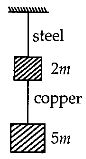
AnswerCorrect option: B. $\;\frac{{7q}}{{5{p^2}s}}$
b
$As\,Y = \frac{{FL}}{{A\Delta L}} = \frac{{4FL}}{{\pi {D^2}\Delta L}}$
$\Delta L = \frac{{4FL}}{{\pi {D^2}Y}}$
$\therefore \frac{{\Delta {L_s}}}{{\Delta {L_c}}} = \frac{{{F_S}}}{{{F_C}}}\frac{{{L_S}}}{{{L_C}}}\frac{{D_C^2}}{{D_S^2}}\frac{{{Y_C}}}{{{Y_S}}}$
Where subscripts $'S'$ and $'C'$ refer to copper and steel respectively.
$Here,\,{F_S} = \left( {5m + 2m} \right)g = 7mg$
${F_C} = 5mg$
$\frac{{{L_S}}}{{{L_C}}} = q,\frac{{{D_S}}}{{{D_C}}} = p,\frac{{{Y_S}}}{{{Y_C}}} = s$
$\therefore \frac{{\Delta {L_S}}}{{\Delta {L_C}}} = \left( {\frac{{7mg}}{{5mg}}} \right)\left( q \right){\left( {\frac{1}{p}} \right)^2}\left( {\frac{1}{s}} \right) = \frac{{7q}}{{5{p^2}s}}$
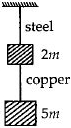
View full question & answer→MCQ 4311 Mark
A cylindrical wire of radius $1\,\, mm$, length $1 m$, Young’s modulus $= 2 × 10^{11} N/m^2$, poisson’s ratio $\mu = \pi /10$ is stretched by a force of $100 N$. Its radius will become
- A
$0.99998\,\, mm$
- B
$0.99999\,\, mm$
- C
$0.99997 \,\,mm$
- ✓
$0.99995 \,\,mm$
AnswerCorrect option: D. $0.99995 \,\,mm$
View full question & answer→MCQ 4321 Mark
A metal wire of length $L_1$ and area of cross section $A$ is attached to a rigid support. Another metal wire of length $L_2$ and of the same cross sectional area is attached to the free end of the first wire. A body of mass $M$ is then suspended from the free end of the second wire. If $Y_1$ and $Y_2$ are the Youngs moduli of the wires respectively, the effective force constant of the system of two wires is :
- A
$\frac{{\left[ {\left( {{Y_1}{Y_2}} \right)A} \right]}}{{\left[ {2\left( {{Y_1}{L_2} + {Y_2}{L_1}} \right)} \right]}}$
- B
$\frac{{\left[ {\left( {{Y_1}{Y_2}} \right)A} \right]}}{{{{\left( {{L_1} + {L_2}} \right)}^{\frac{1}{2}}}}}$
- ✓
$\frac{{\left[ {\left( {{Y_1}{Y_2}} \right)A} \right]}}{{\left[ {\left( {{Y_1}{L_2} + {Y_2}{L_1}} \right)} \right]}}$
- D
$\frac{{\left[ {{{\left( {{Y_1}{Y_2}} \right)}^{1/2}}A} \right]}}{{{{\left( {{L_1} + {L_2}} \right)}^{1/2}}}}$
AnswerCorrect option: C. $\frac{{\left[ {\left( {{Y_1}{Y_2}} \right)A} \right]}}{{\left[ {\left( {{Y_1}{L_2} + {Y_2}{L_1}} \right)} \right]}}$
c
$\mathrm{K}_{1}=\frac{\mathrm{Y}_{1} \mathrm{A}}{\mathrm{L}_{1}}, \mathrm{K}_{2}=\frac{\mathrm{Y}_{2} \mathrm{A}}{\mathrm{L}_{2}}$
$\mathrm{K}=\frac{\mathrm{K}_{1} \mathrm{K}_{2}}{\mathrm{K}_{1}+\mathrm{K}_{2}}$
View full question & answer→MCQ 4331 Mark
Wires $A$ and $B$ are connected with blocks $P$ and $Q$ as shown. The ratio of lengths, radii and Young's modulus of wires $A$ and $B$ are $r, 2r$ and $3r$ respectively ($r$ is a constant). Find the mass of block $P$ if ratio of increase in their corresponding lengths is $1/6r^2$. The mass of block $Q$ is $3M$.
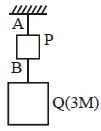
View full question & answer→MCQ 4341 Mark
In the given figure, two elastic rods $A$ & $B$ are rigidly joined to end supports. $A$ small mass $‘m’$ is moving with velocity $v$ between the rods. All collisions are assumed to be elastic & the surface is given to be frictionless. The time period of small mass $‘m’$ will be : [$A=$ area of cross section, $Y =$ Young’s modulus, $L=$ length of each rod ; here, an elastic rod may be treated as a spring of spring constant $\frac{{YA}}{L}$ ]
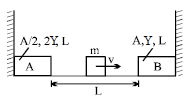
- ✓
$\frac{{2L}}{v} + 2\pi \sqrt {\frac{{mL}}{{AY}}}$
- B
$\frac{{2L}}{v} + 2\pi \sqrt {\frac{{2mL}}{{AY}}}$
- C
$\frac{{2L}}{v} + \pi \sqrt {\frac{{mL}}{{AY}}}$
- D
$\frac{{2L}}{v}$
AnswerCorrect option: A. $\frac{{2L}}{v} + 2\pi \sqrt {\frac{{mL}}{{AY}}}$
a
${t_1} = 2\pi \sqrt {\frac{M}{K}}$
$K = \frac{{YA}}{L}$
${t_2} = \frac{{2L}}{v}$
View full question & answer→MCQ 4351 Mark
$A$ rod of length $1000\, mm$ and coefficient of linear expansion $a = 10^{-4}$ per degree is placed symmetrically between fixed walls separated by $1001\, mm$. The Young’s modulus of the rod is $10^{11} N/m^2$. If the temperature is increased by $20^o C$, then the stress developed in the rod is ........... $MPa$
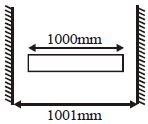
Answera
$\Delta \ell=\ell \alpha \Delta T=2 m m$
$\Delta \ell_{\text {actual }}=2-1=1 \mathrm{mm}$
$\sigma=\mathrm{Y}\left(\frac{\Delta \ell_{\mathrm{actual}}}{\ell}\right)$
View full question & answer→MCQ 4361 Mark
What must be the lengths of steel and copper rods at $0^o C$ for the difference in their lengths to be $10\,cm$ at any common temperature? $(\alpha_{steel}=1.2 \times {10^{-5}} \;^o C^{-1})$ and $(\alpha_{copper} = 1.8 \times 10^{-5} \;^o C^{-1})$
- ✓
$30\, cm$ for steel and $20\,cm$ for copper
- B
$20\,cm$ for steel and $30\,cm$ for copper
- C
$40\,cm$ for steel and $30\,cm$ for copper
- D
$30\,cm$ for steel and $40\,cm$ for copper
AnswerCorrect option: A. $30\, cm$ for steel and $20\,cm$ for copper
a
$L_{f}=L_{i}(1+\alpha \Delta T)$
$L_{S_{f}}=L_{S_{i}}\left[1+\alpha_{S} \Delta T\right]$
$\Rightarrow \Delta L_{\text {steel}}=L_{S_{i}} \alpha_{S} \Delta T$
$L_{C_{f}}=L_{C_{i}}\left[1+\alpha_{C} \Delta T\right]$
$\Rightarrow \Delta L_{\text {copper}}=L_{C_{i}} \alpha_{C} \Delta T$
For $\Delta L_{\text {steel }}=\Delta L_{\text {copper }}$
$\Rightarrow L_{S_{i}} \alpha_{S} \Delta T=L_{C_{i}} \alpha_{C} \Delta T$
$\Rightarrow \frac{L_{S_{i}}}{L_{C_{i}}}=\frac{\alpha_{C}}{\alpha_{S}}=\frac{1.8 \times 10^{-5}}{1.2 \times 10^{-5}}=\frac{3}{2}$
$\therefore \frac{L_{S_{i}}}{L_{C_{i}}}=\frac{3}{2}$ in $(1)$ only
View full question & answer→MCQ 4371 Mark
Two steel wires of same length but radii $r$ and $2r$ are connected together end to end and tied to a wall as shown. The force stretches the combination by $10\ mm$. How far does the midpoint $A$ move ............ $mm$

Answerd
$\frac{F}{A_{1}}=Y \frac{\triangle l_{1}}{\lim }$ plies $\triangle l-1=\frac{F l}{A_{1} Y}$
$\frac{F}{A_{2}}=Y \frac{\triangle l_{2}}{\lim }$ plies $\triangle l-2=\frac{F l}{A_{2} Y}=\frac{F l}{4 A_{1}}=8 m m$
$\Delta l-1+\triangle l_{2}=10 m m$
$\frac{F l}{A_{1} y}+\frac{F l}{4 A_{1} Y}=10 m m \Rightarrow \frac{F l}{A_{1} Y}=8 m m$

View full question & answer→MCQ 4381 Mark
A rod $BC$ of negligible mass fixed at end $B$ and connected to a spring at its natural length having spring constant $K = 10^4\ N/m$ at end $C$, as shown in figure. For the rod $BC$ length $L = 4\ m$, area of cross-section $A = 4 × 10^{-4}\ m^2$, Young's modulus $Y = 10^{11} \ N/m^2$ and coefficient of linear expansion $\alpha = 2.2 × 10^{-4} K^{-1}.$ If the rod $BC$ is cooled from temperature $100^oC$ to $0^oC,$ then find the decrease in length of rod in centimeter.(closest to the integer)
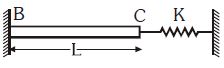
Answera
$Y=\frac{F L}{A(L \alpha \theta-x)} \ldots(i)$ and $F=K x \ldots .(ii)$
Solving $(i) \&(\text { ii }) x=\frac{L \alpha \theta Y A}{Y A+K L}$
View full question & answer→MCQ 4391 Mark
Two steel wires of same length but radii $r$ and $2r$ are connected together end to end and tied to a wall as shown. The force stretches the combination by $10\ mm$ . How far does the midpoint $A$ move ......... $mm$
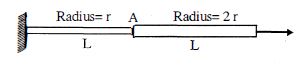
Answerd
$\frac{F}{A_{1}}=Y \frac{\triangle l_{1}}{\lim }$ plies $\triangle l-1=\frac{F l}{A_{1} Y}$
$\frac{F}{A_{2}}=Y \frac{\triangle l_{2}}{\lim }$ plies $\triangle l-2=\frac{F l}{A_{2} Y}=\frac{F l}{4 A_{1}}=8 m m$
$\Delta l-1+\triangle l_{2}=10 m m$
$\frac{F l}{A_{1} y}+\frac{F l}{4 A_{1} Y}=10 m m \Rightarrow \frac{F l}{A_{1} Y}=8 m m$

View full question & answer→MCQ 4401 Mark
A meter scale of mass $m$ , Young modulus $Y$ and cross section area $A$ is hanged vertically from ceiling at zero mark. Then separation between $30\ cm$ and $70\ cm$ mark will be :-( $\frac{{mg}}{{AY}}$ is dimensionless)
- A
$30\frac{{mg}}{{AY}}\ cm + 40\ cm$
- ✓
$20\frac{{mg}}{{AY}}\ cm + 40\ cm$
- C
$50\frac{{mg}}{{AY}}\ cm + 40\ cm$
- D
$40\frac{{mg}}{{AY}}\ cm + 40\ cm$
AnswerCorrect option: B. $20\frac{{mg}}{{AY}}\ cm + 40\ cm$
b
Tension is rod at a distnace $x$ from lower end is $\frac{\mathrm{mxg}}{\ell}$
$Y$ is young modulus of elasticity then change in length in $dx$ element is $dy$ $\mathrm{Y} \times$ strain $=$ stress
$\mathrm{Y} \times \frac{\mathrm{dy}}{\mathrm{dx}}=\frac{\mathrm{T}}{\mathrm{A}}$
$\mathrm{Y} \times \frac{\mathrm{dy}}{\mathrm{dx}}=\frac{\mathrm{mgx}}{\ell \times \mathrm{A}}$
$\int_{0}^{y} Y d y=\int_{30}^{70} \frac{m g}{\ell A} \times x d x$
$\mathrm{Y} \mathrm{y}=\frac{\mathrm{mg}}{\ell \mathrm{A}}\left[\frac{(70)^{2}-(30)^{2}}{2}\right]$
$\mathrm{y}=\frac{\mathrm{mg}}{\mathrm{AY} \times 100} \times 2000$
$\mathrm{y}=\frac{\mathrm{mg}}{\mathrm{AY}} \times 20$
Total length is $=40 \mathrm{cm}=20 \frac{\mathrm{mg}}{\mathrm{AY}} \mathrm{cm}$
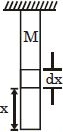
View full question & answer→MCQ 4411 Mark
A steel wire $1.5\,m$ long and of radius $1\,mm$ is attached with a load $3\,kg$ at one end the other end of the wire is fixed it is whirled in a vertical circle with a frequency $2\,Hz$ . Find the elongation of the wire when the weight is at the lowest position $(Y = 2 \times 10^{11}\,N/m^2$ and $g = 10\,m/s^2)$
- ✓
$1.77 \times 10^{-3}\,m$
- B
$7.17 \times 10^{-3}\,m$
- C
$3.17 \times 10^{-7}\,m$
- D
$1.37 \times 10^{-7}\,m$
AnswerCorrect option: A. $1.77 \times 10^{-3}\,m$
a
At lower most position
Tension in wire $\mathrm{T}=\mathrm{Mg}+\mathrm{m} \omega^{2} \ell$
$\Delta \ell=\frac{\mathrm{FL}}{\mathrm{AY}}=\frac{\left(\mathrm{Mg}+\mathrm{m} \omega^{2} \ell\right) \ell}{\mathrm{AY}}$
$=\frac{\left[3 \times 10+3 \times(2 \times 3.14 \times 2)^{2} \times 1.5\right] \times 1.5}{3.14 \times\left(10^{-3}\right)^{2} \times 2 \times 10^{11}}$
$=1.77 \times 10^{-3} \mathrm{m}$
View full question & answer→MCQ 4421 Mark
Consider the situation shown in figure. The force $F$ is equal to the $m_2g/2.$ If the area of cross-section of the string is $A$ and its Young's modulus $Y$, find the strain developed in it. The string is light and there is no friction anywhere
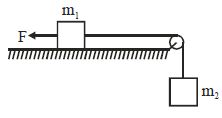
- A
$\frac{{{m_2}g\,\left( {2{m_1} + {m_2}} \right)}}{{AY\,\left( {{m_1} + {m_2}} \right)\,}}$
- B
$\frac{{{m_2}g\,\left( {{m_1} + {m_2}} \right)}}{{2AY\,\left( {{m_1} + {m_2}} \right)\,}}$
- ✓
$\frac{{{m_2}g\,\left( {2{m_1} + {m_2}} \right)}}{{2AY\,\left( {{m_1} + {m_2}} \right)\,}}$
- D
AnswerCorrect option: C. $\frac{{{m_2}g\,\left( {2{m_1} + {m_2}} \right)}}{{2AY\,\left( {{m_1} + {m_2}} \right)\,}}$
c
$a = \frac{{{m_2}g/2}}{{{m_1} + {m_2}}}$
$T = m_2\,(g -a)$
Strain $= \frac{T}{{AY}}$
View full question & answer→MCQ 4431 Mark
A uniform rod of mass $m$, length $L$, area of cross-section $A$ and Young's modulus $Y$ hangs from the ceiling. Its elongation under its own weight will be
- A
- ✓
$\frac {mgL}{2AY}$
- C
$\frac {mgL}{AY}$
- D
$\frac {2mgL}{AY}$
AnswerCorrect option: B. $\frac {mgL}{2AY}$
b
Mass of section $\mathrm{BC}=\frac{\mathrm{M}}{\mathrm{L}}(\mathrm{L}-\mathrm{y})$
$\text { Tension at } \mathrm{B}=\mathrm{T}=\frac{\mathrm{m}}{\mathrm{L}}(\mathrm{L}-\mathrm{y}) \mathrm{g}$
$\therefore$ Elongation of element dy at $\mathrm{B}$.
$\mathrm{dx}=\mathrm{dy} \frac{\mathrm{T}}{\mathrm{AY}}=\frac{\mathrm{m}}{\mathrm{L}}(\mathrm{L}-\mathrm{y}) \mathrm{g} \frac{\mathrm{dy}}{\mathrm{AY}}$
Total elongation
$\mathrm{x}=\int \mathrm{dx}=\frac{\mathrm{mg}}{\mathrm{LAY}} \int_{0}^{\mathrm{L}}(\mathrm{L}-\mathrm{y}) \mathrm{dy}=\frac{\mathrm{mgL}}{2 \mathrm{YA}}$
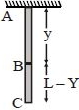
View full question & answer→MCQ 4441 Mark
Force constant of a spring $(K)$ is synonymous to
- ✓
$\frac{YA}{L}$
- B
$\frac{YL}{A}$
- C
$\frac{AL}{Y}$
- D
$ALY$
AnswerCorrect option: A. $\frac{YA}{L}$
a
$\mathrm{Y}=\frac{\mathrm{FL}}{\mathrm{A} \Delta \mathrm{L}}$
Or $\mathrm{F}=\left(\frac{\mathrm{YA}}{\mathrm{L}}\right) \Delta \mathrm{L}$
Comparing this with $\mathrm{F}=\mathrm{K} \Delta \mathrm{L}$
$\mathrm{K}=\frac{\mathrm{YA}}{\mathrm{L}}$
View full question & answer→MCQ 4451 Mark
The length of wire, when $M_1$ is hung from it, is $I_1$ and is $I_2$ with both $M_1$ and $M_2$ hanging. The natural length of wire is ........
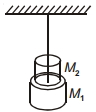
AnswerCorrect option: A. $\frac{M_1}{M_2}\left(l_1-l_2\right)+l_1$
a
(a)
Let the natural length of wire be $=1$
When only $M_1$ hanging
Using $\Delta l=\frac{F L}{A Y}$
$\left(l_1-l \right)=\frac{M_1 g \cdot l}{A Y \ldots(1)}$
When both $M_1, M_2$ hanging
$\left(l_2-l\right)=\frac{\left(M_1+M_2\right) g \cdot l}{A Y} \ldots(2)$
Dividing $(1)$ by $(2)$
$\frac{l_1-l}{l_2-l}=\frac{M_1}{M_1+M_2}$
Solving this we get
$I=\frac{M_1}{M_2}\left(l_1-l_2\right)+I_1$
View full question & answer→MCQ 4461 Mark
A bar is subjected to axial forces as shown. If $E$ is the modulus of elasticity of the bar and $A$ is its crosssection area. Its elongation will be

- A
$\frac{Fl}{A E}$
- B
$\frac{2 Fl}{A E}$
- C
$\frac{3 Fl}{A E}$
- ✓
$\frac{4 Fl}{A E}$
AnswerCorrect option: D. $\frac{4 Fl}{A E}$
d
(d)
Elongation in $I^{st}$ part
$\Delta x_1=\frac{\text { Net force } \times L}{A Y}$
$=\frac{(3+2) F L}{A E}$
$=\frac{5 F L}{A E}$
Elongation in $II^{nd}$ part
$\Delta x_2=\frac{(F-2 F) L}{A E}=-\frac{F L}{A E}$
So net elongation
$\Delta x=\Delta x_1+\Delta x_2$
$=\frac{5 F L}{A E}-\frac{F L}{A E}=\frac{4 F L}{A E}$
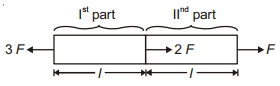
View full question & answer→MCQ 4471 Mark
A mild steel wire of length $2l$ meter cross-sectional area $A \;m ^2$ is fixed horizontally between two pillars. A small mass $m \;kg$ is suspended from the mid point of the wire. If extension in wire are within elastic limit. Then depression at the mid point of wire will be .............
- A
$\left(\frac{M g}{Y A}\right)^{1 / 3}$
- B
$\left(\frac{M g}{1 A}\right)^{1 / 3}$
- C
$\frac{M g}{2 Y A}$
- ✓
$\left(\frac{M g l^3}{Y A}\right)^{1 / 3}$
AnswerCorrect option: D. $\left(\frac{M g l^3}{Y A}\right)^{1 / 3}$
d
Now, increave in tength $=2 P S-P R$
$=2 \sqrt{l^2+x^2}-2 l$.
$=2\left(\sqrt{\ell^2+x^2}-l\right)$.
$=2 l\left(\sqrt{1+x^2 /l^2}-1\right)$
$\therefore$ strain $=\frac{2 l\left[\sqrt{1+x^2/l^2}-1\right]}{2 l}$
$=\left(1+x^2 / l^2\right)^{1 / 2}-1$
$=1+\frac{1}{2} x^2 / L^2-1=\frac{x^2}{2l^2}$
Now, tension, $T=\frac{m g}{2 \cos \theta}$
$\cos \theta=\frac{x}{\left(1+\frac{x^2}{l^2}\right)^{1 / 2} l}$
$=\frac{x}{\left(1+\frac{1}{2} \frac{x^2}{l^2}\right) l}$
$=x / l(\because l>>x)$
$T=\frac{m g}{2 \cos \theta}$
$=\frac{m g l}{2 x}$
Stress $=T/ A=\frac{2 m g l}{2 A x}$
$y=\frac{m g l / 2 A x}{x^2 / 2 l^2}=\frac{m g l^3}{A x^3}$.
$\therefore x=l\left(\frac{m g}{\text { YA }}\right)^{1 / 3}$
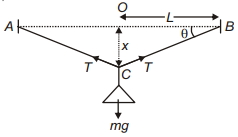
View full question & answer→MCQ 4481 Mark
The pressure applied from all directions on a cube is $P$. How much its temperature should be raised to maintain the original volume $?$ The volume elasticity of the cube is $\beta $ and the coefficient of volume expansion is $\alpha $
- ✓
$\frac{P}{{\alpha \beta }}$
- B
$\frac{{P\alpha }}{\beta }$
- C
$\frac{{P\beta }}{\alpha }$
- D
$\frac{{\alpha \beta }}{P}$
AnswerCorrect option: A. $\frac{P}{{\alpha \beta }}$
a
(a) If coefficient of volume expansion is $\alpha $ and rise in temperature is $\Delta \theta $ then $\Delta V = V\alpha \Delta \theta $$\Rightarrow $ $\frac{{\Delta V}}{V} = \alpha \Delta \theta $
Volume elasticity $\beta = \frac{P}{{\Delta V/V}}$ $ = \frac{P}{{\alpha \Delta \theta }}$==> $\Delta \theta = \frac{P}{{\alpha \beta }}$
View full question & answer→MCQ 4491 Mark
A solid sphere of radius $R$ made of of material of bulk modulus $K$ is surrounded by a liquid in a cylindrical container. $A$ massless piston of area $A$ floats on the surface of the liquid. When a mass $m$ is placed on the piston to compress the liquid, the fractional change in the radius of the sphere $\delta R/R$ is
- A
$mg/AK$
- ✓
$mg/3AK$
- C
$mg/A$
- D
$mg/3AR$
AnswerCorrect option: B. $mg/3AK$
b
Volume of the sphere $V=\frac{4 \pi}{3} R^{3}$
$\Longrightarrow \quad \frac{\delta V}{V}=\frac{3 \delta R}{R}$
Pressure exerted on the sphere by the piston $\quad P=\frac{F}{A}=\frac{M g}{A}$
Bulk modulus $\quad K=-\frac{P}{\delta V / V}$
OR $\quad K=-\frac{M g / A}{3 \delta R / R}$
$\Longrightarrow \quad \frac{\delta R}{R}=-\frac{M g}{3 A K}$
View full question & answer→MCQ 4501 Mark
If the Bulk modulus of lead is $8.0 \times 10^9 \,N / m ^2$ and the initial density of the lead is $11.4 \,g / cc$, then under the pressure of $2.0 \times 10^8 \,N / m ^2$, the density of the lead is ............. $g / cc$
- A
$11.3$
- B
$11.5$
- C
$11.6$
- ✓
$11.7$
AnswerCorrect option: D. $11.7$
d
(d)
We know,
$\left[\frac{1}{\rho_2}-\frac{1}{\rho_1}\right]=-\frac{P}{B}$ $\left\{\begin{array}{l}\text { Where } \\ P=2 \times 10^8 \,N / m ^2 \\ B=8 \times 10^9 \,N / m ^2 \\ \rho_1=11.4 \,g / cc \\ \rho_2=?\end{array}\right.$
Substitute value's
$\left[\frac{1}{\rho_2}-\frac{1}{114}\right]=-\frac{2 \times 10^8}{8 \times 10^9}$
After solving, we get
$\rho_2=11.7 \,g / cc$
View full question & answer→MCQ 4511 Mark
A rod of length $l$ and radius $r$ is joined to a rod of length $l/2$ and radius $r/2$ of same material. The free end of small rod is fixed to a rigid base and the free end of larger rod is given a twist of $\theta°$, the twist angle at the joint will be
- A
$\theta /4$
- B
$\theta /2$
- C
$5\theta /6$
- ✓
$8\theta /9$
AnswerCorrect option: D. $8\theta /9$
d
(d) $\tau = C.\theta = \frac{{\pi \eta {r^4}\theta }}{{2L}} = $ Constant
$ \Rightarrow \frac{{\pi \eta {r^4}(\theta - {\theta _0})}}{{2l}} = \frac{{\pi \eta {{(r/2)}^4}({\theta _0} - \theta ')}}{{2(l/2)}}$
$ \Rightarrow \frac{{(\theta - {\theta _0})}}{2} = \frac{{{\theta _0}}}{{16}} \Rightarrow {\theta _0} = \frac{8}{9}\theta $
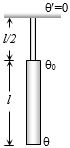
View full question & answer→MCQ 4521 Mark
An Indian rubber cord $L$ metre long and area of cross-section $A$ $metr{e^2}$ is suspended vertically. Density of rubber is $D$ $kg/metr{e^3}$ and Young's modulus of rubber is $E$ $newton/metr{e^2}$. If the wire extends by $l$ metre under its own weight, then extension $l$ is
- A
${L^2}Dg/E$
- ✓
${L^2}Dg/2E$
- C
${L^2}Dg/4E$
- D
$L$
AnswerCorrect option: B. ${L^2}Dg/2E$
b
(b) $F=m g=(A L D) g$
stress $=\frac{F}{A}=L D g$
strain $=\frac{l}{L / 2}$
Stress $=E \times$ strain
$L D g=E \times \frac{l}{L / 2}$
$l=\frac{L^{2} D g}{2 E}$
View full question & answer→MCQ 4531 Mark
A metal wire of length $'L'$ is suspended vertically from a rigid support. When a body of mass $M$ is attached to the lower end of wire, the elongation in wire is $'l'$, consider the following statements
$(I)$ the loss of gravitational potential energy of mass $M$ is $Mgl$
$(II)$ the elastic potential energy stored in the wire is $Mgl$
$(III)$ the elastic potential energy stored in wire is $\frac{1}{2}\, Mg l$
$(IV)$ heat produced is $\frac{1}{2}\, Mg l$
Correct statement are :-
- A
Only $I$
- B
$I$ and $II$
- C
Only $III$
- ✓
$I, III$ and $IV$
AnswerCorrect option: D. $I, III$ and $IV$
d
Energy stored per unit volume $=\frac{1}{2} \times$ stress $\times$ strain
$\mathrm{u}=\frac{1}{2} \times \frac{\mathrm{Mg}}{\mathrm{A}} \times \frac{\ell}{\mathrm{L}}$
Energy stored in total value
$\mathrm{U}=\mathrm{ALu}=\frac{1}{2} \mathrm{mg} \ell$ and work done by weight
$W=\mathbf{M g \ell}$
So heat produced $=$ loss in energy
$=\mathrm{Mg} \ell-\frac{1}{2} \mathrm{Mg} \ell$
$=\frac{1}{2} \mathrm{Mg} \ell$
View full question & answer→MCQ 4541 Mark
Given : $\sigma$ is the compressibility of water, $\rho$ is the density of water and $K$ is the bulk modulus of water. What is the energy density of water at the bottom of a lake $‘h’$ metre deep ?
- ✓
$\frac{1}{2}\sigma {(h\rho g)^2}$
- B
$\frac{1}{2}\sigma {(h\rho g)}$
- C
$\frac{1}{2}\frac{{h\rho g}}{\sigma }$
- D
$\frac{{h\rho g}}{\sigma }$
AnswerCorrect option: A. $\frac{1}{2}\sigma {(h\rho g)^2}$
a
Energy density, $\mathrm{u}=\frac{1}{2}$ stress $\times$ strain
Or $\mathrm{u}=\frac{1}{2} \mathrm{stress} \times \frac{\mathrm{stress}}{\mathrm{Bulk\,mod\,ulus}}$
$\mathrm{O} \mathrm{r}$ $\mathrm{u}=\frac{1}{2} \times \text { compressibility } \times(\text { stress })^{2}$
View full question & answer→MCQ 4551 Mark
The work done in increasing the length of a metre long wire of cross-sectional area ........ $J.$ $1\,mm^2$ through $1\,mm$ will be $(Y = 2 \times 10^{11}\,Nm^{-2})$
Answera
Young's modulus $Y=\frac{F / A}{l / L} \Rightarrow F=\frac{Y A}{L} l$ Work done
$d W=F \times d l=\int_{o}^{I} \frac{Y A}{L} l d l=\frac{1}{2} Y A \frac{l^{2}}{L}$ Given $, A=1 m m^{2}=10^{-6}$
$l=1 m m=10^{-3} m, Y=2 \times 10^{11} N m^{-2}, L=1 m=$
$W=\frac{1}{2} \times 2 \times 10^{11} \times 10^{-6} \times\left(10^{-3}\right)^{2} \mathrm{W}=0.1 \mathrm{J}$
View full question & answer→MCQ 4561 Mark
Two wires of the same material (Young's modulus $Y$ ) and same length $L$ but radii $R$ and $2R$ respectively are joined end to end and a weight $W$ is suspended from the combination as shown in the figure. The elastic potential energy in the system is
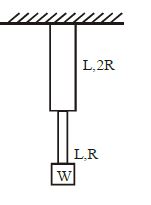
- A
$\frac{{3{W^2}L}}{{4\pi {R^2}Y}}$
- B
$\frac{{3{W^2}L}}{{8\pi {R^2}Y}}$
- ✓
$\frac{{5{W^2}L}}{{8\pi {R^2}Y}}$
- D
$\frac{{{W^2}L}}{{\pi {R^2}Y}}$
AnswerCorrect option: C. $\frac{{5{W^2}L}}{{8\pi {R^2}Y}}$
c
Energy stored $\mathrm{U}=\frac{1}{2} \times \frac{(\text { stress })^{2}}{\mathrm{Y}} \times$ volume
$U_{T}=U_{1}+U_{2}$
$=\frac{1}{2 \mathrm{Y}}\left[\left(\frac{\mathrm{W}}{\mathrm{A}_{1}}\right)^{2} \times \mathrm{A}_{1} \times \mathrm{L}+\left(\frac{\mathrm{W}}{\mathrm{A}_{2}}\right)^{2} \times \mathrm{A}_{2} \times \mathrm{L}\right]$
$=\frac{W^{2} L}{2 Y}\left[\frac{1}{A_{1}^{2}}+\frac{1}{A_{2}^{2}}\right]$
$=\frac{W^{2} L}{2 Y}\left[\frac{1}{\pi R^{2}}+\frac{1}{\pi(2 R)^{2}}\right]$
$=\frac{W^{2} L}{2 \pi Y R^{2}}\left(1+\frac{1}{4}\right)=\frac{5 W^{2} L}{8 \pi Y R^{2}}$
View full question & answer→MCQ 4571 Mark
A steel rod of length $\ell$, cross sectional area $A$, young's modulus of elasticity $Y$, and thermal coefficient of linear expansion $'a'$ is heated so that its temperature increases by $t\,^oC$. Work that can be done by rod on heating will be
- A
$(YA\, \alpha\, t)\times(\ell\, \alpha\, t)$
- ✓
$\frac{1}{2}\left( {YA\,\alpha \,t} \right) \times \left( {\ell \,\alpha \,t} \right)$
- C
$\frac{1}{2}\left( {YA\,\alpha \,t} \right) \times \left( {1/2} \right)\left( {\ell \,\alpha \,t} \right)$
- D
$2(YA\, \alpha\, t)\,(\ell\, \alpha\, t)$
AnswerCorrect option: B. $\frac{1}{2}\left( {YA\,\alpha \,t} \right) \times \left( {\ell \,\alpha \,t} \right)$
b
Work done $=\frac{1}{2} \mathrm{Y}(\text { strain })^{2}(\mathrm{A} \ell)$
$=\frac{1}{2} \mathrm{Y}\left(\frac{\Delta \ell}{\ell} \mathrm{A}\right)(\mathrm{A} \ell)=\frac{1}{2} \mathrm{Y}\left(\frac{\Delta \ell}{\ell} \mathrm{A}\right)\left(\frac{\Delta \ell}{\ell} \times \ell\right)$
$=\frac{1}{2} \mathrm{Y}(\alpha \text { t } \mathrm{A})(\alpha \text { t } \ell)[\therefore \Delta \ell=\ell \alpha \mathrm{f}]$
$=\frac{1}{2}(\mathrm{YA} \propto \mathrm{t})(\ell \propto \mathrm{t})$
View full question & answer→MCQ 4581 Mark
An $8\,m$ long copper wire and $4\,m$ long steel wire, each of cross section $0.5\,cm^2$ are fastened end to end and stretched by $500\,N$ force. The elastic potential energy of the system is (Youngs mod $: Y_{cu}= 1\times 10^{11}\,N/m^2,$ $Y_{steel} = 2\times 10^{11}\,N/m^2$ ) :
- ✓
$1/4\,\,J$
- B
$1/3\,\,J$
- C
$1/2\,\,J$
- D
$1\,\,J$
AnswerCorrect option: A. $1/4\,\,J$
a
Work $=$ Energy stored
$=\frac{1}{2} \times(\text { Force }) \times(\Delta l)$
$\Delta l_{1}=\frac{\mathrm{FL}_{1}}{\mathrm{Y}_{\mathrm{cu}} \mathrm{A}}=0.8 \mathrm{mm} \quad \& \mathrm{\Delta l}_{2}=\frac{\mathrm{FL}_{2}}{\mathrm{Y}_{\mathrm{steel}} \mathrm{A}}=0.2 \mathrm{mm}$
Net $\Delta l=\Delta l_{1}+\Delta l_{2}=1 \mathrm{mm}=10^{-3} \mathrm{m}$
Elastic potential energy $=\frac{1}{2} \times 500 \times 10^{-3}=?$
$=\frac{1}{4} J$
View full question & answer→MCQ 4591 Mark
The relationship between Young's modulus $Y,$ Bulk modulus $K$ and modulus of rigidity $\eta $ is
- ✓
$Y = \frac{{9\eta K}}{{\eta + 3K}}$
- B
$\eta = \frac{{9YK}}{{Y + 3K}}$
- C
$Y = \frac{{9\eta K}}{{3 + K}}$
- D
$Y = \frac{{3\eta K}}{{9\eta + K}}$
AnswerCorrect option: A. $Y = \frac{{9\eta K}}{{\eta + 3K}}$
a
(a)$Y = 3K(1 - 2\sigma ){\rm{ and}}\;Y = 2\eta (1 + \sigma )$
Eliminating $\sigma $ we get $Y = \frac{{9\eta K}}{{\eta + 3K}}$
View full question & answer→MCQ 4601 Mark
The relation between $\gamma ,\,\eta $ and $K$ for a elastic material is
- A
$\frac{1}{\eta } = \frac{1}{{3\gamma }} + \frac{1}{{9K}}$
- B
$\frac{1}{K} = \frac{1}{{3\gamma }} + \frac{1}{{9\eta }}$
- C
$\frac{1}{\gamma } = \frac{1}{{3K}} + \frac{1}{{9\eta }}$
- ✓
$\frac{1}{\gamma } = \frac{1}{{3\eta }} + \frac{1}{{9K}}$
AnswerCorrect option: D. $\frac{1}{\gamma } = \frac{1}{{3\eta }} + \frac{1}{{9K}}$
d
$\mu=$ Modulus of Rigiditg
$k =$ Bulk Modulus.
$\sigma=$ Normal stress
$y =3 k (1-2 \sigma)-(1)$
$y =2 \eta(1+\alpha)-(2)$
$\frac{ y }{3 k }=1-2 \sigma-(3), \frac{ x }{2 \mu}=1+\sigma-(4)$
Multiply eq $4$ by $2$.
$\frac{ y }{3 k }+\frac{ y }{\mu}=3-(5)$
Adding equ" $(3)$ and eqn $(5)$
$\frac{ y }{3 k }+\frac{ y }{\mu}=3$
$\frac{1}{3 k }+\frac{1}{\mu}=\frac{3}{ y }$
$\frac{1}{ y }=\frac{1}{9 k }+\frac{1}{3 \mu}$
View full question & answer→MCQ 4611 Mark
Which of the following relations is true
AnswerCorrect option: D. $\sigma = \frac{{0.5Y - \eta }}{\eta }$
d
(d)$Y = 2\eta (1 + \sigma ) \Rightarrow \sigma = \frac{{0.5Y - \eta }}{\eta }$
View full question & answer→MCQ 4621 Mark
The Young's modulus of the material of a wire is $6 \times {10^{12}}\,N/{m^2}$ and there is no transverse strain in it, then its modulus of rigidity will be
- ✓
$3 \times {10^{12}}\,N/{m^2}$
- B
$2 \times {10^{12}}\,N/{m^2}$
- C
${10^{12}}\,N/{m^2}$
- D
AnswerCorrect option: A. $3 \times {10^{12}}\,N/{m^2}$
a
(a) $Y = 2\eta (1 + \sigma )$
For no transverse strain $(\sigma = 0)$
$Y = 2\eta \Rightarrow \eta = \frac{Y}{2} = 3 \times {10^{12}}N/{m^2}$
View full question & answer→MCQ 4631 Mark
If the Young's modulus of the material is $3$ times its modulus of rigidity, then its volume elasticity will be
- A
- ✓
- C
$2 \times {10^{10}}\,N/{m^2}$
- D
$3 \times {10^{10}}\,N/{m^2}$
Answerb
(b) $Y = 2\eta (1 + \sigma )$$\Rightarrow$ $3\eta = 2\eta (1 + \sigma )$ $\Rightarrow$ $\sigma = \frac{3}{2} - 1 = \frac{1}{2}$
Now substituting the value of $\sigma$ in the following expression.
$Y = 3K(1 - 2\sigma )$ $\Rightarrow$ $K = \frac{Y}{{3(1 - 2\sigma )}} = \infty $
View full question & answer→MCQ 4641 Mark
Auniform rod rotating in gravity free region with certain constant angular velocity. The variation of tensile stress with distance $x$ from axis of rotation is best represented by which of the following graphs.
View full question & answer→MCQ 4651 Mark
The Young's modulus of steel is twice that of brass. Two wires of same length and of same area of cross section, one of steel and another of brass are suspended from the same roof. If we want the lower ends of the wires to be at the same level, then the weights added to the steel and brass wires must be in the ratio of
Answera
Let $'L'$ and $A$ be lenght and area of cross section of each wire. In order to have the lower ends of the wires to be at the same level $(i.e.,\,same\,elongation\,is\,produced\,in\,both\,wiers)$ let weights $W_s$ and $W_b$ are added to steel and brass wires respectively. Then, By definition of $Young's$ modulus, the elongation produced in the steel wire is
$\Delta {L_s} = \frac{{{W_s}L}}{{{Y_s}A}}$ $\left( {asY = \frac{{W/A}}{{\Delta L/L}}} \right)$
and that in the brass wire is $\Delta {L_b} = \frac{{{W_b}L}}{{{Y_b}A}}$
But $\Delta {L_s} = \Delta {L_b}$ $(given)$
$\therefore \frac{{{W_s}L}}{{{Y_s}A}} = \frac{{{W_b}L}}{{{Y_b}A}}\,\,or\,\,\frac{{{W_s}}}{{{W_b}}} = \frac{{{Y_s}}}{{{Y_b}}}$
$As\,\frac{{{Y_s}}}{{{Y_b}}} = 2$ $(given)$
$\therefore \frac{{{W_s}}}{{{W_b}}} = \frac{2}{1}$
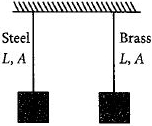
View full question & answer→MCQ 4661 Mark
Copper of fixed volume $V$ is drawn into wire of length $l$. When this wire is subjected to a constant force $F$, the extension produced in the wire is $\Delta l$. Which of the following graphs is a straight line?
- A
$\Delta l \rightarrow \frac {1}{l}$
- ✓
$\Delta l \rightarrow l^2$
- C
$ \Delta l \rightarrow \frac {1}{l^2}$
- D
$\Delta l \rightarrow l$
AnswerCorrect option: B. $\Delta l \rightarrow l^2$
b
As $V=Al$ $.....(i)$
where $A$ is the area of $cross-section$ of the wire.
$Young's\,modulus,\,Y = \frac{{\left( {F/A} \right)}}{{\left( {\Delta l/l} \right)}} = \frac{{Fl}}{{A\Delta l}}$
$\Delta l = \frac{{Fl}}{{YA}} = \frac{{F{l^2}}}{{YV}}$ $(Using(i))$
$\Delta l \propto {l^2}$
Hence, the graph between $\Delta l$ and ${l^2}$ is a straight line.
View full question & answer→MCQ 4671 Mark
The following four wires are made of the same material. Which of these will have the largest extension when the same tension is applied?
- ✓
length $ =50 \;cm$,diameter $=0.5\; mm$
- B
length $=100 \;cm$,diameter $=1 \;mm$
- C
length $= 200\; cm$,diameter $= 2 \;mm$
- D
length $= 300\; cm$,diameter $= 3\; mm$
AnswerCorrect option: A. length $ =50 \;cm$,diameter $=0.5\; mm$
a
Young's modulus,
$Y = \frac{{FL}}{{A\Delta L}} = \frac{{4FL}}{{\pi {D^2}\Delta L}}\,\,or\,\,\Delta L = \frac{{4FL}}{{\pi {D^2}Y}}$
Where $F$ is the force applied, $L$ is the length, $D$ is the diameter and $\Delta L$ is the extension of the wire respectively.
As each wire is made up of same material therefore their $Young's$ modulus is same for each wire.
Foe all the four wires, $Y,F\,(=tension)$ are the same.
$\therefore \Delta L \propto \frac{L}{{{D^2}}}$
$In\,\,\left( a \right)\,\,\frac{L}{{{D^2}}} = \frac{{200\,cm}}{{{{\left( {0.2\,cm} \right)}^2}}} = 5 \times {10^3}\,c{m^{ - 1}}$
$In\,\,\left( b \right)\,\,\,\frac{L}{{{D^2}}} = \frac{{300\,cm}}{{{{\left( {0.3\,cm} \right)}^2}}} = 3.3 \times {10^3}\,c{m^{ - 1}}$
$In\,\,\left( c \right)\,\,\frac{L}{{{D^2}}} = \frac{{50\,cm}}{{{{\left( {0.05\,cm} \right)}^2}}} = 20 \times {10^3}\,c{m^{ - 1}}$
$In\,\,\left( d \right)\,\,\frac{L}{{{D^2}}} = \frac{{100\,cm}}{{{{\left( {0.1\,cm} \right)}^2}}} = 10 \times {10^3}\,\,c{m^{ - 1}}$
View full question & answer→MCQ 4681 Mark
The compressibility of water is $6 \times 10^{-10} N ^{-1} m ^{2} .$ If one litre is subjected to a pressure of $4 \times 10^{7} Nm ^{-2}$ the decrease in its volume is (in $cc$)
Answerb
The formula for the bulk modulus is,
$\beta=\frac{-P}{\Delta V / V}$
The formula for the compressibility is,
$K=\frac{1}{\beta}=-\frac{\Delta V}{V P}$
Rewrite the above equation.
$-\Delta V=K P V$
Substitute the values in the above equation.
$-\Delta V=\left(6 \times 10^{-10}\right) \times\left(4 \times 10^{7}\right) \times 1$
$=24 \times 10^{-3} L$
$=24 cc$
View full question & answer→MCQ 4691 Mark
A $2 \,m$ long rod of radius $1 \,cm$ which is fixed from one end is given a twist of $0.8$ radians. The shear strain developed will be
- A
$0.002$
- ✓
$0.004$
- C
$0.008$
- D
$0.016$
AnswerCorrect option: B. $0.004$
b
The shear strain generated in the rod given as,
$r \theta=L \phi$
$10^{-2} \times 0.8=2 \times \phi$
$\phi=0.004$
View full question & answer→MCQ 4701 Mark
$Assertion :$ Solids are least compressible and gases are most compressible.
$Reason :$ solids have definite shape and volume but gases do not have either definite shape or definite volume.
- A
If both Assertion and Reason are correct and the Reason is a correct explanation of the Assertion.
- ✓
If both Assertion and Reason are correct but Reason is not a correct explanation of the Assertion.
- C
If the Assertion is correct but Reason is incorrect.
- D
If both the Assertion and Reason are incorrect.
AnswerCorrect option: B. If both Assertion and Reason are correct but Reason is not a correct explanation of the Assertion.
b
The incompressibility of solids is primarily due to the tight coupling between the neighbouring atoms. Molecules in gases are very poorly coupled to their neighbours.
View full question & answer→MCQ 4711 Mark
$Assertion :$ Hollow shaft is found to be stronger than a solid shaft made of same equal material.
$Reason :$ Torque required to produce a given twist in hollow cylinder is greater than that required to twist a solid cylinder of same length and material.
- ✓
If both Assertion and Reason are correct and the Reason is a correct explanation of the Assertion.
- B
If both Assertion and Reason are correct but Reason is not a correct explanation of the Assertion.
- C
If the Assertion is correct but Reason is incorrect.
- D
If both the Assertion and Reason are incorrect.
AnswerCorrect option: A. If both Assertion and Reason are correct and the Reason is a correct explanation of the Assertion.
a
Torque required to produce a given twist in hollow cylinder is greater than solid cylinder thus both are correct.
View full question & answer→MCQ 4721 Mark
$Assertion :$ Strain causes the stress in an elastic body.
$Reason :$ An elastic rubber is more plastic in nature.
- ✓
If both Assertion and Reason are correct but Reason is not a correct explanation of the Assertion.
- B
If both Assertion and Reason are correct and the Reason is a correct explanation of the Assertion.
- C
If the Assertion is correct but Reason is incorrect.
- D
If both the Assertion and Reason are incorrect.
AnswerCorrect option: A. If both Assertion and Reason are correct but Reason is not a correct explanation of the Assertion.
a
Young'smodulus$(Y)=\frac{\text {stress}}{\text {strain}}$
If strain changes stress also changes since $Y$ is constant for a material.
Also, poisson's ratio $=\frac{\text { lateralstrain }}{\text { longitudinalstrain }}$
$\nu=0.5$ for rubber and is most elastic material.
So, both are correct but not reason of assertion.
View full question & answer→MCQ 4731 Mark
Which of the following relation is true ?
- A
$3Y = K(1- \sigma )$
- B
$K = \frac{{9\eta Y}}{{Y + \eta }}$
- C
$\sigma = \left( {6K + \eta } \right)Y$
- ✓
$\sigma = \frac{{0.5Y - \eta }}{\eta }$
AnswerCorrect option: D. $\sigma = \frac{{0.5Y - \eta }}{\eta }$
d
$\sigma = 2\eta (1 + \sigma ) \Rightarrow \sigma = \frac{{0.5Y - \eta }}{\eta }$
View full question & answer→MCQ 4741 Mark
There are two wire of same material and same length while the diameter of second wire is two times the diameter of first wire, then the ratio of extension produced in the wires by applying same load will be
- A
$1 : 1$
- B
$2 : 1$
- C
$1 : 2$
- ✓
$4 : 1$
AnswerCorrect option: D. $4 : 1$
d
Both wires are same materials so both will have same $Young's$ modulus, and let it
be. $Y.Y = \frac{{stress}}{{strain}} = \frac{F}{{A.\left( {\Delta L/L} \right)}},$
$F = applied\,force$
$A = \,area\,of\,cross - \,section\,of\,wire$
$Now,$
${Y_1} = {Y_2} \Rightarrow \frac{{FL}}{{\left( {{A_1}} \right)\left( {\Delta {L_1}} \right)}} = \frac{{FL}}{{\left( {{A_2}} \right)\left( {\Delta {L_2}} \right)}}$
Since load and length are same for both
$ \Rightarrow r_1^2\Delta {L_1} = r_2^2\Delta {L_2},$
$\left( {\frac{{\Delta {L_1}}}{{\Delta {L_2}}}} \right) = {\left( {\frac{{{r_2}}}{{{r_1}}}} \right)^2} = 4\,\Delta {L_1}\,:\,\Delta {L_2} = 4:1$
View full question & answer→MCQ 4751 Mark
The adjacent graph shows the extension $(\Delta l)$ of a wire of length $1\, m$ suspended from the top of a roof at one end and with a load $W$ connected to the other end. If the cross-sectional area of the wire is $10^{-6}\, m^2$, calculate the Young’s modulus of the material of the wire.
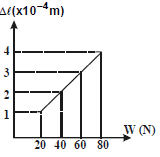
- ✓
$2\times10^{11}\, N/m^2$
- B
$2\times10^{-11}\, N/m^2$
- C
$3\times10^{-12}\, N/m^2$
- D
$2\times10^{-13}\, N/m^2$
AnswerCorrect option: A. $2\times10^{11}\, N/m^2$
a
$Y = \frac{F}{A}/\frac{{\Delta l}}{l} = \frac{{20 \times 1}}{{{{10}^{ - 6}} \times {{10}^{ - 4}}}}$
$ = 2 \times {10^{11}}N/{m^2}$
View full question & answer→MCQ 4761 Mark
Shear modulus is zero for
Answerd
Shear modulus is applicable to solids where deforming force causes change in shape of body. For fluids it is not possible since they have no fixed shape.
View full question & answer→MCQ 4771 Mark
The breaking stress of a wire depends upon
- A
- B
- ✓
- D
Shape of the cross section
Answerc
(c) Breaking stress for a wire depends only on material.
View full question & answer→MCQ 4781 Mark
$Assertion :$ Stress is the internal force per unitarea of a body.
$Reason :$ Rubber is more elastic than steel.
- A
If both Assertion and Reason are correct and the Reason is a correct explanation of the Assertion.
- B
If the Assertion is correct but Reason is incorrect.
- ✓
If both Assertion and Reason are correct but Reason is not a correct explanation of the Assertion.
- D
If both the Assertion and Reason are incorrect.
AnswerCorrect option: C. If both Assertion and Reason are correct but Reason is not a correct explanation of the Assertion.
c
Stress is internal force (restoring force) developed within the body of the object. Since it is easier to stretch rubber so it is less stressful and therefore less elastic.
View full question & answer→MCQ 4791 Mark
If $x$ longitudinal strain is produced in a wire of Young's modulus $y,$ then energy stored in the material of the wire per unit volume is
- A
$y{x^2}$
- B
$2\,y{x^2}$
- C
$\frac{1}{2}{y^2}x$
- ✓
$\frac{1}{2}y{x^2}$
AnswerCorrect option: D. $\frac{1}{2}y{x^2}$
d
(d) Energy stored per unit volume
$ = \frac{1}{2} \times {\rm{Stress}} \times {\rm{Strain}}$
$ = \frac{1}{2} \times {\rm{Young's\, modulus }} \times {{\rm{(Strain)}}^{\rm{2}}} = \frac{1}{2} \times Y \times {x^2}$
View full question & answer→MCQ 4801 Mark
According to Hook’s law of elasticity, if stress is increased, the ratio of stress to strain
Answerd
(d) $Y = \frac{{{\rm{Stress}}}}{{{\rm{Strain}}}} = {\rm{Constant}}$
It depends only on nature of material.
View full question & answer→MCQ 4811 Mark
The isothermal bulk modulus of a gas at atmospheric pressure is
AnswerCorrect option: C. $1.013 \times {10^5}\,N/{m^2}$
c
(c) Isothermal elasticity ${K_i} = P = 1atm = 1.013 \times {10^5}\;N/{m^2}$
View full question & answer→MCQ 4821 Mark
- A
- ✓
Increased potential energy
- C
- D
Decreased potential energy
AnswerCorrect option: B. Increased potential energy
b
(b) Due to stretching, a potential energy is stored in the rubber band which is released on releasing the rubber. Thus, potential energy is increased.
View full question & answer→MCQ 4831 Mark
Which of the following affects the elasticity of a substance
Answerd
(d) Elasticity depends on temperature.
Also, elasticity changes due to impurities because they increase binding of crystal grains, hence enhancing elasticity.
Hammering also changes the structure of material as crystal grains break up into smaller units which plays a large role in determining elasticity (increases elasticity).
Also, annealing tends to form a uniform orientation of crystal grains, hence producing larger crystal and changing elasticity.
View full question & answer→MCQ 4841 Mark
If a spring extends by $x$ on loading, then the energy stored by the spring is (if $T$ is tension in the spring and $k$ is spring constant)
- A
$\frac{{{T^2}}}{{2x}}$
- ✓
$\frac{{{T^2}}}{{2k}}$
- C
$\frac{{2x}}{{{T^2}}}$
- D
$\frac{{2{T^2}}}{k}$
AnswerCorrect option: B. $\frac{{{T^2}}}{{2k}}$
b
(b) $U = \frac{{{F^2}}}{{2K}} = \frac{{{T^2}}}{{2K}}$
View full question & answer→MCQ 4851 Mark
The diagram shows stress v/s strain curve for the materials $A$ and $B$. From the curves we infer that
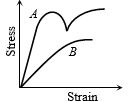
- A
$A$ is brittle but $B$ is ductile
- ✓
$A$ is ductile and $B$ is brittle
- C
Both $A$ and $B$ are ductile
- D
Both $A$ and $B$ are brittle
AnswerCorrect option: B. $A$ is ductile and $B$ is brittle
b
(b) In ductile materials, yield point exist while in Brittle material, failure would occur without yielding.
View full question & answer→MCQ 4861 Mark
The Young's modulus of a rubber string $8\, cm$ long and density $1.5\,kg/{m^3}$ is $5 \times {10^8}\,N/{m^2}$, is suspended on the ceiling in a room. The increase in length due to its own weight will be
- A
$9.6 \times {10^{ - 5}}\,m$
- ✓
$9.6 \times {10^{ - 11}}\,m$
- C
$9.6 \times {10^{ - 3}}\,m$
- D
$9.6\, m$
AnswerCorrect option: B. $9.6 \times {10^{ - 11}}\,m$
b
(b)$l = \frac{{{L^2}dg}}{{2Y}} = \frac{{{{(8 \times {{10}^{ - 2}})}^2} \times 1.5 \times 9.8}}{{2 \times 5 \times {{10}^8}}}$
$ = 9.6 \times {10^{ - 11}}m$
View full question & answer→MCQ 4871 Mark
A wire of length $L$ and radius $r$ is rigidly fixed at one end. On stretching the other end of the wire with a force $F$, the increase in its length is $l$. If another wire of same material but of length $2L$ and radius $2r$ is stretched with a force of $2F$, the increase in its length will be
- ✓
$l$
- B
$2l$
- C
$\frac{l}{2}$
- D
$\frac{l}{4}$
Answera
(a) $l = \frac{{FL}}{{AY}} = \frac{{FL}}{{\pi {r^2}Y}}\therefore l \propto \frac{{FL}}{{{r^2}}}$ ($Y =$ constant)
$\frac{{{l_2}}}{{{l_1}}} = \frac{{{F_2}}}{{{F_1}}} \times \frac{{{L_2}}}{{{L_1}}}{\left( {\frac{{{r_1}}}{{{r_2}}}} \right)^2} = 2 \times 2 \times {\left( {\frac{1}{2}} \right)^2} = 1$
${l_2} = {l_1}$ i.e. increment in its length will be $l.$
View full question & answer→MCQ 4881 Mark
Two wires $A$ and $B $ of same length and of the same material have the respective radii ${r_1}$ and ${r_2}$. Their one end is fixed with a rigid support, and at the other end equal twisting couple is applied. Then the ratio of the angle of twist at the end of $A$ and the angle of twist at the end of $B $ will be
- A
$\frac{{r_1^2}}{{r_2^2}}$
- B
$\frac{{r_2^2}}{{r_1^2}}$
- ✓
$\frac{{r_2^4}}{{r_1^4}}$
- D
$\frac{{r_1^4}}{{r_2^4}}$
AnswerCorrect option: C. $\frac{{r_2^4}}{{r_1^4}}$
c
(c)Twisting couple $C = \frac{{\pi \eta {r^4}\theta }}{{2l}}$
If material and length of the wires $A$ and $B$ are equal and equal twisting couple are applied then
$\theta \propto \frac{1}{{{r^4}}}$ $\Rightarrow $ $\frac{{{\theta _1}}}{{{\theta _2}}} = {\left( {\frac{{{r_2}}}{{{r_1}}}} \right)^4}$
View full question & answer→MCQ 4891 Mark
A structural steel rod has a radius of $10\,mm$ and length of $1.0\,m.$ A $100\,kN$ force stretches it along its length . Young's modulus of structural steel is $2 \times 10^{11}\,Nm^{-2}.$ The percentage strain is about ....... $\%$
- ✓
$0.16$
- B
$0.32$
- C
$0.08$
- D
$0.24$
AnswerCorrect option: A. $0.16$
a
$Given:F = 100kN = {10^5}N$
$Y = 2 \times {10^{11}}N{m^{ - 2}}$
${\ell _0} = 1.0m$
$radius\,r = 10mm = {10^{ - 2}}m$
$From\,formula,\,y = \frac{{Stress}}{{Strain}}$
$ \Rightarrow \,\,Strain = \frac{{Stress}}{Y} = \frac{F}{{AY}}$
$ = \frac{{{{10}^5}}}{{\pi {r^2}Y}} = \frac{{{{10}^5}}}{{3.14 \times {{10}^{ - 4}} \times 2 \times {{10}^{11}}}}$
$ = \frac{1}{{628}}$
$Therefor\% strain = \frac{1}{{628}} \times 10 = 0.16\% $
View full question & answer→MCQ 4901 Mark
A steel wire can sustain $100\,kg$ weight without breaking. If the wire is cut into two equal parts, each part can sustain a weight of ......... $kg$
Answerc
Breaking force $\alpha $ area of cross section of wire Load hold by wire is independent of length of the wire.
View full question & answer→MCQ 4911 Mark
The load versus elongation graphs for four wires of same length and made of the same material are shown in the figure. The thinnest wire is represented by the line
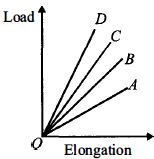
Answera
From the graph, it is clear that for the same value of load, elongation is maximum for wire $OA.$ Hence $OA$ is the thinnest wire among the four wires .
View full question & answer→MCQ 4921 Mark
A wooden wheel of radius $R$ is made of two semicircular part (see figure). The two parts are held together by a ring made of a metal strip of cross section area $S$ and length $L$. $L$ is slighly less than $2\pi R$. To fit the ring on the wheel, it is heated so that its temperature rises by $\Delta T$ and it just steps over the wheel.As it cools down to surronding temperature, it presses the semicircular parts together. If the coefficint of linear expansion of the metal is $\alpha$, and its young's modulus is $Y$, the force that one part of wheel applies on the other part is
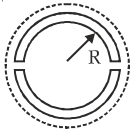
- ✓
$2SY\alpha \Delta T$
- B
$2\pi SY\Delta T$
- C
$SY\alpha \Delta T$
- D
$\pi SY\alpha \Delta T$
AnswerCorrect option: A. $2SY\alpha \Delta T$
a
$Y = \frac{{F/S}}{{\Delta L/L}} \Rightarrow \Delta L = \frac{{FL}}{{SY}}$
$\therefore L\alpha \Delta T = \frac{{FL}}{{SY}}$ $\left[ {\Delta L = L\alpha \Delta T} \right]$
$\therefore F = SY\alpha \Delta T$
$\therefore $ The ring is pressing the wheel from both sides,
$\therefore {F_{net}} = 2F = 2YS\alpha \Delta T$
View full question & answer→MCQ 4931 Mark
A wire elongates by $l$ $mm$ when a load $W$ is hanged from it. If the wire goes over a pulley and two weights $W$ each are hung at the two ends, the elongation of the wire will be (in $mm$)
Answerb
Case $(i)$
At equilibrium, $T=W$
$Y=\frac{W / A}{l / L}$ $...(1)$
Case $(ii)$ At equilibrium $T=W$
$\therefore Y=\frac{W / A}{l / 2} \Rightarrow Y=\frac{W / A}{l / L}$
Elongation is the same.
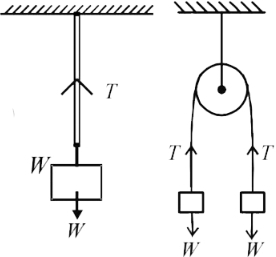
View full question & answer→MCQ 4941 Mark
A wire fixed at the upper end stretches by length $l$ by applying a force $F$. The work done in stretching is
- A
$\frac{F}{{2l}}$
- B
$Fl$
- C
$2Fl$
- ✓
$\frac{{Fl}}{2}$
AnswerCorrect option: D. $\frac{{Fl}}{2}$
d
$F_{a v}=\frac{0+F}{2}=\frac{F}{2}$
$W=\left(\frac{0+F}{2}\right) \ell=\frac{F \ell}{2}$
View full question & answer→MCQ 4951 Mark
A wire suspended vertically from one of its ends is stretched by attaching a weight of $200\, N$ to the lower end. The weight stretches the wire by $1\, mm$ Then the elastic energy stored in the wire is ........ $J$
Answera
(a) $U = \frac{1}{2} \times F \times l = \frac{1}{2} \times 200 \times {10^{ - 3}} = 0.1\;J$
View full question & answer→MCQ 4961 Mark
Rod of constant cross-section moves towards right with constant acceleration. Graph of stress and distance from left end is given as in figure. If density of material of rod at cross section $1$ is $9$ $\frac{{gm}}{{c{m^3}}}$ . Find density at cross section $2$.
.......... $\mathrm{gm} / \mathrm{cm}^{3}$
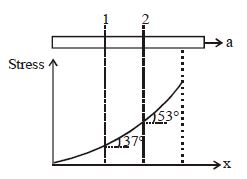
Answera
$\tan \theta=\frac{\mathrm{d}(\text { stress })}{dx}(\text { slope })$
$=\frac{\mathrm{dF} / \mathrm{A}}{\mathrm{dx}}=\frac{(\mathrm{dm}) \mathrm{a} / \mathrm{A}}{\mathrm{dx}}=\frac{(\rho \cdot \mathrm{d}(\mathrm{vol} .)) \mathrm{a}}{\mathrm{A} \,\mathrm{dx}}$
$\tan \theta=\rho a$
$\frac{\tan 37^{\circ}}{\tan 53^{\circ}}=\frac{\rho_{1}}{\rho_{2}}=\frac{9}{\rho_{2}}$
$\Rightarrow \rho_{2}=16 \mathrm{gm} / \mathrm{cm}^{3}$
View full question & answer→MCQ 4971 Mark
Overall changes in volume and radii of a uniform cylindrical steel wire are $0.2 \%$ and $0.002 \%$ respectively when subjected to some suitable force. Longitudinal tensile stress acting on the wire is ($Y = 2.0 × 10^{11} Nm^{-2}$)
- A
$3.2 × 10^9 Nm^{-2}$
- B
$3.2 × 10^7 Nm^{-2}$
- C
$3.6 × 10^9 Nm^{-2}$
- ✓
$4.08 × 10^3 Nm^{-3}$
AnswerCorrect option: D. $4.08 × 10^3 Nm^{-3}$
View full question & answer→MCQ 4981 Mark
A rigid massless rod of length $6\ L$ is suspended horizontally by means of two elasticrods $PQ$ and $RS$ as given figure. Their area of cross section, young's modulus and lengths are mentioned in figure. Find deflection of end $S$ in equilibrium state. Free end of rigid rod is pushed down by a constant force . $A$ is area of cross section, $Y$ is young's modulus of elasticity
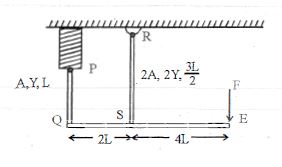
- A
$\frac {6FL}{4AY}$
- ✓
$\frac {9FL}{8AY}$
- C
$\frac {FL}{6AY}$
- D
$\frac {FL}{4AY}$
AnswerCorrect option: B. $\frac {9FL}{8AY}$
b
In equilibrium condition
$S_{Q}=\frac{T_{s}\left(\frac{3 L}{2}\right)}{2 A(2 Y)}=\frac{9 F L}{8 A Y}$
$\mathrm{F}=\mathrm{T}_{\mathrm{S}}-\mathrm{T}_{\mathrm{Q}}$
$\mathrm{F}(6 \mathrm{L})=\mathrm{T}_{\mathrm{D}}(2 \mathrm{L})$
$\mathrm{T}_{\mathrm{S}}=3 \mathrm{F}$
$\mathrm{T}_{Q}=2 \mathrm{F}$
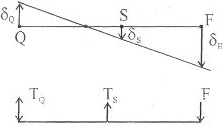
View full question & answer→MCQ 4991 Mark
A uniform dense rod with non uniform young's modulus is hanging from ceiling under gravity. If elastic energy density at every point is same then young's modulus with $x$ will change as which of the shown graph
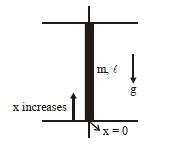
Answerc
Elastic energy density at
$A=\frac{1}{2} \frac{(\text { stress })^{2}}{Y}=$ constant
$\frac{_{1}}{2} \frac{\left(\frac{M}{L} \frac{x}{A} g\right)^{2}}{Y}=$ constant
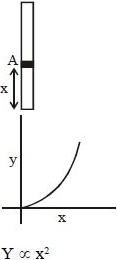
View full question & answer→