A brass rod of cross-sectional area $1\,c{m^2}$ and length $0.2\, m$ is compressed lengthwise by a weight of $5\, kg$. If Young's modulus of elasticity of brass is $1 \times {10^{11}}\,N/{m^2}$ and $g = 10\,m/{\sec ^2}$, then increase in the energy of the rod will be
Medium


Download our appand get started for free
Experience the future of education. Simply download our apps or reach out to us for more information. Let's shape the future of learning together!No signup needed.*
Similar Questions
- 1The increase in length on stretching a wire is $0.05\%$. If its Poisson's ratio is $0.4$, then its diameterView Solution
- 2Two persons pull a wire towards themselves. Each person exerts a force of $200 \mathrm{~N}$ on the wire. Young's modulus of the material of wire is $1 \times 10^{11} \mathrm{~N} \mathrm{~m}^{-2}$. Original length of the wire is $2 \mathrm{~m}$ and the area of cross section is $2 \mathrm{~cm}^2$. The wire will extend in length by . . . . . . . .$\mu \mathrm{m}$.View Solution
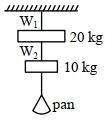
- 3Wires ${W}_{1}$ and ${W}_{2}$ are made of same material having the breaking stress of $1.25 \times 10^{9} \,{N} / {m}^{2}$ ${W}_{1}$ and ${W}_{2}$ have cross-sectional area of $8 \times 10^{-7}\, {m}^{2}$ and $4 \times 10^{-7}\, {m}^{2}$, respectively. Masses of $20 \,{kg}$ and $10\, {kg}$ hang from them as shown in the figure. The maximum mass that can be placed in the pan without breaking the wires is $.....{kg}$ (Use $\left.{g}=10\, {m} / {s}^{2}\right)$View Solution
- 4If a spring is extended to length $l,$ then according to Hook's lawView Solution
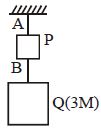
- 5Wires $A$ and $B$ are connected with blocks $P$ and $Q$ as shown. The ratio of lengths, radii and Young's modulus of wires $A$ and $B$ are $r, 2r$ and $3r$ respectively ($r$ is a constant). Find the mass of block $P$ if ratio of increase in their corresponding lengths is $1/6r^2$. The mass of block $Q$ is $3M$.View Solution
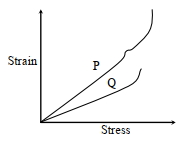
- 6In plotting stress versus strain curves for two materials $P$ and $Q$, a student by mistake puts strain on the $y$-axis and stress on the $x$-axis as shown in the figure. Then the correct statement$(s)$ is(are)View Solution
$(A)$ $P$ has more tensile strength than $Q$
$(B)$ $P$ is more ductile than $Q$
$(C)$ $P$ is more brittle than $Q$
$(D)$ The Young's modulus of $P$ is more than that of $Q$
- 7View SolutionYoung's modulus depends upon
- 8View SolutionIf Young's modulus for a material is zero, then the state of material should be
- 9A rod of uniform cross-sectional area $A$ and length $L$ has a weight $W$. It is suspended vertically from a fixed support. If Young's modulus for rod is $Y$, then elongation produced in rod is ......View Solution

- 10Two wires $A$ and $B$ of same length, same area of cross-section having the same Young's modulus are heated to the same range of temperature. If the coefficient of linear expansion of $A$ is $3/2$ times of that of wire $B$. The ratio of the forces produced in two wires will beView Solution