A brass rod of cross-sectional area $1\,c{m^2}$ and length $0.2\, m$ is compressed lengthwise by a weight of $5\, kg$. If Young's modulus of elasticity of brass is $1 \times {10^{11}}\,N/{m^2}$ and $g = 10\,m/{\sec ^2}$, then increase in the energy of the rod will be
Medium


Download our appand get started for free
Experience the future of education. Simply download our apps or reach out to us for more information. Let's shape the future of learning together!No signup needed.*
Similar Questions
- 1The density of a metal at normal pressure is $\rho$. Its density when it is subjected to an excess pressure $p$ is $\rho^{\prime}$ If $B$ is Bulk modulus of the metal, the ratio of $\frac{{\rho '}}{\rho }$ isView Solution
- 2View SolutionAccording to Hook’s law of elasticity, if stress is increased, the ratio of stress to strain
- 3A $0.1 \mathrm{~kg}$ mass is suspended from a wire of negligible mass. The length of the wire is $1 \mathrm{~m}$ and its crosssectional area is $4.9 \times 10^{-7} \mathrm{~m}^2$. If the mass is pulled a little in the vertically downward direction and released, it performs simple harmonic motion of angular frequency $140 \ \mathrm{rad} \mathrm{s}^{-1}$. If the Young's modulus of the material of the wire is $\mathrm{n} \times 10^9 \mathrm{Nm}^{-2}$, the value of $\mathrm{n}$ isView Solution
- 4A wire of length $5 \,m$ is twisted through $30^{\circ}$ at free end. If the radius of wire is $1 \,mm$, the shearing strain in the wire is ..........,.View Solution
- 5View SolutionA light rod acted upon by three forces, is in equilibrium. Which of the following diagram shows the possible position and direction of the forces?
- 6View SolutionThe spring balance does not read properly after its long use, because
- 7View SolutionLiquids have no Poisson's ratio, because
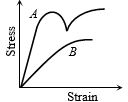
- 8The diagram shows stress v/s strain curve for the materials $A$ and $B$. From the curves we infer thatView Solution
- 9View SolutionThe compressibility of a material is
- 10Find the depth of lake at which density of water is $1\%$ greater than at the surface. Given compressibility ........... $km$ . $K = 50\times10^{-6}/atm$ ?View Solution