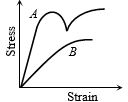
The diagram shows stress v/s strain curve for the materials $A$ and $B$. From the curves we infer that
AIIMS 1987, Easy
Download our app for free and get started
(b) In ductile materials, yield point exist while in Brittle material, failure would occur without yielding.

Download our appand get started for free
Experience the future of education. Simply download our apps or reach out to us for more information. Let's shape the future of learning together!No signup needed.*
Similar Questions
- 1The Young's modulus of a rubber string $8\, cm$ long and density $1.5\,kg/{m^3}$ is $5 \times {10^8}\,N/{m^2}$, is suspended on the ceiling in a room. The increase in length due to its own weight will beView Solution
- 2If a spring extends by $x$ on loading, then the energy stored by the spring is (if $T$ is tension in the spring and $k$ is spring constant)View Solution
- 3View SolutionLiquids have no Poisson's ratio, because
- 4If the temperature of a wire of length $2 \,m$ and area of cross-section $1 \,cm ^2$ is increased from $0^{\circ} C$ to $80^{\circ} C$ and is not allowed to increase in length, then force required for it is ............$N$ $\left\{Y=10^{10} \,N / m ^2, \alpha=10^{\left.-6 /{ }^{\circ} C \right\}}\right.$View Solution
- 5If the breaking force for a given wire is $F$, then the breaking force of two wires of same magnitude will beView Solution
- 6A wire can be broken by applying a load of $20\, kg$ weight. The force required to break the wire of twice the diameter is .......... $kg\, wt$View Solution
- 7Two wires $A$ and $B $ of same length and of the same material have the respective radii ${r_1}$ and ${r_2}$. Their one end is fixed with a rigid support, and at the other end equal twisting couple is applied. Then the ratio of the angle of twist at the end of $A$ and the angle of twist at the end of $B $ will beView Solution
- 8A cubical solid aluminium (bulk modulus $=-V \frac{ dP }{ dV }=70 GPa$ ) block has an edge length of $1 m$ on the surface of the earth. It is kept on the floor of a $5 km$ deep ocean. Taking the average density of water and the acceleration due to gravity to be $10^3 kg m ^{-3}$ and $10 ms ^{-2}$, respectively, the change in the edge length of the block in $mm$ is . . . . .View Solution
- 9Copper of fixed volume $V$ is drawn into wire of length $l$. When this wire is subjected to a constant force $F$, the extension produced in the wire is $\Delta l$. Which of the following graphs is a straight line?View Solution
- 10View SolutionIf the length of a wire is made double and radius is halved of its respective values. Then, the Young's modules of the material of the wire will :