Question
A bright student of class XI, under peer pressure started taking drugs. He started neglecting studies, misbehaving with parents and friends in school. The principal of school counselled him, but it had no effect. His parents took him to a rehabilitation center. After a few months, he came back recovered.
  1. What is drug abuse?
  2. Name some commonly abused drugs and their source.
  3. What should be the attitude of his parents after his return?
  4. What values did the principal reflect through his initiative?
Answer

  1. Intake of drugs for a non-medicinal purpose (such as to increase the strength and performance) impairs mental and physical functions. This is called drug abuse.
  2. Some commonly abused drugs and their sources are
  1. Opium: from plant Papaver somniferum; its derivatives include morphine, cocaine, heroin, smack, i.e. brown sugar, etc.
  2. Cocaine: from Erythroxylum coca. It is also called crack or coke. A cocaine derivative include caffeine from Thea sinensis, Coffea arabica, Theobroma cacao.
  3. LSD: from fungus Claviceps purpurea.
Parents should be compassionate and more caring towards the child and behave normally.
(iv) The principal showed his social liability and responsibility.

Need a full question paper?

Generate a complete, print-ready paper with questions like this in minutes — across 16+ boards, with answer keys.

Start Generating Free

Similar questions

Answer the following questions:
Draw a sectional view of human ovary and label the different follicular stages, ovum and corpus luteum.
Explain with an example, where a gene, which carries a major disadvantage in homozygous state, confers an advantage in heterozygous condition.
Match the sex-chromosome complements in Column I with the male/ female organisms in Column II.
S.No
Column I
S.No
Column II
A.
XO
1.
Human male
B.
XX
2.
Male bird
C.
XY
3.
Male grasshopper
D.
ZZ
4.
Female Drosophila
 
 
5.
Female bird
Answer the following questions:
Draw a diagrammatic sectional view of the female reproductive system of human and label the parts:
  1. Where the secondary oocytes develop.
  2. Which helps in collection of ovum after ovulation.
  3. Where fertilisation occurs.
  4. Here implantation of embryo occurs.
Explain the process of replication of a retrovirus after it gains entry into human body.
What is the Human Genome Project? Write the features of the Human Genome Project. Give a diagram representing the Human Genome Project.

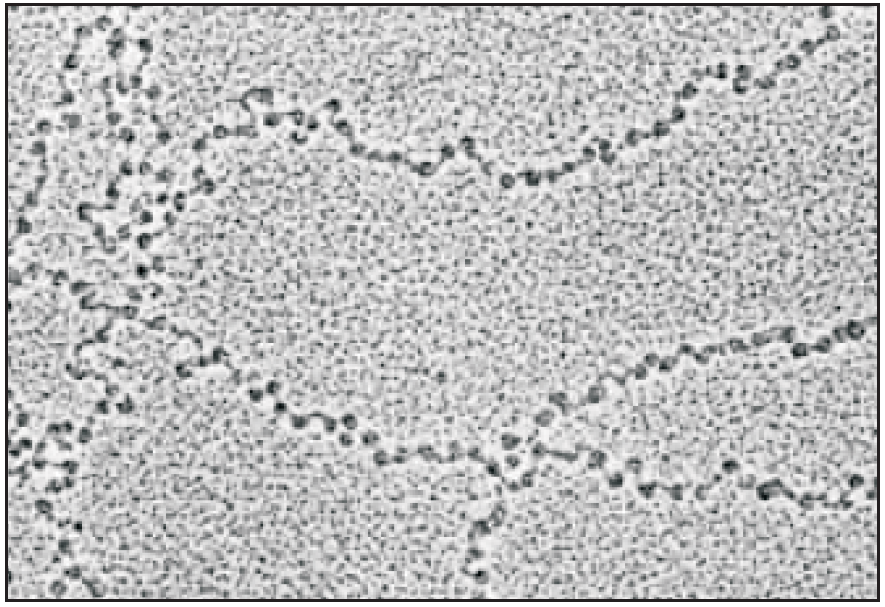
Shown above is the electron micrograph (EM) picture of 'beads-on-string'.
  1. Identify and explain the detailed structure of a bead with the help of a labelled diagram.
  2. Describe the packaging of 'beads-on-string'in a eukaryotic cell.
Explain any three preventive measures to control microbial infections.
What is integrated waste water management? Discuss its advantage.
List three strategies that a bisexual chasmogamous flower can evolve to prevent self pollination (autogamy).