MCQ
A bubble of $8$ mm diameter is formed in the air. The surface tension of soap solution is $30$ dynes/cm. The excess pressure inside the bubble is ........ $dynes/cm^2$
  • A
    $150$
  • $300$
  • C
    $3 × 10^{-3}$
  • D
    $12$

Answer

Correct option: B.
$300$
b
(b) $\Delta P = \frac{{4T}}{r} = \frac{{4 \times 30}}{{0.4}} = 300\;dyne/c{m^2}$.

Need a full question paper?

Generate a complete, print-ready paper with questions like this in minutes — across 16+ boards, with answer keys.
Start Generating Free

Similar questions

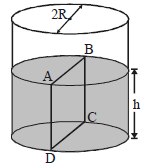
Water is filled up to a height $h$ in a beaker of radius $R$ as shown in the figure. The density of water is $\rho$, the surface tension of water is $T$ and the atmospheric pressure is $P_0$. Consider a vertical section $ABCD$ of the water column through a diameter of the beaker. The force on water on one side of this section by water on the other side of this section has magnitude
The mass number of a nucleus is:
In thermal equilibrium, the average velocity of gas molecules is
What is the average velocity of the molecules of an ideal gas?
Which of the following statement is incorrect for a spherical body rolling without slipping on a rough horizontal ground at rest?
A force of $10$ Newton acts on a body of mass $20kg$ for $10 \,seconds$. Change in its momentum is  ........... $kg\,m/s$
The distance between Sun and Earth is $R.$ The duration of year if the distance between Sun and Earth becomes $3R$ will be 
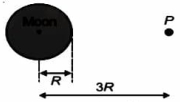
A stationary object is released from a point $P$ at a distance $3 R$ from the centre of the moon which has radius $R$ and mass $M$. Which of the following gives the speed of the object on hitting the moon?
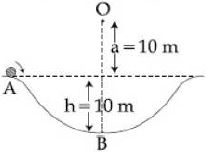
A particle of mass $20\,g$ is released with an initial velocity $5\,m/s$ along the curve from the point $A,$ as shown in the figure. The point $A$ is at height $h$ from point $B.$ The particle slides along the frictionless surface. When the particle reaches point $B,$ its angular momentum about $O$ will be ......... $kg - m^2/s$. [Take $g = 10\,m/s^2$ ]
The kinetic energy needed to project a body of mass $m$ from the earth surface (radius $R$) to infinity is