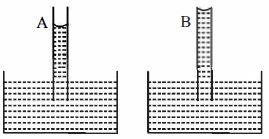
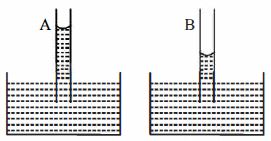
MCQ 11 Mark
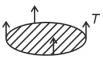
A thin flat circular disc of radius $4.5 \mathrm{~cm}$ is placed gently over the surface of water. If surface tension of water is $0.07 \mathrm{~N} \mathrm{~m}^{-1}$, then the excess force required to take it away from the surface is
- A
$198 \mathrm{~N}$
- B
$1.98 \mathrm{mN}$
- C
$99 \mathrm{~N}$
- ✓
$19.8 \mathrm{mN}$
AnswerCorrect option: D. $19.8 \mathrm{mN}$
d
$\text { Excess force }=T \times 2 \pi R$
$=\frac{7}{100} \times 2 \times 3.14 \times \frac{4.5}{100}$
$=197.82 \times 10^{-4}$
$=19.8 \times 10^{-3} \mathrm{~N}$
$=19.8 \mathrm{mN}$
View full question & answer→MCQ 21 Mark
The amount of energy required to form a soap bubble of radius $2\,cm$ from a soap solution is nearly $..........\,\times 10^{-4}\,J$: (surface tension of soap solution $=0.03\,N\,m ^{-1}$ )
- A
$50.1$
- B
$30.16$
- C
$5.06$
- ✓
$3.01$
AnswerCorrect option: D. $3.01$
d
$E =2 T \left(4 \pi R ^3\right)$
$=2(0.03)(4)(3.14)\left(2 \times 10^{-2}\right)^2$
$=3.01 \times 10^{-4}\,J$
View full question & answer→MCQ 31 Mark
If a soap bubble expands, the pressure inside the bubble:
- A
- B
- C
is equal to the atmospheric pressure
- ✓
Answerd
$P=P_{0}+\frac{4 T}{R}$
$\Rightarrow R$ increases and $P$ decreases
View full question & answer→MCQ 41 Mark
A capillary tube of radius $r$ is immersed in water and water rises in it to a helght $h$. The mass of the water in the capillary is $5\,g.$ Another capillary tube of radlus $2\, r$ is immersed in water. The mass of water that will rise in this tube is $........\;g$
- A
$20.0$
- B
$2.5$
- C
$5.0$
- ✓
$10.0$
AnswerCorrect option: D. $10.0$
d
$h=\frac{2 T \cos \theta}{r \rho g}$
Mass of water in the firsr tube,
$m=\pi r^{2} h \rho=\pi r^{2} \times\left(\frac{2 T \cos \theta}{r \rho g}\right) \times \rho$
$=\frac{2 \pi r T \cos \theta}{g}$
$m \propto r$
$\frac{ m _{2}}{ m _{1}}=\frac{ r _{2}}{ r _{1}}$
$\frac{ m _{2}}{5}=\frac{2 r }{ r }$
$m _{2}=10 g$
View full question & answer→MCQ 51 Mark
A liquid does not wet the solid surface if angle of contact is
AnswerCorrect option: D. greater than $90^{\circ}$
d
If angle of contact is greater than $90^{\circ},$ then liquid will not wet the wall of container.
View full question & answer→MCQ 61 Mark
A soap bubble, having radius of $1\; \mathrm{mm}$, is blown from a detergent solution having a surface tension of $2.5 \times 10^{-2}\; N / m$. The pressure inside the bubble equals at a point $Z_{0}$ below the free surface of water in a container. Taking $g=10\; \mathrm{m} / \mathrm{s}^{2}$ density of water $=10^{3} \;\mathrm{kg} / \mathrm{m}^{3},$ the value of $\mathrm{Z}_{0}$ is......$cm$
Answerc
$P=P_{0}+\rho g Z_{0}\ldots(i)$
Also, $\mathrm{P}=\mathrm{P}_{0}+\frac{4 \mathrm{T}}{\mathrm{R}}\ldots$ (ii)
From $(i) \;and\; (ii)$
$\rho g Z_{0}=\frac{4 \mathrm{T}}{\mathrm{R}}$
$\mathrm{z}_{0}=\frac{4 \mathrm{T}}{\mathrm{pgR}}$
$=\frac{4 \times 2.5 \times 10^{-2}}{10^{3} \times 10 \times 10^{-3}}=10^{-2} \mathrm{m}=1 \;\mathrm{cm}$
View full question & answer→MCQ 71 Mark
A rectangular film of liquid is extended from $(4 \,\,cm \times 2\, cm)$ to $(5\,\, cm \times 4\, cm).$ If the work done is $3 \times 10^{-4}\, J,$ the value of the surface tension of the liquid is ............ $Nm^{-1}$
- A
$0.2$
- B
$8.0$
- C
$0.250$
- ✓
$0.125$
AnswerCorrect option: D. $0.125$
d
$work\,done = Surface\,tension\,of\,film \times $
$Change\,in\,area\,of\,the\,film$
$or,\,\,W = T \times \Delta A$
$Here,{A_1} = 4\,cm \times 2\,cm = 8\,c{m^2}$
${A_2} = 5\,cm \times 4\,cm = 20\,c{m^2}$
$\Delta A = 2\,\left( {{A_2} - {A_1}} \right) = 24\,c{m^2} = 24 \times {10^{ - 4}}{m^2}$
$W = 3 \times {10^{ - 4}}J,T = ?$
$\therefore \,\,T = \frac{W}{{\Delta A}} = \frac{{3 \times {{10}^{ - 4}}}}{{24 \times {{10}^{ - 4}}}} = \frac{1}{8} = 0.125\,N\,{m^{ - 1}}$
View full question & answer→MCQ 81 Mark
Three liquids of densities $\rho _1,\rho _2$ and $\rho _3$ (with $\rho _1 > \rho _2 > \rho_3),$ having the same value of surface tension $T,$ rise to the same height in three identical capillaries. The angles of contact $\theta_1 \,,\theta_2$ and $\theta_3$ obey
- A
$\frac{\pi }{2} < {\theta _1} < {\theta _2} < {\theta _3} < \pi \;$
- B
$\;\pi > {\theta _1} > {\theta _2} > {\theta _3} > \frac{\pi }{2}$
- C
$\;\frac{\pi }{2} > {\theta _1} > {\theta _2} > {\theta _3} > 0$
- ✓
$\;0 \le {\theta _1} < {\theta _2} < {\theta _3} < \frac{\pi }{2}$
AnswerCorrect option: D. $\;0 \le {\theta _1} < {\theta _2} < {\theta _3} < \frac{\pi }{2}$
d
$Capillary\,rise,\,h = \frac{{2T\cos \theta }}{{r\rho g}}$
$For\,given\,value\,of\,T\,and\,r,h \propto \frac{{\cos \theta }}{\rho }$
$Also,{h_1} = {h_2} = {h_3}\,\,or\,\,\frac{{\cos {\theta _1}}}{{{\rho _1}}} = \frac{{\cos {\theta _2}}}{{{\rho _2}}} = \frac{{\cos {\theta _3}}}{{{\rho _3}}}$
$Since\,{\rho _1} > {\rho _2} > {\rho _{3'}}\,so\,\cos {\theta _1} > \cos {\theta _2} > \cos {\theta _3}$
$For\,0 \le \theta < \frac{\pi }{2},{\theta _1} < {\theta _2} < {\theta _3}$
$Hence,\,0 \le {\theta _1} < {\theta _2} < {\theta _3} < \frac{\pi }{2}$
View full question & answer→MCQ 91 Mark
A square frame of side $L$ is dipped in a liquid. On taking out, a membrane is formed. If the surface tension of the liquid is $T$, the force acting on the frame will be
- A
$2\, TL$
- B
$4 \,TL$
- ✓
$8 \,TL$
- D
$10\, TL$
AnswerCorrect option: C. $8 \,TL$
c
(c) Force on each side $ = 2\,TL$ (due to two surfaces)
$\therefore $ Force on the frame = $ 4(2\,TL) = 8\,TL$
View full question & answer→MCQ 101 Mark
Force necessary to pull a circular plate of $5\, cm$ radius from water surface for which surface tension is $75\, dynes/cm,$ is
- A
$30\,dyne$
- B
$60 \,dynes$
- C
$750 \,dynes$
- ✓
$750 \,\pi \,dynes$
AnswerCorrect option: D. $750 \,\pi \,dynes$
d
(d) The total length of the circular plate on which the force will act $ = 2\pi R$
Force to pull $ = 2\pi RT = 2 \times \pi \times 5 \times 75 = 750\pi \, dynes$
View full question & answer→MCQ 111 Mark
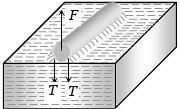
The maximum force, in addition to the weight required to pull a wire of $ 5.0\, cm$ long from the surface of water at temperature $20^\circ C$, is $728 $ dynes. The surface tension of water is
- A
$7.28 \,N/cm$
- B
$7.28 \,dyne/cm$
- ✓
$72.8\, dyne/cm$
- D
$7.28×10^2\, dyne/cm$
AnswerCorrect option: C. $72.8\, dyne/cm$
c
(c) $T = \frac{F}{{2l}} = \frac{{728}}{{2 \times 5}}$
$T = 72.8\;dyne/cm$
View full question & answer→MCQ 121 Mark
A $10\, cm$ long wire is placed horizontally on the surface of water and is gently pulled up with a force of $2 ×10^{-2}\,N$ to keep the wire in equilibrium. The surface tension, in $Nm^{-1}$, of water is
- ✓
$0.1$
- B
$0.2$
- C
$0.001$
- D
$0.002$
Answera
(a) $T = \frac{F}{{2l}} = \frac{{2 \times {{10}^{ - 2}}}}{{2 \times 10 \times {{10}^{ - 2}}}} = 0.1\;N/m$
View full question & answer→MCQ 131 Mark
The force required to separate two glass plates of area ${10^{ - 2}}{m^2}$ with a film of water $0.05\, mm$ thick between them, is ...... $N$ (Surface tension of water is $70 \times {10^{ - 3}}\,N/m$)
Answera
(a) Force required to separate the plates
$F = \frac{{2TA}}{t} = \frac{{2 \times 70 \times {{10}^{ - 3}} \times {{10}^{ - 2}}}}{{0.05 \times {{10}^{ - 3}}}} = 28N$
View full question & answer→MCQ 141 Mark
A wooden stick $2\,m$ long is floating on the surface of water. The surface tension of water $0.07\, N/m$. By putting soap solution on one side of the sticks the surface tension is reduced to $0.06 \,N/m.$ The net force on the stick will be ....... $N$
- A
$0.07$
- B
$0.06$
- C
$0.01$
- ✓
$0.02$
AnswerCorrect option: D. $0.02$
d
(d) Net force on stick $ = {F_1} - {F_2} = ({T_1} - {T_2})l$
$ = (0.07 - 0.06)l = 0.01 \times 2 = 0.02N$
View full question & answer→MCQ 151 Mark
The force required to take away a flat circular plate of radius $2\, cm$ from the surface of water, will be (the surface tension of water is $70\, dyne/cm$)
- ✓
$280\pi \,dyne$
- B
$250\pi \,dyne$
- C
$140\pi \,dyne$
- D
$210\pi \,dyne$
AnswerCorrect option: A. $280\pi \,dyne$
a
(a) Force required, $F = 2\pi rT = 2\pi \times 2 \times 70 = 280\pi Dyne$
View full question & answer→MCQ 161 Mark
A soap film of surface tension $3 \times {10^{ - 2}}\,N{m^{ - 1}}$ formed in rectangular frame, can support a straw. The length of the film is $10\, cm$. Mass of the straw the film can support is ........ $gm$
Answerb
(b) The weight of straw will be balanced by the force of surface tension
$mg = 2Tl$==> $m = \frac{{2Tl}}{g}$
$ = \frac{{2 \times 3 \times {{10}^{ - 2}} \times 10 \times {{10}^{ - 2}}}}{{9.8}}kg = 0.6gm$
View full question & answer→MCQ 171 Mark
A razor-blade floats on the surface of water contained in a glass. When the glass is gently shaken, the razor-blade sinks. Mark the incorrect statement
- A
Volume of displaced water is lesser than blades own volume
- B
When the razor-blade sinks, the height of the water decreases.
- ✓
For a floating body of greater density than water its weight is balanced by the compressive forces of the water below it.
- D
Weight of razor-blade is equal to the weight of the displaced water due to volume occupied by the razor-blade and some additional region affected by surface tension.
AnswerCorrect option: C. For a floating body of greater density than water its weight is balanced by the compressive forces of the water below it.
c
Force is developed due to property of liquid called surface tension.
View full question & answer→MCQ 181 Mark
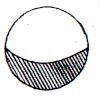
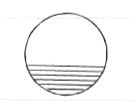
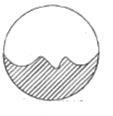
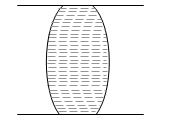
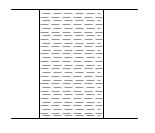
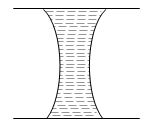
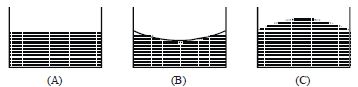
Three surfaces of liquid are shown here. Find the correct statements
- A
the surface tension of liquid $A$ is infinite and such a surface is not possible practically
- B
in case of liquid $B$ , the resultant force on a molecule on the surface would be downward, and the surface is concave
- ✓
in case of liquid $C$ , the resultant force due to surface tension is directed downwards
- D
the surfaces of all three liquids $A, B$ and $C$ are in equilibrium and so the net force due to surface tension is the same
AnswerCorrect option: C. in case of liquid $C$ , the resultant force due to surface tension is directed downwards
View full question & answer→MCQ 191 Mark
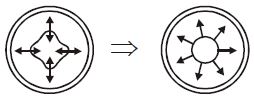
A soap film is formed on a circular frame. A loop of thread is lying on film. If the film inside the loop is broken, then tension in the thread will be : ($R =$ radius of loop, $T =$ surface tension of liquid)
- A
$2\pi RT$
- B
$\pi RT$
- ✓
$RT$
- D
$\pi {R^2}T$
Answerc
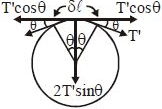
$\Rightarrow 2 \mathrm{T}^{\prime} \sin \theta=\mathrm{T} \delta \ell$
$2 \mathrm{T}^{\prime} \theta=\mathrm{T}(2 \theta . \mathrm{R})$
Tension $\left.\mathrm{T}^{\prime}=\mathrm{RT}\right]$
View full question & answer→MCQ 201 Mark
The length of needle floating on the surface of water is $1.5\,cm$. The force in addition to its weight required to lift the needle from water surface will be...... $N$ (surface tension of water $= 7.5\,N/cm$ )
- ✓
$22.5$
- B
$2.25$
- C
$0.25$
- D
$225$
AnswerCorrect option: A. $22.5$
a
Force $= T \times $ Contact length
$F = 7.5 \times 2 \times 1.5$
$F = 22.5\, N$
View full question & answer→MCQ 211 Mark
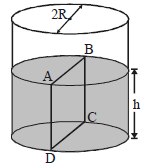
Water is filled up to a height $h$ in a beaker of radius $R$ as shown in the figure. The density of water is $\rho$, the surface tension of water is $T$ and the atmospheric pressure is $P_0$. Consider a vertical section $ABCD$ of the water column through a diameter of the beaker. The force on water on one side of this section by water on the other side of this section has magnitude
- A
$| 2P_0Rh + \pi R^2\rho gh - 2RT |$
- ✓
$| 2P_0Rh + R\rho gh^2 - 2RT |$
- C
$| P_0\pi R^2 + R\rho gh^2 - 2RT |$
- D
$| P_0\pi R^2 + R\rho gh^2 + 2RT |$
AnswerCorrect option: B. $| 2P_0Rh + R\rho gh^2 - 2RT |$
b
$Net\,force = Average\,pressure \times Area - T \times 2R$
$\left( {{P_0} + \rho g\frac{h}{2}} \right)\left( {2Rh} \right) - T2R$
$ \Rightarrow \left| {2\,{P_0}Rh + R\rho g{h^2} - 2RT} \right|$
View full question & answer→MCQ 221 Mark
A $U-$shaped wire is dipped in a soap solution, and removed. The thin soap film formed between the wire and the light slider supports a weight of $1.5 \times 10^{-2}\; N$ (which includes the small weight of the slider). The length of the slider is $30 \;cm .$ What is the surface tension of the film?
- A
$6.32 \times 10^{-3}\; N m ^{-1}$
- B
$5.25 \times 10^{-4}\; N m ^{-1}$
- C
$6.8 \times 10^{-3}\; N m ^{-1}$
- ✓
$2.5 \times 10^{-2}\; N m ^{-1}$
AnswerCorrect option: D. $2.5 \times 10^{-2}\; N m ^{-1}$
d
The weight that the soap film supports, $W=1.5 \times 10^{-2} N$
Length of the slider, $l=30 cm =0.3 m$
A soap film has two free surfaces.
$\therefore$ Total length $=2 l=2 \times 0.3=0.6 m$
Surface tension, $S=\frac{\text { Force o-Weight }}{2 l}$ $=\frac{1.5 \times 10^{-2}}{0.6}$$=2.5 \times 10^{-2} N / m$
Therefore, the surface tension of the film is $2.5 \times 10^{-2}\; N m ^{-1}$
View full question & answer→MCQ 231 Mark
A massless inextensible string in the form of a loop is placed on a horizontal film of soap solution of surface tension $T$. If film is pierced inside the loop and it convert into a circular loop of diameter $d$, then the tension produced in string is ..........
- ✓
$Td$
- B
$\pi T d$
- C
$\pi d^2 T$
- D
$\frac{\pi d^2 T}{4}$
Answera
(a)
By force balancing in vertical direction
$S_F=2 T \sin \theta$
$S_F=2 T \theta$ $\left\{\begin{array}{l}\because \theta \text { is small } \\ \sin \theta=\theta\end{array}\right.$
$S \times 2 r \times 2 \theta=2 \times T \times \theta$
$S \times 2 r=$ Tension
$S \times d=$ Tension $\left\{\begin{array}{l}r \text {-radius } \\ d \text {-diameter }\end{array}\right.$
$\because S=T$
So, Tension $=T d$ $\left\{\begin{array}{l}\text { Where, } \\ S_F=\text { Force due to surface tension } \\ T=\text { Tension in string } \\ \theta=\text { Small angle } \\ S=\text { Surface tension }\end{array}\right.$
View full question & answer→MCQ 241 Mark
Energy needed in breaking a drop of radius $R$ into $n$ drops of radii $ r$ is given by
AnswerCorrect option: A. $4\pi T(n{r^2} - {R^2})$
a
(a) Energy needed = Increment in surface energy
= (surface energy of $n$ small drops) -(surface energy of
one big drop)
$ = n4\pi {r^2}T - 4\pi {R^2}T = 4\pi T(n{r^2} - {R^2})$
View full question & answer→MCQ 251 Mark
A drop of liquid of diameter $2.8\, mm$ breaks up into $125$ identical drops. The change in energy is nearly ........ $erg$ (S.T. of liquid = $75\, dynes/cm$)
Answerd
(d) $E = 4\pi {R^2}T({n^{1/3}} - 1)$
= $4 \times 3.14 \times {(1.4 \times {10^{ - 1}})^2} \times 75({125^{1/3}} - 1)$$ = 74\;erg$
View full question & answer→MCQ 261 Mark
Radius of a soap bubble is $'r'$, surface tension of soap solution is $T$. Then without increasing the temperature, how much energy will be needed to double its radius
- A
$4\pi {r^2}T$
- B
$2\pi {r^2}T$
- C
$12\pi {r^2}T$
- ✓
$24\pi {r^2}T$
AnswerCorrect option: D. $24\pi {r^2}T$
d
(d) $W = 8\pi T(R_2^2 - R_1^2) = 8\pi T[{(2r)^2} - {(r)^2}] = 24\pi {r^2}T$
View full question & answer→MCQ 271 Mark
A spherical liquid drop of radius $R$ is divided into eight equal droplets. If surface tension is $T$, then the work done in this process will be
- A
2$\pi {R^2}T$
- B
3$\pi {R^2}T$
- ✓
4$\pi {R^2}T$
- D
2$\pi R{T^2}$
AnswerCorrect option: C. 4$\pi {R^2}T$
c
(c)$W = 4\pi {R^2}T({r^{1/3}} - 1) = 4\pi {R^2}T({8^{1/3}} - 1) = 4\pi {R^2}T$
View full question & answer→MCQ 281 Mark
The amount of work done in blowing a soap bubble such that its diameter increases from $d$ to $D$ is ($T=$ surface tension of the solution)
- A
$4\pi ({D^2} - {d^2})T$
- B
$8\pi ({D^2} - {d^2})T$
- C
$\pi ({D^2} - {d^2})T$
- ✓
$2\pi ({D^2} - {d^2})T$
AnswerCorrect option: D. $2\pi ({D^2} - {d^2})T$
d
(d)$W = T \times 8\pi (r_2^2 - r_1^2) = T \times 8\pi \left( {\frac{{{D^2}}}{4} - \frac{{{d^2}}}{4}} \right)$
$ = 2\pi ({D^2} - {d^2})T$
View full question & answer→MCQ 291 Mark
If $T$ is the surface tension of soap solution, the amount of work done in blowing a soap bubble from a diameter $D$ to $2D$ is
- A
$2\pi {D^2}T$
- B
$4\pi {D^2}T$
- ✓
$6\pi {D^2}T$
- D
$8\pi {D^2}T$
AnswerCorrect option: C. $6\pi {D^2}T$
c
(c) Work done to increase the diameter of bubble from $d$ to $D$
$W = 2\pi ({D^2} - {d^2})T = 2\pi [{(2D)^2} - {(D)^2}]\;T = 6\pi {D^2}T$
View full question & answer→MCQ 301 Mark
If work $W$ is done in blowing a bubble of radius $R$ from a soap solution, then the work done in blowing a bubble of radius $2R$ from the same solution is
- A
$W/2$
- B
$2W$
- ✓
$4W$
- D
$2\frac{1}{3}W$
Answerc
(c) $W = 8\pi {R^2}T$
$W \propto {R^2}$ ($T$ is constant)
If radius becomes double then work done will become four times.
View full question & answer→MCQ 311 Mark
A spherical drop of oil of radius $1\, cm$ is broken into $1000$ droplets of equal radii. If the surface tension of oil is $50$ dynes/cm, the work done is
- A
$18\pi $ ergs
- B
$180\pi $ ergs
- ✓
$1800\pi $ ergs
- D
$8000\pi $ ergs
AnswerCorrect option: C. $1800\pi $ ergs
c
(c) $W = 4\pi {R^2}T({n^{1/3}} - 1)$$ = 4\pi \times 1 \times 50({10^{3/3}} - 1)$ = $1800\pi \;erg$
View full question & answer→MCQ 321 Mark
The work done in blowing a soap bubble of radius $r$ of the solution of surface tension $T$ will be
- ✓
$8\pi {r^2}T$
- B
$2\pi {r^2}T$
- C
$4\pi {r^2}T$
- D
$\frac{4}{3}\pi {r^2}T$
AnswerCorrect option: A. $8\pi {r^2}T$
a
(a) work done $=T . T . \times$ area of soap bubble
$=T \times\left(4 \pi r^{2}\right) \times 2=8 \pi T r^{2}$
View full question & answer→MCQ 331 Mark
The surface tension of a soap solution is $2 \times {10^{ - 2}}N/m.$ To blow a bubble of radius $1 \,cm,$ the work done is
- A
$4\pi \times {10^{ - 6}}J$
- B
$8\pi \times {10^{ - 6}}J$
- C
$12\pi \times {10^{ - 6}}J$
- ✓
$16\pi \times {10^{ - 6}}J$
AnswerCorrect option: D. $16\pi \times {10^{ - 6}}J$
d
(d)$W = 8\pi {R^2}T = 8 \times \pi \times {({10^{ - 2}})^2} \times 2 \times {10^{ - 2}}$$ = 16\pi \times {10^{ - 6}}J$
View full question & answer→MCQ 341 Mark
A mercury drop of $1\, cm$ radius is broken into ${10^6}$ small drops. The energy used will be (surface tension of mercury is $35 \times {10^{ - 3}}N/cm)$
- ✓
$4.4 \times {10^{ - 3}}\,J$
- B
$2.2 \times {10^{ - 4}}\,J$
- C
$8.8 \times {10^{ - 4}}\,J$
- D
${10^4}\,J$
AnswerCorrect option: A. $4.4 \times {10^{ - 3}}\,J$
a
(a) $E = 4\pi {R^2}T({n^{1/3}} - 1)$
$ = 4 \times 3.14 \times {10^{ - 4}} \times 35 \times {10^{ - 1}}({10^{6/3}} - 1)$ $ = 4.4 \times {10^{ - 3}}\,J$
View full question & answer→MCQ 351 Mark
Surface tension of a soap solution is $1.9 \times {10^{ - 2}}N/m$. Work done in blowing a bubble of $2.0\, cm$ diameter will be
- A
$7.6 \times {10^{ - 6}}\pi $ joule
- ✓
$15.2 \times {10^{ - 6}}\pi $ joule
- C
$1.9 \times {10^{ - 6}}\pi $ joule
- D
$1 \times {10^{ - 4}}$ joule
AnswerCorrect option: B. $15.2 \times {10^{ - 6}}\pi $ joule
b
(b) $W = 8\pi {R^2}T = 8\pi \times {(1 \times {10^{ - 2}})^2} \times 1.9 \times {10^{ - 2}}$=$15.2 \times {10^{ - 6}}\pi\, J$
View full question & answer→MCQ 361 Mark
What is ratio of surface energy of $1$ small drop and $1$ large drop, if $1000$ small drops combined to form $1$ large drop
- A
$100:1$
- B
$1000 : 1$
- C
$10:1$
- ✓
$1 : 100$
AnswerCorrect option: D. $1 : 100$
d
(d) Volume of liquid remain same i.e. volume of $1000$ small drops will be equal to volume of one big drop
$n\frac{4}{3}\pi {r^3} = \frac{4}{3}\pi {R^3}$ $⇒$ $1000{r^3} = {R^3}$ $⇒$ $R = 10r$
$\therefore \frac{r}{R} = \frac{1}{{10}}$
$\frac{{{\rm{surface \,energy \,of \,one\, small\, drop}}}}{{{\rm{surface\, energy \,of\, one \,big\, drop}}}} = \frac{{4\pi {r^2}T}}{{4\pi {R^2}T}} = \frac{1}{{100}}$
View full question & answer→MCQ 371 Mark
A liquid drop of diameter $D$ breaks upto into $27$ small drops of equal size. If the surface tension of the liquid is $\sigma$, then change in surface energy is
- A
$\pi {D^2}\sigma $
- ✓
$2\pi {D^2}\sigma $
- C
$3\pi {D^2}\sigma $
- D
$4\pi {D^2}\sigma $
AnswerCorrect option: B. $2\pi {D^2}\sigma $
b
(b) Work done = $4\pi {R^2}T({n^{1/3}} - 1)$$ = 4\pi {\left( {\frac{D}{2}} \right)^2}\sigma ({n^{1/3}} - 1)$
$ = \pi {D^2}\sigma ({27^{1/3}} - 1)$$ = 2\pi {D^2}\sigma $
View full question & answer→MCQ 381 Mark
One thousand small water drops of equal radii combine to form a big drop. The ratio of final surface energy to the total initial surface energy is
- A
$1000:1$
- B
$1 : 1000$
- C
$10:1$
- ✓
$1:10$
AnswerCorrect option: D. $1:10$
d
(d) As volume remain constant therefore $R = {n^{1/3}}r$
$\frac{{{\rm{surface\, energy\, of\, one \,big \,drop}}}}{{{\rm{surface \,energy \,of \,}}n{\rm{ drop}}}} = \frac{{4\pi {R^2}T}}{{n \times 4\pi {r^2}T}}$
$\frac{{{R^2}}}{{n{r^2}}} = \frac{{{n^{2/3}}{r^2}}}{{n{r^2}}}$ = $\frac{1}{{{n^{1/3}}}} = \frac{1}{{{{(1000)}^{1/3}}}} = \frac{1}{{10}}$
View full question & answer→MCQ 391 Mark
If $\sigma$ be the surface tension, the work done in breaking a big drop of radius R in n drops of equal radius is
- A
$R{n^{2/3}}\sigma $
- B
$({n^{2/3}} - 1)R\sigma $
- C
$({n^{1/3}} - 1)R\sigma $
- ✓
$4\pi {R^2}({n^{1/3}} - 1)\sigma $
AnswerCorrect option: D. $4\pi {R^2}({n^{1/3}} - 1)\sigma $
d
(d) Volume will be conserved
$\frac{4}{3} \pi R^{3}=n \frac{4}{3} \pi r^{3}$
$r=n^{-1 / 3} R$
workdone $=$ $final energy - initial energy$
$=\left[n 4 \pi n^{-2 / 3} R^{2}-4 \pi R^{2}\right] \sigma$
$=4 \pi R^{2}\left(n^{1 / 3}-1\right) \sigma$
View full question & answer→MCQ 401 Mark
A big drop of radius $R$ is formed by $1000 $ small droplets of water, then the radius of small drop is
- A
$R/2$
- B
$R/5$
- C
$R/6$
- ✓
$R/10$
AnswerCorrect option: D. $R/10$
d
(d) $\frac{4}{3}\pi {R^3} = 1000 \times \frac{4}{3}\pi {r^3}$ (As volume remains constant)
${R^3} = 1000{r^3}$ $⇒$ $R = 10r \Rightarrow r = \frac{R}{{10}}$
View full question & answer→MCQ 411 Mark
When ${10^6}$small drops coalesce to make a new larger drop then the drop
Answerc
(c)Because energy is liberated
View full question & answer→MCQ 421 Mark
$8000$ identical water drops are combined to form a big drop. Then the ratio of the final surface energy to the initial surface energy of all the drops together is
- A
$1:10$
- B
$1:15$
- ✓
$1:20$
- D
$1:25$
AnswerCorrect option: C. $1:20$
c
(c) As volume remains constant ${R^3} = 8000{r^3}$
$\therefore R = 20r$
$\frac{{{\rm{Surface \,energy\, of \,one \,big \,drop}}}}{{{\rm{Surface \,energy \,of \,8000 \,small\, drop}}}} = \frac{{4\pi {R^2}T}}{{8000\;4\pi {r^2}T}}$
$ = \frac{{{R^2}}}{{8000{r^2}}} = \frac{{{{\left( {20r} \right)}^2}}}{{8000{r^2}}} = \frac{1}{{20}}$
View full question & answer→MCQ 431 Mark
$8$ mercury drops coalesce to form one mercury drop, the energy changes by a factor of
Answerc
(c) As volume remains constant therefore $R = {n^{1/3}}r$
$\frac{{{\rm{Energy\, of \,big \,drop}}}}{{{\rm{Energy \,of\, small\, drop}}}} = \frac{{4\pi {R^2}T}}{{4\pi {r^2}T}} = \frac{{{R^2}}}{{{r^2}}}$$ = {(8)^{2/3}} = 4$
View full question & answer→MCQ 441 Mark
A film of water is formed between two straight parallel wires of length $10\,cm$ each separated by $0.5\, cm$. If their separation is increased by $1\, mm$ while still maintaining their parallelism, how much work will have to be done (Surface tension of water = $7.2 \times {10^{ - 2}}\,N/m)$
- A
$7.22 \times {10^{ - 6}}\,Joule$
- ✓
$1.44 \times {10^{ - 5}}\,Joule$
- C
$2.88 \times {10^{ - 5}}\,Joule$
- D
$5.76 \times {10^{ - 5}}\,Joule$
AnswerCorrect option: B. $1.44 \times {10^{ - 5}}\,Joule$
b
(b) Increment in area of soap film = ${A_2} - {A_1}$
$ = 2 \times [(10 \times 0.6) - (10 \times 0.5)] \times {10^{ - 4}} = 2 \times {10^{ - 4}}{m^2}$
Work done = $T \times \Delta A$
$ = 7.2 \times {10^{ - 2}} \times 2 \times {10^{ - 4}} = 1.44 \times {10^{ - 5}}J$
View full question & answer→MCQ 451 Mark
A drop of mercury of radius $2\, mm$ is split into $8$ identical droplets. Find the increase in surface energy ....... $\mu J$. (Surface tension of mercury is $0.465\;J/{m^2}$)
- ✓
$23.4$
- B
$18.5$
- C
$26.8$
- D
$16.8$
AnswerCorrect option: A. $23.4$
a
(a) Increase in surface energy or work done in splitting a big drop $ = 4\pi {R^2}T({n^{1/3}} - 1)$
$ \Rightarrow W = 4\pi \times {(2 \times {10^{ - 3}})^2} \times 0.465({8^{1/3}} - 1) = 23.4\;\mu \,J$
View full question & answer→MCQ 461 Mark
If two soap bubbles of equal radii $r$ coalesce then the radius of curvature of interface between two bubbles will be
Answerc
(c) $r = \frac{{{r_1}{r_2}}}{{{r_2} - {r_1}}} = \infty \;\sin ce\;{r_1} = {r_2}$
View full question & answer→MCQ 471 Mark
A liquid is coming out from a vertical tube. The relation between the weight of the drop $W$, surface tension of the liquid $T$ and radius of the tube $r$ is given by, if the angle of contact is zero
AnswerCorrect option: B. $W = 2\pi rT$
b
(b) The weight of liquid drop is equal to surface tension force.
Therefore, $W=S . T=2 \pi r . T$
View full question & answer→MCQ 481 Mark
Energy required to form a soap bubble of diameter $20 \,cm$ will be (Surface tension for soap solution is $30$ dynes/cm)
- A
$12000\, \pi$ ergs
- B
$1200 \,\pi$ ergs
- C
$2400 \,\pi$ ergs
- ✓
$24000\,\pi$ ergs
AnswerCorrect option: D. $24000\,\pi$ ergs
d
(d) $E = 8\pi {r^2}T = 8\pi {(10)^2} \times 30 = 24000\;\pi \;erg$
View full question & answer→MCQ 491 Mark
If the work done in blowing a bubble of volume $V$ is $W$, then the work done in blowing the bubble of volume $2V$ from the same soap solution will be
- A
$W/2$
- B
$\sqrt 2 $$W$
- C
$\sqrt[3]{2}$ $W$
- ✓
$\sqrt[3]{4}$$W$
AnswerCorrect option: D. $\sqrt[3]{4}$$W$
d
(d) Work done to form a soap bubble
$W = 8\pi {R^2}T$(As $V \propto {R^3}$ $\therefore R \propto {V^{1/3}}$)
$\therefore W \propto {V^{2/3}}$
$\frac{{{W_2}}}{{{W_1}}} = {\left( {\frac{{{V_2}}}{{{V_1}}}} \right)^{2/3}} = {(2)^{2/3}}$==> ${W_2} = {(4)^{1/3}}W$
View full question & answer→MCQ 501 Mark
Surface tension of soap solution is $ 2 ×10^{-2} N/m$. The work done in producing a soap bubble of radius $2 \,cm$ is
- ✓
$64\pi \times {10^{ - 6}}J$
- B
$32\pi \times {10^{ - 6}}J$
- C
$16\pi \times {10^{ - 6}}J$
- D
$8\pi \times {10^{ - 6}}J$
AnswerCorrect option: A. $64\pi \times {10^{ - 6}}J$
a
(a) $W = 8\pi {R^2}T$$ = 8 \times \pi \times {(2 \times {10^{ - 2}})^2} \times 2 \times {10^{ - 2}}$$ = 64\pi \times {10^{ - 6}}J$
View full question & answer→MCQ 511 Mark
A soap bubble of radius $R$ is blown. After heating the solution a second bubble of radius $2R$ is blown. The work required to blow the second bubble in comparison to that required for the first bubble is
- A
- B
Slightly less than double
- ✓
Slightly less than four times
- D
Slightly more than four times
AnswerCorrect option: C. Slightly less than four times
c
(c) Work done to form a bubble of radius $R$
${W_1} = 8\pi {R^2}{T_1}$
Work done to form a bubble of radius $2R$
${W_2} = 8\pi {(2R)^2}{T_2}$$ = 32\pi {R^2}{T_2}$ ?$\frac{{{W_1}}}{{{W_2}}} = \frac{{{T_1}}}{{4{T_2}}}$
If surface tension of soap solution is same then
${W_2} = 4{W_1}$
But in the problem temperature of solution is increased so its surface tension decreases.
$\therefore {W_2} < 4{W_1}$
View full question & answer→MCQ 521 Mark
Consider a spherical body, one third of its volume is filled with a liquid which has contact angle zero with the surface of sphere. If this sphere (along with liquid) is taken to gravity free space then shape of liquid inside sphere will look like
Answerd
To minimise surface area
View full question & answer→MCQ 531 Mark
Work done in increasing the size of a soap bubble from a radius of $3\, cm$ to $5\,cm$ is (Surface tension of soap solution $= 0.03 \,Nm^{-1})$
- A
$1.92\, \pi \,mJ$
- ✓
$0.384\, \pi \,mJ$
- C
$3.84\, \pi \,mJ$
- D
$0.192\, \pi \,mJ$
AnswerCorrect option: B. $0.384\, \pi \,mJ$
b
$\mathrm{W}=8 \pi\left(\mathrm{r}_{2}^{2}-\mathrm{r}_{1}^{2}\right) \mathrm{T}=0.384 \mathrm{mJ}$
View full question & answer→MCQ 541 Mark
Assume that a drop of liquid evaporates by decrease in its surface energy, so that its temperature remains unchanged. What should be the minimum radius of the drop for this to be possible? The surface tension is $T$, density of liquid is $\rho$ and $L$ is its latent heat of vaporization.
AnswerCorrect option: D. $\frac{2T}{{\rho L}}$
d
Energy for vaporization $=$ change in surface energy $\rho\left(4 \pi r^{2} \mathrm{d} r\right) L=T(8 \pi \mathbf{r d r})$
$\Rightarrow r=\frac{2 \mathrm{T}}{\rho \mathrm{L}}$
View full question & answer→MCQ 551 Mark
The potential energy of a molecule on the surface of a liquid compared to one inside the liquid is
Answerd
When the surface area of a liquid is increased, molecules from the interior of the liquid rise to the surface. As these molecules reach the surface work is done against the cohesive force. This work is stored in the molecules in the form of potential energy. Thus, the potential energy of the molecules lying the surface is greater than that of the molecules in the interior of the liquid
View full question & answer→MCQ 561 Mark
A drop of liquid of diameter $2.8\, mm$ breaks up into $125$ identical drops. The change in energy is nearly ......... $ergs$ (Surface tension $= 75\, dyne/cm$)
Answerd
$\Delta \mathrm{E}=4 \pi \mathrm{R}^{2} \mathrm{T}\left(\mathrm{n}^{1 / 3}-1\right)$
$=4 \times 3.14 \times\left(1.4 \times 10^{-1}\right)^{2} \times 75\left[(125)^{\frac{1}{3}}-1\right]$
$=73.85$ erg $=74$ erg
View full question & answer→MCQ 571 Mark
If $T$ is the surface tension of soap solution, the amount of work done in blowing a soap bubble from a diameter $D$ to $2D$ is
- A
$2\pi D^2T$
- B
$4\pi D^2T$
- ✓
$6\pi D^2T$
- D
$8\pi D^2T$
AnswerCorrect option: C. $6\pi D^2T$
c
Work done to increase the diameter to bubble from $d$ to $D$
$W\, = 2\pi (D^2-d^2)T\, = 2\pi [(2D)^2-(D)^2]T$
$= 6\pi D^2T$
View full question & answer→MCQ 581 Mark
The work done in doubling the radius of a soap bubble of radius $2\,cm$ will be ( $S.T.$ of soap solution $= 30\,dyne/cm$ )
- ✓
$9.043\times 10^3\,erg$
- B
$4.521\times 10^3\,erg$
- C
$2.695\times 10^3\,erg$
- D
$1.507\times 10^3\,erg$
AnswerCorrect option: A. $9.043\times 10^3\,erg$
a
$w=2 T \Delta A$
$\mathrm{w}=60\left(4 \pi \mathrm{r}_{2}^{2}-4 \pi \mathrm{r}_{1}^{2}\right)$
$w=60 \times 4 \pi(16-4)$
$w=60 \times 4 \pi \times 12$
$\mathrm{w}=9.043 \times 10^{3} \mathrm{erg}$
View full question & answer→MCQ 591 Mark
If $T$ be the surface tension, the amount of work done in blowing a soap bubble from a diameter $d$ to diameter $D$ is
- A
$\pi (D^2 -d^2)T$
- ✓
$2\pi (D^2 -d^2)T$
- C
$4\pi (D^2 -d^2)T$
- D
$8\pi (D^2 -d^2)T$
AnswerCorrect option: B. $2\pi (D^2 -d^2)T$
b
Work done $=8 \pi \mathrm{T}\left[\mathrm{r}_{2}^{2}-\mathrm{r}_{1}^{2}\right]$
$=8 \pi \mathrm{T}\left[\frac{\mathrm{D}^{2}}{4}-\frac{\mathrm{d}^{2}}{4}\right]$
$=2 \pi \mathrm{T}\left[\mathrm{D}^{2}-\mathrm{d}^{2}\right]$
View full question & answer→MCQ 601 Mark
A soap bubble $(S.T = 30\, dyne/cm)$ has radius of $1\, cm$. The work done in doubling its radius would be ........ $ergs$
- A
$96$
- B
$113.5$
- C
$20$
- ✓
$2261$
AnswerCorrect option: D. $2261$
d
$W = 2T\,\left[ {4\pi \left( {R_2^2 - R_1^2} \right)} \right]$
View full question & answer→MCQ 611 Mark
A liquid drop of diameter $D$ breaks into $27$ tiny drops. The change in energy is
- ✓
$2\pi \,TD^2$
- B
$4\pi \,TD^2$
- C
$\pi \,TD^2$
- D
AnswerCorrect option: A. $2\pi \,TD^2$
a
$\Delta SE = 4\pi R^2T\,\,(n^{1/3}-1)$
$= 4\pi \frac {D^2}{4}T [(27)^{1/3}-1] = 2\pi D^2T$
View full question & answer→MCQ 621 Mark
Area of liquid film is $6 \times 10\, cm^2$ and surface tension is $T = 20\, dyne/cm$. What is the work done to change area upto $12 \times 10\, cm^2$
- A
$120\,J$
- B
$120\, erg$
- C
$1200\, J$
- ✓
$2400\, erg$
AnswerCorrect option: D. $2400\, erg$
d
$W = T\left( {2\Delta A} \right)$
$W = 20\left[ {2 \times \left( {12 \times 10 - 6 \times 10} \right)} \right]$
$W = 2400\, erg$
View full question & answer→MCQ 631 Mark
What will be the work done in increasing the radius of soap bubble from $\frac{r}{2}$ to $2 r$, if surface tension of soap solution is $T$ ?
- A
$3 \pi r^2 T$
- ✓
$15 \pi r^2 T$
- C
$9 \pi r^2 T$
- D
$12 \pi r^2 T$
AnswerCorrect option: B. $15 \pi r^2 T$
b
(b)
Surface energy of soap bubble :
$U=T \times 4 \pi r^2$
$U_1=T \times 4 \pi(\frac{r}{2})^2=T \times 4 \pi (\frac{r^2}{4}) =\pi T r^2$
$U_2=T \times 4 \pi(2 r)^2=16 \pi T r^2$
The work done in increasing the radius of soap bubble is equal to the increase in surface energy.
$\therefore W =\left( U _2- U _1\right)$
$=16 \pi Tr ^2-\pi Tr ^2$
$=15 \pi Tr ^2$
Thus, the work done in increasing the radius of soap bubble will be $=15 \pi Tr ^2$
View full question & answer→MCQ 641 Mark
The work done to break a spherical drop of radius $R$ in $n$ drops of equal size is proportional to .............
- A
$\frac{1}{n^{2/3}}-1$
- B
$\frac{1}{n^{1/ 3}}-1$
- ✓
$n^{1 / 3}-1$
- D
$n^{4 / 3}-1$
AnswerCorrect option: C. $n^{1 / 3}-1$
c
(c)
$\because$ Volume $=$ constant
i.e., $\frac{4}{3} \pi R^3=n \times \frac{4}{3} \pi r^3$
Radius of each new droplet $=\frac{R}{n^{1 / 3}}$
Work done to break into ' $n$ ' drops $=S\left[n \times 4 \pi r^2-4 \pi R^3\right]$
$=S \times 4 \pi R^2\left[n^{1 / 3}-1\right]$
View full question & answer→MCQ 651 Mark
A long cylindrical glass vessel has a small hole of radius $'r'$ at its bottom. The depth to which the vessel can be lowered vertically in the deep water bath (surface tension $T$) without any water entering inside is
- A
$4T/\rho rg$
- B
$3T/\rho rg$
- ✓
$2T/\rho rg$
- D
$T/\rho rg$
AnswerCorrect option: C. $2T/\rho rg$
c
(c) $hdg = \frac{{2T}}{r} \Rightarrow h = \frac{{2T}}{{rdg}}$
View full question & answer→MCQ 661 Mark
The pressure of air in a soap bubble of $0.7\,cm$ diameter is $8\, mm$ of water above the pressure outside. The surface tension of the soap solution is ........ $dyne/cm$
- A
$100$
- ✓
$68.66$
- C
$137$
- D
$150$
AnswerCorrect option: B. $68.66$
b
(b) $\Delta P = \frac{{4T}}{r} = hdg \Rightarrow T = \frac{{rhdg}}{4}$ $ = \frac{{0.35 \times 0.8 \times 1 \times {{10}^3}}}{4}$
$ = 70\;dyne/cm$$ \equiv 68.66\;dyne/cm$
View full question & answer→MCQ 671 Mark
A capillary tube of radius $r$ is dipped in a liquid of density $\rho$ and surface tension $S$. If the angle of contact is $\theta$, the pressure difference between the two surfaces in the beaker and the capillary
- A
$\frac{S}{r}\cos \theta $
- ✓
$\frac{{2S}}{r}\cos \theta $
- C
$\frac{S}{{r\cos \theta }}$
- D
$\frac{{2S}}{{r\cos \theta }}$
AnswerCorrect option: B. $\frac{{2S}}{r}\cos \theta $
b
(b) $S = \frac{{rhdg}}{{2\cos \theta }} \Rightarrow $ Pressure difference $ = hdg = \frac{{2S}}{r}\cos \theta $
View full question & answer→MCQ 681 Mark
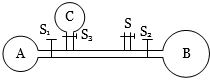
The adjoining diagram shows three soap bubbles $A, B$ and $C$ prepared by blowing the capillary tube fitted with stop cocks, $S_1$, $S_2$ and $S_3$. With stop cock $S$ closed and stop cocks $S_1$, $S_2$ and $S_3$ opened
- A
B will start collapsing with volumes of $A$ and $C$ increasing
- B
$C$ will start collapsing with volumes of $A$ and $ B$ increasing
- ✓
$C$ and $A$ both will start collapsing with the volume of $B$ increasing
- D
Volumes of $A, B$ and $C$ will become equal at equilibrium
AnswerCorrect option: C. $C$ and $A$ both will start collapsing with the volume of $B$ increasing
c
(c) Excess pressure inside soap bubble is inversely proportional to the radius of bubble
i.e. $\Delta P \propto \frac{1}{r}$
This means that bubbles $A$ and $C$ posses greater pressure inside it than $B$. So the air will move from $A$ and $C$ towards $B$.
View full question & answer→MCQ 691 Mark
Excess pressure of one soap bubble is four times more than the other. Then the ratio of volume of first bubble to another one is
- ✓
$1:64$
- B
$1 : 4$
- C
$64:1$
- D
$1 : 2$
AnswerCorrect option: A. $1:64$
a
(a) $\Delta P = \frac{{4T}}{r}\; \Rightarrow \frac{{\Delta {P_1}}}{{\Delta {P_2}}} = 4$
$\therefore \;\frac{{{r_2}}}{{{r_1}}} = 4$ and $\frac{{{V_1}}}{{{V_2}}} = {\left( {\frac{{{r_1}}}{{{r_2}}}} \right)^3} = \frac{1}{{64}}$
View full question & answer→MCQ 701 Mark
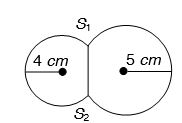
Two soap bubbles of radii ${r_1}$ and ${r_2}$ equal to $4 \,cm $ and $5 \,cm $ are touching each other over a common surface ${S_1}{S_2}$ (shown in figure). Its radius will be ....... $cm$
Answerb
(b) $r = \frac{{{r_1}{r_2}}}{{{r_1} - {r_2}}} = \frac{{5 \times 4}}{{5 - 4}} = 20\;cm$
View full question & answer→MCQ 711 Mark
The pressure inside a small air bubble of radius $0.1\, mm$ situated just below the surface of water will be equal to [Take surface tension of water $70 \times {10^{ - 3}}N{m^{ - 1}}$ and atmospheric pressure = $1.013 \times {10^5}N{m^{ - 2}}$]
- A
$2.054 \times {10^3}\,Pa$
- B
$1.027 \times {10^3}\,Pa$
- ✓
$1.027 \times {10^5}\,Pa$
- D
$2.054 \times {10^5}\,Pa$
AnswerCorrect option: C. $1.027 \times {10^5}\,Pa$
c
(c) Excess pressure inside the air bubble $ = \frac{{2T}}{r}$
$ \Rightarrow {P_{in}} - {P_{out}} = \frac{{2T}}{r} = \frac{{2 \times 70 \times {{10}^{ - 3}}}}{{0.1 \times {{10}^{ - 3}}}} = 1400\,Pa$
$⇒$ ${P_{in}} = 1400 + 1.013 \times {10^5}$$ = 0.014 \times {10^5} + 1.013 \times {10^5} = 1.027 \times {10^5}\,Pa$
View full question & answer→MCQ 721 Mark
If the excess pressure inside a soap bubble is balanced by oil column of height $2\; mm$, then the surface tension of soap solution will be ($r = 1 \,cm$ and density $d = 0.8\, gm/cc$)
- A
$3.9\, N/m$
- ✓
$3.9 ×10^{-2}\, N/m$
- C
$3.9 ×10^{-3}\, N/m$
- D
$3.9\, dyne/m$
AnswerCorrect option: B. $3.9 ×10^{-2}\, N/m$
b
(b) $\frac{{4T}}{R} = hdg$
$T = \frac{{Rhdg}}{4}$
$T = \frac{{{{10}^{ - 2}} \times 2 \times {{10}^{ - 3}} \times 0.8 \times {{10}^3} \times 9.8}}{4}$
$ = 3.9 \times {10^{ - 2}}\,N/m$
View full question & answer→MCQ 731 Mark
The excess pressure in a soap bubble is thrice that in other one. Then the ratio of their volume is
- A
$1:3$
- B
$1:9$
- C
$27:1$
- ✓
$1:27$
AnswerCorrect option: D. $1:27$
d
(d)$\Delta P \propto \frac{1}{r} \Rightarrow \frac{{{r_1}}}{{{r_2}}} = \frac{{\Delta {P_2}}}{{\Delta {P_1}}} = \frac{1}{3} \Rightarrow \frac{{{V_1}}}{{{V_2}}} = {\left( {\frac{{{r_1}}}{{{r_2}}}} \right)^3} = \frac{1}{{27}}$
View full question & answer→MCQ 741 Mark
An air bubble in a water tank rises from the bottom to the top. Which of the following statements are true
- A
Bubble rises upwards because pressure at the bottom is less than that at the top.
- B
Bubble rises upwards because pressure at the bottom is greater than that at the top.
- C
As the bubble rises, its size increases
- ✓
Answerd
(d) ${P_{Bottom}} > {P_{Surface}}.$ So bubble rises upward.
At constant temperature $V \propto \frac{1}{P}$ (Boyle’s law)
Since as the bubble rises upward, pressure decreases, then from above law volume of bubble will increase i.e. its size increases.
View full question & answer→MCQ 751 Mark
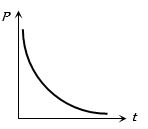
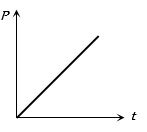
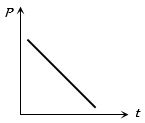
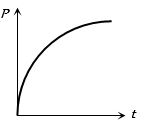
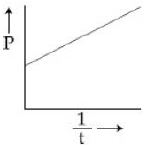
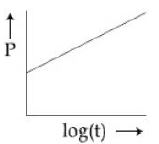
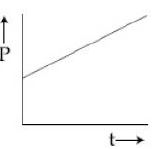
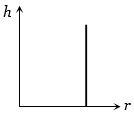
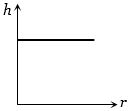
A soap bubble is blown with the help of a mechanical pump at the mouth of a tube. The pump produces a certain increase per minute in the volume of the bubble, irrespective of its internal pressure. The graph between the pressure inside the soap bubble and time $t$ will be-
Answera
(a) $\Delta P = \frac{{4T}}{r}$
$\Delta P \propto \frac{1}{r}$
As radius of soap bubble increases with time
$\Delta P \propto \frac{1}{t}$
View full question & answer→MCQ 761 Mark
A container, whose bottom has round holes with diameter $0.1$ $mm $ is filled with water. The maximum height in cm upto which water can be filled without leakage will be ........ $cm$
Surface tension $= 75 \times 10^{-3}$ $ N/m $ and $g = 10$ $ m/s^2$:
Answerc
Pressure $=\frac{2 T}{R}=\rho g h$
$\Rightarrow \frac{2 \times 75 \times 10^{-3}}{0.05 \times 10^{-3}}=10^{3} \times 10 \times h$
$\Rightarrow 3000=10^{3} \times 10 \times h$
$\Rightarrow h=0.3 m=30 \mathrm{cm}$
View full question & answer→MCQ 771 Mark
If two soap bubbles of different radii are connected by a tube,
- A
air flows from the bigger bubble to the smaller bubble till the sizes become equal
- B
air flows from bigger bubble to the smaller bubble till the sizes are interchanged
- ✓
air flows from the smaller bubble to the bigger
- D
AnswerCorrect option: C. air flows from the smaller bubble to the bigger
c
$p_{0}-p_{i}=\frac{2 T}{R}$
$\therefore P_{1}>P_{2}$
hence air moves from smaller bubble to bigger bubble.
View full question & answer→MCQ 781 Mark
A soap bubble in a form of circular tube having radius of curvature $R$ and radius of curvature perpendicular to it is $5R$ . Find the excess pressure in the bubble :
- A
$\frac{{6T}}{{5R}}$
- B
$\frac{{4T}}{{5R}}$
- C
$\frac{{8T}}{{5R}}$
- ✓
$\frac{{12T}}{{5R}}$
AnswerCorrect option: D. $\frac{{12T}}{{5R}}$
d
$P=2 \times\left(\frac{T}{R_{1}}+\frac{T}{R_{2}}\right)=2 \times\left(\frac{T}{5 R}+\frac{T}{R}\right)=\frac{12 T}{5 R}$
View full question & answer→MCQ 791 Mark
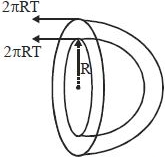
If a section of soap bubble (of radius $R$) through its center is considered, then force on one half due to surface tension is
- A
$2\pi RT$
- ✓
$4\pi RT$
- C
$\pi RT$
- D
$\frac{{4T}}{R}$
AnswerCorrect option: B. $4\pi RT$
b
$F$ due to $\mathrm{S} . \mathrm{T} .=4 \pi \mathrm{RT}$
View full question & answer→MCQ 801 Mark
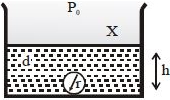
An air bubble of radius $r$ in water is at depth $h$ below the water surface at same instant. If $P$ is atmospheric pressure and $d$ and $T$ are the density and surface tension of water respectively. The pressure inside the bubble will be
- A
$P + hdg -(4\pi/r)$
- ✓
$P + hdg + (2\pi/r)$
- C
$P + hdg -(2\pi/r)$
- D
$P + hdg + (4\pi/r)$
AnswerCorrect option: B. $P + hdg + (2\pi/r)$
b
$\mathrm{P}_{\mathrm{in}}=\mathrm{P}_{0}+\mathrm{hdg}+\frac{2 \mathrm{T}}{\mathrm{r}}$
View full question & answer→MCQ 811 Mark
There is a small hole in hollow sphere. Water enters in sphere when it is taken at depth of $40\,cm$ in water. Diameter of hole is ....... $mm$ (Surface tension of water $= 0.07\, N/m$):
- A
$7$
- ✓
$0.07$
- C
$0.0007$
- D
$0.7$
AnswerCorrect option: B. $0.07$
b
$P=\frac{2 T}{r} \Rightarrow r=\frac{2 T}{P}$
diameter of the hole $=\mathrm{d}=2 \mathrm{r}=\frac{4 \mathrm{T}}{\mathrm{hP}_{\mathrm{w}} \mathrm{g}}$
$d=\frac{4 \times 0.07}{0.4 \times 10^{3} \times 9.8}=0.07 \times 10^{-3} \mathrm{m}=0.07 \mathrm{mm}$
View full question & answer→MCQ 821 Mark
Two soap bubbles of radii $3r$ and $4r$ in contact with each other. The radius of curvature of the interface between bubbles is
Answerc
${r_{common}}\, = \,\frac{{{r_1}{r_2}}}{{{r_2} - {r_1}}} = \frac{{12r}}{1} = 12r$
View full question & answer→MCQ 831 Mark
Consider the following two statement $A$ and $B$, and identify the correct choice in the given answers
$A :$ The excess pressure inside a small liquid drop is more than that of a big drop.
$B :$ As the aeroplane moves fast on the runway the pressure is more on the upper surface of its wings and less on the bottom surface of the wings.
- A
Both $A$ and $B$ are true
- ✓
$A$ is true but $B$ is false
- C
$A$ is false but $B$ is true
- D
Both $A$ and $B$ are false
AnswerCorrect option: B. $A$ is true but $B$ is false
View full question & answer→MCQ 841 Mark
A drop of water of volume $0.05\, cm^3$ is pressed between two glass plates, as a consequence of which it spreads and occupies an area of $40\, cm^2$. If the surface tension of water is $70\, dyne/cm$, then the normal force required to separate out the two glass plates will be in Newton
- A
$90$
- ✓
$44.8$
- C
$22.4$
- D
$448$
AnswerCorrect option: B. $44.8$
b
$F = \frac{{2T}}{d}\,A = \frac{{2T}}{V}\,{A^2} = \frac{{2\left( {70} \right)}}{{5 \times {{10}^{ - 2}}}}{\left( {40} \right)^2}$
View full question & answer→MCQ 851 Mark
The excess of pressure inside a soap bubble is twice the excess pressure inside a second soap bubble. The volume of the first bubble is $n$ times the volume of the second where $n$ is
AnswerCorrect option: A. $0.125$
a
$Given,\frac{{4T}}{{{r_1}}} = 2 \times \frac{{4T}}{{{r_2}}}\,or\,{r_2} = 2{r_1}$
$\frac{4}{3}\pi r_1^3 = n \times \frac{4}{3}\pi r_2^3 = n \times \frac{4}{3}\pi {\left( {2{r_1}} \right)^3}$
$or\,\,n = \frac{1}{8} = 0.125$
View full question & answer→MCQ 861 Mark
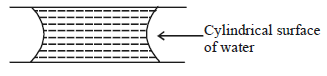
If two glass plates have water between them and are separated by very small distance (see figure), it is very difficult to pull them apart. It is because the water in between forms cylindrical surface on the side that gives rise to lower pressure in the water in comparison to atmosphere. If the radius of the cylindrical surface is $R$ and surface tension of water is $T$ then the pressure in water between the plates is lower by
- A
$\frac{2T}{R}$
- B
$\frac{4T}{R}$
- C
$\frac{T}{4R}$
- ✓
$\frac{T}{R}$
AnswerCorrect option: D. $\frac{T}{R}$
d
Here excess pressure, $P_{\text {excess }}=\frac{T}{r_{1}}+\frac{T}{r_{2}}$
$P_{\text {excess }}=\frac{T}{R} \quad \quad \because\left(\begin{array}{l}{r_1=R} \\ {r_{2}=0}\end{array}\right)$
View full question & answer→MCQ 871 Mark
Pressure inside two soap bubbles are $1.02 \,atm$ and $1.05 \,atm$ respectively. The ratio of their surface area is .........
- A
$\frac{125}{8}$
- ✓
$\frac{25}{4}$
- C
$\frac{5}{2}$
- D
$\frac{2}{5}$
AnswerCorrect option: B. $\frac{25}{4}$
b
(b)
Excess pressure $\Delta P =\frac{4 T }{ R }$
$\frac{\Delta P _1}{\Delta P _2}=\frac{ R _2}{ R _1}=\frac{2}{5}$
$\frac{ S _1}{ S _2}=\left(\frac{ R _2}{ R _1}\right)^2=\frac{25}{4}$
View full question & answer→MCQ 881 Mark
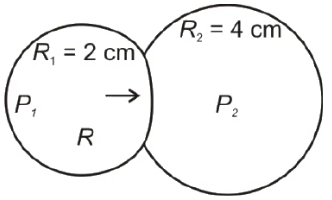
Two soap bubbles of radii $2 \,cm$ and $4 \,cm$ join to form a double bubble in air, then radius of curvature of interface is .......... $cm$
- A
$2 \sqrt{5}$
- B
$2$
- ✓
$4$
- D
$2 \sqrt{3}$
Answerc
(c)
$P_1-P_0=\frac{4 T}{R_1} ; P_2-P_0=\frac{4 T}{R_2}$
$P_1-P_2=4 T\left(\frac{1}{R_1}-\frac{1}{R_2}\right)=\frac{4 T}{R}$
$\frac{1}{R}=\frac{1}{R_1}-\frac{1}{R_2}=\frac{1}{2}-\frac{1}{4}$
$\frac{1}{R}=\frac{2-1}{4}=\frac{1}{4}$
$R=4\,Cm$
View full question & answer→MCQ 891 Mark
The excess pressure in a soap bubble is double that in other one. The ratio of their volume is .............
- A
$1: 2$
- ✓
$1: 8$
- C
$1: 4$
- D
$1: 1$
AnswerCorrect option: B. $1: 8$
b
(b)
Excess pressure in soap bubble $=\frac{4 S}{R}$
$P=\frac{4 S}{R}$ $\left\{\begin{array}{l}S \text { - Surface tension } \\ R \text { - Radius }\end{array}\right.$
For second bubble,
$2 P=\frac{4 S}{x}$ $\left\{\begin{array}{l}S \text { - Surface tension } \\ R \text { - Radius }\end{array}\right.$
Substitute value of $P$
$2 \times \frac{4 S}{R}=\frac{4 S}{x}$
$\Rightarrow x=\frac{R}{2}$
Ratio of Radii $=\frac{R / 2}{R}=\frac{1}{2}$
So, Ratio of volume $=\left(\right.$ Ratio of Radii )$^3$
$=\left(\frac{1}{2}\right)^3=\frac{1}{8}$
View full question & answer→MCQ 901 Mark
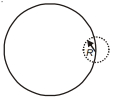
There is small hole in a hollow sphere. The water enters in it when it is taken to a depth of $40 \,cm$ under water. The surface tension of water is $0.07 \,N / m$. The diameter of hole is .......... $mm$
- A
$7$
- ✓
$0.07$
- C
$0.0007$
- D
$0.7$
AnswerCorrect option: B. $0.07$
b
(b)
Let take $g=10 \,m / s ^2$
For water to enter the sphere, pressure required is $=\rho g h$
$=1 \times 10 \times \frac{40}{100} \times 1000 \quad\left(\rho=1000 \,kg / m ^3\right)$
$=4000 \,\frac{ N }{ m ^2}=\text { excess pressure }$
Let the hole have radius $=R$
Excess pressure $=\frac{2 T}{R}$ [One surface air, one surface water]
$\Rightarrow 4000=\frac{2 \times 0.07}{R}$
$\Rightarrow 2 R=0.07 \times 10^{-3} \,m$
$\Rightarrow d=0.07 \,mm$
View full question & answer→MCQ 911 Mark
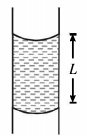
A vertical glass capillary tube of radius $r$ open at both ends contains some water (surface tension $T$ and density $\rho$ ). If $L$ be the length of the water column, then:
- ✓
$L=\frac{4 T}{r \rho g}$
- B
$L=\frac{2 T}{r \rho g}$
- C
$L=\frac{T}{4 r \rho g}$
- D
$L=\frac{T}{2 r \rho g}$
AnswerCorrect option: A. $L=\frac{4 T}{r \rho g}$
a
(a)
$P_2=P_1 -\frac{2 T}{R}=P_0- \frac{2 T}{R}$
$P_3=P_2+\rho gL=P_0- \frac{2 T}{R}+\rho gL$
here $r=R \cos \theta=R$
$P_4=P_3-\frac{2 T}{R}=P_0- \frac{4T}{R}+\rho gL$
$P_4=P_0$
$\Rightarrow L p g=\frac{4 T}{R}$
$\Rightarrow L=\frac{4 T}{R p g}$
View full question & answer→MCQ 921 Mark
If a water drop is kept between two glass plates, then its shape is
Answerc
(c)Angle of contact is acute.
View full question & answer→MCQ 931 Mark
A liquid is filled in a spherical container of radius $R$ till a height $h$.At this positions the liquid surface at the edges is also horizontal. The contact angle is
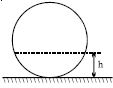
- A
$0$
- ✓
$cos^{^{-1}} $$\left( {\frac{{R - h}}{R}} \right)$
- C
$cos^{^{-1}} $$\left( {\frac{{h - R}}{R}} \right)$
- D
$sin^{-1} $$\left( {\frac{{R - h}}{R}} \right)$
AnswerCorrect option: B. $cos^{^{-1}} $$\left( {\frac{{R - h}}{R}} \right)$
b
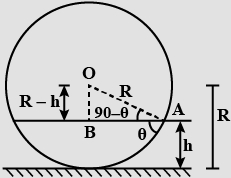
Lets say contact angle is $\theta,$ Then in $\Delta O A B,$ we have,
$\sin \left(90^{\circ}-\theta\right)=\frac{R-h}{R}$
$\Rightarrow \cos \theta=\frac{R-h}{R}$
$\Rightarrow \theta=\cos ^{-1}\left(\frac{R-h}{R}\right)$
View full question & answer→MCQ 941 Mark
The grease deposited on a glass plate can be easily removed by cleaning the glass with hot water containing detergent powder, because the detergent powder
- ✓
Reduces the angle of contact between the solution and glass
- B
Increases the temperature of the solution
- C
Decrease the density of the solution
- D
Makes the angle of contact between solution and the glass to an obtuse angle
AnswerCorrect option: A. Reduces the angle of contact between the solution and glass
View full question & answer→MCQ 951 Mark
When two capillary tubes of different diameters are dipped vertically, the rise of the liquid is
- A
- B
More in the tube of larger diameter
- C
Less in the tube of smaller diameter
- ✓
More in the tube of smaller diameter
AnswerCorrect option: D. More in the tube of smaller diameter
d
(d) $h = \frac{{2T\cos \theta }}{{rdg}}\therefore h \propto \frac{1}{r}$ ($T$,$\theta$, $d$ and $g$ are constant)
If $r$ is less then $h$ will be more.
View full question & answer→MCQ 961 Mark
Water rises in a capillary tube when its one end is dipped vertically in it, is $3\, cm$. If the surface tension of water is $75 × 10^{-3}\, N/m$, then the diameter of capillary will be....... $mm$
Answerc
(c) $T = \frac{{rh\rho g}}{2} \Rightarrow 75 \times {10^{ - 3}} = \frac{{3 \times {{10}^{ - 2}} \times r \times {{10}^3} \times 9.8}}{2}$
$ \Rightarrow r = \frac{1}{2}mm$
$\therefore D = 2r = 1\;mm$
View full question & answer→MCQ 971 Mark
If the surface tension of water is $0.06\, Nm^{-1}$, then the capillary rise in a tube of diameter $1 \,mm $ is ....... $cm$ ($\theta =0^°$ )
- A
$1.22$
- ✓
$2.44$
- C
$3.12$
- D
$3.86$
AnswerCorrect option: B. $2.44$
b
(b) $h = \frac{{2T}}{{rdg}} = \frac{{2 \times 6 \times {{10}^{ - 2}}}}{{5 \times {{10}^{ - 4}} \times {{10}^3} \times 10}}$$ = 2.4 \times {10^{ - 2}}\,m = 2.4\,cm$
View full question & answer→MCQ 981 Mark
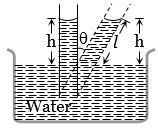
A capillary tube when immersed vertically in liquid records a rise of $3\, cm$. If the tube is immersed in the liquid at an angle of ${60^0}$ with the vertical. The length of the liquid column along the tube is...... $cm$
Answerb
(b) Vertical height of the water in the tube remains constant
So, $l = \frac{h}{{\cos \theta }} = \frac{3}{{\cos {{60}^o}}} = 6\;cm$
View full question & answer→MCQ 991 Mark
- ✓
$r = \frac{{2T\,\cos \theta }}{{hdg}}$
- B
$r = \frac{{hdg}}{{2T\,\cos \theta }}$
- C
$r = \frac{{2T\,dgh}}{{\cos \theta }}$
- D
$r = \frac{{T\cos \theta }}{{2hdg}}$
AnswerCorrect option: A. $r = \frac{{2T\,\cos \theta }}{{hdg}}$
a
(a) $h=\frac{2 T \cos \theta}{r d g}$
$r=\frac{2 T \cos \theta}{h d g}$
View full question & answer→MCQ 1001 Mark
Two capillary tubes of same diameter are put vertically one each in two liquids whose relative densities are $0.8$ and $0.6$ and surface tensions are $60$ and $50$ dyne/cm respectively Ratio of heights of liquids in the two tubes $\frac{{{h_1}}}{{{h_2}}}$ is
- A
$\frac{{10}}{9}$
- B
$\frac{3}{{10}}$
- C
$\frac{{10}}{3}$
- ✓
$\frac{9}{{10}}$
AnswerCorrect option: D. $\frac{9}{{10}}$
d
(d) Ascent formula $h = \frac{{2T\cos \theta }}{{rdg}}$
$ \Rightarrow \frac{{{h_1}}}{{{h_2}}} = \frac{{{T_1}}}{{{T_2}}} \times \;\frac{{{d_2}}}{{{d_1}}}$ ($r,\;\theta $ and $g$ are constants)
$ \Rightarrow \frac{{{h_1}}}{{{h_2}}} = \frac{{60}}{{50}} \times \frac{{0.6}}{{0.8}} = \frac{9}{{10}}$
View full question & answer→MCQ 1011 Mark
Water rises in a vertical capillary tube upto a height of $2.0 \,cm $. If the tube is inclined at an angle of ${60^o}$ with the vertical, then upto what length the water will rise in the tube....... $cm$
- A
$2.0$
- ✓
$4.0$
- C
$\frac{4}{{\sqrt 3 }}$
- D
$2\sqrt {2\,}$
Answerb
(b) $l = \frac{h}{{\cos \theta }} = \frac{2}{{\cos {{60}^o}}} = 4.0\;cm$
View full question & answer→MCQ 1021 Mark
Radius of a capillary is $2 \times {10^{ - 3}}\,m.$ A liquid of weight $6.28 \times {10^{ - 4}}\,N$ may remain in the capillary then the surface tension of liquid will be
- A
$5 \times {10^{ - 3}}\,N/m$
- ✓
$5 \times {10^{ - 2}}\,N/m$
- C
$5\,N/m$
- D
$50\,N/m$
AnswerCorrect option: B. $5 \times {10^{ - 2}}\,N/m$
b
(b) $T = \frac{F}{{2\pi r}} = \frac{{6.28 \times {{10}^{ - 4}}}}{{2 \times 3.14 \times 2 \times {{10}^{ - 3}}}} = 5 \times {10^{ - 2}}\,N/m$
View full question & answer→MCQ 1031 Mark
If water rises in a capillary tube upto $3\, cm$. What is the diameter of capillary tube (Surface tension of water $= 7.2 ×10^{-2}\, N/m$)
- ✓
$9.6×10^{-4} \,m$
- B
$9.6×10^{-3}\, m$
- C
$9.6×10^{-2}\, m$
- D
$9.6×10^{-1} \,m$
AnswerCorrect option: A. $9.6×10^{-4} \,m$
a
(a) $\;h = \frac{{2T\cos \theta }}{{rdg}}$, for water $\theta = 0^\circ $
$⇒$ $r = \frac{{2T}}{{hdg}} = \frac{{2 \times 7.2 \times {{10}^{ - 2}}}}{{3 \times {{10}^{ - 2}} \times {{10}^3} \times 10}} = 4.8 \times {10^{ - 4}}$
$d = 2r = 9.6 \times {10^{ - 4}}\,m$
View full question & answer→MCQ 1041 Mark
When a capillary is dipped in water, water rises $0.015$ min it. If the surface tension of water is $75×10^{-3}\, N/m$, the radius of capillary is ....... $mm$
Answerc
(c) $h = \frac{{2T}}{{rdg}}$ $⇒$ $r = \frac{{2T}}{{hdg}} = \frac{{2 \times 75 \times {{10}^{ - 3}}}}{{15 \times {{10}^{ - 3}} \times {{10}^3} \times 10}} = 1\,mm$
View full question & answer→MCQ 1051 Mark
A capillary tube of radius $R$ is immersed in water and water rises in it to a height $H$. Mass of water in the capillary tube is $M$. If the radius of the tube is halved, mass of water that will rise in the capillary tube will now be
Answerb
(b) Mass of liquid in capillary tube $M = \pi {R^2}H \times \rho $
$M \propto {R^2} \times \left( {\frac{1}{R}} \right)$ (As H $\propto 1/R$)
${\rm M} \propto R$. If radius becomes double then mass will becomes twice.
View full question & answer→MCQ 1061 Mark
The angle of contact between glass and water is $0^o$ and it rises in a capillary upto $6$ cm when its surface tension is $70$ dynes/cm. Another liquid of surface tension $140\, dynes/cm$, angle of contact $60^o$ and relative density $2$ will rise in the same capillary by ........ $cm$
Answerc
(c) $h = \frac{{2T\cos \theta }}{{rdg}}$ $\therefore \frac{{{h_2}}}{{{h_1}}} = \frac{{{T_2}}}{{{T_1}}} \times \frac{{\cos {\theta _2}}}{{\cos {\theta _1}}} \times \frac{{{d_1}}}{{{d_2}}} \times \frac{{{r_1}}}{{{r_2}}}$
$\frac{{{h_2}}}{{{h_1}}} = \frac{{140}}{{70}} \times \frac{{\cos 60^\circ }}{{\cos 0^\circ }} \times \frac{1}{2} \times 1 = \frac{1}{2} \Rightarrow {h_2} = \frac{{{h_1}}}{2} = 3cm.$
View full question & answer→MCQ 1071 Mark
A $20$ $cm$ long capillary tube is dipped in water. The water rises up to $8$ $cm$. If entire arrangement is put in a freely falling elevater the length of water coloumn in the capillary will be ....... $cm$
Answerb
In the condition of weightlessness, water rise to the whole of the available length.
View full question & answer→MCQ 1081 Mark
Water rises to a height of $10\,cm$ in a certain capillary tube. An another identical tube when dipped in mercury the level of mercury is depressed by $3.42\,cm$. Density of mercury is $13.6\, g/cc$. The angle of contact for water in contact with glass is $0^o$ and mercury in contact with glass is $135^o$. The ratio of surface tension of water to that of $Hg$ is :-
- A
$1:3$
- B
$1:4$
- C
$1:55$
- ✓
$1:6.5$
AnswerCorrect option: D. $1:6.5$
d
$h=\frac{2 T \cos \theta}{r \rho g} \Rightarrow \frac{T_{w}}{T_{m}} \times 13.6 \times(-\sqrt{2})=\frac{10}{-3.42}$
$\Rightarrow \frac{T_{w}}{T_{m}} \cong \frac{1}{6.5}$
View full question & answer→MCQ 1091 Mark
A capillary tube of radius $0.2\,cm$ is dipped vertically in a beaker containing liquid. If the liquid rises to a height of $5\,cm$ for which the angle of contact is $60^o$ , then surface tension of the liquid is ...... $dynes/cm$ $(d = 1\,gm/cm^3)$
View full question & answer→MCQ 1101 Mark
A glass rod of radius $1.0\,mm$ is inserted symmetrically into a vertical capillary tube of radius $2\,mm$ such that their lower ends are at same level. This arrangement is now dipped in water. The height to which water will rise into the tube will be ...... $mm$ ( $S.T.$ of water $= 75 \times 10^{-3}\,N/m$ )
Answerc
$\mathrm{h}=\frac{2 \mathrm{T}}{\rho\left(\mathrm{r}_{1}-\mathrm{r}_{2}\right) \mathrm{g}}=\frac{2 \times 75 \times 10^{-3}}{10^{3} \times 1 \times 10^{-3} \times 10}=15 \mathrm{mm}$
View full question & answer→MCQ 1111 Mark
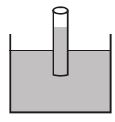
A long capillary tube of mass $'\pi '\,gm$ , radius $2\,mm$ and negligible thickness, is partially immersed in a liquid of surface tension $0.1\,N/m$ . Take angle of contact zero and neglect buoyant force of liquid. Find the force required to hold the tube vertically. $(g = 10\,m/s^2)$
- ✓
$10.4\,\pi \,mN$
- B
$10.8\,\pi \,mN$
- C
$0.8\,\pi \,mN$
- D
$4.8\,\pi \,mN$
AnswerCorrect option: A. $10.4\,\pi \,mN$
a
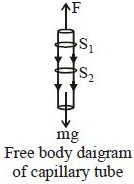
The free body diagram of the capillary tube is as shown in the figure. Net force $F$ required to hold tube is
$\mathrm{F}=$ force due to surface tension at cross-section
$\left(\mathrm{S}_{1} \text { and } \mathrm{S}_{2}\right)+$ weight of tube.
$ = 2\pi RT + mg$
View full question & answer→MCQ 1121 Mark
Water rise in a capillary upto an extension height such that upward force of surface tension balances the force of $75 \times 10^{-4}\,N$ due to weight of water. If surface tension of water is $12 \times 10^{-2}\,N/m$. The internal circumference of the capillary must be
- A
$12.5 \times 10^{-2}\,m$
- B
$6.5 \times 10^{-2}\,m$
- C
$1.25 \times 10^{-2}\,m$
- ✓
$6.25 \times 10^{-2}\,m$
AnswerCorrect option: D. $6.25 \times 10^{-2}\,m$
d
$\mathrm{T}(2 \pi \mathrm{r})=$ weight
$\Rightarrow 2 \pi r=\frac{75 \times 10^{-4}}{12 \times 10^{-2}}=6.25 \times 10^{-2} \mathrm{m}$
View full question & answer→MCQ 1131 Mark
The sap in tree rises in a system of capillaries of radius $2.5 \times 10^{-5}\,m$. The surface tension of sap is $7.28 \times 10^{-2}\,N\,m^{-1}$ and the angle of contact is $0^o$. The maximum height to which sap can rise in a tree through capillarity action is ...... $m$ $(\rho _{sap} = 10^3\,kg \,m^{-3}$ )
- A
$0.21$
- ✓
$0.59$
- C
$0.87$
- D
$0.91$
AnswerCorrect option: B. $0.59$
b
Here, $r=2.3 \times 10^{-5} \mathrm{m}, S=7.28 \times 10^{-2} \mathrm{Nm}^{-1}$
Angle of contact, $\theta=0^{\circ}, \rho=10^{3} \mathrm{kgm}^{-3}$
The maximum height to which the sap can rise by capillary action is,
$h=\frac{2 S \cos \theta}{r \rho g}=\frac{2 \times 7.28 \times 10^{-2} \times \cos 0^{\circ}}{2.5 \times 10^{-5} \times 10^{3} \times 9.8}=0.59 m$
View full question & answer→MCQ 1141 Mark
Two capillary tubes of same diameter are put vertically one each in two liquids whose relative densities are $0.8$ and $0.6$ and surface tensions are $60$ and $50\, dyne/cm$ respectively Ratio of heights of liquids in the two tubes $\frac{h_1}{h_2}$ is
- A
$\frac{10}{9}$
- B
$\frac{3}{10}$
- C
$\frac{10}{3}$
- ✓
$\frac{9}{10}$
AnswerCorrect option: D. $\frac{9}{10}$
d
Ascent formula $\mathrm{h}=\frac{2 \mathrm{T} \cos \theta}{\mathrm{rdg}}$
$\Rightarrow \frac{\mathrm{h}_{1}}{\mathrm{h}_{2}}=\frac{\mathrm{T}_{1}}{\mathrm{T}_{2}} \times \frac{\mathrm{d}_{2}}{\mathrm{d}_{1}} \quad[\mathrm{r}, \theta \text { and } \mathrm{g} \text { are constants }]$
$=\frac{60}{50} \times \frac{0.6}{0.8}=\frac{9}{10}$
View full question & answer→MCQ 1151 Mark
Water rises to height $'h'$ in capillary tube. If the length of capillary tube above the surface of water is made less than $'h'$, then
- A
water does not rise at all
- B
water rises upto the tip of capillary tube and then starts overflowing like a fountain
- ✓
water rises upto the top of capillary tube and stays there without overflowing
- D
water rises upto a point a little below the top and stays there
AnswerCorrect option: C. water rises upto the top of capillary tube and stays there without overflowing
c
Water in capillary never overflows
View full question & answer→MCQ 1161 Mark
The water rises in the capillary to a height of $10\, cm$. If the surface tension of water is $73 \times 10^{-3}\, N/m$, density is $10^3\, kg/m^3$ and $g = 9.8\, m/sec^2$, then find radius of capillary
- A
$0.02\, cm$
- ✓
$0.015\, cm$
- C
$0.05\, cm$
- D
$0.08\, cm$
AnswerCorrect option: B. $0.015\, cm$
b
$\mathrm{h}=\frac{2 \mathrm{T}}{\mathrm{r} \rho \mathrm{g}} \Rightarrow \mathrm{r}=\frac{2 \mathrm{T}}{\mathrm{h} \rho \mathrm{g}}$
$r=\frac{2 \times 73 \times 10^{-3}}{10 \times 10^{-2} \times 10^{3} \times 9.8}=0.015 \mathrm{cm}$
View full question & answer→MCQ 1171 Mark
Water rises in a capillary upto a height $h$ . If this capillary is tilted by an angle of $45^o$, then the length of the water column in the capillary becomes
- A
$2h$
- B
$\frac {h}{2}$
- C
$\frac {h}{\sqrt 2}$
- ✓
${h}{\sqrt 2}$
AnswerCorrect option: D. ${h}{\sqrt 2}$
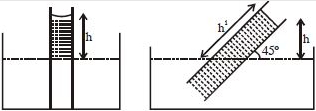
d
$\mathrm{h}^{1}=\sqrt{2} \mathrm{h}$
View full question & answer→MCQ 1181 Mark
If a capillary tube is tilted to $45^o$ and $60^o$ from the vertical then the ratio of length $l_1$ and $l_2$ of liquid columns in it will be
- ✓
$1:\sqrt 2 $
- B
$\sqrt 2 :1$
- C
$2 : 1$
- D
$1 : 2$
AnswerCorrect option: A. $1:\sqrt 2 $
a
$l_1\, cos\, 45^o = l_2\, cos\, 60^o$
View full question & answer→MCQ 1191 Mark
Water rises in a capillary upto a height of $4\, cm$. If it is titled to $30^o$ from the vertical, then the length of water column in it will be
AnswerCorrect option: A. $\frac{8}{{\sqrt 3 }}\,cm$
a
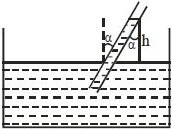
$\cos \alpha=\frac{h}{\ell}$
$\ell=\frac{h}{\cos \alpha}$
$=\frac{4 \mathrm{cm}}{\cos 30^{\circ}}$
$=\frac{8}{\sqrt{3}} \mathrm{cm}$
View full question & answer→MCQ 1201 Mark
Two narrow bores of diameters $3.0 \;mm$ and $6.0 \;mm$ are joined together to form a U-tube open at both ends. If the U-tube contains water, what is the difference (in $mm$) in its levels in the two limbs of the tube? Surface tension of water at the temperature of the experiment is $7.3 \times 10^{-2} \;N m ^{-1} .$ Take the angle of contact to be zero and density of water to be $1.0 \times 10^{3}\;\operatorname{kg} m ^{-3}\left( g =9.8 \;m s ^{-2}\right)$
Answera
Diameter of the first bore, $d_{1}=3.0 mm =3 \times 10^{-3} m$
Hence, the radius of the first bore, $r_{1}=\frac{d_{1}}{2}=1.5 \times 10^{-3} m$
Diameter of the second bore, $d_{2}=6.0 mm$
Hence, the radius of the second bore, $r_{2}=\frac{d_{2}}{2}=3 \times 10^{-3} m$
Surface tension of water, $s=7.3 \times 10^{-2} N m ^{-1}$
Angle of contact between the bore surface and water, $\theta=0$
Density of water, $\rho=1.0 \times 10^{3} kg / m ^{-3}$
Acceleration due to gravity, $g=9.8 m / s ^{2}$ Let $h_{1}$ and $h_{2}$ be the heights to which water rises in the first and second tubes respectively. These heights are given by the relations:
$h_{1}=\frac{2 s \cos \theta}{r_{1} \rho g}$
$h_{2}=\frac{2 s \cos \theta}{r_{2} \rho g}$
The difference between the levels of water in the two limbs of the tube can be calculated as
$=\frac{2 s \cos \theta}{r_{i} \rho g }-\frac{2 s \cos \theta}{r_{2} \rho g }$
$=\frac{2 s \cos \theta}{\rho g}\left[\frac{1}{r_{1}}-\frac{1}{r_{2}}\right]$
$=\frac{2 \times 7.3 \times 10^{-2} \times 1}{1 \times 10^{3} \times 9.8}\left[\frac{1}{1.5 \times 10^{-3}}-\frac{1}{3 \times 10^{-3}}\right]$
$=4.966 \times 10^{-3} m$
$=4.97 mm$
Hence, the difference between levels of water in the two bores is $4.97\; mm$
View full question & answer→MCQ 1211 Mark
A glass capillary tube of inner diameter $0.28 \,mm$ is lowered vertically into water in a vessel. The pressure to be applied on the water in the capillary tube so that water level in the tube is same as that in the vessel is ............ $\times 10^3$ (surface tension of water $=0.07 \,N / m$ and atmospheric pressure $\left.=10^5 \,N / m ^2\right)$.
Answerd
(d)
Height of liquid in capillary $=\frac{2 T}{r \rho g}=h$
Pressure we need to apply $=\rho g h+P_0$ $\left\{\begin{array}{l}\text { Where, } \\ T=\text { Surface tension } \\ r=\text { Radius of capillary } \\ \rho=\text { Density of liquid } \\ P_0=\text { Atmospheric pressure }\end{array}\right.$
Substitute value of $h$
$P=\rho g \times \frac{2 T}{r \rho g}+P_0=\frac{2 T}{r}+P_0=\frac{4 T}{d}+P_0$
$\Rightarrow P=\frac{4 \times 0.07}{\left(0.28 \times 10^{-3}\right)}+P_0=1000 \,Nm ^{-2}+10^5 \,Nm ^{-2}$ $\left\{\begin{array}{l}\text { Given, } \\ T=0.07 \,N / m \\ d=0.28 \,mm \end{array}\right.$
$\Rightarrow P=\left(10^3+10^5\right) \,Nm ^{-2}=101 \times 10^3 \,Nm ^{-2}$
View full question & answer→MCQ 1221 Mark
A glass capillary tube of internal radius $r=0.25\,mm$ is immersed in water. The top end of the tube projected by $2\,cm$ above the surface of the water. At $...........^{\circ}$ angle does the liquid meet the tube.Surface tension of water $=0.7\,N / m$.
Answera
Water wets glass and so the angle of contact is zero.
Neglecting the small mass in the meniscus, for full rise,
$2 \pi r T=\pi r^2 h \rho g$
$\rho=\frac{2 T}{r \rho g}=\frac{2 \times 0.07}{0.25 \times 10^{-3} \times 1000 \times 9.8}=0.057 m =5.7 cm$
But there the tbe is only $2 cm$ above the water and so water will rise by $2 cm$ and meet the tube at an angle such that
$2 \pi r T \cos 0^{\circ}=\pi r^2 h^{\prime} \rho g$
$\Rightarrow 2 T \cos \theta=h^{\prime} r \rho g$
$\Rightarrow \cos \theta=\frac{h^{\prime} r \rho g}{2 T}$
$\therefore \cos \theta=\frac{2 \times 10^{-2} \times 0.25 \times 10^{-3} \times 1000 \times 9.8}{2 \times 0.07}$
$\Rightarrow \theta=70^{\circ}$
View full question & answer→MCQ 1231 Mark
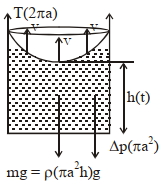
According to Poiseuille's law, the pressure drop per unit length required (overcome viscous forces is $\Delta P =\frac{8 \eta v }{ r ^2}$, where $r$ is the radius of cross section, $v$ is the fluid velocity and $\eta$ is the coefficient of viscosity. A capillary tube of radius a is dipped in a liquid of density $\rho$, surface tension $T$ and coefficient of viscosity $\eta$. The liquid starts rising in it so that its height $h ( t )$ is a function of time t. The resulting rate of change of the momentum of liquid column in the capillary (taking vertically up to be positive direction and the contact angle to be close to $\left.0^{\circ}\right)$ is $-\pi a ^2 \rho gh + F$. Then $F$ is $[ g$ is the acceleration due to gravity):
- A
$4 \pi Ta +8 \pi \eta h \frac{ dh }{ dt }$
- B
$4 \pi Ta -8 \pi \eta h \frac{ dh }{ dt }$
- ✓
$2 \pi Ta -8 \pi \eta h \frac{ dh }{ dt }$
- D
$2 \pi Ta +8 \pi \eta h \frac{ dh }{ dt }$
AnswerCorrect option: C. $2 \pi Ta -8 \pi \eta h \frac{ dh }{ dt }$
c
(C)
$\Delta P =\frac{8 \eta v }{ a ^2} h$
$\frac{ dp }{ dt }= T (2 \pi a )-\rho\left(\pi a ^2 h \right) g-\left[\frac{8 \eta v }{ a ^2} h \right]\left(\pi a ^2\right)$
$F -\pi a ^2 \rho g h = T (2 \pi a )-\rho\left(\pi a ^2 h \right) g-8 \pi \eta h\left(\frac{ dh }{ dt }\right)$
$F = T (2 \pi a )-8 \pi \eta h \left(\frac{ dh }{ dt }\right)$
View full question & answer→MCQ 1241 Mark
Air (density $\rho$ ) is being blown on a soap film (surface tension $T$ ) by a pipe of radius $R$ with its opening right next to the film. The film is deformed and a bubble detaches from the film when the shape of the deformed surface is a hemisphere. Given that the dynamic pressure on the film due to the air blown at speed $v$ is $\frac{1}{2} \rho v^{2}$, the speed at which the bubble formed is
- A
$\frac{T}{\sqrt{\rho R}}$
- B
$\sqrt{\frac{2 T}{\rho R}}$
- C
$\sqrt{\frac{4 T}{\rho R}}$
- ✓
$\sqrt{\frac{8 T}{\rho R}}$
AnswerCorrect option: D. $\sqrt{\frac{8 T}{\rho R}}$
d
$(d)$ Bubble detached from the look at ends of circumference, when force of dynamic pressure exceeds force of surface tension.
$\Rightarrow p_{\text {dynamic }} \times \text { Area } \geq \text { Force of surface tension }$
$\Rightarrow \frac{1}{2} \rho v^{2} \times \pi R^{2} \geq 2(2 \pi R T)$
Note that factor $2$ on right hand side appears as there are two sides of film surface.
$\Rightarrow \quad v \geq \sqrt{\frac{8 T}{\rho R}}$
$\Rightarrow \quad v_{\min }=\sqrt{\frac{8 T}{\rho R}}$
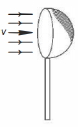
View full question & answer→MCQ 1251 Mark
Consider a bowl filled with water on which some black pepper powder have been sprinkled uniformly. Now, a drop of liquid soap is added at the centre of the surface of water. The picture of the surface immediately after this will look like
Answerc
$(c)$ Soap solution lowers the surface tension of water. So, water surface is punctured and is pulled back near circumference of vessel due to surface tension.
View full question & answer→MCQ 1261 Mark
Given below are two statements :
$Statement$ $(I)$ :Viscosity of gases is greater than that of liquids.
$Statement$ $(II)$ : Surface tension of a liquid decreases due to the presence of insoluble impurities.
In the light of the above statements, choose the most appropriate answer from the options given below :
- A
Statement $I$ is correct but statement $II$ is incorrect
- ✓
Statement $I$ is incorrect but Statement $II$ is correct
- C
Both Statement $I$ and Statement $II$ are incorrect
- D
Both Statement $I$ and Statement $II$ are correct
AnswerCorrect option: B. Statement $I$ is incorrect but Statement $II$ is correct
b
Gases have less viscosity.
Due to insoluble impurities like detergent surface tension decreases
View full question & answer→MCQ 1271 Mark
A small liquid drop of radius $R$ is divided into $27$ identical liquid drops. If the surface tension is $\mathrm{T}$, then the work done in the process will be
- ✓
$8 \pi R^2 \mathrm{~T}$
- B
$3 \pi R^2 T$
- C
$\frac{1}{8} \pi R^2 T$
- D
$4 \pi R^2 \mathrm{~T}$
AnswerCorrect option: A. $8 \pi R^2 \mathrm{~T}$
a
Volume constant
$ \frac{4}{3} \pi \mathrm{R}^3=27 \times \frac{4}{3} \times \pi \mathrm{r}^3 $
$ \mathrm{R}^3=27 \mathrm{r}^3 $
$ \mathrm{R}=3 \mathrm{r} $
$ \mathrm{r}=\frac{\mathrm{R}}{3} $
$ \mathrm{r}^2=\frac{\mathrm{R}^2}{9}$
Work done $=\mathrm{T} \Delta \mathrm{A}$
$=27 \mathrm{~T}\left(4 \pi \mathrm{r}^2\right)-\mathrm{T} 4 \pi \mathrm{R}^2$
$=27 \mathrm{~T} 4 \pi \frac{\mathrm{R}^2}{9}-4 \pi \mathrm{R}^2 \mathrm{~T}$
$8 \pi \mathrm{R}^2 \mathrm{~T}$
View full question & answer→MCQ 1281 Mark
A big drop is formed by coalescing $1000$ small identical drops of water. If $E_1$ be the total surface energy of $1000$ small drops of water and $E_2$ be the surface energy of single big drop of water, the $E_1$ : $\mathrm{E}_2$ is $\mathrm{x}: 1$ where $x$ =_____.
Answerb
$\rho\left({ }_3^4 \pi r^3\right) 1000={ }_3^4 \pi R^3 \rho$
$R=10 r$
$E_1=1000 \times 4 \pi r^2 \times S$
$E_2=4 \pi(10 r)^2 S$
$\frac{E_1}{E_2}=\frac{10}{1}, x=10$
View full question & answer→MCQ 1291 Mark
A big drop is formed by coalescing $1000$ small droplets of water. The surface energy will become :
- A
$100$ times
- B
$10$ times
- C
$\frac{1}{100}$ th
- ✓
$\frac{1}{10}$ th
AnswerCorrect option: D. $\frac{1}{10}$ th
d
Lets say radius of small droplets is $r$ and that of big drop is $R$
$\frac{4}{3} \pi R^3=1000 \frac{4}{3} \pi r^3$
$R=10 r$
$U_i=1000\left(4 \pi r^2 S\right)$
$U_f=4 \pi R^2 S$
$=100\left(4 \pi r^2 S\right)$
$U_f=\frac{1}{10} U_i$
View full question & answer→MCQ 1301 Mark
A soap bubble is blown to a diameter of $7 \mathrm{~cm}$. $36960 \mathrm{erg}$ of work is done in blowing it further. If surface tension of soap solution is $40 \mathrm{dyne} / \mathrm{cm}$ then the new radius is______. $\mathrm{cm}$. Take $:\left(\pi=\frac{22}{7}\right)$.
Answerb
$\omega=\Delta \mathrm{U}=\mathrm{S} \Delta \mathrm{A}$
$36960$ $\mathrm{erg}=\frac{40 \text { dyne }}{\mathrm{cm}} 8 \pi\left[(\mathrm{r})^2-\left(\frac{7}{2}\right)^2\right] \mathrm{cm}^2$
$\mathrm{r}=7 \mathrm{~cm}$
View full question & answer→MCQ 1311 Mark
A big drop is formed by coalescing $1000$ small droplets of water. The ratio of surface energy of $1000$ droplets to that of energy of big drop is $\frac{10}{x}$. The value of $x$ is_______.
Answerc
$1000 \frac{4}{3} \pi \mathrm{r}^3=\frac{4}{3} \pi \mathrm{R}^3$
$10 \mathrm{r}=\mathrm{R}$
$\mathrm{R}=10 \mathrm{r}$
$\frac{\text { S.E. of } 1000 \text { drops }}{\text { S.E. of Big drop }}=\frac{1000\left(4 \pi^2\right) T}{4 \pi R^2 T}$
$=\frac{1000 \times \mathrm{r}^2}{(10 \mathrm{r})^2}=10=\frac{10}{\mathrm{x}}$
$\therefore \quad \mathrm{x}=1$
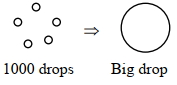
View full question & answer→MCQ 1321 Mark
Pressure inside a soap bubble is greater than the pressure outside by an amount :
(given : $\mathrm{R}=$ Radius of bubble, $\mathrm{S}=$ Surface tension of bubble)
- ✓
$\frac{4 S}{R}$
- B
$\frac{4 R}{S}$
- C
$\frac{S}{R}$
- D
$\frac{2 S}{R}$
AnswerCorrect option: A. $\frac{4 S}{R}$
a
There are two liquid-air surfaces in bubble so
$\Delta \mathrm{P}=2\left(\frac{2 \mathrm{~S}}{\mathrm{R}}\right)=\frac{4 \mathrm{~S}}{\mathrm{R}}$
View full question & answer→MCQ 1331 Mark
A liquid column of height $0.04 \mathrm{~cm}$ balances excess pressure of soap bubble of certain radius. If density of liquid is $8 \times 10^3 \mathrm{~kg} \mathrm{~m}^{-3}$ and surface tension of soap solution is $0.28 \mathrm{Nm}^{-1}$, then diameter of the soap bubble is . . . . . . .. . $\mathrm{cm}$.
$\text { (if } g=10 \mathrm{~ms}^{-2} \text { ) }$
Answerb
$\rho g h=\frac{4 S}{R}$
$\Rightarrow R=\frac{4 \times 0.28}{8 \times 10^3 \times 10 \times 4 \times 10^{-4}}$
$\Rightarrow \frac{0.28}{8} \mathrm{~m}=\frac{28}{8} \mathrm{~cm}$
$\Rightarrow R=3.5 \mathrm{~cm}$
$\text { Diameter }=7 \mathrm{~cm}$
View full question & answer→MCQ 1341 Mark
The excess pressure inside a soap bubble is thrice the excess pressure inside a second soap bubble. The ratio between the volume of the first and the second bubble is:
- A
$1: 9$
- B
$1: 3$
- C
$1: 81$
- ✓
$1: 27$
AnswerCorrect option: D. $1: 27$
d
$\mathrm{P}_1-\mathrm{P}_0=\frac{4 \mathrm{~T}}{\mathrm{r}_1} \quad \mathrm{P}_2-\mathrm{P}_0=\frac{4 \mathrm{~T}}{\mathrm{r}_2}$
$\mathrm{P}_1-\mathrm{P}_0=3\left(\mathrm{P}_2-\mathrm{P}_0\right)$
$\frac{4 \mathrm{~T}}{\mathrm{r}_1}=3 \frac{4 \mathrm{~T}}{\mathrm{r}_2}$
$\mathrm{r}_2=3 \mathrm{r}_1$
$\frac{\mathrm{V}_1}{\mathrm{~V}_2}=\frac{\frac{4}{3} \pi \mathrm{r}_1^3}{\frac{4}{3} \pi \mathrm{r}_2^3}=\frac{1}{27}$
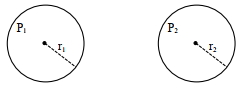
View full question & answer→MCQ 1351 Mark
Given below are two statements:
$Statement$ $I$ : If a capillary tube is immersed first in cold water and then in hot water, the height of capillary rise will be smaller in hot water.
$Statement$ $II$ : If a capillary tube is immersed first in cold water and then in hot water, the height of capillary rise will be smaller in cold water.
In the light of the above statements, choose the most appropriate from the options given below
- A
Both Statement $I$ and Statement $II$ are true
- B
Both Statement $I$ and Statement $II$ are false
- ✓
Statement$I$ is true but Statement $II$ is false
- D
Statement $I$ is false but Statement $II$ is true
AnswerCorrect option: C. Statement$I$ is true but Statement $II$ is false
c
Surface tension will be less as temperature increases
$\mathrm{h}=\frac{2 \mathrm{~T} \cos \theta}{\rho \mathrm{gr}}$
Height of capillary rise will be smaller in hot water and larger in cold water.
View full question & answer→MCQ 1361 Mark
Given below are two statements :
Statement $I$ : The contact angle between a solid and a liquid is a property of the material of the solid and liquid as well.
Statement $II$ : The rise of a liquid in a capillary tube does not depend on the inner radius of the tube.
In the light of the above statements, choose the correct answer from the options given below :
- A
Both Statement $I$and Statement $II$ are false
- B
Statement $I$ is false but Statement $II$ is true.
- ✓
Statement $I$ is true but Statement $II$ is false.
- D
Both Statement $I$ and Statement $II$ are true.
AnswerCorrect option: C. Statement $I$ is true but Statement $II$ is false.
c
Statement $I$ is correct as we know contact angle depends on cohesine and adhesive forces.
Statement $II$ is incorrect because height of liquid is given by $h==\frac{2 T \cos \theta_C}{\rho g r}$ where $r$ is radius of
Tube (assuming length of capillary is sufficient) Hence option $(3)$ is correct.
View full question & answer→MCQ 1371 Mark
Given below are two statements :
Statement-I: When a capillary tube is dipped into a liquid, the liquid neither rises nor falls in the capillary. The contact angle may be $0^{\circ}$.
Statement-II: The contact angle between a solid and a liquid is a property of the material of the solid and liquid as well :
In the light of above statement, choose the correct answer from the options given below.
- ✓
Statement-$I$ is false but Statement-$II$ is true.
- B
Both Statement-$I$ and Statement-$II$ are true.
- C
Both Statement-$I$ and Statement-$II$ are false.
- D
Statement-$I$ is true and Statement-$II$ is false.
AnswerCorrect option: A. Statement-$I$ is false but Statement-$II$ is true.
a
Capillary rise
$\mathrm{h}=\frac{2 \mathrm{~T} \cos \theta}{\rho \mathrm{gr}} \text {; }$
If $\theta=0^{\circ}$ then rise is non-zero
$\therefore$ Statement- $1$ is incorrect.
Option$(1)$ is correct
View full question & answer→MCQ 1381 Mark
A spherical drop of liquid splits into $1000$ identical spherical drops. If $u _{ i }$ is the surface energy of the original drop and $u_f$ is the total surface energy of the resulting drops, the (ignoring evaporation). $\frac{u_f}{u_i}=\left(\frac{10}{x}\right)$. Then value of $x$ is $......$
Answerb
Surface Tension $= T$
$R$ : Radius of bigger drop
$r :$ Radius of smaller drop
Volume will remain same
$\frac{4}{3} \pi R ^3=1000 \times \frac{4}{3} \pi r^3$
$R =10 r$
$u _{ i }= T \cdot 4 \pi R ^2$
$u _{ f }= T .4 \pi r ^2 \times 1000$
$\frac{ u _{ f }}{ u _{ i }}=\frac{1000 r ^2}{ R ^2}$
$\frac{ u _{ f }}{ u _{ i }}=\frac{10}{1}$
So, $x =1$
View full question & answer→MCQ 1391 Mark
Surface tension of a soap bubble is $2.0 \times 10^{-2}\; Nm ^{-1}$. Work done to increase the radius of soap bubble from $3.5\; cm$ to $7\; cm$ will be $.........\times 10^{-4}\,J$ [Take $\pi=\frac{22}{7}$ ]
- A
$0.72$
- B
$5.76$
- ✓
$18.48$
- D
$9.24$
AnswerCorrect option: C. $18.48$
c
Surface area of soap bubble $=2 \times 4 \pi R^2$
Work done $=$ change in surface energy $\times T_S$
$= T _{ S } \times 8 \pi \times\left( R _2^2- R _1^2\right)$
$=2 \times 10^{-2} \times 8 \times \frac{22}{7} \times 49 \times \frac{3}{4} \times 10^{-4}$
$=18.48 \times 10^{-4}\,J$
View full question & answer→MCQ 1401 Mark
If $1000$ droplets of water of surface tension $0.07\,N / m$. having same radius $1\,mm$ each, combine to from a single drop. In the process the released surface energy is $\left(\text { Take } \pi=\frac{22}{7}\right)$
- A
$7.92 \times 10^{-6}\,J$
- ✓
$7.92 \times 10^{-4}\,J$
- C
$9.68 \times 10^{-4}\,J$
- D
$8.8 \times 10^{-5}\,J$
AnswerCorrect option: B. $7.92 \times 10^{-4}\,J$
b
$1000 \times \frac{4 \pi}{3}(1)^3=\frac{4 \pi}{3} R ^3$
$R =10\,mm$
$T \times 1000 \times 4 \pi\left(10^{-3}\right)^2- T \times 4 \pi\left(10 \times 10^{-3}\right)^2=\Delta E$
$\Delta E =4 \times \pi \times 7 \times 10^{-2}[1000-100] \times 10^{-6}$
$\Delta E =7.92 \times 10^{-4}\,J$
View full question & answer→MCQ 1411 Mark
A mercury drop of radius $10^{-3}\,m$ is broken into $125$ equal size droplets. Surface tension of mercury is $0.45\,Nm ^{-1}$. The gain in surface energy is $......\times 10^{-5}\,J$
AnswerCorrect option: A. $2.26$
a
Initial surface energy $=0.45 \times 4 \pi\left(10^{-3}\right)^2$
$\frac{4}{3} \pi\left(10^{-3}\right)^3=125 \times \frac{4 \pi}{3} R_{\text {new }}^3$
$10^{-3}=5 R_{\text {new }}$
$R_{\text {new }}=\frac{10^{-3}}{5}\,m$
So, final surface energy $=0.45 \times 125 \times 4 \pi\left(\frac{10^{-3}}{5}\right)^2$
Increase in energy $=0.45 \times 4 \pi \times\left(10^{-3}\right)^2\left[\frac{125}{25}-1\right]$
$=4 \times 0.45 \times 4 \pi \times 10^{-6}$
$=2.26 \times 10^{-5}\,J$
View full question & answer→MCQ 1421 Mark
The surface tension of soap solution is $3.5 \times 10^{-2}\,Nm ^{-1}$. The amount of work done required to increase the radius of soap bubble from $10\,cm$ to $20\,cm$ is $.....\times 10^{-4}\,J$
Answera
$W = T .(\Delta A )$
$W = T \left(8 \pi\left( r _2^2- r _1^2\right)\right)$
$W =264 \times 10^{-4}\,J$
View full question & answer→MCQ 1431 Mark
The height of liquid column raised in a capillary tube of certain radius when dipped in liquid A vertically is, $5 cm$. If the tube is dipped in a similar manner in another liquid $B$ of surface tension and density double the values of liquid $A$, the height of liquid column raised in liquid $B$ would be $........m$.
- A
$0.20$
- B
$0.5$
- ✓
$0.05$
- D
$0.10$
AnswerCorrect option: C. $0.05$
c
$h =\frac{2 S \cos \theta}{ r \rho g }$
$\frac{ h _1}{ h _2}=\frac{ S _1}{ S _2} \frac{\rho_2}{\rho_1}$
$\frac{5}{ h _2}=\left[\frac{1}{2}\right]\left[\frac{2}{1}\right] \Rightarrow h _2=5\,cm =0.05\,m$
Info about angle of contact not there so most appropriate is $3$
View full question & answer→MCQ 1441 Mark
There is an air bubble of radius $1.0\,mm$ in a liquid of surface tension $0.075\,Nm ^{-1}$ and density $1000\,kg$ $m ^{-3}$ at a depth of $10\,cm$ below the free surface. The amount by which the pressure inside the bubble is greater than the atmospheric pressure is $....Pa \left( g =10\,ms ^{-2}\right)$
- ✓
$1150$
- B
$1151$
- C
$1152$
- D
$1153$
AnswerCorrect option: A. $1150$
a
Pressure inside the bubble
$P=P_0+h \rho g+\frac{2 T}{r}$
$P-P_0=h \rho g+\frac{2 T}{r}$
$=0.1 \times 1000 \times 10+\frac{2 \times .075}{10^{-3}}$
$=1000+(0.15)(1000)$
$=1150\,Pa$
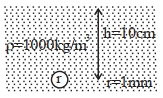
View full question & answer→MCQ 1451 Mark
A water drop of radius $1\,cm$ is broken into $729$ equal droplets. If surface tension of water is $75\,dyne / cm$, then the gain in surface energy upto first decimal place will be$...\times 10^{-4}\,J$
Answerc
Initial surface energy $= TA$
Where $T$ is surface tension and $A$ is surface area
$U _{ i }=\left(\frac{75 \times 10^{-5}}{10^{-2}} \frac{ N }{ m }\right) \times\left[4 \pi\left(1 \times 10^{-2}\right)^{2}\right]$
$=75 \times 10^{-3} \times 4 \pi \times 10^{-4}=942 \times 10^{-7}\,J$
To get final radius of drops by volume conservation
$\frac{4}{3} \pi R^{3}=729\left(\frac{4}{3} \pi r^{3}\right)$
$R=\text { Initial radius }$
$r=\text { final radius }$
$r=\frac{R}{(729)^{1 / 3}}=\frac{R}{9}=\frac{1}{9}\,cm$
Final surface energy
$U _{ f }=729[ TA ]$
$=729\left[\frac{75 \times 10^{-5}}{10^{-2}} \frac{ N }{ m }\right] \times\left[4 \pi\left(\frac{1}{9} \times 10^{-2}\right)^{2}\right]$
$=729\left[75 \times 10^{-3} \times \frac{4 \pi \times 10^{-4}}{81}\right]$
$=9\left[942 \times 10^{-7} J \right]$
Gain in surface energy
$\Delta U =9 \times 942 \times 10^{-7}-942 \times 10^{-7}$
$=8 \times 942 \times 10^{-7} J =7536 \times 10^{-7}\,J$
$=7.5 \times 10^{-4}\,J$
View full question & answer→MCQ 1461 Mark
Given below are two statements: One is labelled as Assertion $(A)$ and the other is labelled as Reason $(R)$.
Assertion $(A)$: Clothes containing oil or grease stains cannot be cleaned by water wash.
Reason $(R)$: Because the angle of contact between the oil/ grease and water is obtuse. In the light of the above statements, choose the correct answer from the option given below.
- ✓
Both $(A)$ and $(R)$ are true and $(R)$ is the correct explanation of $( A )$
- B
Both $(A)$ and $(R)$ are true but $(R)$ is not the correct explanation of $( A )$
- C
$(A)$ is true but $(R)$ is false
- D
$(A)$ is true but $(R)$ is true
AnswerCorrect option: A. Both $(A)$ and $(R)$ are true and $(R)$ is the correct explanation of $( A )$
a
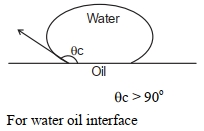
View full question & answer→MCQ 1471 Mark
A drop of liquid of density $\rho$ is floating half immersed in a liquid of density $\sigma$ and surface tension $7.5 \times 10^{-4}\,N\,cm ^{-1}$. The radius of drop in $cm$ will be : (Take : $g =10\,m / s ^{2}$ )
- ✓
$\frac{15}{\sqrt{2 \rho-\sigma}}$
- B
$\frac{15}{\sqrt{\rho-\sigma}}$
- C
$\frac{3}{2 \sqrt{\rho-\sigma}}$
- D
$\frac{3}{20 \sqrt{2 \rho-\sigma}}$
AnswerCorrect option: A. $\frac{15}{\sqrt{2 \rho-\sigma}}$
a
Boyant force $+$ surace tension $= mg$
$\sigma \frac{ V }{2} g+2 \pi R T=\rho Vg$
$2 \pi RT =\frac{(2 \rho-\sigma)}{2} \frac{4}{3} \pi R ^{3} g ; \quad\left[ V =\frac{4}{3} \pi R ^{3}\right]$
$R ^{3}=\frac{3 T }{(2 \rho-\sigma) g} \Rightarrow R =\sqrt{\frac{3 \times 7.5 \times 10^{-2} N - m ^{-1}}{(2 \rho-\sigma) \times 10}}$
$R=\frac{3}{20 \sqrt{(2 \rho-\sigma)}} m =\frac{15}{\sqrt{2 \rho-\sigma}}\,\,cm$
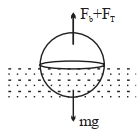
View full question & answer→MCQ 1481 Mark
A water drop of diameter $cm$ is broken into $64$ equal droplets. The surface tension of water is $0.075\,N / m$. In this process the gain in surface energy will be ...........$J$
- ✓
$2.8 \times 10^{-4}$
- B
$1.5 \times 10^{-3}$
- C
$1.9 \times 10^{-4}$
- D
$9.4 \times 10^{-5}$
AnswerCorrect option: A. $2.8 \times 10^{-4}$
a
$d =2\,cm ; \quad r =1\,cm ; \quad T =0.075$
$\Delta SE = T \Delta A$
$=0.075\left( A _{ f }- A _{1}\right)$
$A _{ i }=4 \pi r ^{2}$
$A _{ t }=4 \pi r _{0}^{2} \times 64$
By volume conservation
$\frac{4}{3} \pi r ^{3}=64 \cdot \frac{4}{3} \pi r_{0}^{3}$
$I _{0}=\frac{ r }{4}$
$A _{ f }=4 \pi\left(\frac{ r }{4}\right)^{2} \cdot 64=16 \pi r ^{2}$
$\Delta SE =0.075\left(16 \pi r ^{2}-4 \pi r ^{2}\right)$
$=0.075\left(12 \pi(0.01)^{2}\right)$
$=2.8 \times 10^{-4}\,J$
View full question & answer→MCQ 1491 Mark
A spherical soap bubble of radius $3\,cm$ is formed inside another spherical soap bubble of radius $6\,cm$. If the internal pressure of the smaller bubble of radius $3\,cm$ in the above system is equal to the internal pressure of the another single soap bubble of radius $r\,cm$. The value of $r$ is.......
Answerd
$P_{2}-P_{0}=\frac{4 T}{6}\,and\,P_{1}-P_{2}=\frac{4 T}{3}$
$\Rightarrow P_{1}-P_{0}=\frac{4 T}{2}=2$
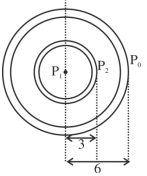
View full question & answer→MCQ 1501 Mark
The radii of two soap bubbles are $r_1$ and $r_2$. In isothermal conditions, two meet together in vaccum. Then the radius of the resultant bubble is given by
AnswerCorrect option: C. $\sqrt{r_{1}^{2}+r_{2}^{2}}$
c
(c) $8\pi r_1^2T + 8\pi r_2^2T = 8\pi {R^2}T$ $⇒$ ${R^2} = r_1^2 + r_2^2$
View full question & answer→MCQ 1511 Mark
A large number of water drops, each of radius $r$, combine to have a drop of radius $R$. If the surface tension is $T$ and mechanical equivalent of heat is $J ,$ the rise in heat energy per unit volume will be
AnswerCorrect option: D. $\frac{3 T }{ J }\left(\frac{1}{ r }-\frac{1}{ R }\right)$
d
$n \times \frac{4}{3} \pi r ^{3}=\frac{4}{3} \pi R ^{3}$
$\therefore n ^{1 / 3} r = R$
$\therefore$ Total change in surface energy
$=\left(n\left(4 \pi r^{2}\right)-4 \pi R^{2}\right) T$
$\Rightarrow 4 \pi T \left( nr ^{2}- R ^{2}\right)$
$\therefore$ Heat energy
$=\frac{4 \pi T \left( nr ^{2}- R ^{2}\right)}{ J \times \frac{4}{3} \pi R ^{3}}=\frac{3 T }{ J }\left(\frac{ nr ^{2}}{ R ^{3}}-\frac{1}{ R }\right)$
Put $nr ^{3}= R ^{3}$
$\therefore \frac{3 T }{ J }\left(\frac{1}{ r }-\frac{1}{ R }\right)$
View full question & answer→MCQ 1521 Mark
When two soap bubbles of radii $a$ and $b ( b > a )$ coalesce, the radius of curvature of common surface is
- ✓
$\frac{a b}{b-a}$
- B
$\frac{a+b}{a b}$
- C
$\frac{ b - a }{ ab }$
- D
$\frac{a b}{a+b}$
AnswerCorrect option: A. $\frac{a b}{b-a}$
a
Let say $P_{1}$ and $P_{2}$ are the excess pressure on the two sides of the interface then the resultant excess pressure is $P$
$\Rightarrow P=P_{2}-P_{1}$
$\Rightarrow \frac{4 T}{r}=\frac{4 T}{r_{2}}-\frac{4 T}{r_{1}}$
$\Rightarrow \frac{1}{r}=\frac{1}{r_2}-\frac{1}{r_1}$
$\Rightarrow r=\frac{r_{1} r_{1}}{r_{1}-r_{2}}$
View full question & answer→MCQ 1531 Mark
Two narrow bores of diameter $5.0\, {mm}$ and $8.0\, {mm}$ are joined together to form a $U-$shaped tube open at both ends. If this ${U}$-tube contains water, what is the difference in the level of two limbs of the tube.
[Take surface tension of water ${T}=7.3 \times 10^{-2} \, {Nm}^{-1}$, angle of contact $=0, {g}=10\, {ms}^{-2}$ and density of water $\left.=1.0 \times 10^{3} \,{kg} \,{m}^{-3}\right]$ (in $mm$)
- A
$3.62$
- ✓
$2.19$
- C
$5.34$
- D
$4.97$
AnswerCorrect option: B. $2.19$
b
We have $P_{A}=P_{B}$. [Points $A$ $\&$ $B$ at same horizontal level]
$\therefore \mathrm{P}_{\mathrm{atm}}-\frac{2 \mathrm{~T}}{\mathrm{r}_{1}}+\rho \mathrm{g}(\mathrm{x}+\Delta \mathrm{h})=\mathrm{P}_{2 \mathrm{tm}}-\frac{2 \mathrm{~T}}{\mathrm{r}_{2}}+\rho g \mathrm{x}$
$\therefore \rho g \Delta \mathrm{h}=2 \mathrm{~T}\left[\frac{1}{\mathrm{r}_{1}}-\frac{1}{\mathrm{I}_{2}}\right]$
$=2 \times 7.3 \times 10^{-2}\left[\frac{1}{2.5 \times 10^{-3}}-\frac{1}{4 \times 10^{-3}}\right]$
$\therefore \Delta \mathrm{h}=\frac{2 \times 7.3 \times 10^{-2} \times 10^{3}}{10^{3} \times 10}\left[\frac{1}{2.5}-\frac{1}{4}\right]$
$=2.19 \times 10^{-3} \mathrm{~m}=2.19 \mathrm{~mm}$
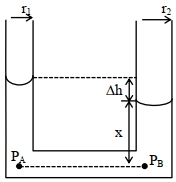
View full question & answer→MCQ 1541 Mark
A soap bubble of radius $3\, {cm}$ is formed inside the another soap bubble of radius $6\, {cm}$. The radius of an equivalent soap bubble which has the same excess pressure as inside the smaller bubble with respect to the atmospheric pressure is .......... ${cm}$
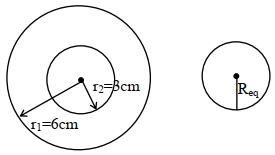
Answerc
Excess pressure inside the smaller soap bubble
$\Delta {P}=\frac{4 {S}}{{r}_{1}}+\frac{4 {S}}{{r}_{2}}\ldots \text { (i) }$
The excess pressure inside the equivalent soap bubble
$\Delta {P}=\frac{4 {S}}{{R}_{{eq}}} \ldots \text { (ii) }$
From $ (i) \,\& \,(ii)$
$\frac{4 {S}}{{R}_{{eq}}}=\frac{4 {S}}{{T}_{1}}+\frac{4 {S}}{{T}_{2}}$
$\frac{1}{{R}_{{eq}}}=\frac{1}{{T}_{1}}+\frac{1}{{I}_{2}}$
$=\frac{1}{6}+\frac{1}{3}$
${R}_{{eq}}=2 \,{cm}$
View full question & answer→MCQ 1551 Mark
Pressure inside two soap bubbles are $1.01$ and $1.02$ atmosphere, respectively. The ratio of their volumes is
- ✓
$8:1$
- B
$0.8:1$
- C
$2:1$
- D
$4:1$
Answera
$\Delta P _{1}=0.01=4 T / R _{1} \quad \ldots . .(1)$
$\Delta P _{2}=0.02=4 T / R _{2} \quad \ldots . .(2)$
Equation $(1)+(2)$
$\frac{1}{2}=\frac{ R _{2}}{ R _{1}}$
$R _{1}=2 R _{2}$
$\frac{V_{1}}{V_{2}}=\frac{R_{1}^{3}}{R_{2}^{3}}=\frac{8 R_{2}^{3}}{R_{2}^{3}}=8$
View full question & answer→MCQ 1561 Mark
When a long glass capillary tube of radius $0.015\;cm$ is dipped in a liquid, the liquid rises to a height of $15\, cm$ within it. If the contact angle between the liquid and glass to clase to $0^{\circ},$ the surface tension of the liquid, in $milli\,Newton \;m ^{-1}$ is $.....$
$\left[\rho_{\text {(liquid) }}=900\; kg\,m ^{-3}, g =10\, ms ^{-2}\right]$ (Give answer in closest integer)
Answerc
Capillary rise
$h =\frac{2 S \cos \theta}{\rho gr }$
$S=\frac{\rho grh}{2 \cos \theta}$
$=\frac{(900)(10)\left(15 \times 10^{-5}\right)\left(15 \times 10^{-2}\right)}{2}$
$S=1012.5 \times 10^{-4}$
$S=101.25 \times 10^{-3}=101.25 mN / m$
In question closest integer is asked
so closest integer $=101.00$
View full question & answer→MCQ 1571 Mark
A small spherical droplet of density $d$ is floating exactly half immersed in a liquid of density $\rho$ and surface tension $\mathrm{T}$. The radius of the droplet is
(take note that the surface tension applies an upward force on the droplet)
- A
$r=\sqrt{\frac{2 T}{3(d+\rho) g}}$
- ✓
$r=\sqrt{\frac{3 T}{(2 d-\rho) g}}$
- C
$r=\sqrt{\frac{T}{(d-\rho) g}}$
- D
$r=\sqrt{\frac{\mathrm{T}}{(\mathrm{d}+\rho) \mathrm{g}}}$
AnswerCorrect option: B. $r=\sqrt{\frac{3 T}{(2 d-\rho) g}}$
b
$B + F = mg$
$\mathrm{B}=\left(\frac{2}{3} \pi \mathrm{R}^{3}\right) \rho \mathrm{g}$
$\mathrm{F}=\mathrm{T}(2 \pi \mathrm{R})$
$\mathrm{m}=\mathrm{d}\left(\frac{4}{3} \pi \mathrm{R}^{3}\right)$
$\left(\frac{2}{3} \pi \mathrm{R}^{3}\right) \rho \mathrm{g}+\mathrm{T}(2 \pi \mathrm{R})=\mathrm{d}\left(\frac{4}{3} \pi \mathrm{R}^{3}\right) \mathrm{g}$
$\mathrm{T}(2 \pi \mathrm{R})=\left(\frac{2}{3} \pi \mathrm{R}^{3}\right) \mathrm{g}[2 \mathrm{d}-\rho]$
$\mathrm{R}=\sqrt{\frac{3 \mathrm{T}}{(2 \mathrm{d}-\rho) \mathrm{g}}}$
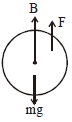
View full question & answer→MCQ 1581 Mark
A capillary tube made of glass of radius $0.15\, mm$ is dipped vertically in a beaker filled with methylene iodide (surface tension $=0.05\, Nm ^{-1},$ density $\left.=667\, kg m ^{-3}\right)$ which rises to height $h$ in the tube. It is observed that the two tangents drawn from liquid-glass interfaces (from opp. sides of the capillary) make an angle of $60^{\circ}$ with one another. Then $h$ is close to $......m$
$\left(g=10\, ms ^{-2}\right)$
- A
$0.137$
- B
$0.172$
- ✓
$0.087$
- D
$0.049$
AnswerCorrect option: C. $0.087$
c
$r \rightarrow$ radius of capillary
$R \rightarrow$ Radius of meniscus.
From figure, $\frac{r}{R}=\cos 30^{\circ}$
$R =\frac{2 r }{\sqrt{3}}=\frac{2 \times 0.15 \times 10^{-3}}{\sqrt{3}}$
$=\frac{0.3}{\sqrt{3}} \times 10^{-3} m$
Height of capillary
$h =\frac{2 T }{\rho gR }=2 \sqrt{3} T$
$h =\frac{2 \times 0.05}{667 \times 10 \times\left(\frac{0.3 \times 10^{-3}}{\sqrt{3}}\right)}$
$h=0.087 m$
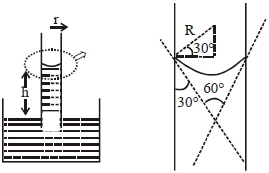
View full question & answer→MCQ 1591 Mark
A soap bubble, blown by a mechanical pump at the mouth of a tube, increases in volume, with time, at a constant rate. The graph that correctly depicts the time dependence of pressure inside the bubble is given by
Answerd
$V = kt = \frac{4}{3}\pi {R^3}$
$R = {\left( {\frac{{3k}}{{4\pi }}t} \right)^{1/3}}$
${P_{in}} = {P_{atm}} + \frac{{4T}}{R}$
View full question & answer→MCQ 1601 Mark
If $‘M’$ is the mass of water that rises in a capillary tube of radius $‘r’,$ then mass of water which will rise in a capillary tube of radius $‘2r’$ is
- A
$4\,M$
- B
$\frac {M}{2}$
- C
$M$
- ✓
$2\,M$
AnswerCorrect option: D. $2\,M$
d
Height of liquid rise in capillary tube $h = \frac{{2T\cos {\theta _c}}}{{\rho rg}}$
$ \Rightarrow h \propto \frac{1}{r}$
When radius becomes double height become half
$\therefore h' = \frac{h}{2}$
$Now,\,M = \pi {r^2}h \times \rho \,and\,M'$
$ = \pi {\left( {2r} \right)^2}\left( {h/2} \right) \times \rho = 2M.$
View full question & answer→MCQ 1611 Mark
The ratio of surface tensions of mercury and water is given to be $7.5$ while the ratio of their densities is $13.6$. Their contact angles, with glass, are close to $135^o$ and $0^o$, respectively. It is observed that mercury gets depressed by an amount $h$ in a capillary tube of radius $r_1$, while water rises by the same amount $h$ in a capillary tube of radius $r_2$. The ratio, $(r_1/r_2)$, is then close to
Answerd
$h = \frac{{2{S_1}\cos \theta }}{{{r_1}{\rho _1}g}}$
$h = \frac{{2{s_2}\cos {\theta _2}}}{{{r_2}{\rho _2}g}}$
$ \Rightarrow \frac{{{r_1}}}{{{r_2}}} = \frac{2}{5}$
View full question & answer→MCQ 1621 Mark
When an air bubble of radius $r$ rises from the bottom to the surface of a lake, its radius becomes $\frac{{5r}}{4}$.Taking the atmospheric pressure to be equal to $10\,m$ height of water column, the depth of the lake would approximately be ....... $m$ (ignore the surface tension and the effect of temperature)
- A
$10.5$
- B
$8.7$
- C
$11.2$
- ✓
$9.5$
Answerd
Using${P_1}{V_1} = {P_2}{V_2}$
$\left( {{P_1}} \right)\frac{4}{3}\pi {r^3} = \left( {{P_2}} \right)\frac{4}{3}\pi \frac{{125{r^3}}}{{64}}$
$\frac{{\rho g\left( {10} \right) + \rho gh}}{{\rho g\left( {10} \right)}} = \frac{{125}}{{64}}$
$640 + 64\,h = 1250$
$On\,solving\,we\,get\,h = 9.5\,m$
View full question & answer→MCQ 1631 Mark
A small soap bubble of radius $4\,cm$ is trapped inside another bubble of radius $6\,cm$ without any contact. Let $P_2$ be the pressure inside the inner bubble and $P_0$ the pressure outside the outer bubble. Radius of another bubble with pressure difference $P_2 - P_0$ between its inside and outside would be....... $cm$
Answerd
Clearly from figure,
${P_2} = {P_0} + \frac{{4T}}{6} + \frac{{4t}}{4}$
$or,\,\,\,{P_2} - {P_0} = \frac{{4T}}{6} + \frac{{4T}}{4}$ $...\left( i \right)$
Let $r$ be the radius of bubble with pressure difference
${P_2} - {P_0}\,so,$
${P_2} - {P_0} = \frac{{4T}}{r}$ $...(ii)$
$From\,e{q^n}\,\left( i \right)\,and\,\left( {ii} \right),$
$\frac{{4T}}{r} = \frac{{4T}}{6} + \frac{{4T}}{4}$
$\frac{1}{r} = \frac{1}{6} + \frac{1}{4} \Rightarrow r = 2.4\,cm$

View full question & answer→MCQ 1641 Mark
If two glass plates have water between them and are separated by very small distance ( see figure), it is very difficult to pull them apart. It is because the water in between forms cylindrical surface on the side that gives rise to lower pressure in the water in comparison to atmosphere. If the radius of the cylindrical surface is $R$ and surface tension of water is $T$ then the pressure in water between the plates is lower by
- A
$\frac {T}{R}$
- B
$\frac {4T}{R}$
- C
$\frac {T}{4R}$
- ✓
$\frac {2T}{R}$
AnswerCorrect option: D. $\frac {2T}{R}$
d
$d=2 R \cos \theta$
Pressure difference across a double curvature film $\Delta P=2 T\left(\frac{1}{R_{1}}+\frac{1}{R_{2}}\right)$
$\because \quad R_{1}=R$ and $R_{2}=\infty$
$\Delta P=2 T\left(\frac{1}{R}+\frac{1}{\infty}\right)$
$\Delta P=\frac{2T}{R}$
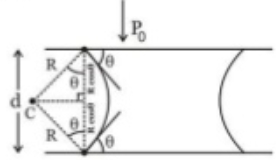
View full question & answer→MCQ 1651 Mark
An air bubble of radius $0 .1\, cm$ is in a liquid having surface tension $0.06\, N/m$ and density $10^3\, kg/m^3$. The pressure inside the bubble is $1100\, Nm^{-2}$ greater than the atmospheric pressure. At ....... $m$ depth is the bubble below the surface of the liquid ? $(g\, = 9.8\, ms^{- 2})$
- ✓
$0.1$
- B
$0.15$
- C
$0.20$
- D
$0.25$
Answera
Given: Radius of air bubble,
$r = 0.1\,cm = {10^{ - 3}}m$
Surface tension of liquid,
$S = 0.06\,N/m = 6 \times {10^{ - 2}}\,N/m$
Density of liquid, $\rho = {10^3}\,kg/{m^3}$
Excess pressure inside the bubble,
${\rho _{exe}} = 1100N{m^{ - 2}}$
Depth of bubble below the liquid surface,
$h=?$
As we know,
${\rho _{Excess}} = h\rho g + \frac{{2s}}{r}$
$ \Rightarrow 1100 = h \times {10^3} \times 9.8 + \frac{{2 \times 6 \times {{10}^{ - 2}}}}{{{{10}^{ - 3}}}}$
$ \Rightarrow 1100 - 9800h + 120$
$ \Rightarrow 9800h = 1100 - 120$
$ \Rightarrow h = \frac{{980}}{{9800}} = 0.1\,m$
View full question & answer→MCQ 1661 Mark
A capillary tube is immersed vertically in water and the height of the water column is $x$. When this arrangement is taken into a mine of depth $d$, the height of the water column is $y$. If $R$ is the radius of earth, the ratio $\frac{x}{y}$ is
- ✓
$\left( {1 - \frac{d}{R}} \right)$
- B
$\left( {1 - \frac{2d}{R}} \right)$
- C
$\left( {\frac{{R - d}}{{R + d}}} \right)$
- D
$\left( {\frac{{R + d}}{{R - d}}} \right)$
AnswerCorrect option: A. $\left( {1 - \frac{d}{R}} \right)$
a
Acceleration due to gravity changes with the depth,
$g' = g\left( {1 - \frac{d}{R}} \right)$
$pressure,\,P = \rho gh$
$Hence\,ratio,\frac{x}{y}is\left( {1 - \frac{d}{R}} \right)$
View full question & answer→MCQ 1671 Mark
On heating water, bubbles being formed at the bottom of the vessel detach and rise. Take the bubbles to be spheres of radius $R$ and making a circular contact of radius $r$ with the bottom of the vessel. If $r < < R$, and the surface tension of water is $T$, value of $r$ just before bubbles detach is (density of water is $\rho_{w}$)
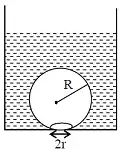
- A
$R^{2} \sqrt{\frac{\rho_{w} g}{T}}$
- ✓
$R^{2} \sqrt{\frac{2 \rho_{w} g}{3 T}}$
- C
$R^{2} \sqrt{\frac{3 \rho_{w} g}{T}}$
- D
$R^{2} \sqrt{\frac{\rho_{w} g}{6 T}}$
AnswerCorrect option: B. $R^{2} \sqrt{\frac{2 \rho_{w} g}{3 T}}$
b
When the bubble gets detached,
Buoyant force = force due to surface tension
$\int T \times d l \sin \theta=\frac{4}{3} \pi R^{3} \rho_{w} g$
$\Rightarrow T \times 2 \pi r \times \frac{r}{R}=\frac{4}{3} \pi R^{3} \rho_{w} g$
$\Rightarrow r^{2}=\frac{2 R^{4} \rho_{w g} g}{3}$
$\Rightarrow r=R^{2} \sqrt{\frac{2 \rho_{w D g}}{3 T}}$
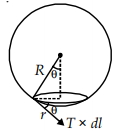
View full question & answer→MCQ 1681 Mark
Two soap bubbles coalesce to form a single bubble. If $V$ is the subsequent change in volume of contained air and $S$ change in total surface area, $T$ is the surface tension and $P$ atmospheric pressure, then which of the following relation is correct?
- A
$4PV+3ST = 0$
- ✓
$3PV+4ST = 0$
- C
$2PV+3ST = 0$
- D
$3PV+2ST = 0$
AnswerCorrect option: B. $3PV+4ST = 0$
b
Let $P_i$ and $R_i$ be the inside pressure and radius of the ith soap bubble respectively.
$\therefore {P_1} = P + \frac{{4T}}{{{R_1}}}.\,\,\,{P_2} = P + \frac{{4T}}{{{R_2}}}\,\,and\,\,{P_3} = P + \frac{{4T}}{{{R_3}}}$
$Also\,{P_1}{V_1} + {P_2}{V_2} = {P_3}{V_3}$
$\therefore \left( {P + \frac{{4T}}{{{R_1}}}} \right)\frac{{4\pi }}{3}R_1^3 + \left( {P + \frac{{4T}}{{{R_2}}}} \right)\frac{{4\pi }}{3}R_2^3$
$ = \left( {p + \frac{{4T}}{{{R_3}}}} \right)\frac{{4\pi }}{3}R_3^3$
$P\left( {\frac{{4\pi }}{3}R_1^3 + \frac{{4\pi }}{3}R_2^3 - \frac{{4\pi }}{3}R_3^2} \right)$
$ + \frac{{4T}}{3}\left( {4\pi R_1^2 + 4\pi R_2^2 - 4\pi R_3^2} \right) = 0$
$P\left( {{V_1} + {V_2} - {V_3}} \right) + \frac{{4T}}{3}\left( {{S_1} - {S_2} - {S_3}} \right) = 0$
$PV + \frac{{4T}}{3}S = 0\,\,\,\,\,\,\, \Rightarrow \,\,\,\,3PV + 4ST = 0$
View full question & answer→MCQ 1691 Mark
Assume that a drop of liquid evaporates by decrease in its surface energy, so that its temperature remains unchanged. What should be the minimum radius of the drop for this to be possible? The surface tension is $T$, density of liquid is $\rho$ and $L$ is its latent heat of vaporization
AnswerCorrect option: A. $\frac{{2T}}{{\rho L}}$
a
When radius is decrease by $\Delta R,$
$4\pi {R^2}\Delta R\rho L = 4\pi T\left[ {{R^2} - {{\left( {R - \Delta R} \right)}^2}} \right]$
$ \Rightarrow \rho {R^2}\Delta RL = T\left[ {{R^2} - {R^2} + 2R\Delta R - \Delta {R^2}} \right]$
$ \Rightarrow \rho {R^2}\Delta RL = T2R\Delta R\,\,\left[ {\Delta R\,is\,very\,small} \right]$
$ \Rightarrow R = \frac{{2T}}{{\rho L}}$
View full question & answer→MCQ 1701 Mark
This question has Statement-I and Statement-2. Of the four ch.oices given after the Statements, choose the one that best describes the two Statetnents.
Statement $-1$ : A capillary is dipped in a liquid and liquid rises to a height $h$ in it. As the temperature of the liquid is raised, the height $h$ increases (if the density of the liquid and the angle of contact remain the same).
Statement $-2$ : Surface tension of a liquid decreases with the rise in its temperature.
- A
Statement $- 1$ is true, Statement $-2$ is true; Statement $-2$ is not the correct explanation for Statemer $- 1$
- ✓
Statement $-1$ is false, Statement $-2$ is true
- C
Statement $- 1$ is true, Statement $-2$ is false
- D
Statement $- 1$ is true, Statement $-2$ is true; Statement $-2$ is the correct explanation for Statement $- 1$
AnswerCorrect option: B. Statement $-1$ is false, Statement $-2$ is true
b
Surface tension of a liquid decreases with the rise in temperture. At the boiling point of liquid, surface tension is zero.
$Capillary\,rise\,h = \frac{{2T\cos \theta }}{{rdg}}$
As surface tension $T$ decreases with rise in temperature hence capillary rise also decreases.
View full question & answer→MCQ 1711 Mark
Wax is coated on the inner wall of a capillary tube and the tube is then dipped in water. Then, compared to the unwaxed capillary, the angle of contact $\theta $ and the height $h$ upto which water rises change. These changes are
- A
$\theta $ increases and $h$ also increases
- B
$\theta $ decreases and $h$ also decreases
- ✓
$\theta $ increases and $h$ decreases
- D
$\theta $ decreases and $h$ increases
AnswerCorrect option: C. $\theta $ increases and $h$ decreases
c
Angle of contact $\theta $
$\cos \theta = \frac{{{T_{SA}} - {T_{SL}}}}{{{T_{LA}}}}$
when water is on a waxy or oily surface
${T_{SA}} < {T_{SL}}\cos \theta \,is\,negative\,i.e.,$
${90^ \circ } < \theta < {180^ \circ }$
$i.e.,\,angle\,of\,contact\,\theta \,increases$
$And\,for\,\theta > {90^ \circ }\,liquid\,level\,in\,capillary\,tube$
$fall.\,i.e.,\,h\,decreases$
View full question & answer→MCQ 1721 Mark
A bubble has surface tension $S$. The ideal gas inside the bubble has ratio of specific heats $\gamma=\frac{5}{3}$. The bubble is exposed to the atmosphere and it always retains its spherical shape. When the atmospheric pressure is $P_{a 1}$, the radius of the bubble is found to be $r_1$ and the temperature of the enclosed gas is $T_1$. When the atmospheric pressure is $P_{a 2}$, the radius of the bubble and the temperature of the enclosed gas are $r_2$ and $T_2$, respectively.
Which of the following statement($s$) is(are) correct?
$(A)$ If the surface of the bubble is a perfect heat insulator, then $\left(\frac{r_1}{r_2}\right)^5=\frac{P_{a 2}+\frac{2 S}{r_2}}{P_{a 1}+\frac{2 S}{r_1}}$
$(B)$ If the surface of the bubble is a perfect heat insulator, then the total internal energy of the bubble including its surface energy does not change with the external atmospheric pressure.
$(C)$ If the surface of the bubble is a perfect heat conductor and the change in atmospheric temperature is negligible, then $\left(\frac{r_1}{r_2}\right)^3=\frac{P_{a 2}+\frac{4 S}{r_2}}{P_{a 1}+\frac{4 S}{r_1}}$.
$(D)$ If the surface of the bubble is a perfect heat insulator, then $\left(\frac{T_2}{T_1}\right)^{\frac{5}{2}}=\frac{P_{a 2}+\frac{4 S}{r_2}}{P_{a 1}+\frac{4 S}{r_1}}$.
Answerc
$P _{ gas }= P _{ a }+\frac{4 S }{ r }$
$PV ^\gamma=\text { constant [adiabatic process] }$
$\left( Pa _1+\frac{4 S }{ r _1}\right)\left(\frac{4}{3} \pi r _1^3\right)^{5 / 3}=\left( P _{2,}+\frac{4 S }{ r _2}\right)\left(\frac{4}{3} \pi r _2^3\right)^{5 / 3}$
$\frac{r_1^3}{r_2^3}=\left(\frac{P_{2_2}+\frac{4 S}{r_2}}{P_{a_1}+\frac{4 S}{r_1}}\right)$
$P ^{1-5} T ^y=\text { constant }$
$\left( P _{2,}+\frac{4 S }{ r _2}\right)^{1-5 / 3} T _2^{5 / 3}=\left( P _{ a _1}+\frac{4 S }{ r _1}\right)^{1-5 / 3} T _1^{5 / 3}$
$\left(\frac{T_2}{T_1}\right)^{s / 3}=\left(\frac{P_{2_1}+\frac{4 S}{I_1}}{P_{2_2}+\frac{4 S}{I_2}}\right)^{-2 / 3}$
$\left(\frac{T_2}{T_1}\right)^{s / 2}=\left(\frac{P_{a_2}+\frac{4 S}{r_2}}{P_{a_1}+\frac{4 S}{r_1}}\right)$
$(D)$ is correct

View full question & answer→MCQ 1731 Mark
When water is filled carefully in a glass, one can fill it to a height $h$ above the rim of the glass due to the surface tension of water. To calculate $h$ just before water starts flowing, model the shape of the water above the rim as a disc of thickness $h$ having semicircular edges, as shown schematically in the figure. When the pressure of water at the bottom of this disc exceeds what can be withstood due to the surface tension, the water surface breaks near the rim and water starts flowing from there. If the density of water, its surface tension and the acceleration due to gravity are $10^3 kg m ^{-3}$, $0.07 Nm ^{-1}$ and $10 ms ^{-2}$, respectively, the value of $h$ (in $mm$ ) is. . . . . .
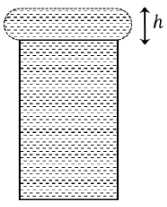
- A
$3.60$
- ✓
$3.65$
- C
$3.70$
- D
$3.75$
AnswerCorrect option: B. $3.65$
b
Pressure at the bottom of disc $=$ pressure due to surface tension
$\rho g h= T \left(\frac{1}{ R _1}+\frac{1}{ R _2}\right)$
$R _1 \gg R _2$
$\text { So } \frac{1}{ R _1} \ll \frac{1}{ R _2} \text { and } R _2= h / 2$
$\therefore \rho h = T \left[\frac{1}{ R _1}+\frac{1}{ R _2}\right]= T \left[0+\frac{1}{ h / 2}\right]$
$h ^2=\frac{2 T }{\rho g }$
$h =\sqrt{\frac{2 T }{\rho g}}=\sqrt{\frac{2 \times 0.07}{10^3 \times 10}}=\sqrt{\frac{14 \times 100}{10^4 \times 100}}$
$h =\sqrt{14} mm =3.741$
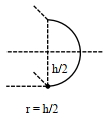
View full question & answer→MCQ 1741 Mark
A cylindrical capillary tube of $0.2 mm$ radius is made by joining two capillaries $T 1$ and $T 2$ of different materials having water contact angles of $0^{\circ}$ and $60^{\circ}$, respectively. The capillary tube is dipped vertically in water in two different configurations, case I and II as shown in figure. Which of the following option($s$) is(are) correct?
(Surface tension of water $=0.075 N / m$, density of water $=1000 kg / m ^3$, take $g =10 m / s ^2$ )
$(1)$ The correction in the height of water column raised in the tube, due to weight of water contained in the meniscus, will be different for both cases.
$(2)$ For case I, if the capillary joint is $5 cm$ above the water surface, the height of water column raised in the tube will be more than $8.75 cm$. (Neglect the weight of the water in the meniscus)
$(3)$ For case $I$, if the joint is kept at $8 cm$ above the water surface, the height of water column in the tube will be $7.5 cm$. (Neglect the weight of the water in the meniscus)
$(4)$ For case II, if the capillary joint is $5 cm$ above the water surface, the height of water column raised in the tube will be $3.75 cm$. (Neglect the weight of the water in the meniscus)
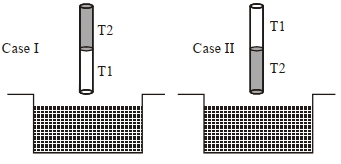
- A
$1,2,3$
- ✓
$1,3,4$
- C
$1,2,4$
- D
$1,2$
AnswerCorrect option: B. $1,3,4$
b
$h =\frac{2 T \cos \theta}{\rho g R } ; h _1=\frac{2 \times 0.075 \times \cos 0^{\circ}}{1000 \times 10 \times 0.2 \times 10^{-3}}$
$\Rightarrow h _1=75 mm$ (in $T1$) [If we assume entire tube of $T 1$ ]
$\Rightarrow h _2=\frac{2 \times 0.075 \times \cos 60^{\circ}}{1000 \times 10 \times 0.2 \times 10^{-3}}=37.5 mm$ (in $T2$) [If we assume entire tube of $T2$]
Option $(1)$ : Since contact angles are different so correction in the height of water column raised in the tube will be different in both the cases, so option $(1)$ is correct
Option $(2)$ : If joint is $5 cm$ is above water surface, then lets say water crosses the joint by height $h$, then:
$\Rightarrow P_0-\frac{2 T}{r}+\rho g h+\rho g \times 5 \times 10^{-2}$
$=P_0$
$\Rightarrow \cos \theta=\frac{R}{r}, r=\frac{R}{\cos \theta}$
$\Rightarrow \rho g\left( h +5 \times 10^{-2}\right)=\frac{2 T \cos \theta}{ R }$
(image)
$\Rightarrow h =\frac{2 \times 0.075 \times \cos 60}{0.2 \times 10^{-3} \times 1000 \times 10}-5 \times 10^{-2}$
$\Rightarrow h =-$ ve, not possible, so liquid will not cross the interface, but angle of contact at the interface will change, to balance the pressure,
So option $(2)$ is wrong.
Option $(3)$ : If interface is $8 cm$ above water then water will not even reach the interface, and water will rise till $7.5 cm$ only in $T 1$, so option $(3)$ is right.
Option $(4)$ : If interface is $5 cm$ above the water in vessel, then water in capillary will not even reach the interface. Water will reach only till $3.75 cm$, so option $(4)$ is right.
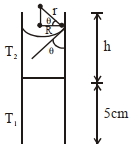
View full question & answer→MCQ 1751 Mark
A uniform capillary tube of inner radius $r$ is dipped vertically into a beaker filled with water. The water rises to a height $h$ in the capillary tube above the water surface in the beaker. The surface tension of water is $\sigma$. The angle of contact between water and the wall of the capillary tube is $\theta$. Ignore the mass of water in the meniscus. Which of the following statements is (are) true?
$(A)$For a given material of the capillary tube, $\mathrm{h}$ decreases with increase in $\mathrm{r}$.
$(B)$ For a given material of the capillary tube, $\mathrm{h}$ is independent of $\sigma$
$(C)$ If this experiment is performed in a lift going up with a constant acceleration, then $\mathrm{h}$ decreases
$(D)$ $\mathrm{h}$ is proportional to contact angel $\theta$
- A
$A,B$
- ✓
$A,C$
- C
$A,D$
- D
$A,B,C$
Answerb
$\frac{2 \sigma}{\mathrm{R}}=\rho g \mathrm{~h}$
where $\mathrm{R}$ is the radius of meniscus.
$h=\frac{2 \sigma}{\rho g R}$
$\mathrm{R}=\frac{\mathrm{r}}{\cos \theta}$, where $\mathrm{r}$ is the radius of capillary and $\theta$ is the angle of contact.
$h=\frac{2 \sigma \cos \theta}{\rho g r}$
$(A)$ For a given material, $\theta$ is constant.
Therefore, $\mathrm{h} \propto \frac{1}{\mathrm{r}}$
$(B)$ $\mathrm{h}$ depends on $\sigma$ as $\mathrm{h} \propto \sigma$.
$(C)$ If lift is going up with constant acceleration a,
$\mathrm{g}_{\text {eff }}=\mathrm{g}+\mathrm{a}$
$\mathrm{h}=\frac{2 \sigma \cos \theta}{\rho(\mathrm{g}+\mathrm{a}) \mathrm{r}} ; \mathrm{h} \text { decreases }$
$(D)$ $\mathrm{h}$ is proportional to $\cos \theta$.
View full question & answer→MCQ 1761 Mark
A drop of liquid of radius $\mathrm{R}=10^{-2} \mathrm{~m}$ having surface tension $\mathrm{S}=\frac{0.1}{4 \pi} \mathrm{Nm}^{-1}$ divides itself into $\mathrm{K}$ identical drops. In this process the total change in the surface energy $\Delta U=10^{-3} \mathrm{~J}$. If $\mathrm{K}=10^\alpha$ then the value of $\alpha$. . . . is
Answerb
$\Delta U=U_f-U_i$
$=S \times 4 \pi R^2\left[\mathrm{~K}^{1 / 3}-1\right]$
$\Rightarrow \mathrm{K}^{1 / 3}=\frac{\Delta \mathrm{U}}{4 \pi \mathrm{R}^2 \mathrm{~S}}+1=101$
$\Rightarrow \mathrm{K} \approx 10^6$
View full question & answer→MCQ 1771 Mark
A glass capillary tube is of the shape of a truncated cone with an apex angle $\alpha$ so that its two ends have cross sections of different radii. When dipped in water vertically, water rises in it to a height $h$, where the radius of its cross section is $b$. If the surface tension of water is $S$, its density is $\rho$, and its contact angle with glass is $\theta$, the value of $h$ will be ( $g$ is the acceleration due to gravity)
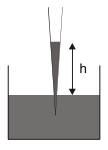
- A
$\frac{2 S }{ b \rho g } \cos (\theta-\alpha)$
- B
$\frac{2 S }{ b _{ p }} \cos (\theta+\alpha)$
- C
$\frac{2 S}{ b g g } \cos (\theta-\alpha / 2)$
- ✓
$\frac{2 S }{ b \rho g } \cos (\theta+\alpha / 2)$
AnswerCorrect option: D. $\frac{2 S }{ b \rho g } \cos (\theta+\alpha / 2)$
d
Using geometry : $\frac{b}{R_e}=\cos \left(\theta+\frac{\alpha}{2}\right)$
Using Pressure method : $P _0-\frac{2 S}{R_c}+h \rho g=P_0$
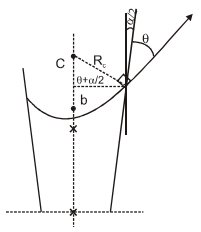
View full question & answer→MCQ 1781 Mark
When liquid medicine of density $\rho$ is to be put in the eye, it is done with the help of a dropper. As the bulb on the top of the dropper is pressed, a drop forms at the opening of the dropper. We wish to estimate the size of the drop. We first assume that the drop formed at the opening is spherical because that requires a minimum increase in its surface energy. To determine the size, we calculate the net vertical force due to the surface tension $T$ when the radius of the drop is $\mathrm{R}$. When the force becomes smaller than the weight of the drop, the drop gets detached from the dropper.
$1.$ If the radius of the opening of the dropper is $\mathrm{r}$, the vertical force due to the surface tension on the drop of radius $R$ (assuming $\mathrm{r} \ll R$ ) is
$(A)$ $2 \pi r T$ $(B)$ $2 \pi R T$ $(C)$ $\frac{2 \pi r^2 T}{R}$ $(D)$ $\frac{2 \pi R^2 T}{r}$
$2.$ If $\mathrm{r}=5 \times 10^{-4} \mathrm{~m}, \rho=10^3 \mathrm{~kg} \mathrm{~m}^{-3}, \mathrm{~g}=10 \mathrm{~m} / \mathrm{s}^2, \mathrm{~T}=0.11 \mathrm{Nm}^{-1}$, the radius of the drop when it detaches from the dropper is approximately
$(A)$ $1.4 \times 10^{-3} \mathrm{~m}$ $(B)$ $3.3 \times 10^{-3} \mathrm{~m}$
$(C)$ $2.0 \times 10^{-3} \mathrm{~m}$ $(D)$ $4.1 \times 10^{-3} \mathrm{~m}$
$3.$ After the drop detaches, its surface energy is
$(A)$ $1.4 \times 10^{-6} \mathrm{~J}$ $(B)$ $2.7 \times 10^{-6} \mathrm{~J}$
$(C)$ $5.4 \times 10^{-6} \mathrm{~J}$ $(D)$ $8.1 \times 10^{-6} \mathrm{~J}$
Give the answer question $1,2$ and $3.$
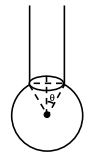
- ✓
$(C,A,B)$
- B
$(A,B,C)$
- C
$(A,D,A)$
- D
$(D,B,B)$
AnswerCorrect option: A. $(C,A,B)$
a
$1.$ Surface Tension force $=2 \pi \mathrm{T} \frac{\mathrm{r}}{\mathrm{R}}=\frac{2 \pi \mathrm{r}^2 \mathrm{~T}}{\mathrm{R}}$
$2.$ $\frac{2 \pi \mathrm{r}^2 \mathrm{~T}}{\mathrm{R}}=\mathrm{mg}=\frac{4}{3} \pi \mathrm{R}^3 \rho g$
$3.$ Surface energy $=\mathrm{T}\left(4 \pi \mathrm{R}^2\right)=2.7 \times 10^{-6} \mathrm{~J}$
View full question & answer→MCQ 1791 Mark
Two soap bubbles $\mathrm{A}$ and $\mathrm{B}$ are kept in a closed chamber where the air is maintained at pressure $8 \mathrm{~N} / \mathrm{m}^2$. The radii of bubbles $\mathrm{A}$ and $\mathrm{B}$ are $2 \mathrm{~cm}$ and $4 \mathrm{~cm}$, respectively. Surface tension of the soap-water used to make bubbles is $0.04 \mathrm{~N} / \mathrm{m}$. Find the ratio $n_{\mathrm{B}} / n_{\mathrm{A}}$, where $n_{\mathrm{A}}$ and $n_{\mathrm{B}}$ are the number of moles of air in bubbles $\mathrm{A}$ and $\mathrm{B}$, respectively. [Neglect the effect of gravity.]
Answerb
$P_A=P_0+\frac{4 T}{r_A} \Rightarrow P_A=8+\frac{4 \times 0.04}{0.02}$
$P_A=16 N / m ^2$
$P_a=P_0+\frac{4 T}{r_B}=8+\frac{4 \times 0.04}{0.04}$
$P_B=12 N / m ^2$
for bubble $A, P V=n R T$
$(16)$ $\frac{4}{3} \pi(0.02)^3=n_A R T \ldots$ $(1)$
for bubble $B$
$(12)$ $\left(\frac{4}{3} \pi(0.04)^3\right)=n_B R T \ldots \ldots$
dividing $e q^n$ ( $i$ ) and $(2)$
$\frac{n_A}{n_6}=\frac{1}{6}, \frac{n_B}{n_A}=6$
View full question & answer→MCQ 1801 Mark
Surface tension is due to
- A
Frictional forces between molecules
- ✓
Cohesive forces between molecules
- C
Adhesive forces between molecules
- D
AnswerCorrect option: B. Cohesive forces between molecules
View full question & answer→MCQ 1811 Mark
When there is no external force, the shape of a liquid drop is determined by
- ✓
Surface tension of the liquid
- B
- C
- D
AnswerCorrect option: A. Surface tension of the liquid
a
(a)The shape of the liquid drop is determined by the surface tension.
View full question & answer→MCQ 1821 Mark
Soap helps in cleaning clothes, because
- A
- B
It increases the surface tension of the solution
- C
- ✓
It lowers the surface tension of the solution
AnswerCorrect option: D. It lowers the surface tension of the solution
d
(d)Soap helps to lower the surface tension of solution, thus soap get stick to the dust particles and grease and these are removed by action of water.
View full question & answer→MCQ 1831 Mark
A pin or a needle floats on the surface of water, the reason for this is
Answera
A pin or a needle floats on the surface of water, the reason for this is Surface tension.
View full question & answer→MCQ 1841 Mark
Coatings used on raincoat are waterproof because
- A
Water is absorbed by the coating
- ✓
Cohesive force becomes greater
- C
Water is not scattered away by the coating
- D
Angle of contact decreases
AnswerCorrect option: B. Cohesive force becomes greater
b
Now lets see, any surface is said to be water proof, if it does not allow water to pass through it. So when we look at the raincoat, it practically does not allow water to pass through it. In other words we can also say that it does not show the property of getting wet.
Now that does not mean that water may not be collected on the outer surface of the raincoat.
Now if we look at the property of water, we know it well that it has the property of wetting the surface it comes in contact with. This is one of the reasons why water wets the surface of the glass.
There is a simple scientific explanation to this...
When speaking of water molecules, they have strong attraction force between its own molecules.
When water molecules come in contact with other surface, the molecules are attracted to the molecules of that surface.
So this is best explained as cohesive force and adhesive force.
Cohesive force is the type of force that is responsible for water molecules to stick together, while the adhesive force is the type of force that forces water molecules to stick to the surface of other material molecules. In case of rain coat, it is obvious that cohesive force in water molecules is much stronger as compared to adhesive force, so water does not stick to the raincoat surface.
View full question & answer→MCQ 1851 Mark
If temperature increases, the surface tension of a liquid
MCQ 1861 Mark
A drop of oil is placed on the surface of water. Which of the following statement is correct
- A
It will remain on it as a sphere
- ✓
It will spread as a thin layer
- C
It will be partly as spherical droplets and partly as thin film
- D
It will float as a distorted drop on the water surface
AnswerCorrect option: B. It will spread as a thin layer
b
(b) when a drop of oil is placed on the surface of water, It will spread as a thin layer because the force of adhesion between water molecules and oils molecules dominates the force of cohesion between oil molecules.
View full question & answer→MCQ 1871 Mark
The temperature at which the surface tension of water is zero
Answerd
(d) At critical temperature (${T_c} = {370^o}C = 643\;K$), the surface tension of water is zero.
View full question & answer→MCQ 1881 Mark
A small air bubble is at the inner surface of the bottom of a beaker filled with cold water. Now water of the beaker is heated. The size of bubble increases. The reason for this may be
- A
Increase in the saturated vapour pressure of water
- B
Root mean square velocity of air molecules inside the bubble increases
- C
Decrease in surface tension of water
- ✓
View full question & answer→MCQ 1891 Mark
The spiders and insects move and run about on the surface of water without sinking because
- ✓
Elastic membrane is formed on water due to property of surface tension
- B
Spiders and insects are lighter
- C
Spiders and insects swim on water
- D
Spider and insects experience upthrust
AnswerCorrect option: A. Elastic membrane is formed on water due to property of surface tension
a
(a)Weight of spiders or insects can be balanced by vertical component of force due to surface tension.
View full question & answer→MCQ 1901 Mark
Small droplets of a liquid are usually more spherical in shape than larger drops of the same liquid because
- A
Force of surface tension is equal and opposite to the force of gravity
- ✓
Force of surface tension predominates the force of gravity
- C
Force of gravity predominates the force of surface tension
- D
Force of gravity and force of surface tension act in the same direction and are equal
AnswerCorrect option: B. Force of surface tension predominates the force of gravity
b
In small drop, surface tension can withstand small gravitational force but in case of large drops, gravitation force dominates the surface tension causing the big drop to bulge more.
View full question & answer→MCQ 1911 Mark
Hairs of shaving brush cling together when it is removed from water due to
- A
Force of attraction between hair
- ✓
- C
- D
Characteristic property of hairs
Answerb
(b) When the brush is taken out of water, the hairs cling together due to surface tension. This happens because the free surface of water tries to acquire a minimum surface area.
Hence, option $\mathrm{B}$ is correct.
View full question & answer→MCQ 1921 Mark
Water does not wet an oily glass because
- A
Cohesive force of oil $>$ adhesive force between oil and glass
- B
Cohesive force of oil $>$ cohesive force of water
- C
- ✓
Cohesive force for water $>$ adhesive force between water and oil molecules
AnswerCorrect option: D. Cohesive force for water $>$ adhesive force between water and oil molecules
d
Water does not wet an oily glass, because of, Cohesive force for water $>$ adhesive force between water and oil molecules.
View full question & answer→MCQ 1931 Mark
A water drop takes the shape of a sphere in a oil while the oil drop spreads in water, because
($A.F.$ = adhesive force, $C.F.$ = cohesive force)
- ✓
$C.F.$ for water $>$ $A.F.$ for water and oil
- B
$C.F.$ for oil $ >$ $A.F.$ for water and oil
- C
$C.F.$ for oil $<$ $A.F.$ for water and oil
- D
AnswerCorrect option: A. $C.F.$ for water $>$ $A.F.$ for water and oil
a
A water drop takes the shape of a sphere in a oil while the oil drop spreads in water, because $C.F.$ for water $>$ $A.F.$ for water and oil.
View full question & answer→MCQ 1941 Mark
Which of the fact is not due to surface tension
- A
Dancing of a camphor piece over the surface of water
- B
Small mercury drop itself becomes spherical
- ✓
A liquid surface comes at rest after stirring
- D
Mercury does not wet the glass vessel
AnswerCorrect option: C. A liquid surface comes at rest after stirring
c
(c)This happens due to viscosity.
View full question & answer→MCQ 1951 Mark
In the glass capillary tube, the shape of the surface of the liquid depends upon
- A
Only on the cohesive force of liquid molecules
- B
Only on the adhesive force between the molecules of glass and liquid
- ✓
Only on relative cohesive and adhesive force between the atoms
- D
Neither on cohesive nor on adhesive force
AnswerCorrect option: C. Only on relative cohesive and adhesive force between the atoms
c
(c) The angle of contact depends upon the relative conesive and adnesive forces between the atoms, which exists above the free surface.
View full question & answer→MCQ 1961 Mark
The property of surface tension is obtained in
- A
Solids, liquids and gases
- ✓
- C
- D
Answerb
The property of surface tension is obtained in Liquids.
View full question & answer→MCQ 1971 Mark
The surface tension of a liquid
- A
- B
- C
Increase with temperature
- ✓
Decrease with temperature
AnswerCorrect option: D. Decrease with temperature
d
(d)$T = {T_0}(1 - \alpha \,t)$
View full question & answer→MCQ 1981 Mark
If two glass plates are quite nearer to each other in water, then there will be force of
Answera
(a)Due to force of attraction it is not easier to separate the two glass plates.
View full question & answer→MCQ 1991 Mark
On mixing the salt in water, the surface tension of water will
Answera
(a)Soluble impurities increases the surface tension.
View full question & answer→MCQ 2001 Mark
Consider a liquid contained in a vessel. The liquid solid adhesive force is very weak as compared to the cohesive force in the liquid. The shape of the liquid surface near the solid shall be
Answerd
(d) Cohesive force $>$ Adhesive force, so shape of liquid surface near the solid would be convex.
For example mercury surface in glass capillary is convex.
View full question & answer→MCQ 2011 Mark
At which of the following temperatures, the value of surface tension of water is minimum ....... $^oC$
Answerd
(d) Surface tension decreases with increase in temperature.
View full question & answer→MCQ 2021 Mark
If a glass rod is dipped in mercury and withdrawn out, the mercury does not wet the rod because
- A
Angle of contact is acute
- ✓
- C
- D
Density of mercury is more
Answerb
(b) Cohesive force is the intermolecular attraction between like molecules, whereas adhesive force is the intermolecular force between unlecules. In the given case cohesive force between mercury molecules is more than adhesive force between mercury molecules and glass rod, hence mercury does not stick to rod.
View full question & answer→MCQ 2031 Mark
Mercury does not wet glass, wood or iron because
AnswerCorrect option: B. Cohesive force is greater than adhesive force
b
(b) Cohesive force is greater than adhesive force.
Therefore, no mercury particles are left behind on glass, wood or iron.
View full question & answer→MCQ 2041 Mark
Surface tension of a liquid is found to be influenced by
- A
It increases with the increase of temperature
- B
Nature of the liquid in contact
- C
Presence of soap that increases it
- ✓
Its variation with the concentration of the liquid
AnswerCorrect option: D. Its variation with the concentration of the liquid
d
(d) Surface tension decreases with temperature, presence of soap also reduces it.
It varies with concentration of liquid.
View full question & answer→MCQ 2051 Mark
When a drop of water is dropped on oil surface, then
- A
- B
It spreads in the form of a film
- C
- ✓
Answerd
(d) Because surface tension of water $>$ surface tension of oil
View full question & answer→MCQ 2061 Mark
Two pieces of glass plate one upon the other with a little water in between them cannot be separated easily because of
Answerc
(c)Surface tension pulls the plates towards each other.
View full question & answer→MCQ 2071 Mark
It is easy to wash clothes in hot water because its
Answerb
(b)Surface tension of water decrease with rise in temperature.
View full question & answer→MCQ 2081 Mark
Due to which property of water, tiny particles of camphor dance on the surface of water
Answerb
The property of water due to which tiny particles of camphor dance on the surface of water Surface tension.
View full question & answer→MCQ 2091 Mark
Oil spreads over the surface of water whereas water does not spread over the surface of the oil, due to
- ✓
Surface tension of water is very high
- B
Surface tension of water is very low
- C
- D
Viscosity of water is high
AnswerCorrect option: A. Surface tension of water is very high
a
Oil spreads over the surface of water whereas water does not spread over the surface of the oil because Surface tension of water is very high.
View full question & answer→MCQ 2101 Mark
Cohesive force is experienced between
- A
- B
Molecules of different substances
- ✓
Molecules of same substances
- D
AnswerCorrect option: C. Molecules of same substances
c
(c)The cohesive force is the force of attraction between the molecules of same substance.
View full question & answer→MCQ 2111 Mark
The dimensions of surface tension are
AnswerCorrect option: C. $[M{L^0}{T^{ - 2}}]$
c
(c)$T = \frac{F}{l} = \frac{{[ML{T^{ - 2}}]}}{{[L]}} = [M{L^0}{T^{ - 2}}]$
View full question & answer→MCQ 2121 Mark
A thread is tied slightly loose to a wire frame as in figure and the frame is dipped into a soap solution and taken out. The frame is completely covered with the film. When the portion $A$ punctured with a pin, the thread.
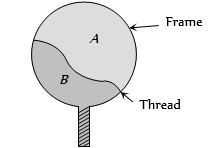
- ✓
Becomes concave toward $A$
- B
Becomes convex towards $A$
- C
Remains in the initial position
- D
Either $(a)$ or $(b)$ depending on the size of $A$ w.r.t. $B$
AnswerCorrect option: A. Becomes concave toward $A$
a
(a) Because film tries to cover minimum surface area.
View full question & answer→MCQ 2131 Mark
Surface tension may be defined as
- ✓
The work done per unit area in increasing the surface area of a liquid under isothermal condition
- B
The work done per unit area in increasing the surface area of a liquid under adiabatic condition
- C
The work done per unit area in increasing the surface area of a liquid under both isothermal and adiabatic conditions
- D
Free surface energy per unit volume
AnswerCorrect option: A. The work done per unit area in increasing the surface area of a liquid under isothermal condition
a
(a) Surface tension of a liquid may also be defined as the work done per unit area in increasing the surface area of a liquid under isothermal conditions$:$
Mathematically, surface tension of the liquid $T=\frac{W}{\Delta A}$
where $W$ is the work done to increase the surface area by $\Delta A$
View full question & answer→MCQ 2141 Mark
The surface tension of a liquid at its boiling point
- ✓
- B
- C
is equal to the value at room temperature
- D
is half to the value at the room temperature
Answera
(a) As the temperature increases, surface tension decreases. At the boiling point, every molecule of a liquid are in motion from bottom to surface, and due to rise in temperature, molecules lose the adhesion and hence, surface tension becomes zero.
View full question & answer→MCQ 2151 Mark
Which graph represents the variation of surface tension with temperature over small temperature ranges for water
Answerb
(b)${T_c} = {T_o}(1 - \alpha t)$ i.e. surface tension decreases with increase in temperature.
View full question & answer→MCQ 2161 Mark
A beaker of radius $15\, cm$ is filled with a liquid of surface tension $0.075\, N/m.$ Force across an imaginary diameter on the surface of the liquid is:-
AnswerCorrect option: D. $2.25 \times 10^{-2} \,N$
d
$F=T \ell$
$=0.075 \times 30 \times 10^{-2}=2.25 \times 10^{-2} \mathrm{N}$
View full question & answer→MCQ 2171 Mark
If a cube of ice is placed in gravity free space, then when the ice melts.
- A
It remains in shape of cube
- B
It will split into pieces of irregular shapes
- C
It will split into small tiny water droplets
- ✓
It will form a spherical shape
AnswerCorrect option: D. It will form a spherical shape
d
When the ice cube melts, it changes its state from solid to liquid. This melted liquid has open surfaces where the surface tension forces come into play. These surface tension forces have a tendency to minimize the surface area. since the melted ice cube is in a gravity-free hall, it has open surface all around. The minimum surface area is achieved by getting a spherical shape.
View full question & answer→MCQ 2181 Mark
If the surface area of the soap solution is increased then its surface tension
MCQ 2191 Mark
An iron needle slowly placed on the surface of water floats because
- A
It displaces water more than its weight
- B
The density of material of needle is less than that of water
- ✓
- D
Answerc
(c)
Needle floats due to surface tension of water which balances the weight of needle.
In equilibrium $2 F \sin \theta=m g$
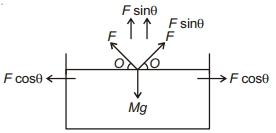
View full question & answer→MCQ 2201 Mark
The potential energy of a molecule on the surface of liquid compared to one inside the liquid is
Answerd
(d) When the surface area of a liquid is increased, molecules from the interior of the liquid rise to the surface. As these molecules reach the surface work is done against the cohesive force. This work is stored in the molecules in the form of potential energy. Thus, the potential energy of the molecules Iying in the surface is greater than that of the molecules in the interior of the liquid.
View full question & answer→MCQ 2211 Mark
Two droplets merge with each other and forms a large droplet. In this process
- ✓
- B
- C
Neither liberated nor absorbed
- D
Some mass is converted into energy
Answera
(a) When two droplets merge with each other, their surface energy decreases.
$W = T(\Delta A) = ({\rm{negative}})$ i.e. energy is released.
View full question & answer→MCQ 2221 Mark
The surface tension of a liquid is $5\, N/m$. If a thin film of the area $0.02\, m^2$ is formed on a loop, then its surface energy will be
- A
$5 \times {10^2}\,J$
- B
$2.5 \times {10^{ - 2}}\,J$
- ✓
$2 \times {10^{ - 1}}\,J$
- D
$5 \times {10^{ - 1}}\,J$
AnswerCorrect option: C. $2 \times {10^{ - 1}}\,J$
c
(c) $W = T \times \Delta A = 5 \times 2 \times (0.02)$ (Film has two free surfaces)
$ = 2 \times {10^{ - 1}}J$
View full question & answer→MCQ 2231 Mark
If two identical mercury drops are combined to form a single drop, then its temperature will
Answerb
(b) Surface energy of combined drop will be lowered, so excess surface energy will raise the temperature of the drop.
View full question & answer→MCQ 2241 Mark
If the surface tension of a liquid is $T$, the gain in surface energy for an increase in liquid surface by $A$ is
- A
$A{T^{ - 1}}$
- ✓
$AT$
- C
${A^2}T$
- D
${A^2}{T^2}$
Answerb
(b) Surface energy = surface tension $×$ increment in area = $T \times A$
View full question & answer→MCQ 2251 Mark
The surface tension of liquid is $0.5\, N/m$. If a film is held on a ring of area $0.02 \,m^2$, its surface energy is
- A
$5 × 10^{-2}\, joule$
- ✓
$2.0 × 10^{-2}\, joule$
- C
$4 × 10-^{4} \,joule$
- D
$0.8 × 10^{-1} \,joule$
AnswerCorrect option: B. $2.0 × 10^{-2}\, joule$
b
(b) Surface energy = $T \times \Delta A = 0.5 \times 2 \times (0.02)$ = $2 \times {10^{ - 2}}\,J$
View full question & answer→MCQ 2261 Mark
The amount of work done in forming a soap film of size $10\,cm \times 10\,cm$ is (Surface tension $T = 3 \times {10^{ - 2}}\,N/m$)
- ✓
$6 \times {10^{ - 4}}\,J$
- B
$3 \times {10^{ - 4}}\,J$
- C
$6 \times {10^{ - 3}}\,J$
- D
$3 \times {10^{ - 2}}\,J$
AnswerCorrect option: A. $6 \times {10^{ - 4}}\,J$
a
(a) $E = T \times \Delta A = 3 \times {10^{ - 2}} \times 2(100 \times {10^{ - 4}}) = 6 \times {10^{ - 4}}\,J$
View full question & answer→MCQ 2271 Mark
The work done in blowing a soap bubble of $10\, cm$ radius is (Surface tension of the soap solution is $\frac{3}{{100}}N/m$)
- ✓
$75.36 \times {10^{ - 4}}\,joule$
- B
$37.68 \times {10^{ - 4}}\,joule$
- C
$150.72 \times {10^{ - 4}}\,joule$
- D
$75.36\,joule$
AnswerCorrect option: A. $75.36 \times {10^{ - 4}}\,joule$
a
(a) $W = 8\pi {R^2}T = 8 \times 3.14 \times (10 \times {10^{ - 2}}) \times \frac{3}{{100}}$
$ = 7.536 \times {10^{ - 3}}J$
View full question & answer→MCQ 2281 Mark
Which of the following statements are true in case when two water drops collapse and make a bigger drop
- A
- B
The surface area of the bigger drop is smaller than the sum of the surface areas of both the drops
- C
The surface area of the bigger drop is greater than the sum of the surface areas of both the drops
- ✓
Both $(a)$ and $(b)$
AnswerCorrect option: D. Both $(a)$ and $(b)$
View full question & answer→MCQ 2291 Mark
The surface energy of liquid film on a ring of area $0.15\;{m^2}$ is ....... $J$ (Surface tension of liquid $ = 5\,N{m^{ - 1}})$
- A
$0.75$
- ✓
$1.5 $
- C
$2.25 $
- D
$3.0$
AnswerCorrect option: B. $1.5 $
b
(b) Surface energy = $T \times A = 5 \times 2 \times (0.15) = 1.5\,J$
View full question & answer→MCQ 2301 Mark
When two small bubbles join to form a bigger one, energy is
Answera
When two small bubbles join to form a bigger one, energy is Released.As surface area is decreased.
View full question & answer→MCQ 2311 Mark
A liquid film is formed in a loop of area $0.05$ $m^2$. Increase in its potential energy will be ($T = 0.2\, N/m$)
- A
$5 \times {10^{ - 2}}\,J$
- ✓
$2 \times {10^{ - 2}}\,J$
- C
$3 \times {10^{ - 2}}\,J$
- D
AnswerCorrect option: B. $2 \times {10^{ - 2}}\,J$
b
(b) Increment in Potential energy = $T \times \Delta A$
$ = 0.02 \times 2 \times 0.05 = 2 \times {10^{ - 2}}J$
View full question & answer→MCQ 2321 Mark
In order to float a ring of area $ 0.04\, m^2$ in a liquid of surface tension $75\, N/m$, the required surface energy will be ....... $J$
Answera
(a) $E = T \times \Delta A = 75 \times 0.04 = 3\,J$
View full question & answer→MCQ 2331 Mark
A drop of water breaks into two droplets of equal size. In this process, which of the following statement is correct
- A
The sum of temperature of the two droplets together is equal to the original temperature of the drop
- ✓
The sum of masses of the two droplets is equal to the original mass of the drop
- C
The sum of the radii of two droplets is equal to the radius of the original drop
- D
The sum of the surface areas of the two droplets is equal to the surface area of the original drop
AnswerCorrect option: B. The sum of masses of the two droplets is equal to the original mass of the drop
b
When a drop of water breaks into two droplets, the total mass of the system remains the same, that is, sum of masses of the two droplets is equal to the mass of the original drop.
Hence $\rho \times \frac{4}{3} \pi R^3=2 \times \rho \times \frac{4}{3} \pi r^3$
$\Rightarrow R=2^{1 / 3} r$
Hence the surface area is in the ratio $\frac{R^2}{ r ^2}=2^{2 / 3}$
View full question & answer→MCQ 2341 Mark
A liquid drop at temperature $t,$ isolated from its surroundings, breaks into a number of droplets. The temperature of the droplets will be
AnswerCorrect option: C. Less than $t$
c
The total surface area of the droplets is greater than that of the single drop. Hence, they have greater surface energy. This extra energy must be drawn from the internal energy of the drop
View full question & answer→MCQ 2351 Mark
The surface tension of a liquid is $5 \,N / m$. If a film is held on a ring of area $0.02 \,m ^2$, its surface energy is about ........... $J$
- A
$5 \times 10^{-2}$
- B
$2.5 \times 10^{-2}$
- ✓
$2 \times 10^{-1}$
- D
$3 \times 10^{-1}$
AnswerCorrect option: C. $2 \times 10^{-1}$
c
(c)
Surface energy $=$ surface tension $\times$ area of film $\times$ number of free surface
$=5 \times 0.02 \times 2$
$=2 \times 10^{-1} \,J$
View full question & answer→MCQ 2361 Mark
The work done in blowing a soap bubble of $10 \,cm$ radius is ...... $J$ (surface tension of soap solution is $0.03 \,N / m )$
- A
$37.68 \times 10^{-4}$
- ✓
$75.36 \times 10^{-4}$
- C
$126.82 \times 10^{-4}$
- D
$75.36 \times 10^{-3}$
AnswerCorrect option: B. $75.36 \times 10^{-4}$
b
(b)
Work done $=$ surface tension $\times$ change in area $\times$ number of free surfaces $=S \times \Delta A \times 2$
$=0.03 \times 4 \pi \times\left(10 \times 10^{-2}\right)^2 \times 2$
$=75.36 \times 10^{-4} \,J$
View full question & answer→MCQ 2371 Mark
A soap bubble assumes a spherical surface. Which of the following statement is wrong
- A
The soap film consists of two surface layers of molecules back to back
- B
The bubble encloses air inside it
- ✓
The pressure of air inside the bubble is less than the atmospheric pressure; that is why the atmospheric pressure has compressed it equally from all sides to give it a spherical shape
- D
Because of the elastic property of the film, it will tend to shrink to as small a surface area as possible for the volume it has enclosed
AnswerCorrect option: C. The pressure of air inside the bubble is less than the atmospheric pressure; that is why the atmospheric pressure has compressed it equally from all sides to give it a spherical shape
View full question & answer→MCQ 2381 Mark
The excess pressure due to surface tension in a spherical liquid drop of radius r is directly proportional to
- A
$r$
- B
${r^2}$
- ✓
${r^{ - 1}}$
- D
${r^{ - 2}}$
AnswerCorrect option: C. ${r^{ - 1}}$
c
The excess pressure due to surface tension in a spherical liquid drop of radius $r$ is excess \ pressure $\Delta p \propto r ^{-1}$
View full question & answer→MCQ 2391 Mark
If the surface tension of a soap solution is $0.03\, MKS$ units, then the excess of pressure inside a soap bubble of diameter $6 \,mm$ over the atmospheric pressure will be
- A
Less than $40\, N/m^2$
- ✓
Greater than $40\, N/m^2$
- C
Less than $20\, N/m^2$
- D
Greater than $20 \,N/m^2$
AnswerCorrect option: B. Greater than $40\, N/m^2$
b
(b) $\Delta P = \frac{{4T}}{r} = 40\;N/{m^2}$
View full question & answer→MCQ 2401 Mark
The excess of pressure inside a soap bubble than that of the outer pressure is
- A
$\frac{{2T}}{r}$
- ✓
$\frac{{4T}}{r}$
- C
$\frac{T}{{2r}}$
- D
$\frac{T}{r}$
AnswerCorrect option: B. $\frac{{4T}}{r}$
b
(b) The pressure inside a soap bubble is greater than outside pressure by $(4 \mathrm{T} / \mathrm{r})$
View full question & answer→MCQ 2411 Mark
There are two liquid drops of different radii. The excess pressure inside over the outside is
- A
- ✓
- C
- D
There is no excess pressure inside the drops
Answerb
(b) $\Delta P \propto \frac{1}{r}$
View full question & answer→MCQ 2421 Mark
The pressure at the bottom of a tank containing a liquid does not depend on
- A
Acceleration due to gravity
- B
Height of the liquid column
- ✓
Area of the bottom surface
- D
AnswerCorrect option: C. Area of the bottom surface
c
(c)$P = h\rho g$
View full question & answer→MCQ 2431 Mark
In capillary pressure below the curved surface of water will be
- A
- B
Equal to upper side pressure
- C
More than upper side pressure
- ✓
Lesser than upper side pressure
AnswerCorrect option: D. Lesser than upper side pressure
d
(d) In capillary pressure below curved surface is less than upper side pressure.
View full question & answer→MCQ 2441 Mark
Two bubbles $A$ and $B$ $(r_A > r_B)$ are joined through a narrow tube. Then
- ✓
The size of $A$ will increase
- B
The size of $B$ will increase
- C
The size of $B $ will increase until the pressure equals
- D
AnswerCorrect option: A. The size of $A$ will increase
a
(a) ${r_A} > {r_B}$ and $P \propto \frac{1}{r}$ so ${P_A} < {P_B}$
So air will flow from $B$ to $A$ i.e. size of $A$ will increase.
View full question & answer→MCQ 2451 Mark
Two soap bubbles have different radii but their surface tension is the same. Mark the correct statement
- ✓
Internal pressure of the smaller bubble is higher than the internal pressure of the larger bubble
- B
Pressure of the larger bubble is higher than the smaller bubble
- C
Both bubbles have the same internal pressure
- D
AnswerCorrect option: A. Internal pressure of the smaller bubble is higher than the internal pressure of the larger bubble
a
(a) $\Delta \,P = \frac{{4T}}{R}$
$\Delta P \propto \frac{1}{R}$ ($T$ = constant)
Hence, the internal pressure of smaller bubble is larger than that of larger bubble.
View full question & answer→MCQ 2461 Mark
In Jager's method, at the time of bursting of the bubble
- ✓
The internal pressure of the bubble is always greater than external pressure
- B
The internal pressure of the bubble is always equal to external pressure
- C
The internal pressure of the bubble is always less than external pressure
- D
The internal pressure of the bubble is always slightly greater than external pressure
AnswerCorrect option: A. The internal pressure of the bubble is always greater than external pressure
a
In Jager's method, at the time of bursting of the bubble The internal pressure of the bubble is always greater than external pressure.
View full question & answer→MCQ 2471 Mark
A bubble of $8$ mm diameter is formed in the air. The surface tension of soap solution is $30$ dynes/cm. The excess pressure inside the bubble is ........ $dynes/cm^2$
- A
$150$
- ✓
$300$
- C
$3 × 10^{-3}$
- D
$12$
Answerb
(b) $\Delta P = \frac{{4T}}{r} = \frac{{4 \times 30}}{{0.4}} = 300\;dyne/c{m^2}$.
View full question & answer→MCQ 2481 Mark
The diameter of rain-drop is $0.02 \,cm$. If surface tension of water be $72 \times {10^{ - 3}}\,newton$ per metre, then the pressure difference of external and internal surfaces of the drop will be
- ✓
$1.44 \times {10^4}\,dyne - c{m^{ - 2}}$
- B
$1.44 \times {10^4}\,newton - {m^{ - 2}}$
- C
$1.44 \times {10^3}\,dyne - c{m^{ - 2}}$
- D
$1.44 \times {10^5}\,newton - {m^{ - 2}}$
AnswerCorrect option: A. $1.44 \times {10^4}\,dyne - c{m^{ - 2}}$
a
(a) $\Delta P = \frac{{2T}}{r} = \frac{{2 \times 72 \times {{10}^{ - 3}}}}{{0.01 \times {{10}^{ - 2}}}} = 1440\;N/{m^2}$
$ = 1.44 \times {10^4}\;dyne/c{m^2}$
View full question & answer→MCQ 2491 Mark
Formation of bubble are in Column - $\mathrm{I}$ and pressure difference between them are given in Column - $\mathrm{II}$. Match them appropriately.
| Column - $\mathrm{I}$ |
Column - $\mathrm{II}$ |
| $(a)$ Liquid drop in air |
$(i)$ $\frac{{4T}}{R}$ |
| $(b)$ Bubble of liquid in air |
$(ii)$ $\frac{{2T}}{R}$ |
| |
$(iii)$ $\frac{{2R}}{T}$ |
- A
$(a-ii),(b-iii)$
- ✓
$(a-ii),(b-i)$
- C
$(a-iii),(b-ii)$
- D
$(a-i),(b-ii)$
AnswerCorrect option: B. $(a-ii),(b-i)$
b
$(a-ii),(b-i)$
View full question & answer→MCQ 2501 Mark
A liquid does not wet the sides of a solid, if the angle of contact is
AnswerCorrect option: B. Obtuse (More than $90^°$)
b
(b) A liquid does not wet the solid surface if the angle of contact is obtuse ie, greater than $90^{\circ} .$ In this case cohesive forces will be greater than adhesive forces and so, the liquid does not wet the surface of solid.
View full question & answer→MCQ 2511 Mark
The meniscus of mercury in the capillary tube is
Answera
(a) Convex meniscus is formed.
The reason for this happening is because of cohesion and adhesion. Meniscus is the curve of the upper surface in any liquid. Curving can be convex or concave. Cohesion is the ability of water molecules to cling to each other because of hydrogen bonds. Adhesion is the ability of water to cling to other polar surfaces, as a result of water's polarity.
So when water is placed into a glass container, surface tension attracts the water molecules to the sides of the glass and because adhesion overcomes the forces of cohesion the water climbs the glass slightly. This does not happen with Mercury because the opposite of water happens. The forces of cohesion are stronger than its attraction to the glass, it's adhesion. It have the opposite effect meaning it will be convex.
View full question & answer→MCQ 2521 Mark
The angle of contact between glass and mercury is......... $^o$
View full question & answer→MCQ 2531 Mark
A mercury drop does not spread on a glass plate because the angle of contact between glass and mercury is
MCQ 2541 Mark
The parts of motor cars are polished by chromium because the angle of contact between water and chromium is
- A
$0^°$
- B
$90^°$
- C
Less than $90^°$
- ✓
Greater than $90^°$
AnswerCorrect option: D. Greater than $90^°$
View full question & answer→MCQ 2551 Mark
A glass plate is partly dipped vertically in the mercury and the angle of contact is measured. If the plate is inclined, then the angle of contact will
Answerb
(b) Angle of contact does not depend upon angle it depend upon temperature so it does not change if you inclined the glass plate
View full question & answer→MCQ 2561 Mark
The liquid meniscus in capillary tube will be convex, if the angle of contact is
- ✓
Greater than $90^°$
- B
Less than $90^°$
- C
Equal to $90^°$
- D
Equal to $0^°$
AnswerCorrect option: A. Greater than $90^°$
a
(a) A convex meniscus occurs when the particles in the liquid have a stronger attraction to each other(conesion) than to the material of the container.
It occurs when mercury is placed in a glass capillary.
The types of meniscus are shown in the figure.
In a convex meniscus, the angle of contact is greater than $90^{\circ},$ which is angle between tangent to the liquid surface and the capillary surface, inside the liquid.
View full question & answer→MCQ 2571 Mark
The value of contact angle for kerosene with solid surface ........ $^o$
Answera
The value of contact angle for kerosene with solid surface is $0^{\circ}$
View full question & answer→MCQ 2581 Mark
Nature of meniscus for liquid of ${0^o}$ angle of contact
Answerc
Nature of meniscus for liquid of $0^{\circ}$ angle of contact is Semi-spherical.
View full question & answer→MCQ 2591 Mark
A liquid wets a solid completely. The meniscus of the liquid in a sufficiently long tube is
Answerb
(b) Liquid wets solid completely. Then the meniscus of liquid is concave as liquid wets solids completely mean angle of contact $\theta$ is less than $90^{\circ} .$ And when $\theta<$ $90^{\circ}$ then meniscus is concave.
View full question & answer→MCQ 2601 Mark
What is the shape when a non-wetting liquid is placed in a capillary tube
Answerb
(b)Since for such liquid (Non-wetting) angle of contact is obtuse.
View full question & answer→MCQ 2611 Mark
For which of the two pairs, the angle of contact is same
- A
Water and glass; glass and mercury
- ✓
Pure water and glass; glass and alcohol
- C
Silver and water; mercury and glass
- D
Silver and chromium; water and chromium
AnswerCorrect option: B. Pure water and glass; glass and alcohol
b
(b)Both liquids water and alcohol have same nature (i.e. wet the solid). Hence angle of contact for both is acute.
View full question & answer→MCQ 2621 Mark
If the surface of a liquid is plane, then the angle of contact of the liquid with the walls of container is
Answerd
(d)Tangent drawn at point of contact makes $0^°$ with wall of container.
View full question & answer→MCQ 2631 Mark
The raincoats are made water proof by coating it with a material, which ............
- A
- B
Increase surface tension of water
- ✓
Increase the angle of contact
- D
Decreases the density of water
AnswerCorrect option: C. Increase the angle of contact
c
(c)
Raincoats are coated with material which increase the angle of contact, so water does not penetrates inside the layer.
View full question & answer→MCQ 2641 Mark
Due to capillary action, a liquid will rise in a tube, if the angle of contact is
Answera
(a) $h = \frac{{2T\cos \theta }}{{rdg}}$. If $\theta$ is less than $90^°$ then $h$ will be positive
View full question & answer→MCQ 2651 Mark
In the state of weightlessness, a capillary tube is dipped in water, then water
- A
- B
Will rise to same height as at atmospheric pressure
- C
Will rise to less height than at atmospheric pressure
- ✓
Will rise up to the upper end of the capillary tube of any length
AnswerCorrect option: D. Will rise up to the upper end of the capillary tube of any length
d
(d) In the state of weightlessness or in gravity free space, water will rise to the upper end of the tube of any length.
View full question & answer→MCQ 2661 Mark
Water rises in a capillary tube to a certain height such that the upward force due to surface tension is balanced by $75 \times {10^{ - 4}}\,N$ force due to the weight of the liquid. If the surface tension of water is $6 \times {10^{ - 2}}\,N{m^{ - 1}}$, the inner circumference of the capillary must be
- A
$1.25 \times {10^{ - 2}}\,m$
- B
$0.50 \times {10^{ - 2}}\,m$
- C
$6.5 \times {10^{ - 2}}\,m$
- ✓
$12.5 \times {10^{ - 2}}\,m$
AnswerCorrect option: D. $12.5 \times {10^{ - 2}}\,m$
d
(d) $6 \times {10^{ - 2}} \times $Circumference = Force
$\therefore $ Circumference $ = \frac{{75 \times {{10}^{ - 4}}}}{{6 \times {{10}^{ - 2}}}} = 12.5 \times {10^{ - 2}}\,m$
View full question & answer→MCQ 2671 Mark
It is not possible to write directly on blotting paper or newspaper with ink pen
Answerd
(d)Due to capillarity it absorbs the ink.
View full question & answer→MCQ 2681 Mark
Two capillary tubes $ P$ and $Q$ are dipped in water. The height of water level in capillary $P$ is $2/3$ to the height in $Q$ capillary. The ratio of their diameters is
- A
$2:3$
- ✓
$3 : 2$
- C
$3:4$
- D
$4:3$
AnswerCorrect option: B. $3 : 2$
b
(b) $ r \propto \frac{1}{h} \Rightarrow \frac{{{r_P}}}{{{r_Q}}} = \frac{{{h_Q}}}{{{h_P}}} = \frac{h}{{\frac{2}{3}h}} = \frac{3}{2}$
View full question & answer→MCQ 2691 Mark
Two capillaries made of same material but of different radii are dipped in a liquid. The rise of liquid in one capillary is $2.2\, cm$ and that in the other is $6.6\, cm$. The ratio of their radii is
- A
$9:1$
- B
$1 : 9$
- ✓
$3:1$
- D
$1 : 3$
Answerc
(c) $r \propto \frac{1}{h} \Rightarrow \frac{{{r_1}}}{{{r_2}}} = \frac{{{h_2}}}{{{h_1}}} = \frac{{6.6}}{{2.2}} = \frac{3}{1}$
View full question & answer→MCQ 2701 Mark
Two capillaries made of the same material with radii ${r_1} = 1\,mm$ and ${r_2} = 2\,mm$. The rise of the liquid in one capillary (${r_1} = 1\,mm$) is $30 \,cm$, then the rise in the other will be ........ $cm$
Answerc
(c) $\frac{{{h_2}}}{{{h_1}}} = \frac{{{r_1}}}{{{r_2}}} = \frac{1}{2} \Rightarrow {h_2} = \frac{{30}}{2} = 15\,cm$
View full question & answer→MCQ 2711 Mark
When a capillary is dipped in water, water rises to a height $h$. If the length of the capillary is made less than $h$, then
- A
- ✓
The water will not come out
- C
- D
The water will rise but less than height of capillary
AnswerCorrect option: B. The water will not come out
b
When a capillary is dipped in water, the water rises to a height $h$. If the length of the capillary is made less than $h$, then The water will not come out but rise to the top and forms a dome over the top of the tube.
View full question & answer→MCQ 2721 Mark
Water rises upto $10\, cm$ height in a long capillary tube. If this tube is immersed in water so that the height above the water surface is only $8 \,cm,$ then
AnswerCorrect option: B. Water rises upto upper end and forms a spherical surface
b
(b) $h=\frac{2 T \cos \theta}{\rho r g}$
View full question & answer→MCQ 2731 Mark
A vessel, whose bottom has round holes with diameter of $0.1\,mm$, is filled with water. The maximum height to which the water can be filled without leakage is ....... $cm$ (S.T. of water =$75 \,dyne/cm, g =1000 \,cm/s^2$)
Answerd
(d) $h = \frac{{2T}}{{rdg}} = \frac{{2 \times 75}}{{0.005 \times 1 \times {{10}^3}}} = 30\,cm$
View full question & answer→MCQ 2741 Mark
A capillary tube made of glass is dipped into mercury. Then
- A
Mercury rises in the capillary tube
- B
Mercury rises and flows out of the capillary tube
- ✓
Mercury descends in the capillary tube
- D
Mercury neither rises nor descends in the capillary tube
AnswerCorrect option: C. Mercury descends in the capillary tube
c
(c)The angle of contact of mercury with glass is obtuse. So it gets depressed below the liquid level outside.
View full question & answer→MCQ 2751 Mark
By inserting a capillary tube upto a depth $l $ in water, the water rises to a height $h$. If the lower end of the capillary is closed inside water and the capillary is taken out and closed end opened, to what height the water will remain in the tube
Answerd
(d) The water rises to height $h$ due to capilarity.
View full question & answer→MCQ 2761 Mark
If the diameter of a capillary tube is doubled, then the height of the liquid that will rise is
Answerb
(b) $h \propto \frac{1}{r}$
View full question & answer→MCQ 2771 Mark
Two capillary tubes of radii $0.2\, cm$ and $0.4\, cm$ are dipped in the same liquid. The ratio of heights through which liquid will rise in the tubes is
- A
$1:2$
- ✓
$2 : 1$
- C
$1:4$
- D
$4 : 1$
AnswerCorrect option: B. $2 : 1$
b
(b) $h \propto \frac{1}{r}$
${r_1}{h_1} = {r_2}{h_2} \Rightarrow \frac{{{h_1}}}{{{h_2}}} = \frac{{{r_{_2}}}}{{{r_1}}} = \frac{{0.4}}{{0.2}} = 2:1$
View full question & answer→MCQ 2781 Mark
The action of a nib split at the top is explained by
Answerc
(c) The tip of nib of a writing pen is split to provide the capillary action.
Due to capillarity, ink will rise in the split of nib and allows the pen to write continuously.
View full question & answer→MCQ 2791 Mark
Water rises upto a height $h$ in a capillary on the surface of earth in stationary condition. Value of $h$ increases if this tube is taken
- A
- B
- C
In a lift going upward with acceleration
- ✓
In a lift going downward with acceleration
AnswerCorrect option: D. In a lift going downward with acceleration
d
(d) If lift moves downward with some acceleration then effective $g$ decreases, so $h$ increases.
As $h = \frac{{2T\cos \theta }}{{rdg}}$
$h \propto \frac{1}{g}$
View full question & answer→MCQ 2801 Mark
During capillary rise of a liquid in a capillary tube, the surface of contact that remains constant is of
MCQ 2811 Mark
A shell having a hole of radius $r$ is dipped in water. It holds the water upto a depth of $h$ then the value of $r$ is
- ✓
$r = \frac{{2T}}{{hdg}}$
- B
$r = \frac{T}{{hdg}}$
- C
$r = \frac{{Tg}}{{hd}}$
- D
AnswerCorrect option: A. $r = \frac{{2T}}{{hdg}}$
a
(a) $\frac{{2T}}{r} = hdg \Rightarrow r = \frac{{2T}}{{hdg}}$
View full question & answer→MCQ 2821 Mark
In a capillary tube, water rises by $1.2\, mm$. The height of water that will rise in another capillary tube having half the radius of the first, is ........ $mm$
Answerb
(b) $h \propto \frac{1}{r}$
${r_1}{h_1} = {r_2}{h_2} \Rightarrow {h_2} = \frac{{{r_1}{h_1}}}{{{r_2}}} = 2.4\;mm$
View full question & answer→MCQ 2831 Mark
If capillary experiment is performed in vacuum then for a liquid there
Answera
If capillary experiment is performed in vacuum then for a liquid there, It will rise.
View full question & answer→MCQ 2841 Mark
If liquid level falls in a capillary then radius of capillary will
Answera
(a) $h \propto \frac{1}{r}$
$rh =$ constant
View full question & answer→MCQ 2851 Mark
Water rises to a height $h$ in a capillary at the surface of earth. On the surface of the moon the height of water column in the same capillary will be
- ✓
$6h$
- B
$\frac{1}{6}h$
- C
$h$
- D
Answera
(a) $h = \frac{{2T\cos \theta }}{{rdg}}$
$h \propto \frac{1}{g}$
As ${g_m} = \frac{{{g_e}}}{6}$
${h_m} = 6{h_e}$
View full question & answer→MCQ 2861 Mark
The surface tension for pure water in a capillary tube experiment is
- A
$\frac{{\rho g}}{{2hr}}$
- B
$\frac{2}{{hr\rho g}}$
- C
$\frac{{r\rho g}}{{2h}}$
- ✓
$\frac{{hr\rho g}}{2}$
AnswerCorrect option: D. $\frac{{hr\rho g}}{2}$
d
(d)$T = \frac{{rhdg}}{{2\cos \theta }}.$ For pure water $\theta = {0^o}$ so $T = \frac{{rhdg}}{2}$
View full question & answer→MCQ 2871 Mark
Two long capillary tubes $A$ and $B $ of radius $R_B>R_A$ dipped in same liquid. Then
AnswerCorrect option: A. Water rise is more in $A$ than $B$
a
(a) $h \propto \frac{1}{R}$
View full question & answer→MCQ 2881 Mark
In a capillary tube, water rises to $3\, mm$. The height of water that will rise in another capillary tube having one-third radius of the first is ........ $mm$
Answerd
(d) $h \propto \frac{1}{r}$
View full question & answer→MCQ 2891 Mark
Kerosene oil rises up the wick in a lantern
- ✓
Due to surface tension of the oil
- B
The wick attracts the kerosene oil
- C
Of the diffusion of the oil through the wick
- D
AnswerCorrect option: A. Due to surface tension of the oil
a
(a) Kerosene oil surface forms a bulge due to surface tension.
View full question & answer→MCQ 2901 Mark
Water rises against gravity in a capillary tube when its one end is dipped into water because
- ✓
Pressure below the meniscus is less than atmospheric pressure
- B
Pressure below the meniscus is more than atmospheric pressure
- C
- D
AnswerCorrect option: A. Pressure below the meniscus is less than atmospheric pressure
View full question & answer→MCQ 2911 Mark
Water rises up to a height $h$ in a capillary tube of certain diameter. This capillary tube is replaced by a similar tube of half the diameter. Now the water will rise to the height of
Answerc
(c) $h \propto \frac{1}{r}$ $⇒$ $\frac{{{h_2}}}{{{h_1}}} = \frac{{{r_1}}}{{{r_2}}} = \frac{{{D_1}}}{{{D_2}}} = 2$ $⇒$ ${h_2} = 2{h_1}$
View full question & answer→MCQ 2921 Mark
In a surface tension experiment with a capillary tube water rises upto $0.1\, m$. If the same experiment is repeated on an artificial satellite, which is revolving around the earth, water will rise in the capillary tube upto a height of
- A
$0.1\, m$
- B
$0.2\, m$
- C
$0.98\, m$
- ✓
Full length of the capillary tube
AnswerCorrect option: D. Full length of the capillary tube
d
(d) In the satellite, the weight of the liquid column is zero. So the liquid will rise up to the top of the tube.
View full question & answer→MCQ 2931 Mark
The correct curve between the height or depression $h$ of liquid in a capillary tube and its radius is
Answerb
(b) $h = \frac{{2T\cos \theta }}{{rdg}}$
$h \propto \frac{1}{r}.$ So the graph between $h$ and $r$ will be rectangular hyperbola.
View full question & answer→MCQ 2941 Mark
When a capillary tube is dipped in water it rises upto $8$ $cm$ in the tube. What happens when the tube is pushed down such that its end is only $5$ $cm$ above the outside water level
- ✓
The radius of the meniscus increases and therefore water does not overflow
- B
The radius of the meniscus decreases and therefore water does not overflow
- C
The water forms a droplet on top of the tube but does not overflow
- D
The water start overflowing
AnswerCorrect option: A. The radius of the meniscus increases and therefore water does not overflow
a
(a) $h = \frac{{2T}}{{Rdg}}$==> $hR = \frac{{2T}}{{dg}} = {\rm{constant}}$
When $h$ decreases, $R$ increases.
View full question & answer→MCQ 2951 Mark
The height upto which water will rise in a capillary tube will be
- A
Maximum when water temperature is $4°C$
- B
Maximum when water temperature is $0°C$
- ✓
Minimum when water temperature is $4°C$
- D
AnswerCorrect option: C. Minimum when water temperature is $4°C$
c
(c) $h = \frac{{2T\cos \theta }}{{rdg}}$. For water, density is maximum at ${4^o}C$, so the height is minimum at ${4^o}C$.
View full question & answer→MCQ 2961 Mark
- A
Angle of contact $\theta < 90^\circ $, if cohesive force < adhesive force
- B
Angle of contact$\theta > 90^\circ ,$, if cohesive force > adhesive force
- C
Angle of contact $\theta $$= 90°$, if cohesive force = adhesive force
- ✓
If the radius of capillary is reduced to half, the rise of liquid column becomes four times
AnswerCorrect option: D. If the radius of capillary is reduced to half, the rise of liquid column becomes four times
d
(d) If radius of capillary is reduced to half, the rise of liquid column will be two times. ${\rm{as }}h \propto 1/r$
View full question & answer→MCQ 2971 Mark
Water rises to a height of $16.3 \,cm$ in a capillary of height $18 \,cm$ above the water level. If the tube is cut at a height of $12\, cm$
- A
Water will come as a fountain from the capillary tube
- ✓
Water will stay at a height of $12 \,cm$ in the capillary tube
- C
The height of the water in the capillary will be $10.3\, cm$
- D
Water will flow down the sides of the capillary tube
AnswerCorrect option: B. Water will stay at a height of $12 \,cm$ in the capillary tube
b
(b) Because if the length available is less than required, then water will rise upto available height and adjust its radius of curvature.
View full question & answer→MCQ 2981 Mark
In an experiment to find surface tension of mercury with the help of capillary rise method the liquid column in capillary will
- A
rise up above level of liquid in container
- ✓
dipress below level of liquid in container
- C
may rise up or dipress below level of liquid container
- D
AnswerCorrect option: B. dipress below level of liquid in container
View full question & answer→MCQ 2991 Mark
Water rises in a vertical capillary tube upto a height of $2.0\ cm$. If the tube is inclined at an angle of $60^o$ with the vertical, then upto what length the water will rise in the tube...... $cm$
- A
$2.0$
- ✓
$4.0$
- C
$\frac{4}{{\sqrt 3 }}$
- D
$2\sqrt 2$
Answerb
$l = \frac{h}{{\cos \theta }} = \frac{2}{{\cos {{60}^o}}} = 4.0\ cm$
View full question & answer→MCQ 3001 Mark
Water rises to a height of $2\, cm$ in a capillary tube. If the tube is tilted $60^o$ from the vertical, water will rise in the tube to a length ...... $cm$
- ✓
$4$
- B
$2$
- C
$1$
- D
water will not rise at all
Answera
$\cos 60^{\circ}=2$ or $1=2 \times 2 \mathrm{cm}=4 \mathrm{cm}$
View full question & answer→MCQ 3011 Mark
The quantity on which the rise of liquid in capillary tube does not depend upon is
Answerb
$h = \frac{{2T\,\cos\, \theta }}{{r\rho g}}$
Rise does not depend upon atmosphere pressure
View full question & answer→MCQ 3021 Mark
If a capillary tube is dipped into liquid and the levels of the liquid inside and outside are same, then the angle of contact is ...... $^o$
Answerb
The height of liquid rise in a capillary tube is given by
$\mathrm{h}=\frac{2 \mathrm{T} \cos \theta}{\mathrm{r} \rho \mathrm{g}}$
When the level of liquid inside and outside are
same, then $\mathrm{h}=0$
Thus, we have
$0=\frac{2 \mathrm{T} \cos \theta}{\mathrm{r} \rho \mathrm{g}}$
$\mathbf{o r}$ $\cos \theta=0 \text { or } \theta=90^{\circ}$
View full question & answer→MCQ 3031 Mark
In a capillary rise experiment, the water level rises to a height of $5\, cm$. If the same capillary tube is placed in water such that only $3\, cm$ of the tube projects outside the water level, then
- A
water will begin to overflow through the capillary
- B
angle of contact decreases
- ✓
angle of contact increases
- D
the meniscus completely vanishes
AnswerCorrect option: C. angle of contact increases
c
If the length of the tube is decreased below $5\, cm$ (in this case), the radius of the meniscus will increase, $hr = h'r'$ When the radius increases, the angle of contact increases.
View full question & answer→MCQ 3041 Mark
Mercury has an angle of contact equal to $140^{\circ}$ with soda lime glass. A narrow tube of radius $1.00 \;mm$ made of this glass is dipped in a trough containing mercury. By what amount does the mercury dip down (in $mm$) in the tube relative to the liquid surface outside? Surface tension of mercury at the temperature of the experiment is $0.465\; N m ^{-1} .$ Density of mercury $=13.6 \times 10^{3} \;kg m ^{-3}$
- A
$11.96$
- B
$2.34$
- C
$8.24$
- ✓
$5.34$
AnswerCorrect option: D. $5.34$
d
Angle of contact between mercury and soda lime glass, $\theta=140^{\circ}$
Radius of the narrow tube, $r=1 mm =1 \times 10^{-3} m$
Surface tension of mercury at the given temperature, $s=0.465 N m ^{-1}$
Density of mercury, $\rho=13.6 \times 10^{3} kg / m ^{3}$
Dip in the height of mercury $=h$
Acceleration due to gravity, $g=9.8 m / s ^{2}$
Surface tension is related with the angle of contact and the dip in the height as
$s=\frac{h \rho g r}{2 \cos \theta}$
$\therefore h=\frac{2 s \cos \theta}{r \rho g}$
$=\frac{2 \times 0.465 \times \cos 140}{1 \times 10^{-3} \times 13.6 \times 10^{3} \times 9.8}$
$=-0.00534 m$
$=-5.34 mm$
Here, the negative sign shows the decreasing level of mercury. Hence, the mercury level dips by $5.34\; mm$
View full question & answer→MCQ 3051 Mark
A barometer tube reads $75 \,cm$ of $Hg$. If tube is gradually inclined at an angle of $30^{\circ}$ with horizontal, keeping the open end in the mercury container, then find the length of mercury column in the barometer tube ......... $cm$
- A
$86.7$
- ✓
$150$
- C
$75$
- D
$92.5$
Answerb
(b)
$\because$ We are not changing the atmospheric pressure, so height of $Hg$ from the surface should not change.
$\frac{75}{x}=\cos 60^{\circ}$
$\Rightarrow x=150 \,cm$
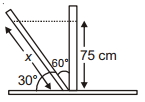
View full question & answer→MCQ 3061 Mark
On putting a capillary tube in a pot filled with water. the level of water rises upto a height of $4 \,cm$ in the tube. If a tube of half the diameter is used instead, the water will rise to a height of nearly ............. $cm$
Answerc
(c)
For capillary tube
$h=\frac{2 T}{r \rho g}$
We can say
$h \propto \frac{1}{r} \text { or } h \propto \frac{1}{d}$
So, $\frac{h_1}{h_2}=\frac{d_2}{d_1}$
$\Rightarrow \frac{4}{x}=\frac{d}{2 d}$
$\Rightarrow x=8 \,cm$
View full question & answer→MCQ 3071 Mark
The kerosene oil rises up in the wick of a lamp ...........
- A
Due to high surface tension of oil
- B
Because the wick attract s the oil
- C
Because wick decreases the surface tension of oil
- ✓
Due to capillaries formed in the wick
AnswerCorrect option: D. Due to capillaries formed in the wick
d
(d)
Capillary action is responsible.
Wick has a lot of capillaries which help the oil rise.
View full question & answer→MCQ 3081 Mark
Ploughing help to retain water by soil ...........
- A
- ✓
- C
By turning the soil upside down
- D
Answerb
(b)
By breaking capillaries as they do not allow water to seep inside.
View full question & answer→MCQ 3091 Mark
A capillary tube is dipped in water and it is $20 \,cm$ outside water. The water rises upto $8 \,cm$. If the entire arrangement is put in freely falling elevator the length of water column in the capillary tube will be ........ $cm$
Answera
(a)
If entire arrangement is in free fall then the weight of water in capillary will be balanced by pseudo force which would be equal to the weight of water.
Hence, surface tension has no weight to balance so full capillary will be filled with water.
View full question & answer→MCQ 3101 Mark
A thin metal disc of radius $r$ floats on water surface and bends the surface downwards along the perimeter making an angle $\theta$ with vertical edge of the disc. If the disc displaces a weight of water $ W $ and surface tension of water is $T$, then the weight of metal disc is
- A
$2\pi rT + W$
- B
$2\pi rT\,\cos \theta - W$
- ✓
${\rm{2}}\pi {\rm{rT\,cos}}\theta + W$
- D
$W - 2\pi rT\,\cos \theta $
AnswerCorrect option: C. ${\rm{2}}\pi {\rm{rT\,cos}}\theta + W$
c
(c) Weight of metal disc = total upward force
= upthrust force + force due to surface tension
= weight of displaced water $+ T \,cos \,\theta\, (2p r)$
$= W + 2p rT\, cos \,\theta$
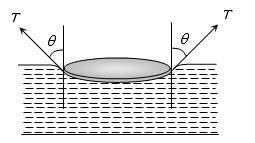
View full question & answer→MCQ 3111 Mark
There is a horizontal film of soap solution. On it a thread is placed in the form of a loop. The film is pierced inside the loop and the thread becomes a circular loop of radius $R$. If the surface tension of the loop be T, then what will be the tension in the thread
- A
$\pi {R^2}/T$
- B
$\pi {R^2}T$
- C
$2\pi RT$
- ✓
$2RT$
Answerd
(d) Suppose tension in thread is F, then for small part $\Delta l$ of thread
$\Delta l = R\theta $ and $2F\sin \theta /2 = 2T\Delta l = 2TR\theta $
$ \Rightarrow F = \frac{{TR\theta }}{{\sin \theta /2}} = \frac{{TR\theta }}{{\theta /2}} = 2TR(\sin \theta /2 \approx \theta /2)$
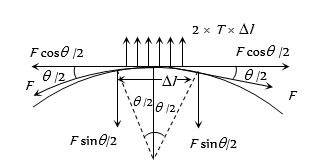
View full question & answer→MCQ 3121 Mark
Consider a spherical drop of radius $R$. Surface tension of the liquid is $\sigma$ . Force of surface tension on shaded sub hemisphere due to remaining drop is $0.5\,\pi \sigma R$ . The value of- angle $\theta$ (angle subtended hy the sub hemisphere at centre of drop) is ......$^o$
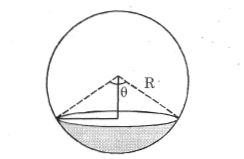
Answera
$F-\sigma 2 \pi r \sin \left(\frac{\theta}{2}\right)=\frac{\sigma \pi R}{2}$
$\sin \left(\frac{\theta}{2}\right)=\frac{1}{2}$
View full question & answer→MCQ 3131 Mark
A ring of a thin wire of cross-sectional area a and length $l$ is dipped into a liquid of surface tension $\sigma$ and taken out so that a film of liquid is formed in the ring. If young's modulus of material of wire is $Y$ then longitudinal strain developed in the ring will. be
- ✓
$\frac{{l\sigma }}{{\pi a\,Y}}$
- B
$\frac{{\pi a\,Y}}{{l\sigma }}$
- C
$\frac{{l\sigma }}{{aY}}$
- D
AnswerCorrect option: A. $\frac{{l\sigma }}{{\pi a\,Y}}$
a
$2 \mathrm{F} \sin \theta=2 \sigma \mathrm{d} l$
$\Rightarrow \mathrm{F} \theta=\sigma \mathrm{d} 1 \text { [for small } \theta, \sin \theta \approx \theta]$
$ \Rightarrow F\theta = \sigma .(2\theta r)$
$\Rightarrow F=2 \sigma r=2 \sigma\left(\frac{\ell}{2 \pi}\right) \Rightarrow F=\frac{\ell \sigma}{\pi}$
Now $\quad Y=\frac{F / a}{x / \ell} \Rightarrow \frac{x}{\ell}=\frac{F}{a Y}=\frac{\ell \sigma}{\pi a Y}$
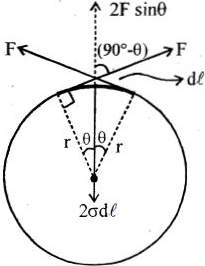
View full question & answer→MCQ 3141 Mark
A soap bubble ( surface tension $= T$) is charged to a maximum surface density of charge $ = \sigma $. When it is just going to burst. Its radius $R$ is given by
- A
$R = \frac{{{\sigma ^2}}}{{8{\varepsilon _0}\,T}}$
- ✓
$R = 8{\varepsilon _0}\frac{T}{{{\sigma ^2}}}$
- C
$R = \frac{\sigma }{{\sqrt {8{\varepsilon _0}\,T} }}$
- D
$R = \frac{{\sqrt {8{\varepsilon _0}\,T} }}{\sigma }$
AnswerCorrect option: B. $R = 8{\varepsilon _0}\frac{T}{{{\sigma ^2}}}$
b
The pressure due to surface tension $=\frac{4 \mathrm{T}}{\mathrm{R}}$
The pressure due to electrostatic forces
$=\frac{\sigma ^{2}}{2 \varepsilon_{0}}$
Just before the bubble bursts.
$\frac{4 \mathrm{T}}{\mathrm{R}}=\frac{\sigma^{2}}{2 \varepsilon_{0}}$ or $\mathrm{R}=\frac{8 \mathrm{T} \varepsilon_{0}}{\sigma^{2}}$
View full question & answer→MCQ 3151 Mark
A thin liquid film formed between a $U-$ shaped wire and a light slider supports a weight of $1.5 \times 10^{-2}\ N$ (see figure). The length of the slider is $30\ cm$ and its weight are negligible. The surface tension of the liquid film is
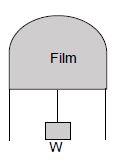
- A
$0.0125\ Nm^{-1}$
- B
$0.1\ Nm^{-1}$
- C
$0.05\ Nm^{-1}$
- ✓
$0.025\ Nm^{-1}$
AnswerCorrect option: D. $0.025\ Nm^{-1}$
d
The force of surface tension acting on the slider of length lin upward direction, balances the force due to the weight acting in downward direction.
$\mathrm{F}=2 \mathrm{TI}-\mathrm{W}$
$2 \mathrm{T}(0.3)=1.5 \times 10^{-2}$
$T=\frac{1.5 \times 10^{-2}}{2 \times 0.3}$
$=0.025 \mathrm{N} / \mathrm{m}$
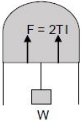
View full question & answer→MCQ 3161 Mark
The radius of a soap bubble is increased from $\frac{1}{{\sqrt \pi }}$cm to $\frac{2}{{\sqrt \pi }}$cm. If the surface tension of water is $30$ dynes per cm, then the work done will be....... $ergs$
Answerc
(c) $W = 8\pi T(r_2^2 - r_1^2)$$ = 8\pi T\left[ {{{\left( {\frac{2}{{\sqrt \pi }}} \right)}^2} - {{\left( {\frac{1}{{\sqrt \pi }}} \right)}^2}} \right]$
$ W = 8 \times \pi \times 30 \times \frac{3}{\pi }$ $ = 720\;erg$
View full question & answer→MCQ 3171 Mark
$n$ drops of $a$ liquid, each with surface energy $E$, joining to form a single drop
AnswerCorrect option: A. some energy will be released in the process
a
$\mathrm{E}=\mathrm{T} 4 \pi \mathrm{r}^{2} \Rightarrow \frac{4}{3} \pi \mathrm{R}^{3}=\mathrm{n} \times \frac{4 \pi}{3} \mathrm{r}^{3}$
$\Rightarrow \mathrm{n}=\frac{\mathrm{R}^{3}}{\mathrm{r}^{3}} \Rightarrow \mathrm{R}=\mathrm{n}^{1 / 3} \mathrm{r}$
Surface energy of big drop
$\mathrm{E}^{\prime}=\mathrm{T} 4 \pi \mathrm{R}^{2}=\mathrm{T} 4 \pi \mathrm{n}^{2 / 3} \mathrm{r}^{2}=\mathrm{En}^{2 / 3}$
Energy released
$=n \mathrm{E}-\mathrm{E}^{\prime}=\mathrm{nE}-\mathrm{n}^{2 / 3} \mathrm{E}=\mathrm{E}\left(\mathrm{n}-\mathrm{n}^{2 / 3}\right)$
View full question & answer→MCQ 3181 Mark
The volume of an air bubble becomes three times as it rises from the bottom of a lake to its surface. Assuming atmospheric pressure to be $75\, cm$ of $Hg$ and the density of water to be $1/10 $ of the density of mercury, the depth of the lake is ....... $m$
Answerc
(c) ${P_1}{V_1} = {P_2}{V_2}$ $⇒$ $({H_{Hg}}{\rho _{Hg}} + {H_W}{\rho _W})V = {H_{Hg}}{\rho _{Hg}} \times 3V$
$⇒$ ${H_{Hg}}{\rho _{Hg}} + {H_W}\frac{{{\rho _{Hg}}}}{{10}} = 3{H_{Hg}}{\rho _{Hg}}$
$⇒$ ${H_W} = 2{H_{Hg}} \times 10$ $ = \frac{{2 \times 75 \times 10}}{{100}} = 15\,m$
View full question & answer→MCQ 3191 Mark
If pressure at half the depth of a lake is equal to $2/3$ pressure at the bottom of the lake then what is the depth of the lake...... $m$
Answerb
(b) Pressure at half the depth $ = {P_0} + \frac{h}{2}dg$
Pressure at the bottom $ = {P_0} + h\rho g$
According to given condition
${P_0} + \frac{h}{2}dg = \frac{2}{3}({P_0} + hdg)$
$⇒$ $3{P_0} + \frac{{3h}}{2}dg = 2{P_0} + 2hdg$
$ \Rightarrow h = \frac{{2{P_0}}}{{dg}} = \frac{{2 \times {{10}^5}}}{{{{10}^3} \times 10}} = 20\;m$
View full question & answer→MCQ 3201 Mark
A soap bubble has radius $R$ and thickness $d ( < < R)$ as shown. It colapses into a spherical drop. The ratio of excess pressure in the drop to the excess pressure inside the bubble is

- A
${\left( {\frac{R}{{3d}}} \right)^{\frac{1}{3}}}$
- B
${\left( {\frac{R}{{6d}}} \right)^{\frac{1}{3}}}$
- ✓
${\left( {\frac{R}{{24d}}} \right)^{\frac{1}{3}}}$
- D
AnswerCorrect option: C. ${\left( {\frac{R}{{24d}}} \right)^{\frac{1}{3}}}$
c
Let $r$ be the radius of the water drop formed.
Since the volume of the water forming bubble and drop is same,
$\frac{4}{3} \pi\left(R^{3}-(R-d)^{3}\right)=\frac{4}{3} \pi r^{3}$
$\Longrightarrow r^{3} \approx 3 R^{2} d\left(\text { neglecting } d^{2} \text { and } d^{3}\right)$
Ratio of excess pressure in the drop to the excess pressure inside the bubble is given by,
Ratio $=\frac{2 \sigma / r}{4 \sigma / R}$
Ratio $=\frac{1}{2}\left(\frac{R}{r}\right)$
Substituting the value of $\mathrm{r}$ gives $\left(\frac{R}{24 d}\right)^{1 / 3}$
View full question & answer→MCQ 3211 Mark
A spherical soap bubble has in ternal pressure $P_0$ and radius $r_0$ and is in equilibrium in an enclosure with pressure ${P_1} = \frac{{8{P_0}}}{9}$ . The enclosure is gradually evacuated . Assuming temperature and surface tension of soap bubble to be fixed find the value of $\frac{{{\rm{final\,\, radius}}}}{{{\rm{initial\,\, radius}}}}$ of soap bubble
Answerc
$\mathrm{P}_{0}-\frac{8 \mathrm{P}_{0}}{9}=\frac{4 \mathrm{S}}{\mathrm{r}_{0}} \Rightarrow \mathrm{P}_{0}=\frac{36 \mathrm{S}}{\mathrm{r}_{0}}$
Finally $\mathrm{P}_{\text {outside }}=0 \Rightarrow \mathrm{P}_{\text {inside }}=\frac{4 \mathrm{S}}{\mathrm{r}}$
$\mathrm{Now} \quad \mathrm{P}_{1} \mathrm{V}_{1}=\mathrm{P}_{2} \mathrm{V}_{2}$
$\left(\frac{36 S}{r_{0}}\right)\left(\frac{4}{3} \pi r_{0}^{s}\right)=\left(\frac{4 S}{r}\right)\left(\frac{4}{3} \pi r^{3}\right) \Rightarrow r=3 r_{0}$
View full question & answer→MCQ 3221 Mark
A capillary type tube $AB$ is connected to a manometer $M$ as shown in the figure. Stopper $S$ controls the flow of air. $AB$ is dipped into a soap solution where surface tension is $T$ . On opening the stopper for a while, a bubble is formed at $B$ end of the manometer and the level difference in manometer limbs is $h$ . If $P$ is the density of manometer soap solution and $r$ the radius of curvature of bubble, then the surface tension $T$ of the liquid is given by ...
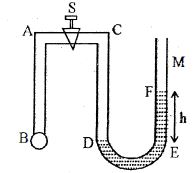
- A
$2r\ \rho gh$
- B
$4r\ \rho gh$
- C
$r\ \rho gh$
- ✓
$\frac{{r\rho gh}}{4}$
AnswerCorrect option: D. $\frac{{r\rho gh}}{4}$
d
Pressure at $\mathrm{B}=$ Pressure $\mathrm{E}$
$\mathrm{P}_{0}+\frac{4 \mathrm{T}}{\mathrm{r}}=\mathrm{P}_{0}+\rho \mathrm{gh}$
$\mathrm{T}=\frac{\mathrm{rpgh}}{4}$
View full question & answer→MCQ 3231 Mark
A drop of water volume $0.05\ cm^3$ is pressed between two glass-plates, as a consequence of which, it spreads between the plates. The area of contact with each plate is $40\ cm^2$ . If the surface tension of water is $70 \ dyne/cm$ , the minimum normal force required to seperate out the two glass plate in newton is approximately...... $N$ (assuming angle of contact is zero)
Answera
Pressure inside the film is less than
outside by an an mount, $\mathrm{P}=\mathrm{T}\left[\frac{1}{\mathrm{r}_{1}}+\frac{1}{\mathrm{r}_{2}}\right]$
where $\mathrm{r}_{1}$ and $\mathrm{r}_{2}$ are the radii of curvature of the meniscus. Here $\mathrm{r}_{1}=\mathrm{t} / 2$ and $\mathrm{r}_{2}=\infty$ then the force required to separate the two glass$-$plates, between which a liquid film is enclosed (figure) is,
$\mathrm{F}=\mathrm{P} \times \mathrm{A}=\frac{2 \mathrm{A} \mathrm{T}}{\mathrm{t}}$
where $t$ is the thickness. of the film,
$A=$ area of film.
$\mathrm{F}=\frac{2 \mathrm{A}^{3} \mathrm{T}}{\mathrm{At}}=\frac{2 \mathrm{A}^{2} \mathrm{T}}{\mathrm{V}}$
$=\frac{2 \times\left(10 \times 10^{4}\right)^{2} \times\left(70 \times 10^{3}\right)}{0.05\times 10^{6}}=45 \mathrm{N}$
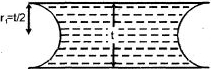
View full question & answer→MCQ 3241 Mark
Two long parallel glass plates has water between them. Contact angle between glass and water is zero. If separation between the plates is $'d'$ ( $d$ is small). Surface tension of water is $'T'$ . Atmospheric pressure = $P_0$ . Then pressure inside water just below the air water interface is
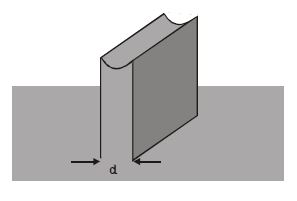
AnswerCorrect option: D. ${P_0} - \frac{{2T}}{d}$
View full question & answer→MCQ 3251 Mark
A $U-$ tube with limbs of diameters $5\, mm$ and $2\, mm$ contains water of surface tension $7 \times 10^{-2}$ newton per metre, angle of contact is zero and density $10^3\, kg/m^3$. If $g$ is $10 \,m/s^2$, then the difference in level of two limbs is :-
- ✓
$8.4\, mm$
- B
$8.4\, cm$
- C
$8.4\, m$
- D
$2.1 \,mm$
AnswerCorrect option: A. $8.4\, mm$
a
$P_{\mathrm{A}}+P_{\mathrm{o}}=$ atmosphere $\mathbf{P r}=\mathbf{P c}$
$P_{\mathrm{B}}=P-\frac{2 \mathrm{T}}{\mathrm{R}}, \mathrm{P}_{\mathrm{D}}=P-\frac{2 \mathrm{T}}{\mathrm{r}}$
$P_{E}=P-\frac{2 T}{r}+\mathbf{h d g}$
$\text { In equilibrium } \quad P_{\mathrm{B}}=P_{E}$
$P-\frac{2 T}{R}=P-\frac{2 T}{r}+h d g \Rightarrow h=\frac{2 T}{d g}\left[\frac{1}{r}-\frac{1}{R}\right]$
$=\frac{2 \times 7 \times 10^{-2}}{10^{3} \times 10 \times 10^{-3}}\left[1-\frac{1}{2.5}\right] \mathrm{m}=8.4 \mathrm{mm}$
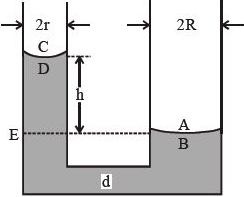
View full question & answer→MCQ 3261 Mark
A cylinder with a movable piston contains air under a pressure $p_1$ and a soap bubble of radius $'r'$ . The pressure $p_2$ to which the air should be compressed by slowly pushing the piston into the cylinder for the soap bubble to reduce its size by half will be: (The surface tension is $\sigma $ , and the temperature $T$ is maintained constant)
- ✓
$\left[ {8{p_1} + \frac{{24\sigma }}{r}} \right]$
- B
$\left[ {4{p_1} + \frac{{24\sigma }}{r}} \right]$
- C
$\left[ {2{p_1} + \frac{{24\sigma }}{r}} \right]$
- D
$\left[ {2{p_1} + \frac{{12\sigma }}{r}} \right]$
AnswerCorrect option: A. $\left[ {8{p_1} + \frac{{24\sigma }}{r}} \right]$
a
Lets say, initially, the pressure due to air inside the bubble is $\mathrm{P}_{\mathrm{air}}$
$\Rightarrow P_{\operatorname{air}}-P_{1}=\frac{4 \sigma}{r}$ $...(i)$
Finally, the radius becomes half; so volume becomes $\frac{1}{8}$ th and hence pressure becomes $8 \mathrm{P}_{\text {air: }}$
So $8 \mathrm{P}_{\mathrm{air}}-\mathrm{P}_{2}=\frac{4 \sigma}{\mathrm{r} / 2}$ $...(ii)$
Solving $(i)$ and $(ii)$
$\operatorname{get} \mathrm{P}_{2}=8 \mathrm{P}_{1}+\frac{24 \sigma}{\mathrm{r}}$
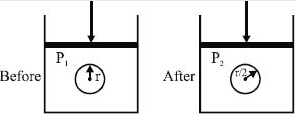
View full question & answer→MCQ 3271 Mark
Two spherical soap bubbles formed in vacuum has diameter $3.0\,mm$ and $4.0\,mm$ . They coalesce to form a single spherical bubble. If the temperature remains unchanged, find the diameter of the bubble so formed ....... $mm$
Answera
Since the bubbles are in vacuum, the pressure of
air inside them are $\mathrm{P}_{1}=\frac{4 \sigma}{\mathrm{r}_{1}}$ and $\mathrm{P}_{2}=\frac{4 \sigma}{\mathrm{r}_{2}},$ Since
the temperature reamins unchanged, we have from Boyle's law
$\mathrm{P}_{1} \mathrm{V}_{1}+\mathrm{P}_{2} \mathrm{V}_{2}=\mathrm{PV}$
or $\frac{4 \sigma}{\mathrm{r}_{1}} \cdot \frac{4}{3} \pi \mathrm{r}_{1}^{3}+\frac{4 \sigma}{\mathrm{r}_{2}} \cdot \frac{4}{3} \pi \mathrm{r}_{2}^{3}=\frac{4 \sigma}{\mathrm{r}} \cdot \frac{4}{3} \pi \mathrm{r}^{3}$ ......$(i)$
where $r$ is the radius of the single bubble formed.
From $(i),$ we get $r^{2}=r^{2}=r^{2}+r_{2}^{2}$ or $r=\sqrt{r_{1}^{2}+r_{2}^{2}}$
So diameter of bubble is $=5.0 \mathrm{\,mm}$
View full question & answer→MCQ 3281 Mark
Two parallel glass plates are dipped partly in the liquid of density $'d'$ keeping them vertical. If the distance between the plates is $'x'$, surface tension for liquids is $T$ and angle of contact is $\theta $, then rise of liquid between the plates due to capillary will be
- A
$\frac{{T\cos \theta }}{{xd}}$
- ✓
$\frac{{2T\cos \theta }}{{xdg}}$
- C
$\frac{{2T}}{{xdg\cos \theta }}$
- D
$\frac{{T\cos \theta }}{{xdg}}$
AnswerCorrect option: B. $\frac{{2T\cos \theta }}{{xdg}}$
b
(b) Let the width of each plate is b and due to surface tension liquid will rise upto height $h$ then upward force due to surface tension = $2Tb\cos \theta $…(i)
Weight of the liquid rises in between the plates = $Vdg = (bxh)dg$…(ii)
Equating (i) and (ii) we get ,$2T\cos \theta = bxhdg$
$\therefore h = \frac{{2T\cos \theta }}{{xdg}}$
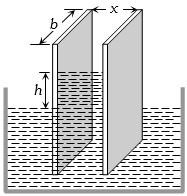
View full question & answer→MCQ 3291 Mark
A barometer tube reads $ 76 cm $ of mercury. If the tube is gradually inclined at an angle of $ 60°$ with vertical, keeping the open end immersed in the mercury reservoir, the length of the mercury column will be ........ $cm$
- ✓
$152$
- B
$76$
- C
$38$
- D
$38\sqrt 3$
Answera
(a) $\cos 60^\circ = \frac{h}{l}$
==>$l = \frac{h}{{\cos 60^\circ }} = \frac{{76}}{{1/2}}$
$>$ $l = 152\;cm$
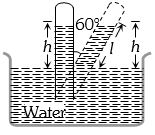
View full question & answer→MCQ 3301 Mark
Along capillary tyube of radius $ ‘r’$ is initially just vertically completely imerged inside a liquid of angle of contact $0^o $. If the tube is slowly raised then relation between radius of curvature of of miniscus inside the capillary tube and displacement $(h)$ of tube can be represented by
Answerb
The curvature equation relating the radius of meniscus inside the capillary tube and the displacement of the tube is given by,
$H=\frac{1}{2} \times\left(\frac{1}{R_{1}}+\frac{1}{R_{2}}\right)$
For a hemispherical, meniscus (which is the case for $0^{\circ}$ contact angle liquid,
$R_{1}=R_{2}=r$
Substituting the values in the equation,
$\mathrm{H}=\frac{1}{r}$
Thus, the graph should resemble a hyperbolic parabola with a value r at a displacement
$\mathrm{h}$
Hence, option $B$
View full question & answer→MCQ 3311 Mark
Two vertical parallel plates are partially submerged in water. The distance between plate is equal to $d$. Water rises due to surface tension $T$, the width of plate is $l$, and contact angle of water with glass is $0^o$. Find the force of attraction between the plates.
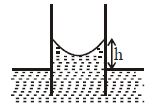
- A
$\frac{{{T^2}l}}{{\rho g{d^2}}}$
- ✓
$\frac{{2{T^2}l}}{{\rho g{d^2}}}$
- C
$\frac{{{T^2}l}}{{2\rho g{d^2}}}$
- D
$\frac{{{T^2}l}}{{4\rho g{d^2}}}$
AnswerCorrect option: B. $\frac{{2{T^2}l}}{{\rho g{d^2}}}$
b
$\mathrm{F}=\left(\mathrm{P}_{0}-\mathrm{P}_{\mathrm{average}}\right) .$ $lh$
$\mathrm{F}=\left[\frac{2 T}{d}-\frac{\rho g h}{2}\right] \ell h$
$h=\frac{2 T}{\rho g d}$ so $\mathrm{F}=\frac{2 T^{2} \ell}{\rho g d^{2}}$
View full question & answer→MCQ 3321 Mark
Water has been filled in a vertical capillary tube upto the top after closing its lower end by a finger. If the finger is removed we shall observe that : ( $T = 70 \,\,dyne/cm,$ radus of capillary $r = 1\,\,mm$ and $g = 980\,\,cm/sec^2$ )
- A
whole of the water will fall down from the capillary tube
- B
whole of the water will stay inside the capillary tube
- C
only $1.42\,\,cm$ of water will stay inside the capillary tube and rest will fall down
- ✓
only $2.86\,\,cm$ of water will stay in the capillary and rest will fall down
AnswerCorrect option: D. only $2.86\,\,cm$ of water will stay in the capillary and rest will fall down
d
$2 \pi r T+2 \pi r T=M g$
$4 \pi \mathrm{T}=\mathrm{v} \cdot \rho \mathrm{g}$
$4 \pi r T=\pi r^{2} h \rho g$
$h=\frac{4 T}{\operatorname{rpg}}=\frac{4 \times 70}{0.1 \times 1 \times 980}$
$=2.86 \mathrm{cm}$
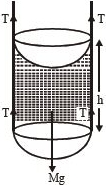
View full question & answer→MCQ 3331 Mark
In a vessel equal masses of alcohol (sp. gravity $0.8$ ) and water are mixed together. A capillary tube of radius $1\,mm$ is dipped vertically in it. If the mixture rises to a height $5\,cm$ in the capillary tube, the surface tension of the mixture is ....... $dyne/cm$
- ✓
$217.9$
- B
$234.18$
- C
$107.9$
- D
$10.79$
AnswerCorrect option: A. $217.9$
a
$f_{\operatorname{mix}}=\frac{H_{\operatorname{mix}}}{V_{\operatorname{mix}}}=\frac{2 m}{\frac{m}{0.8}+\frac{m}{1}}=\frac{2 \times 0.8}{1.8}=\frac{8}{9}$
$\mathrm{h}=\frac{2 \mathrm{T}}{\mathrm{R} \rho \mathrm{g}}$
$s=\frac{2 T \times 9}{0.1 \times 8 \times 980}$
$\mathrm{T}=\frac{98 \times 4 \times 5}{9}=217.77 \mathrm{Dyne} / \mathrm{cm}$
View full question & answer→MCQ 3341 Mark
A $U-$ tube is such that the diameter of one limb is $0.4\,mm$ and that of other is $d\, mm$ . If the surface tension of water contained in the tube is $0.07\,N/m$ and the difference in the levels of liquid in the limbs is $3.6\,cm,$ then the value of $d$ is
- A
$1.6 \times 10^{-3}\,m$
- B
$0.4 \times 10^{-3}\,m$
- ✓
$8 \times 10^{-3}\,m$
- D
$4 \times 10^{-3}\,m$
AnswerCorrect option: C. $8 \times 10^{-3}\,m$
c
$\mathrm{h}_{1}-\mathrm{h}_{2}=\frac{2 \mathrm{T}}{\mathrm{dg}}\left(\frac{1}{\mathrm{r}_{1}}-\frac{1}{\mathrm{r}_{2}}\right)$
$10^{-2} \times 3.6=\frac{4 \times 0.07}{10^{3} \times 9.8}\left(\frac{1}{4 \times 10^{-3}}-\frac{1}{\mathrm{d}}\right)$
Solving, we get, $\mathrm{d}=8 \times 10^{-3} \mathrm{m}$
View full question & answer→MCQ 3351 Mark
The radii of the two columns in $U$ tube are $r_1$ and $r_2$. When a liquid of density $\rho $ (angle of contact is $0^o$ ) is filled in it the level difference of liquid in two arms is $h$. The surface tension of liquid is ($g =$ acceleration due to gravity)
- ✓
$\frac{{\rho gh{r_1}{r_2}}}{{2({r_2} - {r_1})}}$
- B
$\frac{{\rho gh({r_1} - {r_2})}}{{2{r_2}{r_1}}}$
- C
$\frac{{2({r_2} - {r_1})}}{{\rho gh{r_1}{r_2}}}$
- D
$\frac{{\rho gh}}{{2({r_2} - {r_1})}}$
AnswerCorrect option: A. $\frac{{\rho gh{r_1}{r_2}}}{{2({r_2} - {r_1})}}$
a
By using formula,
$h=\frac{2 T \cos \theta}{\rho r g}$
$h_{1}=\frac{2 T(1)}{\rho r_{1} g} \quad\left[\cos \theta=\cos 0^{\circ}=1\right]$
$h_{2}=\frac{2 T(1)}{\rho r_{2} g}$
$h_{1}-h_{2}=h=\frac{2 T}{\rho g}\left(\frac{1}{r_{1}}-\frac{1}{r_{2}}\right)$
$T=\frac{h \rho g r_{1} r_{2}}{2\left(r_{2}-r_{1}\right)}$
View full question & answer→MCQ 3361 Mark
A capillary tube of radius $r$ is immersed in water and water rises in it to a height $h$. The mass of water in the capillary tube is $5\,g$. Another capillary tube of radius $2r$ is immersed in water. The mass of water that will rise in this tube is ...... $g$
Answerc
Let $h$ be the height through which the liquid rises
in the capillary tube of radius $r$
$\therefore \mathrm{h}=\frac{2 \mathrm{T} \cos \theta}{\mathrm{r} \rho \mathrm{g}}$
Mass of the water in the first tube is
$\mathrm{m}=\pi \mathrm{r}^{2} \mathrm{h} \rho=\pi \mathrm{r}^{2} \times\left(\frac{2 \mathrm{T} \cos \theta}{\mathrm{r} \rho \mathrm{g}}\right) \times \rho$
$=\frac{\pi r 2 T \cos \theta}{g} \Rightarrow m \propto r$
$\frac{m^{\prime}}{m}=\frac{r^{\prime}}{r}=\frac{2 r}{r}=2$ or $m^{\prime}=2 m=2 \times 5 g=10 \mathrm{g}$
View full question & answer→MCQ 3371 Mark
Water rises to a height $h$ in capillary tube. If the length of capillary tube above the surface of water is made less than $h,$ then
- A
water does not rise at all.
- B
water rises upto the tip of capillary tube and then starts overflowing like a fountain.
- ✓
water rises upto the top of capillary tube and stays there without overflowing.
- D
water rises upto a point a little below the top and stays there.
AnswerCorrect option: C. water rises upto the top of capillary tube and stays there without overflowing.
c
Water will not overflow but will change its radius of curvature.
View full question & answer→MCQ 3381 Mark
A certain number of spherical drops of a liquid of radius $r$ coalesce to form a single drop of radius $R$ and volume $V.$ If $T$ is the surface tension of the liquid, then
- A
energy $=4VT$ $\left( {\frac{1}{r} - \frac{1}{R}} \right)$ is released.
- B
energy $=3VT $ $\left( {\frac{1}{r} + \frac{1}{R}} \right)$ is absorbed
- ✓
energy $=3VT $ $\left( {\frac{1}{r} - \frac{1}{R}} \right)$ is released.
- D
energy is neither released nor absorbed
AnswerCorrect option: C. energy $=3VT $ $\left( {\frac{1}{r} - \frac{1}{R}} \right)$ is released.
c
Let $n$ droplets each of radius $r$ coalesce to form a big drop of radius $R$.
$\therefore \,\,Volume\,of\,n\,droplets = Volume\,of\,big\,drop$
$n \times \frac{4}{3}\pi {r^3} = \frac{4}{3}\pi {R^3} \Rightarrow n = \frac{{{R^3}}}{{{r^3}}}$ $...\left( i \right)$
$Volume\,of\,big\,drop,\,V = \frac{4}{3}\pi {R^3}\,$ $...\left( {ii} \right)$
Initial surface area of $n$ droplets,
${A_i} = n \times 4\pi {r^2} = \frac{{{R^3}}}{{{r^3}}} \times 4\pi {r^2}$ $(Using (i))$
$ = 4\pi \frac{{{R^3}}}{r} = \left( {\frac{4}{3}\pi {R^3}} \right)\frac{3}{r} = \frac{{3V}}{r}$ $(Using (ii))$
Final surface area of big drop
${A_f} = 4\pi {R^2} = \left( {\frac{4}{3}\pi {R^3}} \right)\frac{3}{R} = \frac{{3V}}{R}$ $(Using (ii)$
Decrease in surface area
$\Delta A = {A_i} - {A_f} = \frac{{3V}}{r} - \frac{{3V}}{R} = 3V\left( {\frac{1}{r} - \frac{1}{R}} \right)$
$\therefore \,\,Energy\,released = surface\,tension$
$ \times Decrease\,in\,surface\,area$
$ = T \times \Delta A = 3VT\left( {\frac{1}{r} - \frac{1}{R}} \right)$
View full question & answer→MCQ 3391 Mark
The wettability of a surface by a liquid depends primarily on
- A
- B
- ✓
angle of contact between the surface and the liquid
- D
AnswerCorrect option: C. angle of contact between the surface and the liquid
c
The wettability of a surface by a liquid depends primarily on angle of contact between the surface and the liquid.
View full question & answer→MCQ 3401 Mark
A mercury drop of radius 1cm is sprayed into ${10^6}$drops of equal size. The energy expended in joules is (surface tension of Mercury is $460 \times {10^{ - 3}}N/m)$
- ✓
$0.057$
- B
$5.7$
- C
$5.7 \times {10^{ - 4}}$
- D
$5.7 \times {10^{ - 6}}$
AnswerCorrect option: A. $0.057$
a
$W = T\Delta A = 4\pi {R^2}T({n^{1/3}} - 1)$
$ = 4 \times 3.14 \times {({10^{ - 2}})^2} \times 460 \times {10^{ - 3}} \times [{({10^6})^{1/3}} - 1] = 0.057\,J$
View full question & answer→MCQ 3411 Mark
Find out the work done (in $ \times 10^{-3}\;J$) to expand the soap bubble to radius $R =5\, cm$ (Surface tension of water $=0.1\; N / m )$
- A
$2.8$
- ✓
$6.28$
- C
$3.7$
- D
$5.8$
AnswerCorrect option: B. $6.28$
b
The work done is given by,
$W=2\left(4 \pi R^{2}\right)(T)$ $...(I)$
Substitute $5 \times 10^{-2} m$ for $R$ and $0.1 N / m$ for $T$ in equation $(I).$
$W=2\left(4 \pi\left(5 \times 10^{-2} m \right)^{2}\right)(0.1 N / m )$
$=6.28 \times 10^{-3} J$
View full question & answer→MCQ 3421 Mark
In an isothermal process $2$ water drops of radius $1 \,mm$ are combined to form a bigger drop. Find the energy (in $\mu J$) change in this process if $T =0.1\, N / m$
Answerb
The expression of energy change in process is given by,
$\Delta U = T \Delta A$
Use volume conservation as,
$2 \times \frac{4}{3} \pi(1)^{3}=\frac{4}{3} \pi R ^{3}$
$R =2^{1 / 3}$
Substitute the values in the energy expression as,
$\Delta U = T \Delta A$
$=(0.1) \times 4 \pi\left(1^{2}-\left(2^{1 / 3}\right)^{2}\right)$
$=4 \pi\left(0.41 \times 10^{-6}\right) J$
$=0.52 \mu J$
View full question & answer→MCQ 3431 Mark
A ring is cut from a platinum tube $8.5\, cm$ internal and $8.7\, cm$ external diameter. It is supported horizontally from the pan of a balance, so that it comes in contact with the water in a glass vessel. If an extra $3.97\,gm$ weight is required to pull it away from water, the surface tension of water is ......... $dyne\, cm^{-1}$
- ✓
$72$
- B
$70.80$
- C
$63.35$
- D
$60$
Answera
$\left( {2\pi {r_1} + 2\pi {r_2}} \right)\sigma = mg$
$\left[ {2\pi \times \frac{{8.7}}{2} + 2\pi \times \frac{{8.5}}{2}} \right]\sigma = 3.97 \times 980$
$ \Rightarrow \sigma = 72\,dyne\,c{m^{ - 1}}$
View full question & answer→MCQ 3441 Mark
Water rises to a height of $10$ cm in capillary tube and mercury falls to a depth of $3.112$ cm in the same capillary tube. If the density of mercury is $13.6$ and the angle of contact for mercury is $135^o $, the ratio of surface tension of water and mercury is
- A
$1:0.15$
- B
$1 : 3$
- ✓
$1:6$
- D
$1.5 : 1$
Answerc
(c) $h = \frac{{2T\cos \theta }}{{rdg}}\therefore T = \frac{{hrdg}}{{2\cos \theta }}$
==> $\frac{{{T_1}}}{{{T_2}}} = \frac{{{h_1}}}{{{h_2}}} \times \frac{{{r_1}}}{{{r_2}}} \times \frac{{{d_1}}}{{{d_2}}} \times \frac{{\cos {\theta _2}}}{{\cos {\theta _1}}}$$ = \frac{1}{6}$
View full question & answer→MCQ 3451 Mark
The work done in blowing a soap bubble of radius $0.2\, m$ is (the surface tension of soap solution being $0.06\, N/m$)
- ✓
$192\pi \times {10^{ - 4}}\,J$
- B
$280\pi \times {10^{ - 4}}\,J$
- C
$200\pi \times {10^{ - 3}}\,J$
- D
AnswerCorrect option: A. $192\pi \times {10^{ - 4}}\,J$
a
(a) $W = 8\pi {r^2} \times T =$$ 8\pi \times {(0.2)^2} \times 0.06 = 192\pi \times {10^{ - 4}}\,J$
View full question & answer→MCQ 3461 Mark
$Assertion :$ A large force is required to draw apart normally two glass plates enclosing a thin water film.
$Reason :$ Water works as glue and sticks two glass plates.
- A
If both Assertion and Reason are correct and the Reason is a correct explanation of the Assertion.
- B
If both Assertion and Reason are correct but Reason is not a correct explanation of the Assertion.
- ✓
If the Assertion is correct but Reason is incorrect.
- D
If both the Assertion and Reason are incorrect.
AnswerCorrect option: C. If the Assertion is correct but Reason is incorrect.
c
In this case, atmospheric pressure does not comes into it because it acts in all direction. The force which is effective in case of water between two pieces of glass is adhesive force. As, adhesive forces are considered that between two different bodies; cohesive forces are internal forces of a body, resulting from attraction between the molecules of it. The attractive force between water and glass (the glass contain silicium atoms, negatively charged and water is a polar molecule so that the positive side of water is attached and causes part of the bound) keep them firmly tovether. Due to the big surface of the glass slide, the resultant force is also big. So we have to apply a large force in order to separate two glass plates enclosed with water film.
View full question & answer→MCQ 3471 Mark
$Assertion :$ Smaller drops of liquid resist deforming forces better than the larger drops
$Reason :$ Excess pressure inside a drop is directly proportional to its surface area.
- A
If both Assertion and Reason are correct and the Reason is a correct explanation of the Assertion.
- ✓
If both Assertion and Reason are correct but Reason is not a correct explanation of the Assertion.
- C
If the Assertion is correct but Reason is incorrect.
- D
If both the Assertion and Reason are incorrect.
AnswerCorrect option: B. If both Assertion and Reason are correct but Reason is not a correct explanation of the Assertion.
b
Smaller drops have larger excess pressure inside. The excess pressure is related to radius as follow $p = \frac{4T}{r}$ That is why smaller droplets resist deforming forces.
View full question & answer→MCQ 3481 Mark
Two small drops of mercury, each of radius $R$, coalesce to form a single large drop. The ratio of the total surface energies before and after the change is
- A
$1:{2^{1/3}}$
- ✓
${2^{1/3}}:1$
- C
$2:1$
- D
$1:2$
AnswerCorrect option: B. ${2^{1/3}}:1$
b
(b) The ratio of the total surface energies before and after the change $ = {n^{1/3}}:1 = {2^{1/3}}:1$
View full question & answer→MCQ 3491 Mark
A soap bubble in vacuum has a radius of $3 \,cm$ and another soap bubble in vacuum has a radius of $4 \,cm$. If the two bubbles coalesce under isothermal condition, then the radius of the new bubble is ....... $cm$
Answerc
(c) $r = \sqrt {r_1^2 + r_2^2} = \sqrt {9 + 16} = 5\;cm$
View full question & answer→MCQ 3501 Mark
The property utilized in the manufacture of lead shots is
- A
Specific weight of liquid lead
- B
Specific gravity of liquid lead
- C
Compressibility of liquid lead
- ✓
Surface tension of liquid lead
AnswerCorrect option: D. Surface tension of liquid lead
d
(d) The property utilized in the manufacture of lead shots is surface tension of liquid lead. In this process, molten lead is made to pass through a sieve from a high tower and allowed to fall in water. The molten lead particles, while descending, assume a spherical shape and solidify in this form, before falling into water.
View full question & answer→MCQ 3511 Mark
If work done in increasing the size of a soap film from $10\;cm \times 6\;cm$ to $10\;cm \times 11\;cm$ is $2 \times {10^{ - 4}}\,J,$ then the surface tension is
- ✓
$2 \times {10^{ - 2}}\,N{m^{ - 1}}$
- B
$2 \times {10^{ - 4}}\,N{m^{ - 1}}$
- C
$2 \times {10^{ - 6}}\,N{m^{ - 1}}$
- D
$2 \times {10^{ - 8}}\,N{m^{ - 1}}$
AnswerCorrect option: A. $2 \times {10^{ - 2}}\,N{m^{ - 1}}$
a
(a) $T = \frac{W}{{\Delta A}} =$$ \frac{{2 \times {{10}^{ - 4}}}}{{2 \times (50 \times {{10}^{ - 4}})}} = 2 \times {10^{ - 2}}\;N/m$
View full question & answer→MCQ 3521 Mark
If the radius of a soap bubble is four times that of another, then the ratio of their excess pressures will be
- ✓
$1:4$
- B
$4:1$
- C
$16:1$
- D
$1:16$
Answera
(a) $\Delta P \propto \frac{1}{r} \Rightarrow \frac{{\Delta {P_1}}}{{\Delta {P_2}}} = \frac{{{r_2}}}{{{r_1}}} = \frac{r}{{4r}} = \frac{1}{4}$
View full question & answer→MCQ 3531 Mark
The work done in increasing the size of a soap film from $10\, cm× 6 \,cm$ to $10\, cm × 11 \,cm$ is $3 ×10^{-4} $ joule. The surface tension of the film is
- A
$1.5 \times {10^{ - 2}}\,N/m$
- ✓
$3.0 \times {10^{ - 2}}\,N/m$
- C
$6.0 \times {10^{ - 2}}\,N/m$
- D
$11.0 \times {10^{ - 2}}\,N/m$
AnswerCorrect option: B. $3.0 \times {10^{ - 2}}\,N/m$
b
(b) $W = T \times \Delta A$
$T = \frac{W}{{\Delta A}}$
$T = \frac{{3 \times {{10}^{ - 4}}}}{{2 \times (110 - 60) \times {{10}^{ - 4}}}}$ (Soap film has two surfaces)
= $3 \times {10^{ - 2}}\,N/m$
View full question & answer→MCQ 3541 Mark
A spherical drop of water has radius $1\, mm$ If surface tension of water is $70 \times {10^{ - 3}}\,N/m$ difference of pressures between inside and out side of the spherical drop is ........ $N/{m^{ - 2}}$
Answerc
(c) $\Delta P = \frac{{2T}}{R} = \frac{{2 \times 70 \times {{10}^{ - 3}}}}{{1 \times {{10}^{ - 3}}}} = 140\,N/{m^2}$
View full question & answer→MCQ 3551 Mark
Work done in splitting a drop of water of $1 \,mm $ radius into $10^6$ droplets is (Surface tension of water $ = 72 \times {10^{ - 3}}J/{m^2})$
- A
$9.58 \times {10^{ - 5}}\,J$
- ✓
$8.95 \times {10^{ - 5}}\,J$
- C
$5.89 \times {10^{ - 5}}\,J$
- D
$5.98 \times {10^{ - 6}}J$
AnswerCorrect option: B. $8.95 \times {10^{ - 5}}\,J$
b
(b) Work done in splitting a water drop of radius $R$ into $n $ drops of equal size $ = 4\pi {R^2}T({n^{1/3}} - 1)$
$ = 4\pi \times {({10^{ - 3}})^2} \times 72 \times {10^{ - 3}} \times ({10^{6/3}} - 1)$
$ = 4\pi \times {10^{ - 6}} \times 72 \times {10^{ - 3}} \times 99 = 8.95 \times {10^{ - 5}}J$
View full question & answer→MCQ 3561 Mark
Excess pressure inside a soap bubble is three times that of the other bubble, then the ratio of their volumes will be
- A
$1:3$
- B
$1 : 9$
- ✓
$1:27$
- D
$1 : 81$
AnswerCorrect option: C. $1:27$
c
(c) $\Delta P \propto \frac{1}{r}$==> $\frac{{\Delta {P_1}}}{{\Delta {P_2}}} = \frac{{{r_2}}}{{{r_1}}} \Rightarrow \frac{{{r_2}}}{{{r_1}}} = \frac{3}{1}$
$\therefore \frac{{{V_1}}}{{{V_2}}} = {\left( {\frac{{{r_1}}}{{{r_2}}}} \right)^3} = {\left( {\frac{1}{3}} \right)^3} = \frac{1}{{27}}$
View full question & answer→MCQ 3571 Mark
The spherical shape of rain-drop is due to
Answerb
(b) Because of surface tension, a liquid surface tends to have the minimum area possible. And as for a given volume the surface of a sphere has got the minimum area, the rain drops take a spherical shape.
View full question & answer→MCQ 3581 Mark
A big drop of radius $R$ is formed by $729$ small drops of water of radius $r$, then the radius of each small drop will be
- ✓
$\frac{R}{9}$
- B
$\frac{R}{900}$
- C
$\frac{R}{1800}$
- D
$\frac{R}{9000}$
AnswerCorrect option: A. $\frac{R}{9}$
a
Equating volume in both cases,
$\frac{4}{3}\pi {R^3} = 729 \times \frac{4}{3}\pi {r^3}$
$ \Rightarrow {r^3} = \frac{{{R^3}}}{{729}}$
$ \Rightarrow r = \frac{R}{9}$
View full question & answer→MCQ 3591 Mark
The surface tension of soap solution is $25 \times {10^{ - 3}}\,N{m^{ - 1}}$. The excess pressure inside a soap bubble of diameter $1 \,cm$ is ....... $Pa$
Answerb
(b) Excess pressure $\Delta P = \frac{{4T}}{r}$
$ = \frac{{4 \times 2 \times 25 \times {{10}^{ - 3}}}}{{1 \times {{10}^{ - 2}}}}$$ = 20\;N/{m^2} = 20\;Pa$ $\left[ {{\rm{as\,\, }}r = \frac{d}{2}} \right]$
View full question & answer→MCQ 3601 Mark
The value of surface tension of a liquid at critical temperature is
Answera
(a) Surface tension decreases with the increase of temperature, reaching a value of zero at the critical temperature.
View full question & answer→MCQ 3611 Mark
When the temperature is increased the angle of contact of a liquid
- A
- ✓
- C
- D
First increases and then decreases
Answerb
(b)Cohesive force decreases so angle of contact decreases.
View full question & answer→MCQ 3621 Mark
A thin liquid film formed between a U-shaped wire and a light slider supports a weight of $1.5 \times 10^{-2} \;N$ (see figure). The length of the slider is $30 \;cm$ and its weight negligible. The surface tension of the liquid film is
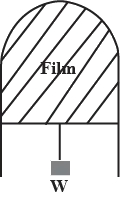
- ✓
$0.025 $ $Nm^{-1}$
- B
$0.0125$ $ Nm^{-1}$
- C
$0.1$ $ Nm^{-1}$
- D
$0.05$ $ Nm^{-1}$
AnswerCorrect option: A. $0.025 $ $Nm^{-1}$
a
$2 T L=m g$
$T=\frac{m g}{2 L}=\frac{1.5 \times 10^{-2}}{2 \times 30 \times 10^{-2}}=\frac{1.5}{600}=0.025\; N / m$
View full question & answer→MCQ 3631 Mark
A large number of droplets, each of radius, $r$ coalesce to form a bigger drop of radius, $R.$ An engineer designs a machine so that the energy released in this process is converted into the kinetic energy of the drop. Velocity of the drop is ($T=$ surface tension, $\rho =$ density)
- A
${\left[ {\frac{T}{\rho }\left( {\frac{1}{r} - \frac{1}{R}} \right)} \right]^{1/2}}$
- ✓
${\left[ {\frac{6T}{\rho }\left( {\frac{1}{r} - \frac{1}{R}} \right)} \right]^{1/2}}$
- C
${\left[ {\frac{3T}{\rho }\left( {\frac{1}{r} - \frac{1}{R}} \right)} \right]^{1/2}}$
- D
${\left[ {\frac{2T}{\rho }\left( {\frac{1}{r} - \frac{1}{R}} \right)} \right]^{1/2}}$
AnswerCorrect option: B. ${\left[ {\frac{6T}{\rho }\left( {\frac{1}{r} - \frac{1}{R}} \right)} \right]^{1/2}}$
b
When small droplets coelesce to form a bigger drop, energy released in this process is given by,
$4\pi {R^3}T\left[ {\frac{1}{r} - \frac{1}{R}} \right]$
Where, $R= radius\,of\,big\,drop$
$r=radius\,of\,small\,drop$
$T=surface\,tension$
According to question
$\frac{1}{2}m{v^2} = 4\pi {R^3}T\left[ {\frac{1}{r} - \frac{1}{R}} \right]$
$ \Rightarrow \frac{1}{2}\left[ {\frac{4}{3}\pi {R^3}\rho } \right]{v^2} = 4\pi {R^3}T\left[ {\frac{1}{r} - \frac{1}{R}} \right]$
$ \Rightarrow {V^2} = \frac{{6T}}{\rho }\left[ {\frac{1}{r} - \frac{1}{R}} \right] \Rightarrow V = {\left[ {\frac{{6T}}{\rho }\left( {\frac{1}{r} - \frac{1}{R}} \right)} \right]^{\frac{1}{2}}}$
View full question & answer→MCQ 3641 Mark
Work done in increasing the size of a soap bubble from a radius of $3\ cm$ to $5\ cm$ is nearly (Surface tension of soap solution $=$ $0.03$ $Nm^{-1}$)
- A
$0.2 $ $\pi mJ$
- B
$2 $ $\pi mJ$
- ✓
$0.4$ $ \pi mJ$
- D
$4$ $ \pi mJ$
AnswerCorrect option: C. $0.4$ $ \pi mJ$
c
$W = T \times change\,in\,surface\,area$
$W = 2T4\pi \left[ {\left( {{5^2}} \right) - {{\left( 3 \right)}^2}} \right] \times {10^{ - 4}}$
$ = 2 \times 0.03 \times 4\pi \left[ {25 - 9} \right] \times {10^{ - 4}}J = 0.4\pi \times {10^{ - 3}}J$
$ = 0.4\pi mJ$
View full question & answer→MCQ 3651 Mark
Two mercury drops (each of radius $r$) merge to form a bigger drop. The surface energy of the bigger drop, if $T$ is the surface tension is
- A
${2^{5/3}}{\pi r^2}T$
- B
$4\pi r^2T$
- C
$2\pi r^2T$
- ✓
${2^{8/3}}{\pi r^2}T$
AnswerCorrect option: D. ${2^{8/3}}{\pi r^2}T$
d
$E = 4\pi {R^2}T\left[ {R = n\frac{1}{3}r} \right]$
View full question & answer→MCQ 3661 Mark
A capillary tube $(A)$ is dipped in water. Another identical tube $(B) $ is dipped in a soap-water solution. Which of the following shows the relative nature of the liquid columns in the two tubes?
Answerd
In case of water, the meniscus shape is concave upwards. Also according to ascent formula
$h = \frac{{2T\cos \theta }}{{r\rho g}}$
The surface tension $(T)$ of soap solution is less than water. Therefore rise of soap solution in the capillary tube is less as compared to water. As in the case of water, the meniscus shape of soap solution is also concave upwards.
View full question & answer→MCQ 3671 Mark
In a capillary tube experiment, a vertical $20 \,cm$ long capillary tube is dipped in water. The water rises up to a height of $8\,cm$ due to capillary action. If this experiment is conducted in a freely falling elevator, the length of the water column becomes ....... $cm$
Answerc
(c)The length of the water column will be equal to full length of capillary tube.
View full question & answer→MCQ 3681 Mark
If two soap bubbles of different radii are connected by a tube,
- A
air flows from the bigger bubble to the smaller bubble till the sizes are interchanged.
- B
The size of the bubbles remains the same
- ✓
air flows from the smaller bubble to the bigger.
- D
AnswerCorrect option: C. air flows from the smaller bubble to the bigger.
c
(c)Since $\Delta P \propto \frac{1}{R}$
View full question & answer→MCQ 3691 Mark
A soap bubble of radius $R$ and surface tension $T$ is formed in vacuum. It is slowly charged so that it slowly expands. It is stopped charging when the radius becomes $2R$ . Find the amount of charge given to the bubble.
- ✓
$Q = \sqrt {768{\pi ^2}{R^3}\,{ \in _0}\,T} $
- B
$Q = \sqrt {568{\pi ^2}{R^3}\,{ \in _0}\,T} $
- C
$Q = \sqrt {568\pi {R^3}\,{ \in _0}\,T} $
- D
AnswerCorrect option: A. $Q = \sqrt {768{\pi ^2}{R^3}\,{ \in _0}\,T} $
a
we have initially $P_{\text {in }}=\frac{4 T}{R}$ ..........$(1)$
Now when extra charge is given, for equilibrium we have
$\mathrm{P}_{\mathrm{in}}^{\prime}+\frac{\sigma^{2}}{2 \varepsilon_{0}}=\left(\frac{4 \mathrm{T}}{2 \mathrm{R}}\right)$ .............$(1)$
Now we have $\mathrm{P}_{\mathrm{in}}^{\prime}=\frac{\left(\mathrm{P}_{\mathrm{in}}\right) \mathrm{v}_{\mathrm{i}}}{\mathrm{v}_{\mathrm{f}}}$ [ isothermal change ]
where $\quad \mathrm{v}_{\mathrm{i}}$ -initial volume of bubble
$\mathrm{v}_{\mathrm{f}}$ - final volume of bubble
so, $\quad P_{\text {in }}^{\prime}=\frac{\left(P_{\text {in }}\right)}{8}$
so, $(1)$ equation will give
$\frac{4 \mathrm{T}}{8 \mathrm{R}}+\frac{\sigma^{2}}{2 \varepsilon_{0}}=\frac{4 \mathrm{T}}{2 \mathrm{R}}$
$\Rightarrow \frac{\sigma^{2}}{2 \varepsilon_{0}}=\frac{4 \mathrm{T}}{2 \mathrm{R}}\left(1-\frac{1}{4}\right)=\frac{12 \mathrm{T}}{8 \mathrm{R}}$
so, $\sigma^{2}=\frac{12 \mathrm{T} \varepsilon_{0}}{4 \mathrm{R}}=\left(\frac{3 \mathrm{T} \varepsilon_{0}}{\mathrm{R}}\right)$ so, $\sigma=\sqrt{\frac{3 \mathrm{T} \varepsilon_{0}}{\mathrm{R}}}$
now charge $\mathrm{Q}=\sigma .4 \pi(2 \mathrm{R})^{2}=4 \pi .\left(4 \mathrm{R}^{2}\right)$
$\sqrt{\frac{3 \mathrm{T} \varepsilon_{0}}{\mathrm{R}}}=\sqrt{256 \times 3 \mathrm{T} \varepsilon_{0} \mathrm{R}^{2} \pi^{2}}$
$\mathrm{Q}=\sqrt{768 \pi^{2} \mathrm{R}^{3} \mathrm{T} \varepsilon_{0}}$

View full question & answer→