A bubble of radius $R$ in water of density $\rho$ is expanding uniformly at speed $v$. Given that water is incompressible, the kinetic energy of water being pushed is
KVPY 2019, Advanced
Download our app for free and get started
$(b)$ Let bubble of radius $x$ expands and pushes water of density $\rho$ by a distance $d x$. Then, kinetic energy of water of strip $d x$ is
$d K=\frac{1}{2} d m \cdot v_{x}^{2} \Rightarrow d K=\frac{1}{2} 4 \pi x^{2} \cdot d x \cdot \rho \cdot v_{x}^{2}$
or $d K=2 \pi R^{2} \cdot \rho \cdot v_{x}^{2} \cdot d x \quad \ldots$ $(i)$
Considering laminar flow, for section $1$ and $2$ shown in figure, by equation of continuity
$A_{1} v_{1}=A_{2} v_{2} \Rightarrow 4 \pi x^{2} v_{x}=4 \pi R^{2} v$
$\Rightarrow \quad v_{x} =\frac{R^{2}}{x^{2}} \cdot v\quad \ldots$ $(ii)$
From Eqs. $(i)$ and $(ii)$, we have
$d K=2 \pi x^{2} \rho\left(\frac{R^{2}}{x^{2}} \cdot v \cdot\right)^{2} d x$
$\Rightarrow d K=2 \pi R^{4} \rho v^{2} \cdot\left(\frac{d x}{x^{2}}\right)$
So, kinetic energy of complete volume of water,
$K=\int \limits_{R}^{\infty} d K=2 \pi R^{4} \rho v^{2} \int \limits_{R}^{\infty} \frac{d x}{x^{2}}$
$\Rightarrow \quad K=2 \pi R^{4} \cdot \rho \cdot v\left[-\frac{1}{x}\right]_{R}^{\infty}$
$=2 \pi \rho R^{3} v^{2}$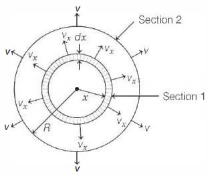

Download our appand get started for free
Experience the future of education. Simply download our apps or reach out to us for more information. Let's shape the future of learning together!No signup needed.*
Similar Questions
- 1View SolutionAs the temperature of water increases, its viscosity
- 2A small drop of water falls from rest through a large height $h$ in air; the final velocity is ................View Solution
- 3We have three beakers $A, B$ and $ C $ containing glycerine, water and kerosene respectively. They are stirred vigorously and placed on a table. The liquid which comes to rest at the earliest isView Solution
- 4View SolutionA liquid is kept in a closed vessel. If a glass plate (negligible mass) with a small hole is kept on top of the liquid surface, then the vapour pressure of the liquid is the vessel is
- 5Asphere of radius $R$ and made of material of relative density $\sigma$ has a concentric cavity of radius $r$. It just floats when placed in a tank full of water. The value of the ratio $R/r$ will beView Solution
- 6View SolutionVelocity of water in a river is
- 7View SolutionA solid cube and a solid sphere both made of same material are completely submerged in water but to different depths. The sphere and the cube have same surface area. The buoyant force is
- 8A large vessel of height $H$, is filled with a liquid of density $\rho$, upto the brim. A small hole of radius $r$ is made at the side vertical face, close to the base. The horizontal force is required to stop the gushing of liquid is ...........View Solution
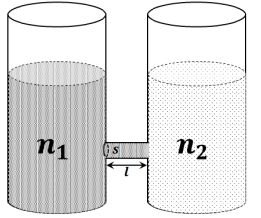
- 9As shown schematically in the figure, two vessels contain water solutions (at temperature $T$ ) of potassium permanganate $\left( KMnO _4\right)$ of different concentrations $n_1$ and $n_2\left(n_1>n_2\right)$ molecules per unit volume with $\Delta n=\left(n_1-n_2\right) \ll n_1$. When they are connected by a tube of small length $\ell$ and cross-sectional area $S , KMnO _4$ starts to diffuse from the left to the right vessel through the tube. Consider the collection of molecules to behave as dilute ideal gases and the difference in their partial pressure in the two vessels causing the diffusion. The speed $v$ of the molecules is limited by the viscous force $-\beta v$ on each molecule, where $\beta$ is a constant. Neglecting all terms of the order $(\Delta n)^2$, which of the following is/are correct? ( $k_B$ is the Boltzmann constant)-View Solution
$(A)$ the force causing the molecules to move across the tube is $\Delta n k_B T S$
$(B)$ force balance implies $n_1 \beta v \ell=\Delta n k_B T$
$(C)$ total number of molecules going across the tube per sec is $\left(\frac{\Delta n}{\ell}\right)\left(\frac{k_B T}{\beta}\right) S$
$(D)$ rate of molecules getting transferred through the tube does not change with time
- 10When a large bubble rises from the bottom of a lake to the surface. Its radius doubles. If atmospheric pressure is equal to that of column of water height $H$, then the depth of lake isView Solution