Question
As the temperature of water increases, its viscosity

Answer

(b)

Need a full question paper?

Generate a complete, print-ready paper with questions like this in minutes — across 16+ boards, with answer keys.

Start Generating Free

Similar questions

$Assertion :$ It is hotter over the top of a fire than at the same distance of the sides.

$Reason :$ Air surrounding the fire conducts more heat upwards.
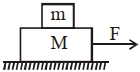
Two blocks $( m =0.5\, kg$ and $M =4.5\, kg$ ) are arranged on a horizontal frictionless table as shown in figure. The coefficient of static friction between the two blocks is $\frac{3}{7} .$ Then the maximum horizontal force that can be applied on the larger block so that the blocks move together is ......... $N.$ (Round off to the Nearest Integer) [Take g as $9.8\, ms ^{-2}$ ]
Equation of motion in the same direction is given by ${y_1} = A\sin (\omega t - kx)$, ${y_2} = A\sin (\omega t - kx - \theta )$. The amplitude of the medium particle will be
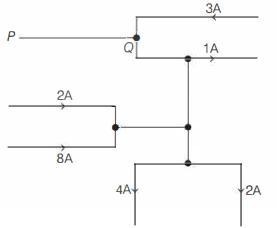
Figure below shows a portion of an electric circuit with the currents in amperes and their directions. The magnitude and direction of the current in the portion $P Q$ is
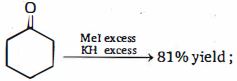
Product of the reaction is
Two waves having equations

${x_1} = a\sin (\omega \,t + {\phi _1})$, ${x_2} = a\sin \,(\omega \,t + {\phi _2})$

If in the resultant wave the frequency and amplitude remain equal to those of superimposing waves. Then phase difference between them is
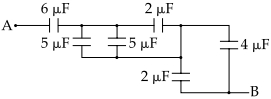
The equivalent capacitance between $A$ and $B$ in the circuit given below is.....$μF$
Two waves having sinusoidal waveforms have different wavelengths and different amplitude. They will be having
Number of particles is given by $n = - D\frac{{{n_2} - {n_1}}}{{{x_2} - {x_1}}}$ crossing a unit area perpendicular to X-axis in unit time, where ${n_1}$ and ${n_2}$ are number of particles per unit volume for the value of $x$ meant to ${x_2}$ and ${x_1}$. Find dimensions of $D$ called as diffusion constant
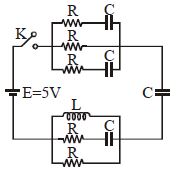
Find the current passing through battery immediately after key $(K)$ is closed. It is given  that initially all the capacitors are uncharged......$A$ (Given that $R = 6\,\Omega$ and $C = 4\, \mu F$)