A bulb has specification of one kilowatt and $250\, volts$, the resistance of bulb is .................. $\Omega$
Easy


Download our appand get started for free
Experience the future of education. Simply download our apps or reach out to us for more information. Let's shape the future of learning together!No signup needed.*
Similar Questions
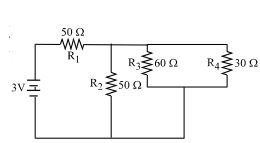
- 1Calculate the current shown by the ammeter $A$ in the circuit diagram is .............. $A$View Solution
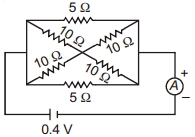
- 2View SolutionIn the experiment of potentiometer, at balance, there is no current in the
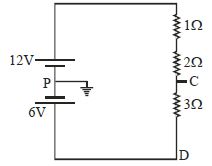
- 3Find potential at point $C$ and $D$View Solution
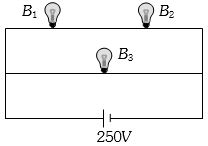
- 4A $100\, W$ bulb $B_1$, and two $60\,W$ bulbs $B_2$ and $B_3$, are connected to a $250\, V$ source, as shown in the figure. Now $ W_1, W_2$ and $W_3$ are the output powers of the bulbs $B_1, B_2$ and $B_3$, respectively. ThenView Solution
- 5Two wires have resistance of $2$ $\Omega$ and $4$ $\Omega$ connected to same voltage, ratio of heat dissipated at resistance isView Solution
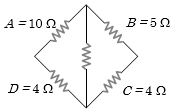
- 6In a typical Wheatstone network, the resistances in cyclic order are $A = 10 \,\Omega $, $B = 5 \,\Omega $, $C = 4 \,\Omega $ and $D = 4 \,\Omega $ for the bridge to be balancedView Solution
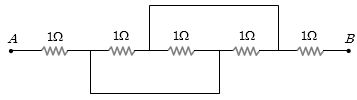
- 7Equivalent resistance between the points $A$ and $B$ is (in $\Omega$)View Solution
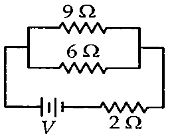
- 8If power dissipated in the $9 \,\Omega$ resistor in the circuit shown is $36\,W$, the potential difference across the $2 \,\Omega$ resistor is .......... $V$View Solution
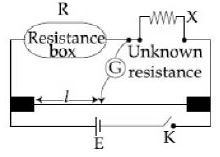
- 9In a meter bridge experiment, the circuit diagram and the corresponding observation table are shown in figureView Solution
$Sl$. $No$. $R\, (\Omega )$ $l\, (cm)$ $1$. $1000$ $60$ $2$. $100$ $13$ $3$. $10$ $1.5$ $4$. $1$ $1.0$ Which of the readings is inconsistent ?
- 10In the circuit shown, the resistances are given in ohms and the battery is assumed ideal with $\mathrm{emf}$ equal to $3.0$ $\mathrm{volts}.$ The resistor that dissipates the most power isView Solution