Question
A bulb is hanging over a table. At which portion of the table is the illuminance maximum? If a plane mirror is placed above the bulb facing the table, will the illuminance on the table increase?

Answer

The illuminance will be maximum on the area just below the bulb that is normal to the table.
Yes, the plane mirror will increase the radiant flux on the table, which will further increase the luminance flux of the table. Therefore, illuminance will increase.

Need a full question paper?

Generate a complete, print-ready paper with questions like this in minutes — across 16+ boards, with answer keys.
Start Generating Free

Similar questions

Given a uniform electric field$\overrightarrow{\text{E}} : 5\times 10^3 \hat{i}$ N/C, find the flux of this field through a square of l0 cm on a side whose plane is parallel to the y-z plane. What would be the flux through the same square if the plane makes a $30^\circ$ angle with the x-axis?
Explain the energy losses in a transformer.
Elemental semiconductor and compound semiconductors. Explain with examples.
State Kirchhoff's rules. Explain briefly how these rules are justified.
Find the maximum Coulomb force that can act on the electron due to the nucleus in a hydrogen atom.
The angular magnification of a system is less than one. Does it mean that the image formed is inverted?
In a Callender's compensated constant pressure air thermometer, the volume of the bulb is 1800 cc. When the bulb is kept immersed in a vessel, 200 cc of mercury has to be poured out. Calculate the temperature of the vessel.
A gas of hydrogen-like ions is prepared in a particular excited state A. It emits photons having wavelength equal to the wavelength of the first line of the Lyman series together with photons of five other wavelengths. Identify the gas and find the principal quantum number of the state A.
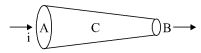
In the given figure, a current carrying conductor of non-uniform cross-section is shown. At what points, the magnitude will be maximum of (i) current (ii) current density and (iii) drift velocity?
Image
Show diagrammatically the behaviour of magnetic field lines in the presence of (i) paramagnetic and (ii) diamagnetic substances. How does one explain this distinguishing feature?