Question
A bulb is made using two filaments. A switch selects whether the filaments are used individually or in parallel. When used with a 15V battery, the bulb can be operated at 5W, 10W or 15W. What should be the resistances of the filaments?

Answer

The various resistances of the bulbs $=\frac{\text{V}^2}{\text{P}}$
Resistances are $\frac{(15)^2}{10},\frac{(15)^2}{10},\frac{(15)^2}{15},=45,22.5,15.$
Since two resistances when used in parallel have resistances less than both.
The resistances are 45 and 22.5.

Need a full question paper?

Generate a complete, print-ready paper with questions like this in minutes — across 16+ boards, with answer keys.
Start Generating Free

Similar questions

When light travels from an optically denser medium to a rarer medium, why does the critical angle of incidence depend on the color of the light?
Calculate the energy in fusion reaction:
$^{2}_{1}\text{H} + ^{2}_{1}\text{H}\rightarrow^{3}_{2}\text{H}+ \text{n}, \text{where BE}\text{ of} ^{ 2}_{1}\text{H} = 2.23 \text{MeV} \text{and} \text{of} ^{3}_{2}\text{He} = 7.73 \text{MeV}.$
  1. An em wave is travelling in a medium with a velocity $\overrightarrow{\text{v}} = \text{v}\hat{\text{i}}.$ Draw a sketch showing the propagation of the em wave, indicating the direction of the oscillating electric and magnetic fields.
  2. How are the magnitudes of the electric and magnetic fields related to the velocity of the em wave?
A concave lens is placed in water. Will there be any change in focal length? Give reason.
A galvanometer has a resistance of 30Ω. It gives full scale deflection with a current of 2 mA. Calculate the value of the resistance needed to convert it into an ammeter of range 0-0.3 A.
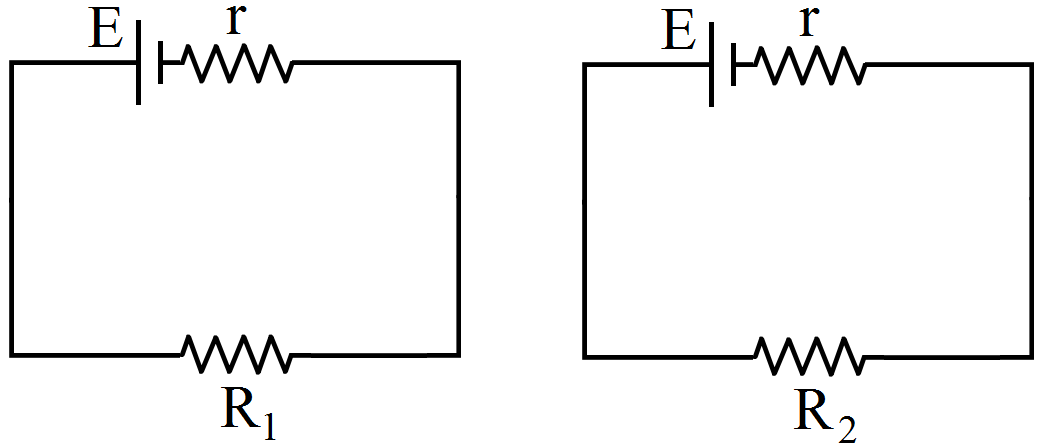
Two unequal resistances $R_1$ and $R_2$ are connected across two identical batteries of emf $\varepsilon$ and internal resistance $r$. Can the thermal energies developed in $R_1$ and $R_{2}$ be equal in a given time. If yes, what will be the condition?
Write short note on Nuclear Force.
The light emitted in the transition $n = 3$ to $n = 2$ in hydrogen is called $\text{H}_\alpha$ light. Find the maximum work function a metal can have so that $\text{H}_\alpha$ light can emit photoelectrons from it.
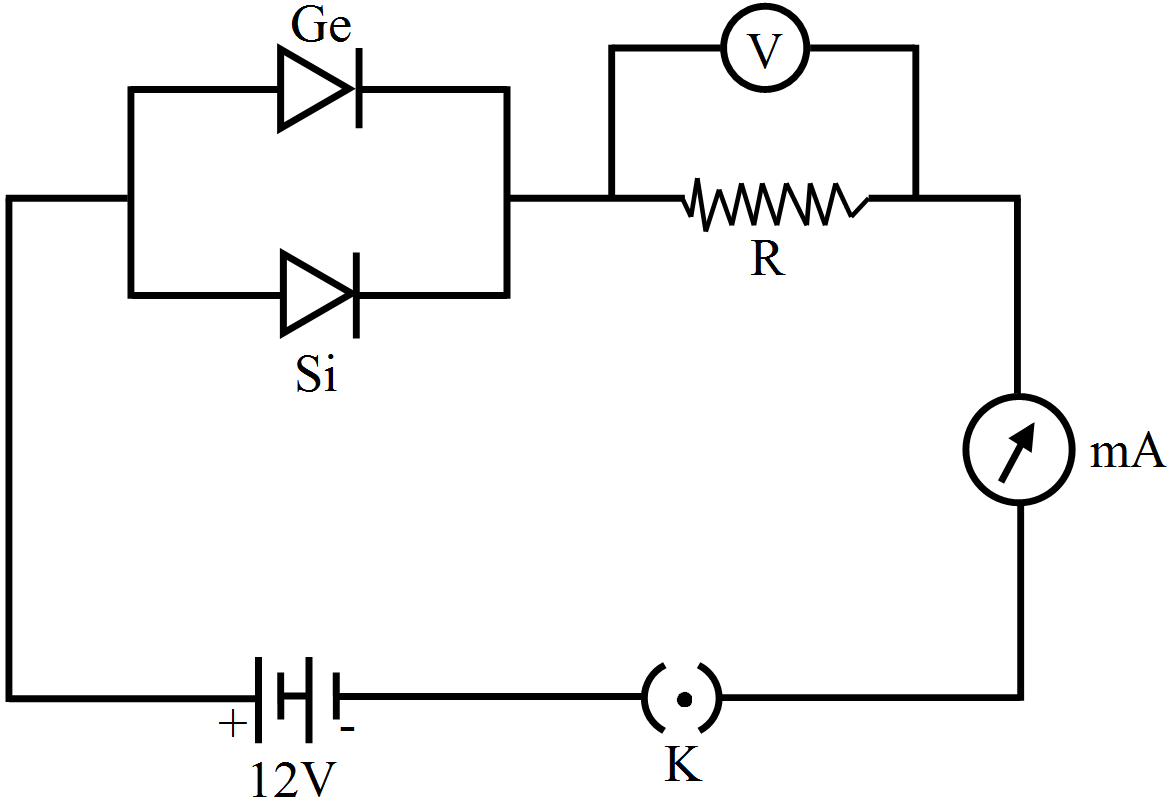
Germanium and silicon junction diodes are connected in parallel. A resistance R, a 12V battery, a milliammeter (mA) and key (K) are connected in series with them (figure). When key (K) is closed, a current begins to flow in the milliammeter. What will be the maximum reading of voltmeter connected across resistance R?
Find the angular separation between the consecutive bright fringes in a Young's double slit experiment with blue$-$green light of wavelength $500\ nm$. The separation between the slits is $2.0 \times 10^{-3}m.$