Question
Find the angular separation between the consecutive bright fringes in a Young's double slit experiment with blue$-$green light of wavelength $500\ nm$. The separation between the slits is $2.0 \times 10^{-3}m.$
Answer

Given that, $\lambda=500\text{nm}=500\times10^{-9}\text{m}$ and $d = 2 \times 10^{-3}m$​​​​​​​

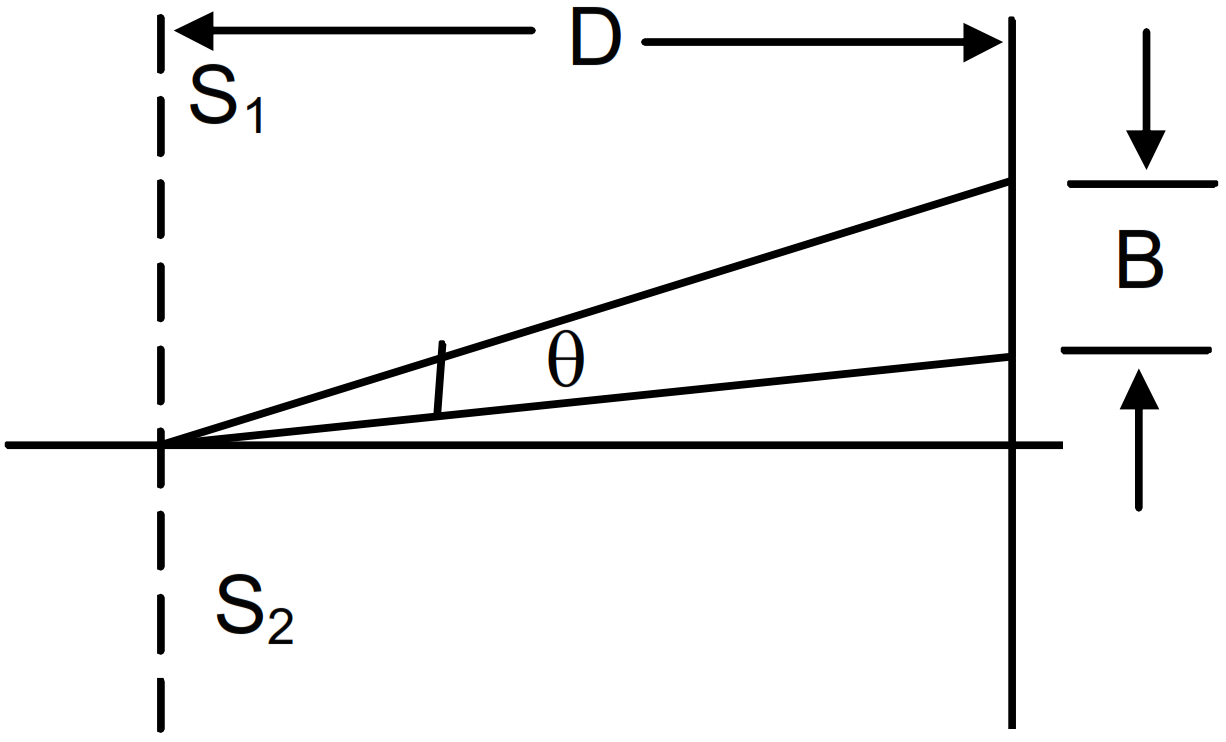
As shown in the figure, angular separation $\theta=\frac{\beta}{\text{D}}=\frac{\lambda\text{D}}{\text{dD}}=\frac{\lambda}{\text{d}}$
So, $\theta=\frac{\beta}{\text{D}}=\frac{\lambda}{\text{d}}=\frac{500\times10^{-9}}{2\times10^{-3}}=250\times10^{-6}$
$= 25 \times 10^{-5}​​​​​​​$ radian
​​​​​​​$= 0.01$4 degree.

Need a full question paper?

Generate a complete, print-ready paper with questions like this in minutes — across 16+ boards, with answer keys.

Start Generating Free

Similar questions

A bullet travelling with a velocity of 16m/s penetrates a tree trunk and comes to rest in 0.4m. Find the time taken during the retardation.
In the decay $^{64}\ce{Cu \rightarrow ^{64}Ni + e^+ + v}, $ the maximum kinetic energy carried by the positron is found to be $0.650MeV.$
  1. What is the energy of the neutrino which was emitted together with a positron of kinetic energy $0.150MeV$?
  2. What is the momentum of this neutrino in $kg-m/s$ ?
Use the formula applicable to a photon.
Compare the following:
i. Wavelengths of the incident solar radiation absorbed by the earth's surface and the radiation re-radiated by the earth.
ii. Tanning effect produced on the skin by UV incident directly on the skin and that coming through glass window.
Two metals A and B have work functions 4eV and 10eV respectively. Which metal has the higher threshold wavelength?
Derive an expression for (i) induced emf and (ii) induced current when a conductor of length l is moved with a uniform velocity, normal to a uniform magnetic field B. Assume the resistance of conductor to be R.
Light from Balmer series of hydrogen is able to eject photoelectrons from a metal. What can be the maximum work function of the metal?
Two successive resonance frequencies in an open organ pipe are 1944Hz and 2592Hz. Find the length of the tube. The speed of sound in air is 324m/s.
A small sphere of radius $r_1$ and charge $q_1$ is enclosed by a spherical shell of radius $r_2$ and charge $q_2.$ Show that if $q_1$ is positive, charge will necessarily flow from the sphere to the shell $($when the two are connected by a wire$)$ no matter what the charge $q_2$ on the shell is.
The pendulum of a clock is replaced by a spring-mass system with the spring having spring constant 0.1N/m. What mass should be attached to the spring?
Consider two particles A and B having equal charges and placed at some distance. The particle A is slightly displaced towards B. Does the force on B increase as soon as the particle A is displaced? Does the force on the particle A increase as soon as it is displaced?