MCQ
A bullet from a gun is fired on a rectangular wooden block with velocity $u$. When bullet travels 16 cm through the block along its length horizontally, velocity of bullet become $\frac{2 u}{3}$. Then it further penetrates into the block in the same direction before coming to rest exactly at the other end of the block. The total length of the block is:
  • A
    28.7cm
  • B
    27.7cm
  • 28.8 cm
  • D
    28.9 cm

Answer

Correct option: C.
28.8 cm
(C)
$\begin{array}{l}\frac{1}{2} m\left(\frac{2 u}{3}\right)^2-\frac{1}{2} m u^2=-F_R \times 160 \\ 0-\frac{1}{2} m u^2=-F_R \times d \\ \frac{\frac{1}{2} m u^2}{\frac{1}{2} m u^2 \times \frac{5}{9}}=\frac{d}{16} \\ d=\frac{16 \times 9}{5}=28.8 cm\end{array}$

Need a full question paper?

Generate a complete, print-ready paper with questions like this in minutes — across 16+ boards, with answer keys.

Start Generating Free

Similar questions

The total internal energy of two mole monoatomic ideal gas at temperature $T=300\,K$ will be ...........$J$.

$\text { (Given } R =8.31\,J / mol.K )$

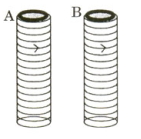
Two metallic rings $\mathrm{A}$ and $\mathrm{B}$, identical in shape and size but having different resistivities $\rho_A$ and $\rho_B$, are kept on top of two identical solenoids as shown in the figure. When current $I$ is switched on in both the solenoids in identical manner, the rings $\mathrm{A}$ and $\mathrm{B}$ jump to heights $h_A$ and $h_B$, respectively, with $h_A>h_B$. The possible relation$(s)$ between their resistivities and their masses $m_A$ and $m_B$ is(are)

$(A)$ $\rho_A>\rho_B$ and $m_A=m_B$

$(B)$ $\rho_A<\rho_B$ and $m_A=m_B$

$(C)$ $\rho_A>\rho_B$ and $m_A > m_B$

$(D)$ $\rho_A<\rho_B$ and $m_A < m_B$

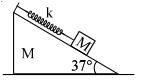
The system of the wedge and the block connected by a massless spring as shown in the figure is released with the spring in its natural length. Friction is absent. maximum elongation in the spring will be
Frequency is the function of density $(\rho )$, length $(a)$ and surface tension $(T)$. Then its value is
A projectile is projected with velocity of $25\, m / s$ at an angle $\theta$ with the horizontal. After t seconds its inclination with horizontal becomes zero. If $R$ represents horizontal range of the projectile, the value of $\theta$ will be : [use $g =10 m / s ^{2}$ ]
What was the fissionable material used in bomb dropped at Nagasaki (Japan) in the year $1945$ ?
Two bodies of mass $m$ and $9 m$ are placed at a distance $R$. The gravitational potential on the line joining the bodies where the gravitational field equals zero, will be ( $G=$ gravitational constant) :
The electric field of a plane electromagnetic wave varies with time of amplitude $2\, Vm^{-1}$ propagating along $z$ -axis. The average energy density of the magnetic field  (in $J\, m^{-3}$) is 
Two projectiles are thrown simultaneously in the same plane from the same point. If their velocities are $v_1$ and $v_2$ at angles $\theta _1$ and $\theta_2$ respectively from the horizontal, then answer the following question

The trajectory of particle $1$ with respect to particle $2$ will be

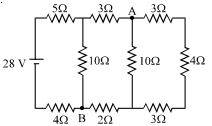
Consider the circuit shown in the figure