MCQ 14 Marks
The radius of inner most orbit of hydrogen atom is $4.5 \times 10^{-11} m$. What is the radius of fourth allowed orbit of hydrogen atom?
Answer(C)
$\begin{array}{l}r_n=a_0 n^2 \\ r_1=a_0=4.5 \times 10^{-11} m \\ r_4=a_0(4)^2 \\ =4.5 \times 10^{-11} \times 16 \\ =72.0 \times 10^{-11}=7.2 Å \end{array}$
View full question & answer→MCQ 24 Marks
Two thin lenses are of same focal lengths (f), both are of Convex. When they are placed in contact with each other, the equivalent focal length of the combination will be:
AnswerCorrect option: D. $f / 2$
(D)
$\begin{array}{l}F_{\text {convex }}=f \\ \frac{1}{f_{\text {comb }}}=\frac{1}{F_{\text {coavex }}}+\frac{1}{F_{\text {corvex }}} \\ =\frac{1}{f}+\frac{1}{ f } \\ \Rightarrow f_{\text {comb }}=\frac{ f }{2}\end{array}$
View full question & answer→MCQ 34 Marks
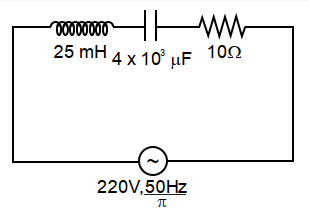
The net impedance of circuit (as shown in figure) will be
- ✓
$10 \Omega$
- B
$10 \sqrt{2} \Omega$
- C
$5 \sqrt{2} \Omega$
- D
$5 \sqrt{5} \Omega$
AnswerCorrect option: A. $10 \Omega$
(A)
$\begin{array}{l}\omega=2 \pi f \Rightarrow \omega=100 \\ Z=\sqrt{10^2+\left(\omega L-\frac{1}{\omega C}\right)^2} \\ =\sqrt{100+\left(100 \times 25 \times 10^{-3}-\frac{1}{100 \times 4 \times 10^3 \times 10^{-6}}\right)} \\ =\sqrt{100+(2.5-2.5)^2} \\ =\sqrt{100} \\ Z=10 \Omega\end{array}$
View full question & answer→MCQ 44 Marks
A wire carrying a current I along the positive x-axis has length L. It is kept in a magnetic field of 6T. The magnitude of the magnetic force acting on the wire is:
- ✓
- B
$\frac{6}{\sqrt{2}} IL$
- C
- D
Answer(A)
$|\vec{F}|=|(\vec{L} \times \vec{B})|
$
$
F=6 IL
$
View full question & answer→MCQ 54 Marks
20 resistors, each of resistance 2R are connected in series to a battery of emf E and negligible internal resistance. Then those are connected in parallel to the same battery, the current is increased n/2 times. The value of n is:
Answer(B)
$\begin{array}{l}i_{\text {series }}=\frac{E}{R_{\text {series }}} \\ \Rightarrow i_{\text {series }}=\frac{E}{40 R} \\ i_{\text {parallel }}=\frac{E}{R_{\text {Parallel }}} \\ =\frac{E}{R / 10}\end{array}$
$\begin{array}{l}i_{\text {parallel }}=n \times i_{\text {secies }} \\ \Rightarrow \frac{10 E}{R}=\frac{\frac{n}{2} E}{40 R} \\ \Rightarrow n=800\end{array}$
View full question & answer→MCQ 64 Marks
The resistance of platinum wire at $0^{\circ} C$ is $1 \Omega$ and $6 \Omega$ at $60^{\circ} C$. The temperature coefficient of resistance of the wire is:
AnswerCorrect option: B. $8.33 \times 10^{-2}$
(B)
$\begin{array}{l} R = R _0(1+\alpha \Delta T ) \\ \Rightarrow 6=1[1+\alpha \times(60-0)] \\ \Rightarrow \alpha=\frac{6-1}{60} \\ =\alpha=\frac{5}{60} \\ =\alpha=8.33 \times 10^{-2}\end{array}$
View full question & answer→MCQ 74 Marks
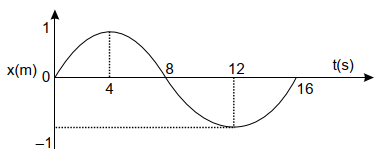
The $x$-t graph of a particle performing simple harmonic motion is shown in the figure. The acceleration of the particle at $t=12 s$ is:
- A
$-\frac{\pi^2}{64} ms^{-2}$
- ✓
$\frac{\pi^2}{64} ms^{-2}$
- C
$-\frac{\pi^2}{24} ms^{-2}$
- D
$\frac{\pi^2}{16} ms^{-2}$
AnswerCorrect option: B. $\frac{\pi^2}{64} ms^{-2}$
(B)
From x - t graph,
$\begin{array}{l}A=1, T=16 \\
\Rightarrow \omega=\frac{2 \pi}{T} \\
\Rightarrow \omega=\frac{\pi}{8} \\
\text { at } t=12, x=-1 \\
a=-\omega^2 x\end{array}$
$\begin{array}{l}\Rightarrow a=\frac{-\pi^2}{64} \times-1 \\ \Rightarrow a=\frac{\pi^2}{64} m / s ^2\end{array}$
View full question & answer→MCQ 84 Marks
A satellite is orbiting just above the surface of the earth with period T. If $\frac{x}{2}$ is the density of the earth and $G$ is the universal constant of gravitation, the quantity $\frac{3 \pi}{2 G x}$ represents:
- A
$\frac{\sqrt{T}}{2}$
- B
$\frac{ T ^2}{2}$
- ✓
$\frac{ T ^2}{4}$
- D
$\frac{ T ^2}{6}$
AnswerCorrect option: C. $\frac{ T ^2}{4}$
(C)
Time period of satellite
$\begin{array}{l}T=2 \pi \sqrt{\frac{ R ^3}{ GM }} \\ =2 \pi \sqrt{\frac{ R ^3}{ G \times \frac{ x }{2} \times \frac{4}{2} \pi R ^3}} \\ \Rightarrow T=\sqrt{\frac{6 \pi}{ Gx }} \\ T ^2=\frac{6 \pi}{ Gx }=\frac{4 \times 3 \pi}{2 Gx } \\ \Rightarrow \frac{3 \pi}{2 Gx }=\frac{ T ^2}{4}\end{array}$
View full question & answer→MCQ 94 Marks
A bullet from a gun is fired on a rectangular wooden block with velocity $u$. When bullet travels 16 cm through the block along its length horizontally, velocity of bullet become $\frac{2 u}{3}$. Then it further penetrates into the block in the same direction before coming to rest exactly at the other end of the block. The total length of the block is:
Answer(C)
$\begin{array}{l}\frac{1}{2} m\left(\frac{2 u}{3}\right)^2-\frac{1}{2} m u^2=-F_R \times 160 \\ 0-\frac{1}{2} m u^2=-F_R \times d \\ \frac{\frac{1}{2} m u^2}{\frac{1}{2} m u^2 \times \frac{5}{9}}=\frac{d}{16} \\ d=\frac{16 \times 9}{5}=28.8 cm\end{array}$
View full question & answer→MCQ 104 Marks
Calculate the maximum acceleration of a moving car so that a body lying on the floor of the car remains stationary. The coefficient of static friction between the body and the floor is 0.25
$\left( g =10 ms^{-2}\right)$
- A
$0.25 ms^{-2}$
- ✓
$2.5 ms^{-2}$
- C
$25 ms^{-2}$
- D
$1.5 ms^{-2}$
AnswerCorrect option: B. $2.5 ms^{-2}$
(B)
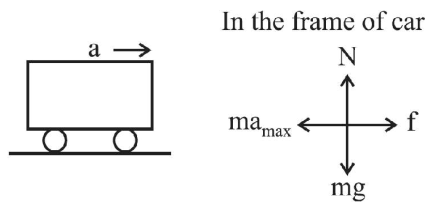
$\begin{array}{l} N = mg \\ \text { and } f = ma \\ f \leq \mu N \\ \Rightarrow a \leq \mu g \\ \Rightarrow a \leq 2.5 ms^{-2} \\ \text { or } a _{\max }=2.5 ms^{-2}\end{array}$
View full question & answer→MCQ 114 Marks
A horizontal bridge is built across a river. A student standing on the bridge throws a small ball vertically downwards with a velocity $6 ms^{-1}$. The ball strikes the water surface after $2 s$. The height of bridge above water surface is (Take $g =10 m^{-2}$ ):
Answer(C)
Let height of bridge $=h$
Displacement of ball, $S =- h$
$\begin{array}{l}S=ut+\frac{1}{2} a t^2 \\
-h=-6 \times 2+\frac{1}{2}(-10)(2)^2 \\
\Rightarrow h=32 m\end{array}$
View full question & answer→MCQ 124 Marks
Given below are two statements:
Statement I: Photovoltaic devices can convert optical radiation into electricity.
Statement II: Zener diode is designed to operate under forward bias in breakdown region.
Choose the most appropriate answer from the options given below:
- A
Statement I is incorrect but Statement II is correct
- B
Both Statement I and Statement II are correct.
- C
Both Statement I and Statement II are incorrect
- ✓
Statement I is correct but Statement II is incorrect.
AnswerCorrect option: D. Statement I is correct but Statement II is incorrect.
View full question & answer→MCQ 134 Marks
A full wave rectifier circuit consists of two p-n junction diodes, a centre-tapped transformer, capacitor and a load resistance. Which of these components remove the ac ripple from the rectified output
- A
- B
A centre-tapped transformer
- C
- ✓
Answer(D)
Capacitor in parallel removes the ac ripple from the rectified output.
View full question & answer→MCQ 144 Marks
A semicircular ring of radius 1 m is uniformly charged with a total charge of $4.2 \times 10^{-9} C$. The magnitude of electric field intensity at the center of this ring is approximately:
- A
- B
$320 V / m$
- C
$240 V / m$
- ✓
$24 V / m$
AnswerCorrect option: D. $24 V / m$
View full question & answer→MCQ 154 Marks
In hydrogen spectrum, the shortest wavelength in the Balmer series is $\lambda$. the shortest wavelength in the Paschan series is:
- ✓
$\frac{9 \lambda}{4}$
- B
$\frac{3 \lambda}{4}$
- C
$\frac{9 \lambda}{2}$
- D
$\frac{3 \lambda}{2}$
AnswerCorrect option: A. $\frac{9 \lambda}{4}$
(A)
$\begin{array}{l}\because \frac{1}{\lambda}= R \left(\frac{1}{ n _2^2}-\frac{1}{ n _1^2}\right) \\ \Rightarrow \frac{1}{\lambda}= R \left(\frac{1}{2^2}\right) \\ \Rightarrow \lambda=\frac{4}{ R }\end{array}$
$\begin{aligned} & \frac{1}{\lambda^{\prime}}= R \left(\frac{1}{3^2}\right) \\ \Rightarrow \lambda^{\prime} & =\frac{9}{ R } \\ \Rightarrow \lambda^{\prime} & =\frac{9 \lambda}{4}\end{aligned}$
View full question & answer→MCQ 164 Marks
The work functions of Caesium (Cs), Potassium (K) and Sodium ( Na ) are $2.04 eV , 2.20 eV$ and $2.40 eV$ respectively. If incident elecromagnetic radiation has an incident energy of $2.40 eV$, which of these photosensitive surfaces may emit photoelectrons?
Answer(C)
Incident energy $=2.20 eV$
If $\phi<2.4 eV$ electron will emit.
$\phi>2.4 eV$ No electron emission
Both Cs & K will emit electron
View full question & answer→MCQ 174 Marks
The maximum loss of energy of X-rays produced by an electron accelerated through a potential difference of V volts is proportional to:
- A
$V^2$
- B
$\sqrt{V}$
- ✓
$\frac{1}{V}$
- D
$\frac{1}{\sqrt{v}}$
AnswerCorrect option: C. $\frac{1}{V}$
(C)
$eV =$ Energy of electron
for minimum wavelength, maximum loss of energy
$\begin{array}{l}eV=\left(\frac{hc}{\lambda}\right) \\
\lambda \propto\left(\frac{1}{V}\right)\end{array}$
View full question & answer→MCQ 184 Marks
For Young's double slit experiment, two statements are given below:
Statement I: If screen is moved towards the plane of slits, angular separation of the fringes remains constant.
Statement II: If the monochromatic source is replaced by another monochromatic source of larger wavelength, the angular separation of fringes increases.
- A
Statement I is false but Statement II is true
- ✓
Both Statement I and Statement II is true
- C
Both Statement I and Statement II is false
- D
Statement I is true but Statement II is false
AnswerCorrect option: B. Both Statement I and Statement II is true
(B)
$\Delta \theta=\frac{\lambda}{d}$
$\Delta \theta$ is proportional to I but independent of $D$.
View full question & answer→MCQ 194 Marks
Light travels a distance $2 x$ in time $t_1$ in air and $5 x$ in time $t_2$ in another denser medium. What is the critical angle for this?
- ✓
$\sin ^{-1}\left(\frac{5 t_1}{2 t_2}\right)$
- B
$\sin ^{-1}\left(\frac{t_2}{t_1}\right)$
- C
$\sin ^{-1}\left(\frac{10 t_2}{4 t_1}\right)$
- D
$\sin ^{-1}\left(\frac{2 t_1}{5 t_2}\right)$
AnswerCorrect option: A. $\sin ^{-1}\left(\frac{5 t_1}{2 t_2}\right)$
(A)
Speed of light in air is
$C-\frac{2 x}{t_1}$
Speed of light in another denser medium.
$\begin{array}{l}C_2=\frac{5 x}{t_2} \\
\Rightarrow \mu=\frac{C}{C_2}=\frac{2 x}{t_1} \times \frac{t_2}{5 x} \\
\Rightarrow \mu=\frac{2 t_2}{5 t_1}\end{array}$
For total internal reflection
$\sin C-\frac{1}{\mu}$
$\Rightarrow \sin C=\frac{5 t_1}{2 t_2}$
$C=\sin ^{-1}\left(\frac{5 t_1}{2 t_2}\right)$
View full question & answer→MCQ 204 Marks
In a plane electromagnetic wave travelling in free space, the electric field component oscillates sinusoidally at a frequency of $1.0 \times 10^{10} Hz$ and amplitude $72 Vm ^{-1}$. Then the amplitude of oscillating magnetic field is:
(Speed of light in free space $=3 \times 10^8 ms^{-1}$ )
- A
$2.4 \times 10^{-6} T$
- B
$1.6 \times 10^{-9} T$
- C
$2.4 \times 10^{-8} T$
- ✓
$2.4 \times 10^{-7} T$
AnswerCorrect option: D. $2.4 \times 10^{-7} T$
(D)
$\begin{array}{l}B=\frac{E}{C}=\frac{72}{3 \times 10^8}=24 \times 10^{-8} \\ =2.4 \times 10^{-7} T\end{array}$
View full question & answer→MCQ 214 Marks
An ac source is connected to a capacitor C. Due to increase in its operating frequency:
- A
Capacitive reactance increases.
- B
Capacitive current decreases.
- ✓
Displacement current increases
- D
Displacement current decreases.
AnswerCorrect option: C. Displacement current increases
(C)
Capacitive reactance $=\frac{1}{\omega C }= X _{ c }$ (say)
On increasing the operating frequency $w$ increases
As $X_c$ is inversily proportional to $w$ the value of $X_c$ decreses.
$\begin{array}{l}\therefore I_c=I_D \\
=\frac{V_o}{X_c}\end{array}$
As $X_c$ decreases therefore displacement current Id increases.
View full question & answer→MCQ 224 Marks
In a series LCR circuit, the inductance L is $40 mH$, capacitance C is $4 \mu F$ and resistance R is $200 \Omega$. The frequency at which resonance
- ✓
- B
$0.20 rad / s$
- C
- D
$1.59 rad / s$
Answer(A)
For resonance frequency
$\begin{array}{l}\omega L=\frac{1}{\omega C} \\
\Rightarrow \omega=\frac{1}{\sqrt{LC}}=\frac{1}{\sqrt{40 \times 10^{-3} \times 4 \times 10^{-6}}} \\
\frac{1}{\sqrt{16 \times 10^{-8}}}=2.5 \times 10^3 rad / sec \\
f=\left(\frac{\omega}{2 \pi}\right)=\frac{2.5 \times 10^3}{2 \pi}=0.40 kHz\end{array}$
View full question & answer→MCQ 234 Marks
The magnetic energy stored in an inductor of inductance $6 \mu H$ carrying a current of 5A is:
- ✓
$75 \mu J$
- B
$150 \mu J$
- C
- D
AnswerCorrect option: A. $75 \mu J$
(A)
$\begin{array}{l}\text { Magnetic energy stored in an inductor }=\frac{1}{2} LI ^2 \\ =\frac{1}{2} \times 6 \times 10^{-5} \times(5)^2 \\ =75 \mu J\end{array}$
View full question & answer→MCQ 244 Marks
The net magnetic flux through any closed surface is:
Answer(B)
$\oint_s \vec{B} \cdot d \vec{A}=0$ (No monopole exist)
View full question & answer→MCQ 254 Marks
If the mass of a particle as well as its speed are doubled, then de-Broglie wavelength associated with the particle will;
- A
increased by a factor more than 2
- B
increase by a factor of 2
- C
decrease by a factor of 2
- ✓
decrease by a factor more than 2
AnswerCorrect option: D. decrease by a factor more than 2
View full question & answer→MCQ 264 Marks
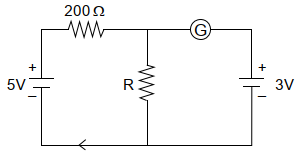
If the galvanometer G does not show any deflection in the circuit shown, the value of R is given by:
- A
$400 \Omega$
- B
$200 \Omega$
- ✓
$300 \Omega$
- D
$100 \Omega$
AnswerCorrect option: C. $300 \Omega$
(C)
No current through 'G'
So potential difference across R is 3 v
$\begin{array}{l}
i=\frac{2}{200}=\frac{1}{100} \\
R=\frac{3}{\frac{1}{100}}=300 \Omega\end{array}$
View full question & answer→MCQ 274 Marks
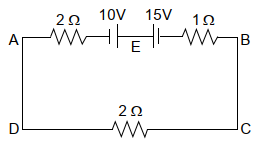
The magnitude and direction of the current in the following circuit is
- A
1.5 A from B to A through E
- ✓
1.0 A from B to A through E
- C
1.0 A from A to B through E
- D
2.0 A from A to B through E
AnswerCorrect option: B. 1.0 A from B to A through E
(B)
The circuit can be redrawn as an equivalent circuit given below
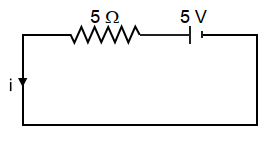
$\Rightarrow i =\frac{5}{5}=1.0 A$ View full question & answer→MCQ 284 Marks
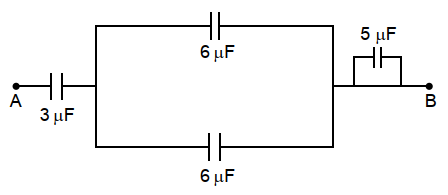
The equivalent capacitance of the system shown in the following circuit is:
- ✓
$2.4 \mu F$
- B
$6.5 \mu F$
- C
$1.5 \mu F$
- D
$0 \mu F$
AnswerCorrect option: A. $2.4 \mu F$
(A)
$3 \mu F$ and $3 \mu F$ in parallel
$=C_{\text {eqv }}=6+6=6 \mu F$
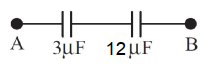
Now, $C _{\text {eq }}^{\prime}=\frac{36}{15}=2.4 \mu F$ View full question & answer→MCQ 294 Marks
If number of flux lines entering the surface equal to the number of flux lines leaving it, then
Answer(D)
$\oint \overrightarrow{E} \cdot d \overrightarrow{s}=0 \Rightarrow \phi_{\text {net }}=\phi_{\text {in }}-\phi_{\text {out }}=0$
$\Rightarrow \phi_{\text {in }}=\phi_{\text {out }}$
View full question & answer→MCQ 304 Marks
An electric dipole is placed at an angle of $60^{\circ}$ with an electric field of intensity $1 \times 10^5 NC ^{-1}$. It experiences a torque equal to 5 Nm. Calculate the magnitude of charge on the dipole, if the dipole length is 2 cm
- A
- ✓
$\frac{5}{\sqrt{3}} mC$
- C
$\sqrt{3} mC$
- D
$2 \sqrt{3} mC$
AnswerCorrect option: B. $\frac{5}{\sqrt{3}} mC$
(B)
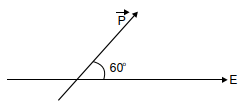
$\begin{array}{l}\vec{\tau}=\overrightarrow{ P } \times \overrightarrow{ E } \\ |\vec{\tau}|=P E \sin \theta \Rightarrow= q \times 2 a \times E \sin 60^{\circ} \\ q =\frac{5}{\left(2 \times 10^{-2}\right) \times 1 \times 10^5 \times\left(\frac{\sqrt{3}}{2}\right)} \\ =\frac{5}{\sqrt{3}} \times 10^{-3} C \end{array}$ View full question & answer→MCQ 314 Marks
The ratio of frequencies of fundamental harmonic produced by a closed pipe to that of an open pipe having the length in ratio 1 : 3
- A
$3: 1$
- B
$1: 2$
- ✓
$3: 2$
- D
$2: 3$
AnswerCorrect option: C. $3: 2$
(C)
Fundamental hormonic frequency closed pipe
$=\frac{v}{4 L_1}=v_1 \text { (say) }$
Fundamental hormonic frequency of open pipe
$\begin{array}{l}=\frac{v}{2 L_2}=v_2 \text { (say) } \\
\Rightarrow \frac{v_1}{v_2}=\frac{\frac{v}{4 L_1}}{\frac{v}{2 L_2}}=\frac{2}{4} \times \frac{L_2}{L_1}=\frac{1}{2} \times \frac{3}{1}=3: 2\end{array}$
View full question & answer→MCQ 324 Marks
The temperature of a gas is $-100^{\circ} C$ . To what temperature the gas should be heated so that the rms speed is increased by 5 times?
- ✓
$5955^{\circ} C$
- B
- C
$3295^{\circ} C$
- D
AnswerCorrect option: A. $5955^{\circ} C$
(A)
$\begin{array}{l}Ti=-100^{\circ} C=173 K \\
v_{mms} \propto \sqrt{T}\end{array}$
As $v _{ rms }$ increased by 5 times
$\begin{array}{l}\text { So }\left(v_{r m s}\right)_f=6\left(v_{r m s}\right)_{\text {initial }} \\
T_f=36 T_{i} \\
=36 \times 173 \\
=6228 K \\
T_{f}=(3368-273)^{\circ} C \\
=3295^{\circ} C\end{array}$
View full question & answer→MCQ 334 Marks
A photon of energy 5 eV is incident on a metal surface of work function 3 eV. Maximum K.E. of the emitted photo electrons will be;
Answer(C)
$\begin{array}{l}\text { (K.E. })_{\max }= hv -\phi_0 \\ =5 eV -3 eV =2 eV \end{array}$
View full question & answer→MCQ 344 Marks
The measuring device which is based on Bernoulli's principle:
MCQ 354 Marks
The amount of energy required to form a bubble of radius 3 cm from a soap solution is nearly: (surface tension of soap solution = $0.05 N m ^{-1}$)
- A
$2.131 \times 10^{-3} J$
- B
$3.131 \times 10^{-3} J$
- ✓
$1.131 \times 10^{-3} J$
- D
$4.131 \times 10^{-3} J$
AnswerCorrect option: C. $1.131 \times 10^{-3} J$
(C)
Surface energy of bubble $=2 \times$ charge in surface area $\times$ surface tension
$\begin{array}{l}=8 \pi R^2 \times T \\ =8 \times 3.142 \times 9 \times 10^{-4} \times 5 \times 10^{-2} J \\ =1.131 \times 10^{-3} J\end{array}$
View full question & answer→MCQ 364 Marks
Let a wire be suspended from the ceiling (rigid support) and stretched by a weight 4W attached at its free end. The longitudinal stress at any point of cross-sectional area 2A of the wire is:
- A
- ✓
$\frac{2 W}{A}$
- C
$\frac{W}{A}$
- D
$\frac{W}{2A}$
AnswerCorrect option: B. $\frac{2 W}{A}$
(B)
Stress $=\frac{F}{A}=\frac{T}{A}=\frac{4 W}{2 A}=\frac{2 W}{A}$
View full question & answer→MCQ 374 Marks
Two bodies of mass m and 25m are placed at a distance R. The gravitational potential on the line joining the bodies where the gravitational field equals zero, will be ( G = graviational constant):
- A
$-\frac{20 Gm }{ R }$
- B
$-\frac{30 Gm }{ R }$
- ✓
$-\frac{36 Gm }{ R }$
- D
$-\frac{16 Gm }{ R }$
AnswerCorrect option: C. $-\frac{36 Gm }{ R }$
(C)
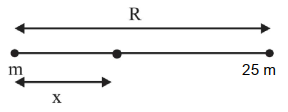
Let the gravitational field is zero at a distance x from the mass m.
$\begin{array}{l}\frac{G m}{x^2}=\frac{G 25 m}{(R-x)^2} \\
\Rightarrow R-x=5 x \text { or } x=\frac{R}{6}
\end{array}$
gravitational potential at $\frac{R}{6}$
$=-\frac{G m}{\frac{R}{6}}-\frac{G 25 m}{\frac{5 R}{6}}=\frac{-6 Gm}{R}-\frac{30 Gm}{R}=\frac{-36 Gm}{R}$ View full question & answer→MCQ 384 Marks
The ratio of radius of gyration of a thin hollow sphere of mass M and radius 2.236 R about its own axis to the radius of gyration of the solid sphere of same mass and radius 1.73 R about its axis is:
- A
$5: 2$
- B
$3: 5$
- ✓
$5: 3$
- D
$2: 5$
AnswerCorrect option: C. $5: 3$
(C)
Radius of gyration of a solid surface,
$K_{s}=\sqrt{\frac{2}{5}} \times 1.73 R$
Radius of gyration of a hollow surface,
$\begin{array}{l}K_{H}=\sqrt{\frac{2}{3}} \times 2.236 R \\
\Rightarrow \frac{K_{H}}{K_{S}}=\sqrt{\frac{5}{3}} \times \frac{2.236}{1.73} \quad=\frac{K_{H}}{K_{s}}=\frac{5}{3}\end{array}$
View full question & answer→MCQ 394 Marks
The quantity which direction is axial in the circular motion:
Answer(C)
The angular acceleration direction is given along angular velocity or opposite to angular velocity depending upon whether angular velocity magnitude is increasing or decreasing and this direction remains along the axis of circular motion.
View full question & answer→MCQ 404 Marks
The potential energy of a long spring when stretched by 2 cm is U. If the spring is stretched by 4 cm, potential energy stored in it will be:
Answer(C)
Potential energy stored in the spring $=\frac{1}{2} k x^2$
Now $\frac{1}{2} k(2)^2=U$ and $\frac{1}{2} k(8)^2=U^{\prime}$ (say)
$\Rightarrow U^{\prime}=\frac{64}{4} U=16 U$
View full question & answer→MCQ 414 Marks
A bullet is fired from a gun at the speed of 180 m/s in the direction 60° above the horizontal. The maximum height attained by the bullet is
$\left( g =9.8 ms^{-2}, \sin 30^{\circ}=0.5\right)$
Answer(B)
$\begin{array}{l}h_{\max }=\frac{u^2 \sin ^2 \theta}{2 g}=\frac{180 \times 180}{2 \times 9.8} \times \frac{3}{4} \\ =1240 m\end{array}$
View full question & answer→MCQ 424 Marks
A football player is moving westward and suddenly turns southward with same speed to avoid an opponent. The force that acts on the player while turning is:
Answer(A)
$\begin{array}{l}\text { Iniial velocity }=-v \hat{i} \\ \text { Final velocity }=-v \hat{j}\end{array}$
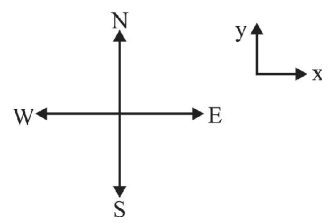
Change in velocity $=-v \hat{j}-(-v \hat{i})$
$=v \hat{i}-v \hat{j}$
Momentum gain is along $\hat{i}+\hat{j}$
$\Rightarrow$ Force experienced is along $\hat{i}+\hat{j}$
$\Rightarrow$ Force experienced is in North-East direction. View full question & answer→MCQ 434 Marks
A vehicle travels half the distance with speed $\frac{ v }{2}$ and the remaining distance with speed $4 v$. Its average speed is:
- ✓
$\frac{8 v }{9}$
- B
$\frac{v }{3}$
- C
$\frac{8 v }{3}$
- D
$\frac{4 v }{3}$
AnswerCorrect option: A. $\frac{8 v }{9}$
(A)
Average speed $=\left(\frac{4 v^2}{3 v}\right)=\frac{4 v}{3}$
View full question & answer→MCQ 444 Marks
A metal wire has mass $(0.8 \pm 0.001) g$, radius $(0.3 \pm 0.002) mm$ and length $(5 \pm 0.04) cm$. The maximum possible percentage error in the measurement of density will nearly be:
Answer(C)
$m=\rho \pi r^2 I$
$\rho=\frac{m}{\pi r^2 \|}$
$\frac{\Delta \rho}{\rho}=\frac{\Delta m}{m}+\frac{2 \Delta r}{r}+\frac{\Delta l}{l}$
$=\frac{0.001}{0.8} \times 100+\frac{2 \times 0.002}{0.3} \times 100+\frac{0.04}{5} \times 100$
$=\frac{1}{8}+\frac{4}{3}+\frac{4}{5}=2.25 \%$
View full question & answer→MCQ 454 Marks
The errors in the measurement which arise due imperfection or faulty calibration of the measuring devices
Answer(B)
As the factors controlling temperature and voltage supply are beyond prediction and control so the error occurred due to unpredictable fluctuations of temperature and voltage would be random errors.
View full question & answer→