MCQ
A bullet from a gun is fired on a rectangular wooden block with velocity $u$.When bullet travels $24\,cm$ through the block along its length horizontally, velocity of bullet becomes $\frac{u}{3}$. Then it further penetrates into the block in the same direction before coming to rest exactly at the other end of the block. The total length of the block is $........\,cm$
  • A
    $30$
  • $27$
  • C
    $24$
  • D
    $28$

Answer

Correct option: B.
$27$
b
By $v^2=u^2+2 a s$

$\left(\frac{u}{3}\right)^2=u^2-2 a x$

$2 a x=u^2-\frac{u^2}{9}$

$2 a x=\frac{8 u^2}{9}.........(1)$

Similarly from starting

$v^2=u^2+2 ax$

$0= u ^2-2 ax _2$

$2 ax _2= u ^2..........(2)$

$By (1) /(2)$

$\frac{ x }{ x _2}=\frac{8}{9}$

$\frac{24}{ x _2}=\frac{8}{9}$

$x _2=27\,cm$

Need a full question paper?

Generate a complete, print-ready paper with questions like this in minutes — across 16+ boards, with answer keys.

Start Generating Free

Similar questions

A Carnot engine whose sink is at $300\, K$ has an efficiency of  $40\%.$ By how much should the temperature of source be increased so as to increase its efficiency by $50\%$ of original efficiency  ..... $K$
A particle is executing $SHM$ of amplitude $A,$ about the mean position $x = 0.$ Which of the following cannot be a possible phase difference between the positions of the particle at $x = +\,A/2$ and $x = - A/\sqrt {2} .$
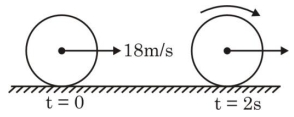
A uniform disc of mass $0.5\,kg$ and radius $r$ is projected with velocity $18\,m / s$ at $t =0\,s$ on a rough horizontal surface. It starts off with a purely sliding motion at $t =0\,s$. After $2\,s$ it acquires a purely rolling motion (see figure). The total kinetic energy of the disc after $2\,s$ will be $..............J$

(given, coefficient of friction is $0.3$ and $\left.g =10\,m / s ^2\right)$

A truck of mass $M$ is at rest on frictionless road when a monkey of mass $m$ starts moving on the truck in forward direction.If the truck recoils with a speed $v$ backward on the road, with what velocity is the monkey moving with respect to truck ?
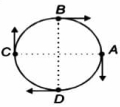
Four particles $A, B, C$ and $D$ are moving with constant speed $v$ each. At the instant shown relative velocity of $A$ with respect to $B, C$ and $D$ are in directions
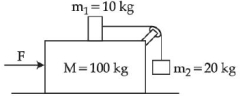
Three masses $M =100\,kg , m _{1}=10\,kg$ and $m_{2}=20\,kg$ are arranged in a system as shown in figure. All the surfaces are frictionless and strings are inextensible and weightless. The pulleys are also weightless and frictionless. $A$ force $F$ is applied on the system so that the mass $m_{2}$ moves upward with an acceleration of $2\,ms ^{-2}$. The value of $F$ is $......N$

$\left(\right.$ Take $\left.g =10\,ms ^{-2}\right)$

The air density at Mount Everest is less than that at the sea level. It is found by mountaineers that for one trip lasting a few hours, the extra oxygen needed by them corresponds to $30,000\ cc$ at sea level (pressure $1$ atmosphere, temperature $27^oC).$ Assuming that the temperature around Mount Everest is $-73^oC$ and that the oxygen cylinder has capacity of $5.2\ litre,$ the pressure at which $O_2$ be filled (at site) in cylinder is ..... $atm$
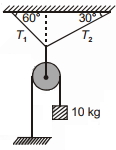
In the arrangement as shown, tension $T_2$ is ......... $N$ $\left(g=10\,m / s ^2\right)$
What is the shape when a non-wetting liquid is displaced in a capillary tube?
The velocity of a freely falling body changes as ${g^p}{h^q}$ where g is acceleration due to gravity and $h$ is the height. The values of $p$ and $q$ are