MCQ
The velocity of a freely falling body changes as ${g^p}{h^q}$ where g is acceleration due to gravity and $h$ is the height. The values of $p$ and $q$ are
  • A
    $1,\frac{1}{2}$
  • $\frac{1}{2},\frac{1}{2}$
  • C
    $\frac{1}{2},\,1$
  • D
    $1,\,1$

Answer

Correct option: B.
$\frac{1}{2},\frac{1}{2}$
b
(b) $v \propto {g^p}{h^q}$ (given)

By substituting the dimension of each quantity and comparing the powers in both sides we get $[L{T^{ - 1}}] = {[L{T^{ - 2}}]^p}{[L]^q}$

$ \Rightarrow $ $p + q = 1,\,\, - 2p = - 1,\,$

$\therefore \,\,p = \frac{1}{2},\,q = \frac{1}{2}$

Need a full question paper?

Generate a complete, print-ready paper with questions like this in minutes — across 16+ boards, with answer keys.
Start Generating Free

Similar questions

Radius of gyration of a uniform thin rod of length  $L$  about an axis passing normally through its centre of mass is
If the mass of the Sun were ten times smaller  and the universal gravitational constant were ten times larger in magnitude, which of the following is not correct? 
A body is rotating nonuniformity about a vertical axis fixed in an inertial frame. The resultant force on a particle of the body not on the axis is:
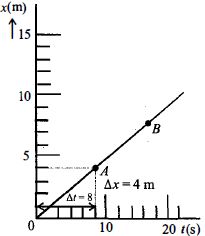
The graph of an object's motion (along the $x-$ axis) is shown in the figure. The instantaneous velocity of the object at points $A$ and $B$ are $v_A$ and $v_B$ respectively. Then
Two sound sources each emitting waves of wavelength $\lambda$ are fixed a given distance apart and an observer moves from one source to another with velocity $u$. Then number of beats heard by him per second is
A particle is moving in a circle
If $\vec A$ and $\vec B$ are two non-zero vectors such that $\left| {\vec A + \vec B} \right| = \frac{{\left| {\vec A - \vec B} \right|}}{2}$ and $\left| {\vec A} \right| = 2\left| {\vec B} \right|$ then the angle between $\vec A$ and $\vec B$ is
The escape velocities of two planets $A$ and $B$ are in the ratio $1: 2$. If the ratio of their radii respectively is $1: 3$, then the ratio of acceleration due to gravity of planet $A$ to the acceleration of gravity of planet $B$ will be:
The unit of the coefficient of viscosity in $S.I.$ system is
A surface of area $S$ is placed perpendicular to the direction of travel of a plane wave. The energy per unit time intercepted by the surface is $E$ when the amplitude of the wave is $A$ . The area of the surface is reduced to $\frac{1}{2} \ S$ and the amplitude of the wave is increased to $2\ A$ . What is the energy per unit time intercepted by this smaller surface?