MCQ
A bullet of mass $5\, g$, travelling with a speed of $210$ $m / s ,$ strikes a fixed wooden target. One half of its kinetic energy is converted into heat in the bullet while the other half is converted into heat in the wood. The rise of temperature of the bullet if the specific heat of its material is $0.030\, cal /\left( g -{ }^{\circ} C \right)$ $\left(1\, cal =4.2 \times 10^{7}\, ergs \right)$ close to$.......^oC$
  • A
    $83.3$
  • $87.5$
  • C
    $119.2$
  • D
    $38.4$

Answer

Correct option: B.
$87.5$
b
$\frac{1}{2} m v^{2} \times \frac{1}{2}=m s \Delta T$

$\Delta T=\frac{v^{2}}{4 \times 5}=\frac{210^{2}}{4 \times 30 \times 4.200}$

$=87.5^{\circ} C$

Need a full question paper?

Generate a complete, print-ready paper with questions like this in minutes — across 16+ boards, with answer keys.

Start Generating Free

Similar questions

A bus is moving with a speed of $10\; ms^{-1}$ on a striaght road. A scooterist wishes to overtake the bus in $100\,s$ . If the bus is at a distance of $1\,km$ from the scooterist, with what speed should the scooterist chase the bus ?.........$m/s$
One end of a light spring of spring constant $k$ is fixed to a wall and the other end is tied to a block placed on a smooth horizontal surface. In a displacement, the work done by the spring is $\frac{1}{2}\text{kx}^2.$ The possible cases are:
  1. At spring was initially compressed by a distance $x$ and was finally in its natural length.
  2. It was initially stretched by a distance $x$ and and finally was in its natural length.
  3. It was initially in its natural length and finally in a compressed position.
  4. It was initially in its natural length and finally in a stretched position.
The radius of a planet is $\frac{1}{4}$ of earth’s radius and its acceleration due to gravity is double that of earth’s acceleration due to gravity. How many times will the escape velocity at the planet’s surface be as compared to its value on earth’s surface
Find the amount of work done to increase the temperature of one mole of an ideal gas by $30^o\ C$ if it is expanding under the condition  .... $J$

$V\propto {T^{\frac{2}{3}}}$ $[R = 1.99\  cal/mol-K]$

In an hour-glass approximately $100$ grains of sand fall per second (starting from rest); and it takes $2 \, s$ for each sand particle to reach the bottom of the hour-glass. If the average mass of each sand particle is $0.2 \,g$, then the average force exerted by the falling sand on the bottom of the hour-glass is close to .......... $N$
At a place where the acceleration due to gravity is $10\,m\,{\sec ^{ - 2}}$ a force of $5\, kg-wt$ acts on a body of mass $10\, kg$ initially at rest. The velocity of the body after $4$ second is .......... $m/\sec^{-1}$
Let $V$ and $E$ be the gravitational potential and gravitational field at a distance $r$ from the centre of a uniform spherical shell. Consider the following two statements:
$A.$ The plot of $V$ against $r$ is discontinuous.
$B.$ The plot of $E$ against $r$ is discontinuous.
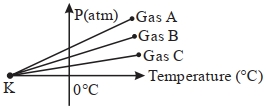
For three low density gases $A, B, C$ pressure versus temperature graphs are plotted while keeping them at constant volume, as shown in the figure.

The temperature corresponding to the point ' $K$ ' is $...........\,{}^{\circ}\,C$

An object thrown vertically up from the ground passes the height $5 m$ twice in an interval of $10 s$. time of flight is ........ $s$
The escape velocity of a body on a planet  $'A'$  is $12 \,kms ^{-1}$. The escape velocity of the body on another planet  $'B'$ , whose density is four times and radius is half of the planet  $'A'$, is ................... $kms ^{-1}$