MCQ
A bus driving along at $39.6 \,km / h$ is approaching a person who is standing at the bus stop, while honking repeatedly at an interval of $30 \,s$. If the speed of sound is $330 \,ms ^{-1}$, at what interval will the person hear the horn?
  • A
    $31 \,s$
  • $29 \,s$
  • C
    $30 \,s$
  • D
    The interval will depend on the distance of the bus from the passenger
Answer

Correct option: B.
$29 \,s$
b
(b)

Here, source is moving towards a stationary observer.

Given,

Velocity of source, $v_s=39.6 \,km / h$

$=39.6 \times \frac{5}{18}=11 \,ms ^{-1}$

Velocity of sound, $v=330 \,ms ^{-1}$

Frequency of source, $f=\frac{1}{30} \,s ^{-1}$

So, apparent frequency of sound as heard by the observer is

$f^{\prime}=\left(\frac{v}{v-v_s}\right) \cdot f=\left(\frac{330}{330-11}\right) \cdot \frac{1}{30}$

$\Rightarrow \quad f^{\prime}=\frac{11}{319}$

$\Rightarrow \quad f^{\prime}=\frac{1}{29}$

So, time interval between two honks of bus horn observed by observer (person at bus stop) is $29 \,s$.

Need a full question paper?

Generate a complete, print-ready paper with questions like this in minutes — across 16+ boards, with answer keys.

Start Generating Free

Similar questions

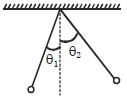
Two masses, both equal to $100\, g$, are suspended at the ends of identical light strings of length $\lambda = 1.0\, m$, attached to the same point on the ceiling (see figure). At time $t = 0$, they are simultaneously released from rest, one at angle $\theta_1 = 1^o$, the other at angle $\theta_2 = 2^o$ from the vertical. The masses will collide
Taking density of Earth constant.Which graph correctly presents the variation of acceleration due to gravity with the distance from the centre of the earth (radius of the earth $= R_E$ )?
Identify the wrong statement:
A uniform solid sphere of mass $M$ and radius $R$ is surrounded symmetrically by a uniform thin spherical shell of equal mass and radius $2R$. The value of gravitational potential at a distance $\frac{3}{2}\,R$ from the centgre is 
The temperature of a gas having $2.0 \times 10^{25}$ molecules per cubic meter at $1.38 \mathrm{~atm}$ (Given, $\mathrm{k}=$ $\left.1.38 \times 10^{-23} \mathrm{JK}^{-1}\right)$ is :
The pressure in the tyre of a car is four times the atmospheric pressure at $300 K$. If this tyre suddenly bursts, its new temperature will be $(\gamma = 1.4)$
The magnitude of displacement of a particle moving in a circle of radius $a$ with constant angular speed $\omega$ varies with time $t$ as
A leak proof cylinder of length $1 \;\mathrm{m},$ made of a metal which has very low coefficient of expansion is floating vertically in water at $0^{\circ} \mathrm{C}$ such that its height above the water surface is $20\; \mathrm{cm} .$ When the temperature of water is increased to $4^{\circ} \mathrm{C},$ the height of the cylinder above the water surface becomes $21 \;\mathrm{cm} .$ The density of water at $\mathrm{T}=4^{\circ} \mathrm{C},$ relative to the density at $\mathrm{T}=0^{\circ} \mathrm{C}$ is close to
The correct curve between the height or depression $h$ of liquid in a capillary tube and its radius is
An $\alpha-$particle is bombarded on ${ }^{14}\mathrm{~N}$. As a result, a ${ }^{17}\mathrm{O}$ nucleus is formed and a particle is emitted. This particle is a: