MCQ
The temperature of a gas having $2.0 \times 10^{25}$ molecules per cubic meter at $1.38 \mathrm{~atm}$ (Given, $\mathrm{k}=$ $\left.1.38 \times 10^{-23} \mathrm{JK}^{-1}\right)$ is :
  • $500 \mathrm{~K}$
  • B
     $200 \mathrm{~K}$
  • C
     $100 \mathrm{~K}$
  • D
     $300 \mathrm{~K}$

Answer

Correct option: A.
$500 \mathrm{~K}$
a
$ \mathrm{PV}=\mathrm{nRT} $

$ \mathrm{PV}=\frac{\mathrm{N}}{\mathrm{N}_{\mathrm{A}}} \mathrm{RT}$

$\mathrm{N}=$ Total no. of molecules

$\mathrm{P}=\frac{\mathrm{N}}{\mathrm{V}} \mathrm{kT}$

$1.38 \times 1.01 \times 10^5=2 \times 10^{25} \times 1.38 \times 10^{-23} \times \mathrm{T}$

$1.01 \times 10^5=2 \times 10^2 \times \mathrm{T}$

$\mathrm{T}=\frac{1.01 \times 10^3}{2} \approx 500 \mathrm{~K}$

Need a full question paper?

Generate a complete, print-ready paper with questions like this in minutes — across 16+ boards, with answer keys.

Start Generating Free

Similar questions

Quality of a musical note depends on
A rigid diatomic ideal gas undergoes an adiabatic process at room temperature. The rational between temperature and volume for the process is $TV^x =$ constant, then $x$ is
A particle is projected from a horizontal plane ($x-z$ plane) such that its velocity vector at time t is given by $\vec V = a\hat i + (b - ct)\hat j$ Its range on the horizontal plane is given by
The resultant of two rectangular simple harmonic motions of the same frequency and equal amplitudes but differing in phase by $\frac{\pi }{2}$ is
Neglecting the air resistance, the time of flight of a projectile is determined by
The ratio of rotational and translatory kinetic energies of a sphere is                
Adiabatic modulus of elasticity of a gas is $2.1 \times {10^5}N/{m^2}.$ What will be its isothermal modulus of elasticity $\left( {\frac{{{C_p}}}{{{C_v}}} = 1.4} \right)$
A particle of mass $0.01 \;kg$ travels with velocity given by $4 \hat{ i }+16 \hat{ k } \;ms ^{-1}$. After sometime, its velocity becomes $8 \hat{ i }+20 \hat{ j }\;ms ^{-1}$. The work done on particle during this interval of time is ...... $J$
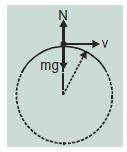
A circular overbridge has radius $20\,m$. What is the maximum speed with which a car can cross the bridge without leaving contact with the overbridge at the heighest point ? $ (g = 9.8\, m/s^2)$ 

............ $m/s$

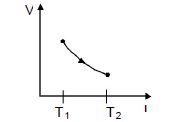
The figure shows a process $AB$ undergone by $2$ moles of an ideal diatomic gas. The process $AB$ is in such a way that $VT =$ constant. $T_1 = 300 K $and $T_2 = 500 K$ ( $R = $ gas constant)