A calorimeter of mass $0.2$ kg and specific heat $900 J/kg-K$ . Containing $0.5$ kg of a liquid of specific heat $2400J /kg-K$ . Its temperature falls from ${60^o}C\,{\rm{to}}\,\,{\rm{5}}{{\rm{5}}^{\rm{o}}}C$ in one minute. The rate of cooling is ....... $J/s$
Medium
Download our app for free and get started
(d) Rate of cooling (here it is rate of loss of heat)
$\frac{{dQ}}{{dt}} = (mc + W)\frac{{d\theta }}{{dt}} = ({m_l}{c_l} + {m_c}{c_c})\frac{{d\theta }}{{dt}}$
==> $\frac{{dQ}}{{dt}} = (0.5 \times 2400 + 0.2 \times 900)\left( {\frac{{60 - 55}}{{60}}} \right)$$ = 115\;\frac{J}{{\sec }}$.

Download our appand get started for free
Experience the future of education. Simply download our apps or reach out to us for more information. Let's shape the future of learning together!No signup needed.*
Similar Questions
- 1There is a rough black spot on a polished metallic plate. It is heated upto $1400 K$ approximately and then at once taken in a dark room. Which of the following statements is trueView Solution
- 2View SolutionWhich of the following statements is wrong
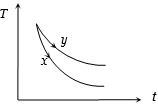
- 3The graph. Shown in the adjacent diagram, represents the variation of temperature $(T)$ of two bodies, $x$ and $y$ having same surface area, with time $(t)$ due to the emission of radiation. Find the correct relation between the emissivityView Solution
- 4View SolutionThe rates of cooling of two different liquids put in exactly similar calorimeters and kept in identical surroundings are the same if
- 5The wavelength of maximum intensity of radiation emitted by a star is $289.8 \,nm$. The radiation intensity for the star is : (Stefan’s constant $5.67 \times {10^{ - 8}}W{m^{ - 2}}{K^{ - 4}}$, constant $b = 2898\mu mK)$View Solution
- 6A thin square steel plate with each side equal to $10$ cm is heated by a blacksmith. The rate of radiated energy by the heated plate is $1134 W$ . The temperature of the hot steel plate is ....... $K$ (Stefan's constant $\sigma = 5.67 \times {10^{ - 8}}watt\;{m^{ - 2}}{K^{ - 4}}$, emissivity of the plate = $1$ )View Solution
- 7View SolutionIn which process, the rate of transfer of heat is maximum
- 8Spheres $P$ and $Q$ are uniformly constructed from the same material which is a good conductor of heat and the radius of $Q$ is thrice the radius of $P$. The rate of fall of temperature of $P$ is $x$ times that of $Q$ when both are at the same surface temperature. The value of $x$ is :View Solution
- 9Surface of the lake is at $2^{\circ} C$. The temperature of the bottom of the lake is ....... $^{\circ} C$View Solution
- 10A small object is placed at the center of a large evacuated hollow spherical container. Assume that the container is maintained at $0 K$. At time $t =0$, the temperature of the object is $200 K$. The temperature of the object becomes $100 K$ at $t = t _1$ and $50 K$ at $t = t _2$. Assume the object and the container to be ideal black bodies. The heat capacity of the object does not depend on temperature. The ratio $\left( t _2 / t _1\right)$ is. . . . .View Solution