MCQ
Which of the following statements is wrong
  • A
    Rough surfaces are better radiators than smooth surface
  • Highly polished mirror like surfaces are very good radiators
  • C
    Black surfaces are better absorbers than white ones
  • D
    Black surfaces are better radiators than white
Answer

Correct option: B.
Highly polished mirror like surfaces are very good radiators
b
(b)Highly polished mirror like surfaces are good reflectors, but not good radiators.

Need a full question paper?

Generate a complete, print-ready paper with questions like this in minutes — across 16+ boards, with answer keys.

Start Generating Free

Similar questions

The energy of a charged capacitor resides in
Two rods, one of aluminum and the other made of steel, having initial length ${l_1}$ and ${l_2}$ are connected together to form a single rod of length ${l_1} + {l_2}$. The coefficients of linear expansion for aluminum and steel are ${\alpha _a}$ and ${\alpha _s}$ respectively. If the length of each rod increases by the same amount when their temperature are raised by ${t^o}C$, then find the ratio $\frac{{{l_1}}}{{({l_1} + {l_2})}}$
The energy of the electromagnetic waves is of the order of 15 keV. To which part of the spectrum, does it belong?
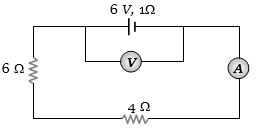
In the circuit shown here, the readings of the ammeter and voltmeter are
A block $A$ of mass $4\, kg$ is placed on another block $B$ of mass $5\, kg$, and the block $B$ rests on a smooth horizontal table. If the minimum force that can be applied on $A$ so that both the blocks move together is $12\, N$, the maximum force that can be applied to $B$ for the blocks to move together will be ....... $N$
At any instant the velocity of a particle of mass $500\,g$ is $\left(2 t \hat{ i }+3 t ^2 \hat{ j }\right)\,ms ^{-1}$. If the force acting on the particle at $t=1 s$ is $(\hat{i}+x \hat{j}) N$. Then the value of $x$ will be:
During the adiabatic expansion of $2 \,moles$ of a gas, the internal energy was found to have decreased by $100 J$. The work done by the gas in this process is ..... $J$
A candle flame of $3\, cm$ is placed at $3\, m$ from a wall. A concave mirror is kept at distance $x$ from the wall in such a way that image of the flame on the wall is $9\, cm$. Then $x$ is......$cm$
In a $PN-$junction
A flat circular disc has a charge $ + Q$ uniformly distributed on the disc. A charge $ + q$ is thrown with kinetic energy $E$ towards the disc along its normal axis. The charge $q$ will