Question
A capacitance C charged to a potential difference V is discharged by connecting its plates through a resistance R. Find the heat dissipated in one time constant after the connections are made. Do this by calculating $\int\text{i}^2\text{R}$ dt and also by finding the decrease in the energy stored in the capacitor.

Answer

Energy stored at a part time in discharging $=\frac{1}{2}\text{CV}^2\Big(\text{e}^{\frac{-\text{t}}{\text{RC}}}\Big)^2$
Heat dissipated at any time = (Energy stored at t = 0) - (Energy stored at time t)
$=\frac{1}{2}\text{CV}^2-\frac{1}{2}\text{CV}^2\big(-\text{e}^{-1}\big)^2$ $=\frac{1}{2}\text{CV}^2\big(1-\text{e}^2\big)$

Need a full question paper?

Generate a complete, print-ready paper with questions like this in minutes — across 16+ boards, with answer keys.

Start Generating Free

Similar questions

An electromagnetic wave of wavelength λ is incident on a photosensitive surface of negligible work function. If the photo-electrons emitted from this surface have the de-Broglie wavelength $\lambda_{1}$, prove that $\lambda = \begin{pmatrix} 2 \text{mc} \\ h \end{pmatrix}\lambda^{2}_{1}$.
It is sometimes heard that inertial frame of reference is only an ideal concept and no such inertial frame actually exists. Comment.
The equation for the vibration of a string, fixed at both ends vibrating in its third harmonic, is given by$\text{y}=(0.4\text{cm})\sin\big[(0.314\text{cm}^{-1})\text{x}\big]\cos\big[(600\pi\text{s}^{-1})\text{t}\big]$
  1. What is the frequency of vibration?
  2. What are the positions of the nodes?
  3. What is the length of the string?
  4. What is the wavelength and the speed of two travelling waves that can interfere to give this vibration ?
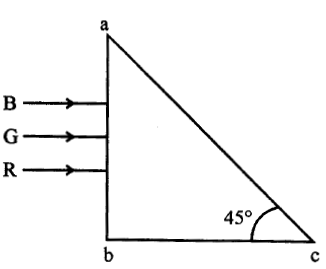
Three light rays red $(R)$, green $(G)$ and blue $(B)$ are incident on a right-angled prism $‘abc\ ’$ at face $‘ab\ ’$. The refractive indices of the material of the prism for red, green and blue wavelengths are $1.39, 1.44$ and $1.47$ respectively. Out of the three which colour ray will emerge out of face $‘ac\ ’$? Justify your answer. Trace the path of these rays after passing through face $‘ab\ ’.$
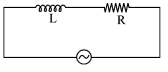
In the given figure, voltage across the ends of inductor ( L ) and resistor ( R ) is 120 V and 90 V respectively. The root mean square value of the current is 3 A. Calculate :
(i) impedance of the circuit and (ii) phase difference between voltage and current.
Image
Explain electric potential energy difference and discuss its important points.
State the Lenz's law regarding electromagnetic induction. This law is based on the conservation law of which quantity?
A horizontal conducting wire of length 2 m oriented in east-west direction is falling down with a speed of 5 m/s perpendicular to the horizontal component of earth's magnetic field of $0.3 \times 10^{-4} T.$ Calculate the instantaneous value of induced emf across the ends of the wire.
Can X-rays be used for photoelectric effect?
A convex lens produces a double size real image when an object is placed at a distance of 18cm from it. Where should the object be placed to produce a triple size real image?
The magnetic field $B$ inside a long solenoid, carrying a current of $5.00A,$ is $3.14 \times 10^{-2}T.$ Find the number of turns per unit length of the solenoid.