Question
Explain electric potential energy difference and discuss its important points.

Answer

Image

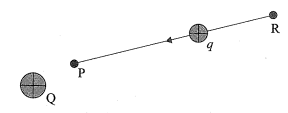
→As shown in the figure, consider a charge $Q$ at the origin (of the cartesian coordinate system.) At each point in the electric field of charge Q , particle having charge $q$ possesses some potential energy.
→Work needs to be done on this charge $q$, in taking it from point R (initial positionl) to point P (final position.)
→This work increase the potentical energy of $q$ which will be equal to the potential energy difference between points R and P .
So, the potential energy difference
$\Delta U=U_P-U_R=W_{R P}$
→Here, the displacement is in the opposite direction to the electric force, hence the work done by electric force is negative $\left(- W _{ RP }\right)$, which is called electric potential energy at point $P$ with respect to point $R$.
→For the electric field of a random electric charge, the electric potential energy difference, between two points, can be defined as the work done by external force in taking the given charge $q$ from one point to the other point without acceleration.
Important points :
(1) The right hand side term of the equation $\Delta U$ $= U _{ P }- U _{ R }$ shows that the work done by the electric field to move the electric charge from one point to another in the electric field depends only on the intial position and the final position. It does not depend on the path joining them, which is a fundamental characteristic of conservative force.
(2) There is no importance of absolute value of electrostatic potential energy. It is only the difference of electrostatic potential energy that matters.
(3) If a random constant $\alpha$ is added to the potential energy at each point, it doesn't make any difference to the potential energy difference between two points. Means, it will be :
$\left( U _{ P }+\alpha\right)-\left( U _{ R }+\alpha\right)= U _{ P }- U _{ R }$
(4) For the sake of ease, the potential energy at infinite distance is taken zero. Suppose, Point $R$ is at infinity. then, $U _{ R }= U _{\infty}=0$
$\therefore W _{ RP }= W _{\infty P }= U _{ P }- U _{\infty}= U _{ P }$
(5) The potential energy of a charge $q$ at any point, is the work done by external force in bringing that charge from infinite distance to that point only.

Need a full question paper?

Generate a complete, print-ready paper with questions like this in minutes — across 16+ boards, with answer keys.
Start Generating Free

Similar questions

A cylindrical capacitor has two co $-$ axial cylinders of length $15\ cm$ and radii $1.5\ cm$ and $1.4\ cm$. The outer cylinder isearthed and the inner cylinder is given a charge of $3.5\mu C$. Determine the capacitance of the system and the potential of the inner cylinder. Neglect end effects $($i.e., bending of field lines at the ends$).$
A long, straight wire of radius r carries a current i and is placed horizontally in a uniform magnetic field B pointing vertically upward. The current is uniformly distributed over its cross-section.
  1. At what points will the resultant magnetic field have maximum magnitude? What will be the maximum magnitude?
  2. What will be the minimum magnitude of the resultant magnetic field?
Assume that the mass of a nucleus is approximately given by $M = Am_p$ where $A$ is the mass number. Estimate the density of matter in $kg/m^3$ inside a nucleus. What is the specific gravity of nuclear matter$?$
A battery of emf 10 V and internal resistance 3 Ω is connected to a resistor. If the current in the circuit is 0.5 A, what is the resistance of the resistor? What is the terminal voltage of the battery when the circuit is closed?
Obtain the equation of equivalent power for combination of thin lenses placed in contact.
A particle is subjected to two simple harmonic motions, one along the X-axis and the other on a line making an angle of 45° with the X-axis, The two motions are given by,$\text{x}=\text{x}_0\sin\omega\text{t}$ and $\text{s}=\text{s}_0\sin\omega\text{t}$
Find the amplitude of the resultant motion.

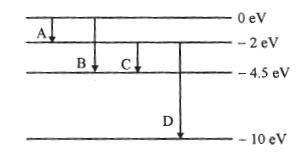
The energy levels of a hypothetical atom are shown below. Which of the shown transitions will result in the emission of a photon of wavelength 275 nm?
Which of these transitions correspond to emission of radiation of (i) maximum and (ii) minimum wavelength?
Draw a labelled diagram of a full wave rectifier circuit. State its working principle. Show the input-output waveforms.
Explain the experiment which represents the total internal reflection.
A constant force of 2.50N accelerates a stationary particle of mass 15g through a displacement of 2.50m. Find the work done and the average power delivered.