Question
A capacitor becomes a perfect insulator for:

Answer

  1. Direct current
Explanation:
A capacitor becomes a perfect insulator for direct current as the regular supply of current charges capacitor and the it behaves as open circuit, where as in A.C. the current being variable in sign and magnitude does not charge capacitor ever it goes through a repetitive process of charging and discharging and hence it never behaves as open circuit.

Need a full question paper?

Generate a complete, print-ready paper with questions like this in minutes — across 16+ boards, with answer keys.
Start Generating Free

Similar questions

In a capacitor of capacitance 20 μF, the distance between the plates is 2mm. If a dielectric slab of width 1mm and dielectric constant 2 is inserted between the plates, then the new capacitance is(a) 2 μF   (b) 15.5 μF(c) 26.6 μF(d) 32 μF
       
In order to see diffraction the thickness of the film is(a) 100 Å(b) 10,000 Å(c) 1 mm(d) 1 cm
       
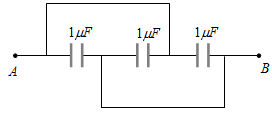
The equivalent capacitance in the circuit between $A$ and $B$ will be
A rod of legth l rotates with a uniform angular velocity $\omega$ about its perpendicular bisector. A uniform magnetic field B exists parallel to the axis of rotation. The potential difference between the two ends of the rod is:
  1. $\text{zero}$
  2. $\frac{1}{2}\text{Bl}\omega^2$
  3. $\text{Bl}\omega ^2$
  4. $2\text{B}\text{l}\omega^2$ 
Correct exposure for a photographic print is 10 seconds at a distance of one metre from a point source of 20 candela. For an equal fogging of the print placed at a distance of 2 m from a 16 candela source, the necessary time for exposure is(a) 100 sec(b) 25 sec(c) 50 sec   (d) 75 sec
       
The relaxation time in conductors(a) Increases with the increase of temperature(b) Decreases with the increase of temperature(c) It does not depend on temperature(d) All of sudden changes at 400 K


The process of radioactive radiations remains unaffected due to:
The force acting between proton and proton inside the nucleus is(a) Coulombic(b) Nuclear(c) Both  (d) None of these
       
A radioactive material has an initial amount 16gm. After 120 days it reduces to 1gm, then the half-life of radioactive material is(a) 60 days(b) 30 days(c) 40 days(d) 240 days
       
A long, straight wire carries a current along the z-axis, One can find two points in the x−yplane such that:
  1. The magnetic fields are equal.
  2. The directions of the magnetic fields are the same.
  3. The magnitudes of the magnetic fields are equal.
  4. The field at one point is opposite to that at the other point.