MCQ
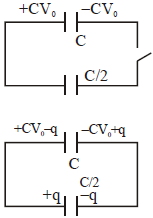
A capacitor $C$ is fully charged with voltage $V _{0}$ After disconnecting the voltage source, it is connected in parallel with another uncharged capacitor of capacitance $\frac{ C }{2} .$ The energy loss in the process after the charge is distributed between the two capacitors is$.........$$CV _{0}^{2}$
  • $0.166$
  • B
    $0.5$
  • C
    $0.33$
  • D
    $0.25$

Answer

Correct option: A.
$0.166$
a
$\frac{ CV _{0}- q }{ C }=\frac{ q }{ C / 2}=\frac{2 q }{ C }$

$V _{0}=\frac{3 q }{ C } \Rightarrow q =\frac{ CV _{0}}{3}$

$U _{ i }=\frac{1}{2} CV _{0}^{2}$

$U _{ f }=\frac{\left(\frac{2 CV _{0}}{3}\right)^{2}}{2 C }+\frac{\left(\frac{ CV _{0}}{3}\right)^{2}}{2\left(\frac{ C }{2}\right)}$

$=\frac{1}{2} CV _{0}^{2}\left[\frac{4}{9}+\frac{2}{9}\right]=\frac{1}{2} CV _{0}^{2}\left(\frac{2}{3}\right)$

Heat loss $=\frac{1}{2} CV _{0}^{2}-\left(\frac{2}{3}\right)\left(\frac{1}{2} CV _{0}^{2}\right)$

$=\frac{1}{6} CV _{0}^{2}$

Need a full question paper?

Generate a complete, print-ready paper with questions like this in minutes — across 16+ boards, with answer keys.

Start Generating Free

Similar questions

In a Young’s double slit experiment with slit separation $0.1\, mm$, one observes a bright fringe at angle $\frac{1}{{40}}\, rad$ by using light of wavelength ${\lambda _1}$. When the light of wavelength $\lambda _2$ is used a bright fringe is seen at the same angle in the same set up. Given that ${\lambda _1}$ and ${\lambda _2}$ are in visible range ($380\, nm$ to $740\, nm$), their values are
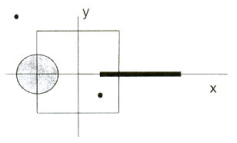
A disk of radius $a / 4$ having a uniformly distributed charge $6 \mathrm{C}$ is placed in the $x-y$ plane with its centre at $(-a / 2,0,0)$. A rod of length $a$ carrying a uniformly distributed charge $8 \mathrm{C}$ is placed on the $x$-axis from $x=a / 4$ to $x=5 a / 4$. Two point charges $-7 \mathrm{C}$ and $3 \mathrm{C}$ are placed at $(a / 4,-a / 4,0)$ and $(-3 a / 4,3 a / 4,0)$, respectively. Consider a cubical surface formed by six surfaces $x= \pm a / 2, y= \pm a / 2$, $z= \pm a / 2$. The electric flux through this cubical surface is
A charge $q$  is spread uniformly over an insulated loop of radius $r$ . If it is rotated with an angular velocity $\omega $ with respect to normal axis then the magnetic moment of the loop is
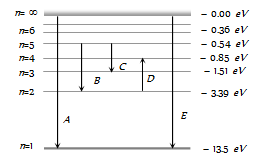
The energy levels of the hydrogen spectrum is shown in figure. There are some transitions A, B, C, D and E. Transition A, B and C respectively represent
The energy band gap of semiconducting material to produce violet (wavelength $=4000 \,A^{\circ}$ ) LED is $.......eV$. (Round off to the nearest integer).
A step-up transformer has transformation ratio of 3 : 2. What is the voltage in secondary if voltage in primary is 30 V
A convex lens is in contact with concave lens. The magnitude of the ratio of their focal length is 2/3. Their equivalent focal length is 30 cm. What are their individual focal lengths
A copper wire of length $1\, m$ and radius $1\, mm$ is joined in series with an iron wire of length $2\, m$ and radius $3\, mm$ and a current is passed through the wires. The ratio of the current density in the copper and iron wires is
The frequency and work function of an incident photon are n and $\phi_{0}$. If $\mathrm{n}_0$ is the threshold frequency then necessary condition for the emission of photo electron is 
Given below are two statements :

Statement $I:$ If the Brewster's angle for the light propagating from air to glass is $\theta_{ B }$, then Brewster's angle for the light propagating from glass to air is $\frac{\pi}{2}-\theta_B$.

Statement $II:$ The Brewster's angle for the light propagating from glass to air is $\tan ^{-1}\left(\mu_{ g }\right)$ where $\mu_{ g }$ is the refractive index of glass.

In the light of the above statements, choose the correct answer from the options given below :