In the following circuit, the equivalent capacitance between terminal $A$and terminal $B$ is :
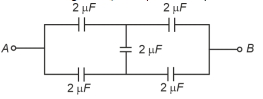
- A$1 \mu \mathrm{F}$
- B$0.5 \mu \mathrm{F}$
- C$4 \mu \mathrm{F}$
- ✓$2 \mu \mathrm{F}$
Answer: D.
View full solution →1,395 questions across 1 question group — pick any mix to generate a Physics paper with step-by-step answer keys.
One sample from each question group in this chapter. Select any group above to see the full set with answer keys.
Answer: D.
View full solution →$A$. the charge stored in it, increases.
$B$. the energy stored in it, decreases.
$C$. its capacitance increases.
$D$. the ratio of charge to its potential remains the same.
$E$. the product of charge and voltage increases.
Choose the most appropriate answer from the options given below:
Answer: A.
View full solution →Assertion $A$: The potential ( $V$ ) at any axial point, at $2 \mathrm{~m}$ distance ( $r$ ) from the centre of the dipole of dipole moment vector $\vec{P}$ of magnitude, $4 \times 10^{-6} \mathrm{C} \mathrm{m}$, is $\pm 9 \times 10^3 \mathrm{~V}$.
(Take $\frac{1}{4 \pi \in_0}=9 \times 10^9 \mathrm{Sl}$ units)
Reason $R$: $V= \pm \frac{2 P}{4 \pi \in_0 r^2}$, where $r$ is the distance of any axial point, situated at $2 \mathrm{~m}$ from the centre of the dipole.
In the light of the above statements, choose the correct answer from the options given below:
Answer: B.
View full solution →(Take $\frac{1}{4 \pi \varepsilon_0}=9 \times 10^9$ $SI$ units)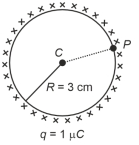
Answer: C.
View full solution →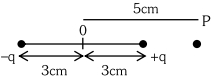
Answer: B.
View full solution →Pick question groups from the list above, set marks and difficulty, and export a branded PDF with step-by-step answer keys. First 3 chapters free — no signup.