Question
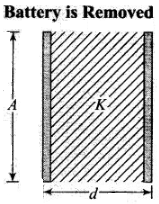
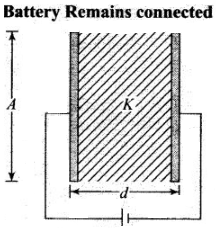
A capacitor has some dielectric between its plates, and the capacitor is connected to a DC source. The battery is now disconnected and then the dielectric is removed. State whether the capacitance, the energy stored in it, electric field, charge stored and the voltage will increase, decrease or remain constant.
Answer

The capacitance of the parallel plate capacitor, filled with dielectric medium of dielectric constant K is given by $\text{C}=\frac{\text{K}\in_0\text{A}}{\text{d}}$.
The capacitance of the parallel plate capacitor decreases with the removal of dielectric medium as for air or vacuum K = 1 and for dielectric K > 1.
If we disconnect the battery from capacitor, then the charge stored will remain the same due to conservation of charge.
The energy stored in an isolated charge capacitor $\text{U}=\frac{\text{q}^2}{2\text{C}}$ as q is constant, energy stored $\text{U}\propto\frac{1}{\text{C}}$. As C decreases with the removal of dielectric medium, therefore energy stored increases.
The potential difference across the plates of the capacitor is given by $\text{V}=\frac{\text{q}}{\text{C}}$.
Since q is constant and C decreases which in turn increases V and therefore E increases as $\text{E}=\frac{\text{V}}{\text{d}}$.
Quantity
Capacity C' = KC C' = KC
Charge Q' = Q (Charge is conserved) Q' = KQ
Potential
$\text{V}'=\frac{\text{V}}{\text{K}}$
V' = V (Since Battery maintains the potential difference)
Intensity
$\text{E}'=\frac{\text{E}}{\text{K}}$
E' = E
Energy
$\text{U}'=\frac{\text{U}}{\text{K}}$
U' = UK

Need a full question paper?

Generate a complete, print-ready paper with questions like this in minutes — across 16+ boards, with answer keys.

Start Generating Free

Similar questions

Figure shows two long coaxial solenoids, each of length ‘L’. The outer solenoid has an area of cross-section $A_1$ and number of turns/ length $n_1$ The corresponding values for the inner solenoid are $A_2$ and $n_2$ Write the expression for self-inductance $L_1, L_2$ of the two coils and their mutual inductance M. Hence show that $\text{M} < \sqrt{\text{L}_2\text{L}_2}.$
A convex lens has a focal length of 10cm. Find the location and nature of the image if a point object is placed on the principal axis at a distance of:
  1. 9.8cm
  2. 10.2cm from the lens.
Two tiny spheres carrying charges 1.5 µC and 2.5 µC are located 30 cm apart. Find the potential and electric field:
  1. At the mid-point of the line joining the two charges, and
  2. At a point 10 cm from this midpoint in a plane normal to the line and passing through the mid-point.
The inverse square law in electrostatics is $|\text{F}|=\frac{\text{e}^2}{(4\pi\in_0)\text{r}^2}$ for the force between an electron and a proton. The $\Big(\frac{1}{\text{r}}\Big)$ dependence of |F| can be understood in quantum theory as being due to the fact that the 'particle' of light (photon) is massless. If photons had a mass $m_p,$ force would be modified to $|\text{F}|=\frac{\text{e}^2}{(4\pi\in_0)\text{r}^2}\Big[\frac{1}{\text{r}^2}+\frac{\lambda}{\text{r}}\Big].\text{e}\times\text{p}(-\lambda\text{r})$ where $\lambda=\frac{\text{m}_\text{p}\text{c}}{\text{h}}$ and $\text{h}=\frac{\text{h}}{2\pi}$. Estimate the change in the ground state energy of a H-atom if $m_p$ were $10^{-6}$ times the mass of an electron.
Two fixed, identical conducting plates $(\alpha\ \&\ \beta)$, each of surface area S are charged to -Q and q, respectively, where Q > q > 0. A third identical plate $(\gamma)$, free to move is located on the other side of the plate with charge q at a distance d (Fig.). The third plate is released and collides with the plate $\beta$. Assume the collision is elastic and the time of collision is sufficient to redistribute charge amongst $\beta\ \&\ \gamma$.

Find the charges on $\beta$ and $\gamma$ after the collision.
A circular coil of radius 2.00cm has 50 turns. A uniform magnetic field B - 0.200T exists in the space in a direction parallel to the axis of the loop. The coil is now rotated about a diameter through an angle of 60.0°. The operation takes 0.100s.
  1. Find the average emf induced in the coil.
  2. If the coil is a closed one (with the two ends joined together) and has a resistance of $4.00\Omega.$ calculate the net charge crossing a cross-section of the wire of the coil.
The illuminance of a small area changes from 900 lumen/m$^2$ to 400 lumen/m$^2$ when it is shifted along its normal by 10cm. Assuming that it is illuminated by a point source placed on the normal, find the distance between the source and the area in the original position.
A glass window is to be fit in an aluminium frame. The temperature on the working day is $40^{\circ} \mathrm{C}$ and the glass window measures exactly $20 \mathrm{~cm} \times 30 \mathrm{~cm}$. What should be the size of the aluminium frame so that there is no stress on the glass in winter even if the temperature drops to $0^{\circ} \mathrm{C}$ ? Coefficients of linear expansion for glass and aluminium are $9.0 \times 10^{-6}{ }^{\circ} \mathrm{C}^{-1}$ and $24 \times 10^{-6}{ }^{\circ} \mathrm{C}^{-1}$ respectively.
Explain motion of a charged particle in a magnetic field in the following circumstances :

(a) When a positively charged particle ( $+q$ ) enters perpendicularly in a uniform magnetic field (B) with velocity $v$.

(b) When a positively charged particle enters a magnetic field (B) at an angle $\theta\left(0^{\circ}<\theta<90^{\circ}\right)$.
Consider a thin lens placed between a source (S) and an observer (O) (Fig). Let the thickness of the lens vary as $\text{w}\text{(b)}=\text{w}_0-\frac{\text{b}^2}{\alpha}$, where b is the verticle distance from the pole. $w_0$ is a constant. Using Fermat’s principle i.e. the time of transit for a ray between the source and observer is an extremum, find the condition that all paraxial rays starting from the source will converge at a point O on the axis. Find the focal length.