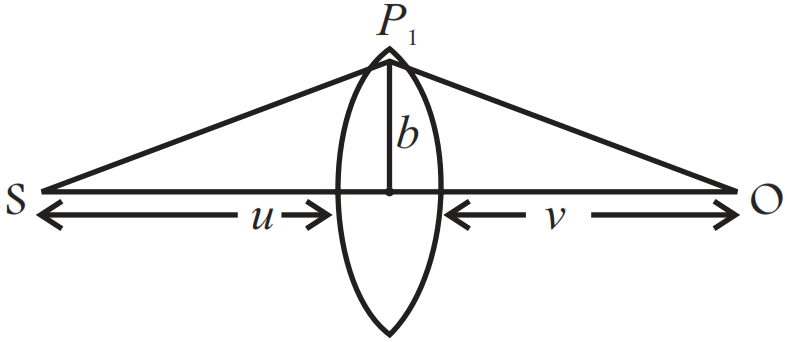
Consider a thin lens placed between a source (S) and an observer (O) (Fig). Let the thickness of the lens vary as $\text{w}\text{(b)}=\text{w}_0-\frac{\text{b}^2}{\alpha}$, where b is the verticle distance from the pole. $w_0$ is a constant. Using Fermat’s principle i.e. the time of transit for a ray between the source and observer is an extremum, find the condition that all paraxial rays starting from the source will converge at a point O on the axis. Find the focal length.
Download our app for free and get started
The time taken by ray to travel from S to $P_1$ is
$\text{t}_1=\frac{\text{SP}_1}{\text{c}}=\frac{\sqrt{\text{u}^2+\text{b}^2}}{\text{c}}$
or $\text{t}_1=\frac{\text{u}}{\text{c}}\Big(1+\frac{1}{2}\frac{\text{b}^2}{\text{u}^2}\Big)$ assuming b < < 1.
The time required to travel from $P_1$ to O is
$\text{t}_2=\frac{\text{P}_1\text{O}}{\text{c}}=\frac{\sqrt{\text{v}^2+\text{b}^2}}{\text{c}}=\frac{\text{v}}{\text{c}}\Big(1+\frac{1}{2}\frac{\text{b}^2}{\text{v}^2}\Big)$
The time required to travel through the lens is
$\text{t}=\frac{(\text{n}-1)\text{w}(\text{b})}{\text{c}}$
where n is the refractive index.
Thus, the total time is
$\text{t}=\frac{1}{\text{c}}\bigg[\text{u}+\text{v}+\frac{1}{2}\text{b}^2\Big(\frac{1}{\text{u}}+\frac{1}{\text{v}}\Big)+(\text{n}-1)\text{w}(\text{b})\bigg]$
Put $\frac{1}{\text{D}}=\frac{1}{\text{u}}+\frac{1}{\text{v}}$
Then, $\text{t}=\frac{1}{\text{c}}\bigg[\text{u}+\text{v}+\frac{1}{2}\frac{\text{b}^2}{\text{D}}+(\text{n}-1)\Big(\text{w}_0+\frac{\text{b}^2}{\alpha}\Big)\bigg]$
Fermat's principle gives the time taken should be minimum.
For that first dericative should be zero.
$\frac{\text{dt}}{\text{db}}=0=\frac{\text{b}}{\text{CD}}-\frac{2(\text{n}-1)\text{b}}{\text{c}\alpha}$
Thus, a convergent lens is formed if $\alpha=2(\text{n}-1)\text{D}$. This is independent of and hence all paraxial rays from S will converge at O i.e., for rays b < < n and b < < v.
Since, $\frac{1}{\text{D}}=\frac{1}{\text{u}}+\frac{1}{\text{v}}$, the focal length is D.
$\text{t}_1=\frac{\text{SP}_1}{\text{c}}=\frac{\sqrt{\text{u}^2+\text{b}^2}}{\text{c}}$
or $\text{t}_1=\frac{\text{u}}{\text{c}}\Big(1+\frac{1}{2}\frac{\text{b}^2}{\text{u}^2}\Big)$ assuming b < < 1.
The time required to travel from $P_1$ to O is
$\text{t}_2=\frac{\text{P}_1\text{O}}{\text{c}}=\frac{\sqrt{\text{v}^2+\text{b}^2}}{\text{c}}=\frac{\text{v}}{\text{c}}\Big(1+\frac{1}{2}\frac{\text{b}^2}{\text{v}^2}\Big)$
The time required to travel through the lens is
$\text{t}=\frac{(\text{n}-1)\text{w}(\text{b})}{\text{c}}$
where n is the refractive index.
Thus, the total time is
$\text{t}=\frac{1}{\text{c}}\bigg[\text{u}+\text{v}+\frac{1}{2}\text{b}^2\Big(\frac{1}{\text{u}}+\frac{1}{\text{v}}\Big)+(\text{n}-1)\text{w}(\text{b})\bigg]$
Put $\frac{1}{\text{D}}=\frac{1}{\text{u}}+\frac{1}{\text{v}}$
Then, $\text{t}=\frac{1}{\text{c}}\bigg[\text{u}+\text{v}+\frac{1}{2}\frac{\text{b}^2}{\text{D}}+(\text{n}-1)\Big(\text{w}_0+\frac{\text{b}^2}{\alpha}\Big)\bigg]$
Fermat's principle gives the time taken should be minimum.
For that first dericative should be zero.
$\frac{\text{dt}}{\text{db}}=0=\frac{\text{b}}{\text{CD}}-\frac{2(\text{n}-1)\text{b}}{\text{c}\alpha}$
Thus, a convergent lens is formed if $\alpha=2(\text{n}-1)\text{D}$. This is independent of and hence all paraxial rays from S will converge at O i.e., for rays b < < n and b < < v.
Since, $\frac{1}{\text{D}}=\frac{1}{\text{u}}+\frac{1}{\text{v}}$, the focal length is D.

Download our appand get started for free
Experience the future of education. Simply download our apps or reach out to us for more information. Let's shape the future of learning together!No signup needed.*
Similar Questions
- 1A hemispherical portion of the surface of a solid glass sphere $(\mu=1.5)$ of radius r is silvered to make the inner side reflecting. An object is placed on the axis of the hemisphere at a distance 3r from the centre of the sphere. The light from the object is refracted at the unsilvered part, then reflected from the silvered part and again refracted at the unsilvered part. Locate the final image formed.View Solution
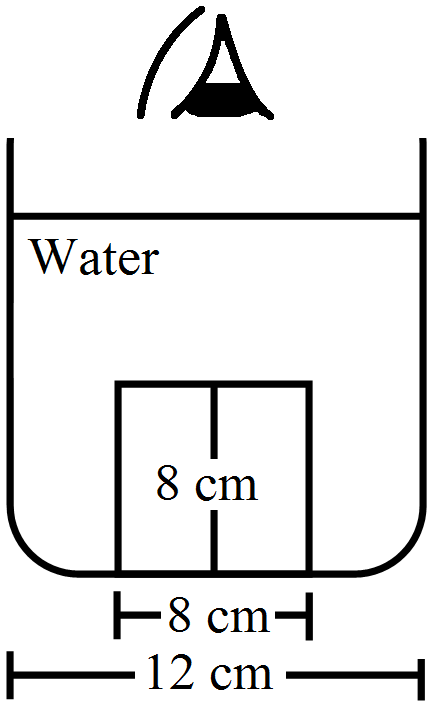
- 2A cylindrical vessel of diameter 12cm contains $800\pi\text{cm}^3$ of water. A cylindrical glass piece of diameter 8.0 cm and height 8.0cm is placed in the vessel. If the bottom of the vessel under the glass piece is seen by the paraxial rays, locate its image. The index of refraction of glass is 1.50 and that of water is 1.33.View Solution
- 3View SolutionA converging lens of focal length 15cm and a converging mirror of focal length 10cm are placed 50cm apart with common principal axis. A point source is placed in between the lens and the mirror at a distance of 40cm from the lens. Find the locations of the two images formed.
- 4View SolutionA thin convex lens of focal length 25cm is cut into two pieces 0.5cm above the principal axis. The top part is placed at (0, 0) and an object placed at (-50cm, 0). Find the coordinates of the image.
- 5View SolutionThe mixture a pure liquid and a solution in a long vertical column (i.e, horizontal dimensions < < vertical dimensions) produces diffusion of solute particles and hence a refractive index gradient along the vertical dimension. A ray of light entering the column at right angles to the vertical is deviated from its original path. Find the deviation in travelling a horizontal distance d < < h, the height of the column.
- 6View Solution
- Draw a ray diagram to show the image formation by a combination of two thin convex lenses in contact. Obtain the expression for the power of this combination in terms of the focal lengths of the lenses.
- A ray of light passing from air through an equilateral glass prism undergoes minimum deviation when the angle of incidence is $\frac{3}{4}^{th}$ of the angle of prism. Calculate the speed of light in the prism.
- 7A point object 'O' is kept in a medium of refractive index $n_1$ in front of a convex spherical surface of radius of curvature R which separates the second medium of refractive index $n_2$ from the first one, as shown in the figure. Draw the ray diagram showing the image formation and deduce the relationship between the object distance and the image distance in terms of $n_1, n_2$ and R.View Solution
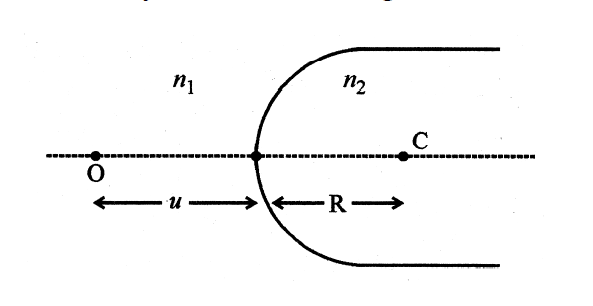
- hen the image formed above acts as a virtual object for concave spherical, surface separating the medium $n_2$ from $n_1 (n_2> n_1),$ draw this ray diagram and write the similar (similar to (a) relation. Hence obtain the expression for the lens maker's formula.
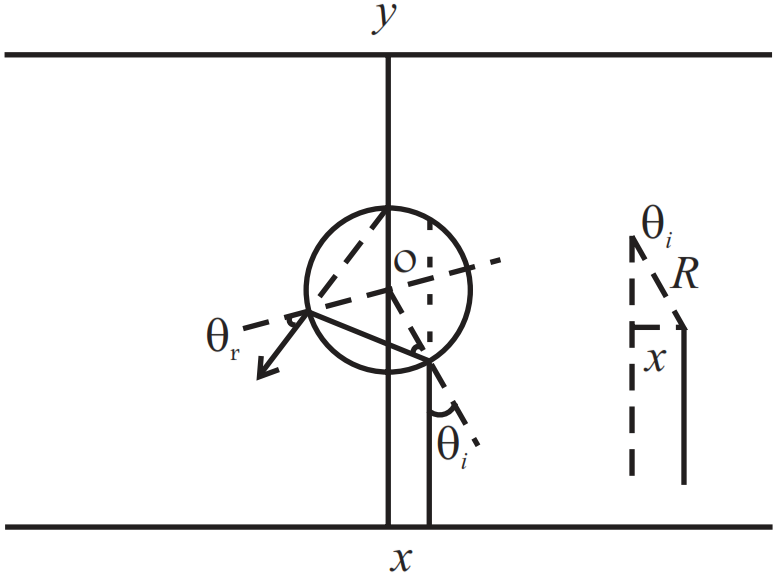
- 8View SolutionAn infinitely long cylinder of radius R is made of an unusual exotic material with refractive index -1 (Fig). The cylinder is placed between two planes whose normals are along the y direction. The center of the cylinder O lies along the y-axis. A narrow laser beam is directed along the y direction from the lower plate. The laser source is at a horizontal distance x from the diameter in the y direction. Find the range of x such that light emitted from the lower plane does not reach the upper plane.
- 9View Solution
- Draw a labelled ray diagram to show the formation of image in an astronomical telescope for a distant object.
- Write three distinct advantages of a reflecting type telescope over a refracting type telescope.
- A convex lens of focal length 10 cm is placed coaxially 5 cm away from a concave lens of focal length 10 cm. If an object is placed 30 cm in front of the convex lens, find the position of the final image formed by the combined system.
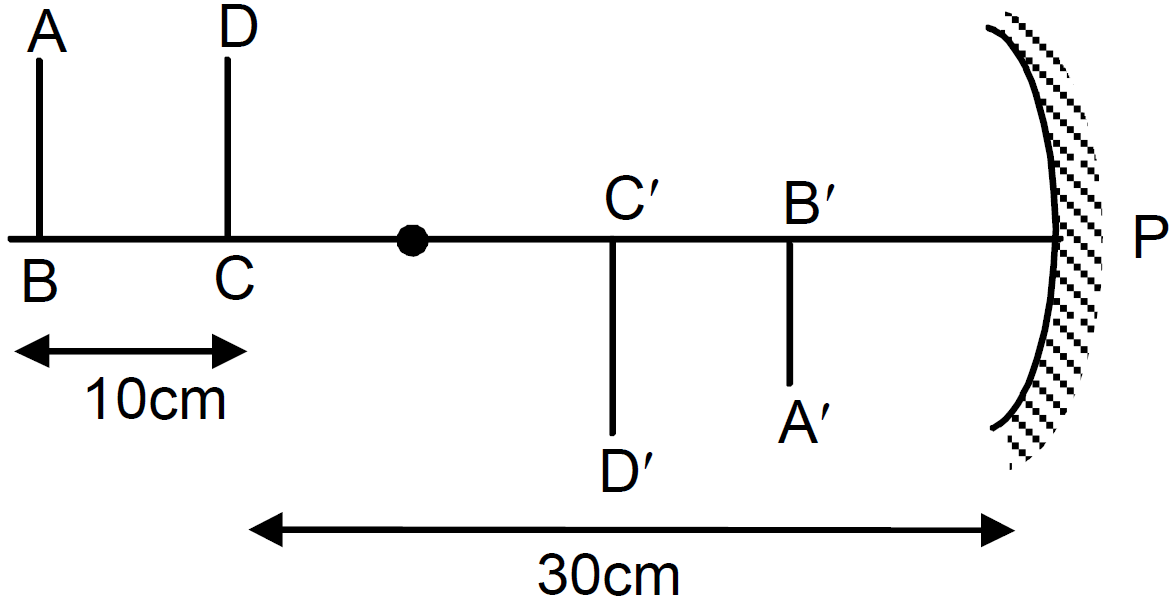
- 10View SolutionA U-shaped wire is placed before a concave mirror having radius of curvature 20cm. Find the total length of the image.